Compare Ceviche vs Sage Intacct Allocations
Intacct keeps the ledger. Ceviche runs the allocations.
Sage Intacct spreads shared costs across entities at quarter end, using percentages you set up front. Ceviche allocates each invoice line the day it arrives, then posts the entries into Intacct.
 SOC 2 Type 2 compliant
Top 3 reasons controllers pick Ceviche over Sage Intacct Allocations

Allocate lines, not pools
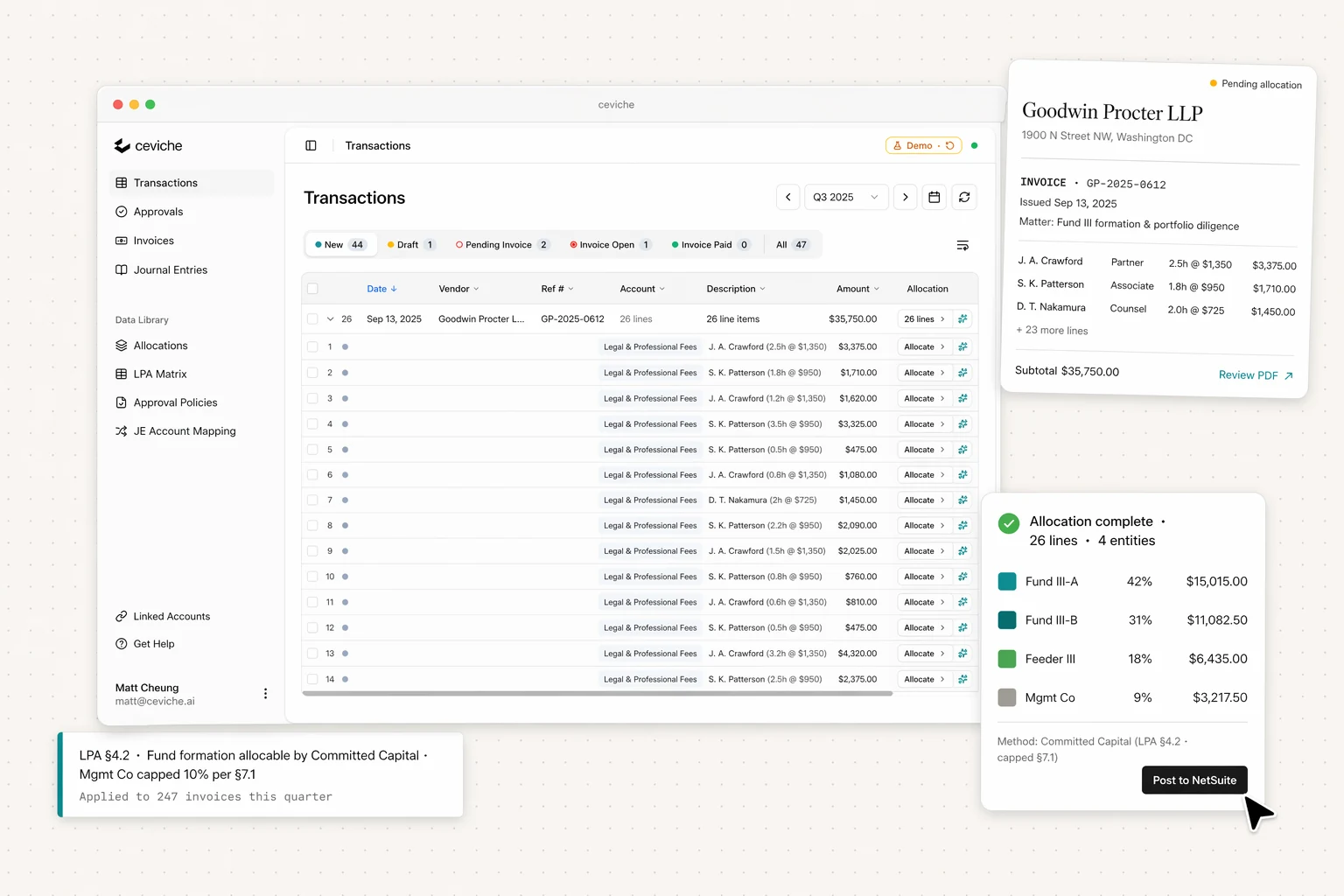
Intacct waits until period end, then spreads lump-sum account totals across entities using preset percentages. Ceviche works at the invoice line. One legal invoice, 25 lines, each line allocated under its own methodology the day it arrives.

Your LPA, applied as costs allocate
Turn your fund agreements into structured rules: caps, thresholds, exclusions, and entity eligibility. They apply at allocation time, not in a quarter-end review.

Your team runs it, self-serve
Allocation percentages buried in ERP admin turn every change into a project. In Ceviche your accounting team owns the rules and changes them itself. Simple changes land same day, complex ones within 48 hours.
Compare Ceviche vs Sage Intacct Allocations
The differences that decide your close, side by side.
 Ceviche Ceviche | Sage Intacct Allocations | |
|---|---|---|
| Unit of allocation | Individual invoice lines | Pools of account balances |
| Legal invoices | Split per line, LEDES files ingested | Never sees the invoice. Splits happen in spreadsheets before the GL |
| LPA policies | Enforced at allocation time | No enforcement at allocation time |
| Who runs it | Your accounting team, self-serve | Percentages configured in ERP admin |
| Rule changes | Self-serve, same-day to 48 hours | Percentages set up front, revisited at period end |
| Implementation period | 3–4 weeks, no separate implementation bill | Scoped within the Intacct implementation |
| Audit trail | Per line, invoice to entry, with methodology snapshots | Setup snapshot per posted entry |
| Your GL | Keeps it. Entries post directly into Intacct | It is the GL |
Every Intacct fund team keeps a reconciliation workbook next to the ledger, the shadow books. Ceviche is what retires it.
 Compare using AIOpens ChatGPT in a new tab.
How Flybridge unified quarterly allocations across 18+ fund entities


“Ceviche streamlines our close process, organizes our data for audits, and drafts entries for our fund admin, all in a single workflow.”
Every allocation traces back to source documentation with a full audit trail, turning year-end fire drills into one-click PDF pulls.

Why does Ceviche stand out?
Ceviche is not a general ledger and does not want to be. It is the allocation layer above yours: it reads invoices from your AP systems, applies your LPA line by line, and hands Intacct clean, audit-ready entries.
Run both. Intacct closes the books. Ceviche makes sure every allocated dollar landed on the right entity, for a reason you can show an auditor.

Ceviche vs Sage Intacct Allocations, answered
No. Intacct stays your GL. Ceviche reads expenses, allocates each invoice line under your LPA, and posts the entries into Intacct.
Yes, for what they do well: spreading internal account balances. Ceviche handles the invoice-level fund allocations that Intacct's allocation tools never see.
No. Ramp, Brex, and Bill.com keep syncing exactly as they do today. Pre-split or unsplit bills both work.
Sage Intacct's built-in allocation tools distribute amounts inside the ledger, from splitting a transaction across dimensions as it posts to spreading pooled account balances across entities at period end, with posted entries and reversal support.




Stop reconciling. Get it right the first time.
Move your fund expense allocation process on Ceviche today.