TL;DR. If you are weighing alternatives to IntegriDATA's Expense Allocation System (EAS), there are really four options: keep allocating in Excel, run EAS or a comparable enterprise suite, hand the work to a managed service, or use a focused allocation layer that the controller configures directly. Which one fits comes down to your size, your existing stack, and whether you need a full accounts payable and payments suite or just defensible allocation across your funds with an audit trail behind it.
Most controllers and CFOs who reach this question did not arrive cold. They came from a spreadsheet that finally got too risky to trust, or from a system that promised to fix allocation and turned into a second job. A lot of them are specifically weighing their options against EAS, now part of Indus Valley Partners. This is what we hear from the seat across the table, and where each alternative honestly fits.
What is EAS and who is it for?
EAS is the Expense Allocation System built by IntegriDATA, an Indus Valley Partners company. On its own product page it describes automated allocation rules across funds, deals, and segments, allocation by AUM, NAV, market value, holdings, or custom logic, N-level fund hierarchies, digitized LPA expense policies, and a complete audit trail built for SEC and auditor review. It integrates with SAP, Oracle, and QuickBooks, and it sits inside a broader suite that includes invoice OCR, vendor management, 1099 reporting, ACH and wire payments, fund billing, and BI reporting.
We have real respect for what EAS built. From what we have seen, it more or less created this category and runs at some of the largest managers in the industry, with a client base that appears to range from around a billion dollars in AUM to well past two hundred billion. If you are a large, complex manager that needs the whole surrounding suite, the accounts payable, the payments rail, soft-dollar tracking, 1099s, treasury, in one platform, that breadth is worth something, and stitching it together from separate tools may cost more than it saves. And if you already have the technical resources to maintain custom logic, have eaten the implementation cost, and the thing works, leaving it alone is a perfectly good decision. Tearing out a working system to save a line item rarely pays off.
The fit starts to break at the other end of the market, which happens to be where most firms reading this live.
PE expense allocation software automates distributing shared expenses across fund entities in private equity and venture firms. It sits between upstream expense systems (Ramp, Brex, Bill.com, Expensify, SAP Concur) and downstream general ledgers (NetSuite, QuickBooks Online, Sage Intacct), applying LPA-defined allocation rules and posting audit-ready intercompany journal entries to the GL. The category exists because mid-market firms with 5 to 30 fund entities typically allocate in Excel, which consumes 1 to 5 days of controller time per quarterly close. Alternatives range from managed services that run allocations for you to legacy systems that require significant implementation.
Why do controllers look for alternatives?
The first complaint we hear is almost never a missing feature. It is about who has to touch the system to get anything done. One CFO described it this way: every time someone needs a number, life-to-date spend on a vendor or a fund, sliced a little differently than last time, she cannot just pull it. She has to walk down the hall to a developer, explain what she needs in plain English, and wait for them to write the query. Tweak it, split it by date or by fund, and it is another round trip. What she wanted was something close to a pivot table she could move around herself, seeing not just the invoices but each allocation: here was the cost, and here is everyone who paid for it. Her system could not do that without a coder in the loop.
That compounds. One firm handed its vendor a four-page wish list and two years later was still working through it, to the point of saying they would rather sacrifice their own policy than keep absorbing the drag. Another stood the system up and switched it off inside about ten months, calling it more work than it took away, then went back to the market for a new fund GL and an allocation layer. We wish those were one-offs. They are closer to a pattern.
None of this means the people running these systems are doing anything wrong. The product is built around how developers work, and the people stuck using it every day are accountants. Those two things pull against each other.
Where does the automation promise break down?
On paper the enterprise pitch is right: automated allocation rules, policies that enforce your fund agreements, a complete audit trail for SEC and auditor review. In practice it is only as good as the configuration, and the configuration is the hard part. Building or changing a rule takes a developer and a queue. One controller told us her system had not actually been set up to apply the allocation criteria she had already handed over, so even with the logic mapped on a spreadsheet, the day-to-day allocation came down to whoever was keying it in. It was sold as automation and it ran on a person.
Digitized LPA policies have the same gap between the brochure and the back office, widest for master-feeder and multi-strategy structures with a lot of legal entities. When the logic lives in code that is picky about how data is labeled, an expense tagged a little differently slips past the cap that should have caught it. Lean on an offshore managed-service layer to operate the system and the error can move offshore rather than disappear. So test the audit trail rather than taking it on faith: ask how long it would take to produce the full approval and timestamp trail for one specific allocation, with an independent submitter and approver shown. The trail only helps if it can rebuild the methodology that was in force when the invoice actually posted, including the one that sat in a queue for six months before anyone touched it.
What are the four real alternatives?
Nobody on page one for this search names the options a fund controller would actually weigh. Here they are.
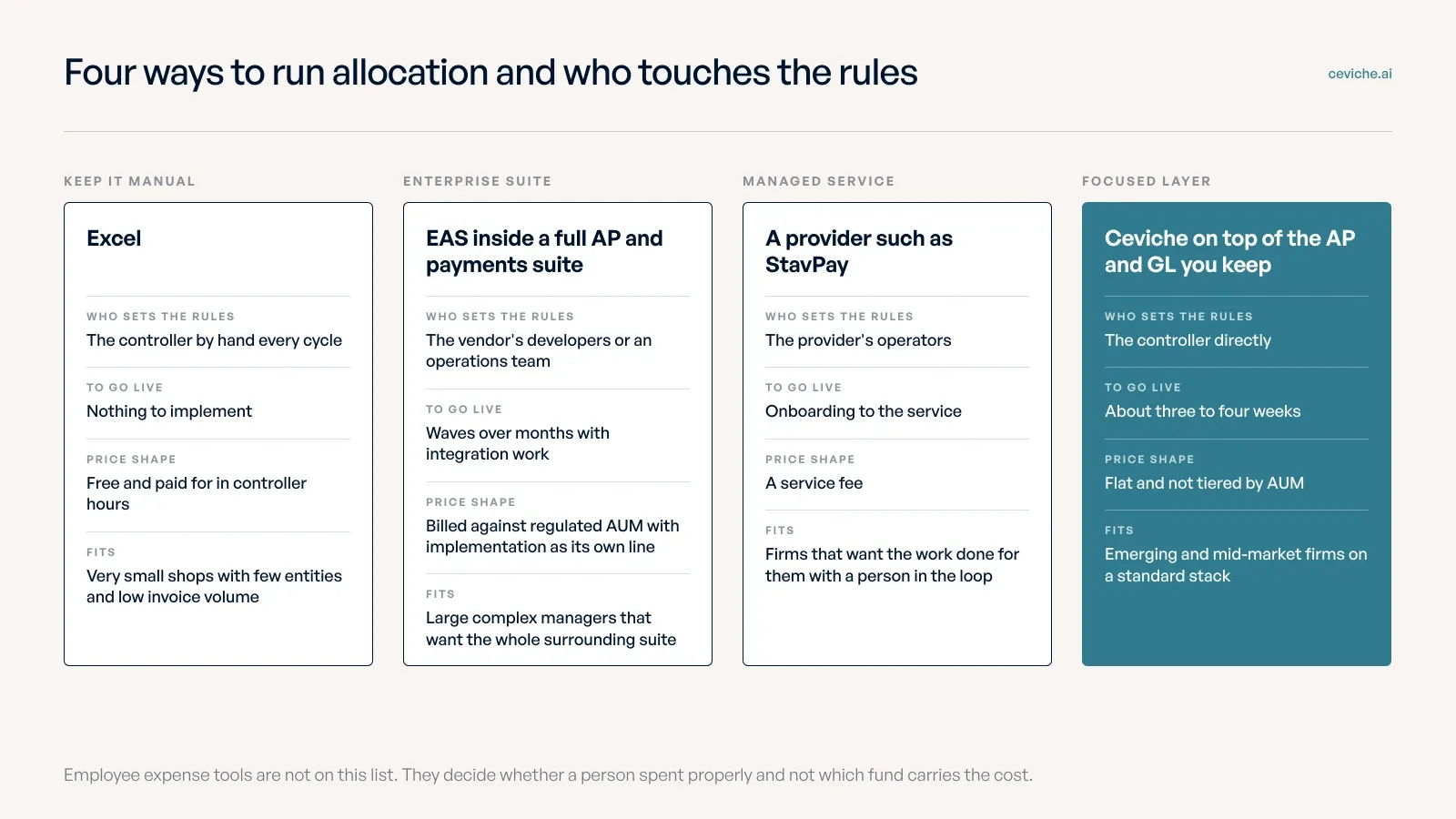
| Option | What it is | Who it genuinely fits | Implementation | Pricing shape | Who configures the rules |
|---|---|---|---|---|---|
| Excel | Manual allocation in a workbook | Very small shops, few entities, low invoice volume | None | Free, paid in controller hours | The controller, by hand every cycle |
| EAS / IntegriDATA | Enterprise allocation engine inside a broad AP, payments, and treasury suite | Large, complex managers that need the whole surrounding suite or already run it | Waves over months: reference data, integrations, development | Typically billed against regulated AUM; implementation a separate, often larger line item | Vendor developers or a managed-service team |
| Managed service (e.g. StavPay) | A provider performs the allocations on your behalf | Firms that want to outsource the work entirely and accept a human operator in the loop | Onboarding to the service | Service fee | The provider's operators |
| Ceviche | A focused allocation layer on top of your existing AP, T&E, and GL | Emerging and mid-market PE and VC with a recognizable stack | About three to four weeks | Flat, not AUM-tiered; no separate implementation bill | The controller, self-serve |
A note on the directories: most of the pages ranking for this term will tell you the alternatives are Concur, Expensify, or Ramp-style tools. That blurs two different jobs, and it sends people down the wrong road. More on that below.
What does an enterprise implementation really cost?
Nobody puts this on the front page, so it is worth being specific. Going by enterprise onboarding guidance, a rollout happens in waves. Reference-data setup runs for weeks. Integrations need development work. For the largest managers, the whole thing can stretch across six to nine months. The people cost is real too: it pulls in developers on the vendor side and a good chunk of your finance team's time on yours, often for several quarters. On price, these systems are usually billed against your regulated AUM, so the number climbs as you cross tiers or raise another fund, and implementation tends to be a separate line item, frequently bigger than the subscription. Firms that have been through it describe an implementation invoice that ran well past what they budgeted.
For contrast, a focused allocation layer can go live in about three to four weeks with no separate implementation bill, because the controller configures the rules instead of an engineer coding them. The honest caveat: that timeline is realistic for emerging and mid-market shops with a recognizable stack. Bigger, more bespoke structures need more setup, ours included, but more should still mean weeks, not a year working through a wish list.
What does the allocation layer actually do?
This is the one job the employee expense tools cannot do, so it is worth seeing the arithmetic. Take a single quarter with two shared costs:
- A $40,000 market-data subscription that serves every active fund, allocated by committed capital. Say Fund I committed $100M, Fund II $200M, Fund III $100M, for $400M total. The split is 25 percent, 50 percent, 25 percent: Fund I $10,000, Fund II $20,000, Fund III $10,000.
- A $15,000 legal bill tied only to Fund III's add-on acquisition, allocated 100 percent to that fund: Fund III $15,000.
The quarter's allocations land as Fund I $10,000, Fund II $20,000, Fund III $25,000, each posted as a balanced set of intercompany journal entries to the general ledger, with the methodology that produced each number recorded next to it. Two line items, two different methodologies, one defensible record. That is the work. A travel-and-expense tool was never built to make that call, hold the methodology that justifies it, or reconstruct it for an examiner two years later.
Are employee expense tools real alternatives?
It is worth pulling this apart, because the directories get it wrong. Employee expense and T&E tools, Concur, Expensify, Ramp, Brex, answer one question: did a person spend the company's money appropriately, and how do we reimburse them and book it. They work at the level of the cardholder and the management company, and they are good at it. One controller told us she had used Concur, but it could not do the allocation the way fund accounting needs, which was the whole reason the allocation work stayed painful.
Fund expense allocation answers a different question: whose money was this, meaning which funds, LPs, deals, or SPVs should carry the cost and in what proportion, according to the LPA, and can you prove it later. A single invoice might get cut ten different ways across a fund structure. Sorting which costs even belong to the funds in the first place, versus the management company, is a related but separate call. Your T&E tool decides whether an expense was legitimate and gets the employee paid back. The allocation layer decides which pools of capital that legitimate expense belongs to, enforces the fund agreement as it does it, and keeps the record that holds up in an audit. The two sit next to each other in the stack. They are not substitutes.
What should you check before you switch?
These are the questions no vendor will raise on its own, mostly because the honest answers tend to favor whoever asked them. A controller can forward this list straight to a CFO. If Ceviche is on the list, how Ceviche onboarding works answers the implementation question in advance.
- Self-serve or ticket? When you need a new entity added or a rule changed, can your finance team do it themselves, or does it take the vendor's developers and a queue? Ask for the realistic timeline and cost of a single change. That one answer tells you what the next two years will feel like.
- Point-in-time accuracy. If an invoice posted under one set of rules months ago, can the system show the methodology that was in force then, not just today's rules? Point-in-time accuracy is what an audit actually tests, and it almost never shows up in a demo.
- Prove the audit trail live. Do not accept "we have full audit trails" at face value. Ask them to produce the complete approval and timestamp trail for one specific allocation on the spot, showing an independent submitter and approver.
- Software versus operator. If the demo leans on managed services, ask what the software does on its own versus what a human operator does, where that operator sits, and who carries the liability when a misclassification breaches an LPA cap.
- The real price. Get implementation quoted separately from the subscription. Ask what happens to your price when you cross an AUM tier or raise another fund. Check whether you are paying for an AP or payments module you already have elsewhere.
- Your data, exportable. Make sure you can get a plain export of every allocation, who made it, when, and who approved it, with the supporting documents, in a format you own.
And plan the switch itself. Data migration is the landmine: when the old system is rigid about how data is labeled, history that was not tagged just right does not carry over cleanly. Run the old and new approaches in parallel until they produce the same numbers before you cut over, and settle how in-flight invoices already queued under the old methodology get treated, so you do not lose the point-in-time story. If your setup leaned on an offshore operations team or one vendor contact, the knowledge of why allocations were done a certain way can walk out with them, and an SEC exam is the worst time to find it gone.
Where does Ceviche fit?
Full disclosure: Ceviche is one of the alternatives in this category, so read this section as the vendor making its own case.
We built Ceviche to do one thing, fund expense allocation, and to put the controls in the hands of the accountants who live in it rather than the developers who built it. It reads from your existing AP and T&E systems, applies allocation rules the controller configures, and writes clean intercompany journal entries down to your GL. There is no second AP system, no payments rail, and no offshore operations team, because emerging and mid-market firms already have those.
One concrete example, since this post is about evidence and not adjectives. Flybridge runs Ceviche across 18+ fund entities, sitting on top of their existing QuickBooks Online and Bill.com stack, and every allocation traces back to source documentation with a full audit trail.
If you are staring down a six-month implementation, or a wish list that never seems to end, that is a conversation we would be glad to have. You can see how it works here.
FAQ
What is the EAS Expense Allocation System? EAS is fund expense allocation software from IntegriDATA, an Indus Valley Partners company. It automates allocation across funds, deals, and entities using rules such as AUM, NAV, market value, or holdings, digitizes LPA expense policies, and keeps an audit trail for SEC and auditor review, inside a broader suite that also covers accounts payable, payments, and reporting.
Who makes EAS? EAS is built by IntegriDATA, which is now part of Indus Valley Partners (IVP). It is positioned at large and complex asset managers and is sold alongside IVP's accounts payable and broader fund-technology products.
What do fund firms use instead of EAS? The real alternatives are allocating in Excel, a managed service such as StavPay that performs allocations for you, or a focused allocation layer such as Ceviche that the controller configures and that posts journal entries to your existing GL. Employee expense tools like Concur and Expensify are a different category and do not allocate across fund entities.
How long does it take to replace an allocation system? For emerging and mid-market firms, a focused allocation layer can go live in about three to four weeks. Enterprise rollouts that include integrations and reference-data setup commonly run six to nine months, with implementation billed separately from the subscription.
Is Concur or Expensify an EAS alternative? No. Those are travel-and-expense tools that decide whether an employee spent appropriately and reimburse them. Fund expense allocation decides which funds, deals, or SPVs should carry a shared cost under the LPA and proves it later. The two sit next to each other in the stack rather than replacing each other.
When is staying on EAS the right call? When you are a large, complex manager that needs the full surrounding suite (accounts payable, payments, treasury, 1099s) in one platform, or when you already run it, have the technical resources to maintain custom logic, and it works. Replacing a working system to save a line item rarely pays off.