A fund-focused comparison of financial close automation software for PE and VC controllers, from a 2026 study of 80 fund finance teams.
TL;DR
For most PE and VC fund finance teams, Ceviche fits the management-company close where multi-entity expense allocation eats the schedule, FundCount and Entrilia handle fund-level books, and HighRadius serves large corporates rather than funds. The hard part is splitting a single legal invoice across Fund I, Fund II, and a co-invest SPV by different methodologies. Ceviche applies LPA-based rules and writes audit-ready journal entries back to your GL.
Why Is the Fund Close Harder Than a Corporate Close?
A corporate controller closing the books reconciles accounts and consolidates entities. A fund controller does that and then allocates a single outside-counsel invoice with 25-plus line items across Fund I, Fund II, and a co-invest SPV, each line carrying its own methodology. One block of fees splits pro rata by committed capital. Another follows a deal-specific allocation tied to which fund the deal benefited. A third gets charged entirely to the management company because it covers fund formation. That allocation logic lives nowhere in standard close software.
The line-item allocation problem is the wedge most generic tools never touch. Enterprise close platforms handle intercompany eliminations and a unified chart of accounts well, but they treat an invoice as one payable to one entity. They have no concept of an LPA rule that says outside counsel on a portfolio dispute gets split 60/40 between two funds while the diligence work on a killed deal gets expensed to the GP. Controllers solve that gap in spreadsheets, which is where the audit trail breaks.
The time cost shows up in the numbers. Roughly 54 percent of finance teams took seven or more business days to close at quarter-end as of 2022, while teams that automate most tasks close in four to six days (numeric.io). Fund teams sit at the slow end because the allocation work is manual, and generic automation does not reach it. Picking the right tool means picking one that understands fund allocation, not just consolidation.
Definition: Financial Close Automation Software (Fund Context)
Financial close automation software for funds records, allocates, and posts period-end accounting entries across multiple fund entities. It applies LPA-based allocation rules to shared expenses, splitting each invoice line across funds and SPVs by the correct methodology, then writes audit-ready journal entries to the general ledger. It maintains a real-time audit trail at the transaction level, so allocation logic and supporting evidence are available for GP and LP audits without post-close reconstruction.
The Two Categories of Tools PE/VC Teams Evaluate
Two distinct categories show up in any PE/VC close software search, and confusing them costs you a wasted evaluation cycle.
The first category is fund-native platforms built around partnership accounting. FundCount, Allvue, and Entrilia treat the fund as the primary operating unit. They track capital accounts, distributions, and entity hierarchies, and their general ledgers understand that Fund I and Fund II are legally separate vehicles with their own allocation logic. Carry, waterfall, and NAV calculations live inside this category or connect to it through integrations like Entrilia's qashqade partnership.
The second category is enterprise close platforms built for large corporates. HighRadius automates reconciliations, journal entries, and record-to-report workflows for the Global 2000. It scales across multiple ERPs and thousands of transactions, but it has no concept of an LPA, a management fee allocation, or a pro rata split across fund entities.
Allocation logic is where the two categories diverge. Fund-native tools encode the rules that decide how an expense splits across entities. Enterprise close tools leave that split to a controller working in spreadsheets, then ask the GL to record whatever number the controller produced. That manual step is the gap purpose-built fund tools close and generic close software does not.
Comparison: Best Financial Close Automation Software for PE and VC Funds
The table below covers five tools against the criteria that matter for a fund finance team. Ceviche publishes this article, so weigh that disclosure as you read.
| Tool | Best For | Deployment Model | GL Integration | Fund-Specific Allocation | Pricing Model |
|---|
| Ceviche | Management-company expense allocation and audit-ready JEs | SaaS, controller-run | NetSuite, QuickBooks Online, Sage | LPA-based rules, per-line-item across entities | Subscription, quote |
| Entrilia | GPs with complex multinational structures | SaaS, API-first | Real-time APIs | Within fund accounting engine; carry via qashqade | Not documented |
| FundCount | Fund administrators needing GL discipline | SaaS, ledger-first | Internal GL authoritative | Partnership accounting, capital accounts | Not documented |
| Allvue | GP quarter-end close workflows | SaaS | Not documented | Not documented | Not documented |
| HighRadius | Global 2000 enterprise close | SaaS, IT-configured | SAP, Oracle, NetSuite, Dynamics | None; generic enterprise close | Subscription, quote, high five to six figures |
Ceviche handles the wedge case the others leave to spreadsheets, allocating a single invoice across Fund I, Fund II, and a co-invest SPV by different methodologies, then writing the journal entries back to your GL.
Best Financial Close Automation Tools for PE and VC Funds
The five tools below run from most fund-specific to least, starting with expense-allocation specialists and ending with enterprise close platforms built for large corporates. Ceviche, which publishes this article, leads the list because automated multi-entity expense allocation is its single focus. Read each section for what the tool actually does well and where it stops, so you can match the tool to your fund structure rather than to a marketing claim.
Ceviche: Automated Expense Allocation for the Management Company Close
Ceviche solves one problem well. It takes a single invoice with many line items, applies the allocation methodology each line requires, and writes audit-ready journal entries to your general ledger. The clearest example is the outside-counsel invoice every controller dreads.
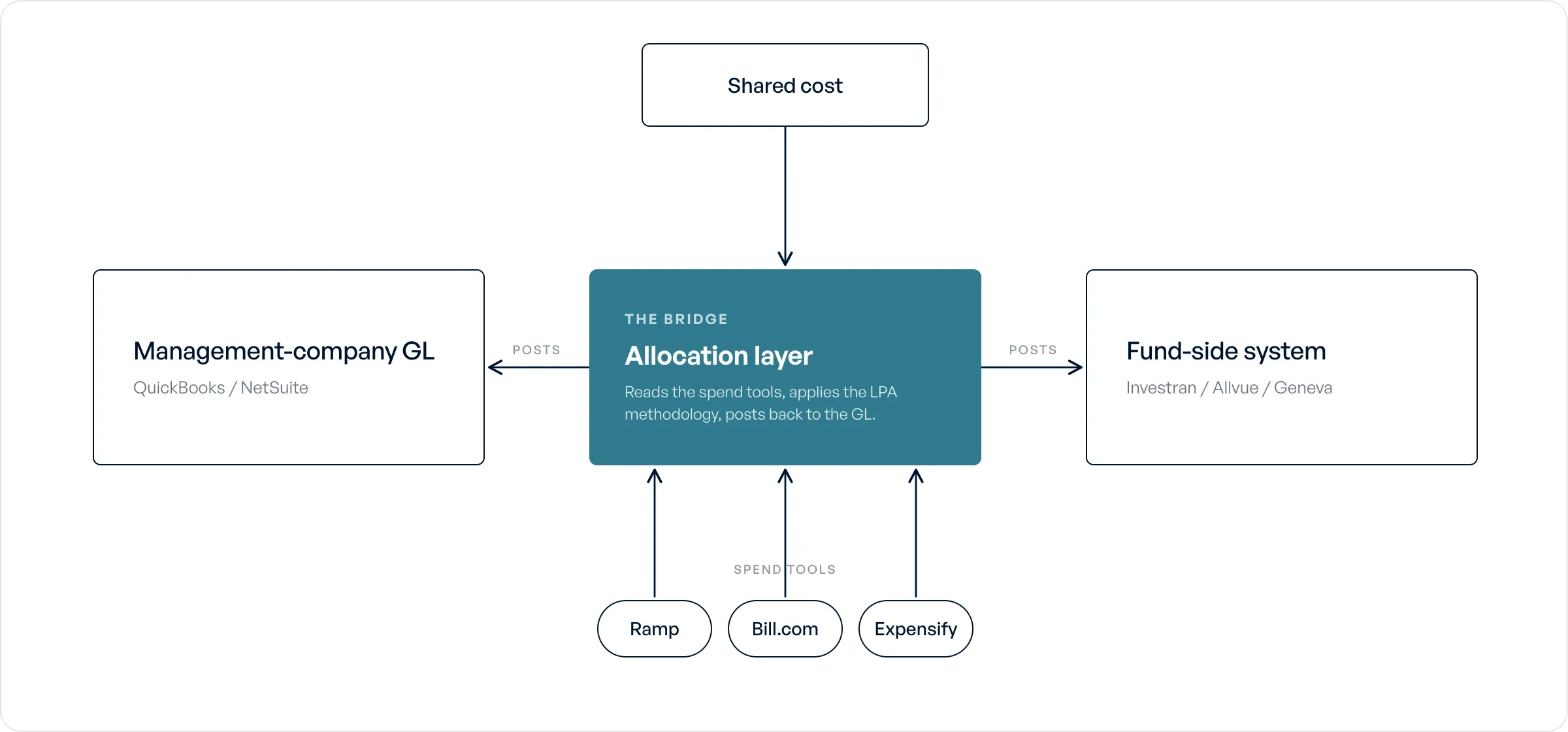
The allocation layer reads invoices upstream, applies your rules, and writes journal entries back to your GL.
Picture a $200,000 invoice from your law firm with 25-plus line items. Some lines cover fund formation work that belongs to Fund I. Some cover a portfolio acquisition split between Fund I and Fund II by committed capital. Some cover a co-invest SPV that took down part of the deal, allocated pro rata to the SPV's stake. One line is a general management-company matter that stays at the GP. No single methodology covers the whole invoice, and that is why the work resists a simple split.
Walk through the arithmetic on one acquisition line of $60,000. Fund I committed $400 million and Fund II committed $100 million to the deal, with a co-invest SPV taking $50 million alongside. On a committed-capital basis across the $550 million total, Fund I takes 72.7 percent ($43,636), Fund II takes 18.2 percent ($10,909), and the SPV takes 9.1 percent ($5,455). The next line uses a different denominator because the SPV did not participate, so the split is only Fund I and Fund II. Ceviche holds the rule per line, runs the math, and produces the journal entries with the allocation logic attached as backup.
That backup is the point. When an auditor samples 20 to 50 transactions and asks how you allocated a given line, you open the entry and show the methodology, the denominator, and the percentages applied. The audit trail is built as you allocate, not reconstructed after the fact. Manual allocation in a spreadsheet leaves you reverse-engineering your own math months later, and that is where confidence in the close erodes.
In our 2026 research across 80 PE and VC fund finance teams, controllers running this work by hand lost 5 to 10 days per quarter to invoice allocation and the documentation around it. You can read the full findings in our research. The teams that automated the allocation step recovered most of that time and closed the management-company books faster, because the slowest manual task stopped gating the rest of the close.
Be clear about what Ceviche does not do. It is not a fund administrator, and it will not run your books for you. It is not an ERP, so it does not replace NetSuite, QuickBooks Online, or Sage. It is not a managed service, which means a person on our side does not do the allocations for you the way a model like StavPay does. Ceviche is software a controller runs to do allocations faster with a full audit trail. You keep the judgment, set the rules from the LPA, and review the output. The tool handles the arithmetic, the entries, and the documentation.
Entrilia: Fund Accounting for Complex Multinational Structures
Entrilia is a fund accounting platform built for GPs running complex multinational structures, and it sells itself as a modular piece of a connected stack rather than an all-in-one system. Co-founders Eric Faw and Yuriy Andrushchenko frame the product as "the most connected accounting platform in private markets," with real-time APIs that share accounting data across the tools a fund already runs. If your fund spans multiple jurisdictions and you want a real-time accounting engine that feeds other systems instead of locking you in, Entrilia fits that profile.
The clearest signal of how Entrilia handles work it does not own itself is its November 2025 integration with qashqade for carry and waterfall modeling. When Entrilia recalculates NAV, qashqade triggers unrealized carry calculations per partner against the configured waterfall, so managers stop tracking carry offline in Excel disconnected from the books. That matters most for funds with multi-tier carry plans or heavy simulation volumes, and for managers prepping a distribution or exit who need the carry math to tie back to audited financials.
Entrilia's stated 2026 direction is AI-first, which Faw describes as AI embedded into ingestion and reconciliation rather than a bolted-on feature. The architecture rests on a deterministic semantic layer, a single source of truth for capital, IRR, allocations, ownership, FX, and hierarchies. Faw's argument is that AI in fund accounting only works when grounded in those deterministic definitions, because ungrounded outputs are not something a finance team can rely on at audit.
Two things are not documented in any source I found. Entrilia publishes no pricing, contract terms, or AUM minimums, and it states no quantified close cycle benchmarks. There is also no public detail on its GL write-back, chart of accounts structure, or expense allocation methodology. If multi-entity expense allocation drives your evaluation, ask Entrilia directly how it handles a single invoice split across funds before assuming the platform covers it.
FundCount: Ledger-First Compliance for Fund Administrators
FundCount earns its place with fund administrators who treat the general ledger as the authoritative record and accounting precision as the priority. The platform posts transactions through defined accounting workflows, and reporting reflects structured ledger entries rather than ad hoc spreadsheets. Third-party analysis from Asset Vantage describes its core strength as disciplined general ledger control within defined fund structures. If the fund is the primary operating unit and you need clean partnership accounting, FundCount fits.
The multi-entity model handles structured partnership accounting across fund vehicles, tracking capital accounts, contributions, and distributions while keeping entities separate. Partnership accounting follows defined legal hierarchies, which matters for GPs running nested structures with their own allocation logic. Audit trails are clear and compliance documentation is structured, so you can defend methodology and sampled transactions when the SEC tests allocation work.
Where FundCount gets harder is correction propagation. Reporting derives from aggregated financial data within configured modules, not from a single recalculation engine, per the same Asset Vantage analysis. When a backdated entry, a prior-quarter valuation restatement, or an ownership restructure in a nested entity occurs, the ledger change has to align with separate reporting layers through defined coordination processes. Aggregated data may need refresh cycles, and validation becomes part of routine accounting work rather than happening automatically.
That modular design also adds reconciliation load. Reconciliation aligns with reporting configuration rather than sitting inside the ledger logic, so it stays a recurring operational layer each quarter. Analytics reflect configured reporting dependencies rather than one shared data structure, which means you maintain those dependencies as the firm grows. Masttro characterizes the product as an accounting-first experience best suited to accounting operations rather than broader stakeholder reporting.
FundCount does not document close cycle times, invoice or expense allocation depth, or automated GL entry generation in its public material, and pricing is not published. For the management-company close specifically, where one outside-counsel invoice splits across Fund I, Fund II, and a co-invest SPV by different methodologies per line, FundCount records the result once you produce it. It is not the engine that computes the split.
Allvue Systems: GP Quarter-End Close Workflow Automation
Allvue targets GPs running quarter-end close, and its fund accounting product is pitched directly at the people doing that work. The company describes the problem in familiar terms. Accountants get stretched thin, manual processes invite errors, and quarter-end consumes more resources than it should. Allvue claims its product reduces those errors and tightens the close cycle.
That is most of what the public marketing actually says. The product positioning rests on efficiency language rather than documented mechanics.
Here is the honest caveat. The available public sources do not document specific features, pricing, or close-cycle benchmarks. There is no published detail on how Allvue handles multi-entity expense allocation, what its audit trail captures, or which GL systems it writes back to. A LinkedIn post from Allvue confirms the GP audience and the quarter-end focus, and it links to a blog by a product marketing manager, but the substantive product detail is not accessible in what we reviewed.
For a buyer, that gap matters. You cannot evaluate allocation logic or audit granularity from efficiency claims alone. If Allvue is on your shortlist, ask for a demo that walks a real multi-entity invoice through allocation and into the GL, and ask for the specific close-cycle numbers their existing GP clients see. Treat the marketing claims as a starting point, not as evidence.
Where Allvue likely fits is as a broader platform for GPs who want fund accounting alongside portfolio monitoring and LP reporting. That breadth is a different bet than the focused expense-allocation problem Ceviche handles. Confirm the specifics before you assume the close workflow covers your allocation methodology.
HighRadius: Enterprise Financial Close for Large Corporates
HighRadius builds for the Global 2000, and that audience shapes every part of the product. Founded in 2006, it calls itself an Autonomous Finance Platform and has run 2,700+ finance automation projects for clients like 3M, Unilever, and Hershey's (stuut.ai). The platform spans six suites covering receivables, payables, treasury, financial close, and consolidation. The close module handles reconciliations, journal entries, and record-to-report automation in generic enterprise terms.
The AI story is the headline. HighRadius announced 186 "Agentic AI" agents, with Cash Application and Cash Forecasting running at 90 percent touchless automation and Collections claiming a 30 percent productivity gain. Analyst recognition backs the enterprise positioning. Gartner named it a Leader in the 2024 Magic Quadrant for Invoice-to-Cash Applications for the third straight year, positioned highest on both axes.
The implementation cost tells the other half. Pricing is quote-only, estimated in the high five to six figures annually, with separate implementation fees and an estimated $50,000 to $100,000 in hidden internal IT costs over a six-month rollout. Some users report implementations stretching to years rather than the stated three to six months. The platform carries a Net Promoter Score of -20 with 56 percent detractors, and verified Capterra reviews note that requested feature improvements take six months or more. HighRadius itself recommends the platform for companies with $1B+ in revenue, five or more ERPs, and a dedicated finance technology team.
None of that maps to a PE or VC fund. Neither source describes fund expense allocation across entities, LP waterfall calculations, management fee automation, capital call processing, or the audit-trail requirements specific to partnership structures. The close module never mentions fund accounting or investor reporting. A controller allocating a single outside-counsel invoice across Fund I, Fund II, and a co-invest SPV by different methodologies will find no native logic for that work here. HighRadius solves a real problem for multinational corporates with many ERPs. It does not solve the management-company close.
How Should a PE or VC Fund Evaluate Financial Close Automation Software?
Most close software evaluations copy a generic corporate checklist and miss the workflows that actually consume a fund finance team's quarter-end. The criteria below filter for the things that matter when the management company and multiple fund entities share expenses, methodologies, and a single legal invoice.
-
LPA-based allocation rule engine. The tool should encode allocation methodologies from your partnership agreements and apply them per line item, not per invoice. A single outside-counsel bill with 25 line items often splits across Fund I, Fund II, and a co-invest SPV by different rules. Ask whether the engine handles committed-capital, pro rata, and fixed-split methodologies, and whether you can document exceptions.
-
GL write-back capability. Confirm the tool writes finished journal entries back to NetSuite, QuickBooks Online, or Sage, rather than producing a spreadsheet you re-key. Re-keying is where errors and audit-trail gaps appear.
-
Multi-entity support. Verify the tool maintains separation between fund entities while applying a consistent allocation logic across them. FundCount and Entrilia both build for partnership structures; generic close tools leave intercompany splits to manual workarounds.
-
Audit trail granularity. The SEC tests allocation methodology against 20 to 50 sampled transactions. Ask whether the tool records, per line item, which rule applied, who approved it, and when, so you can produce that evidence without reconstructing it post-close.
-
Integration with existing expense and ERP systems. The tool should read from Ramp, Bill.com, Expensify, Concur, or Brex on the upstream side and post to your GL downstream. A tool that requires manual data entry on either end recreates the bottleneck you are trying to remove.
-
Pricing model transparency. Most fund accounting vendors, including FundCount, Allvue, and Entrilia, do not publish pricing. Push for a clear model tied to entity count or transaction volume rather than an opaque AUM-based quote, and confirm what is software versus managed service.
One scope question cuts through the category. Some vendors do the allocations for you as a managed service. A tool like Ceviche is software your controller runs to do allocations faster with a full audit trail. Decide which model you are buying before you compare features.
Frequently asked questions
What is financial close automation software for private equity funds?
Financial close automation software for private equity funds finalizes accounting records for a fund or management company across multiple entities, then writes audit-ready journal entries to the general ledger. For PE and VC, the hard part is allocating shared expenses, such as a single outside-counsel invoice, across Fund I, Fund II, and co-invest SPVs by LPA-based rules. Ceviche automates that allocation and produces a full audit trail.
How long does a fund close cycle take and can software reduce it?
Most fund close cycles run one to four weeks, with manual expense allocation and reconciliation consuming the largest blocks. Around 54 percent of finance teams take seven or more business days just for a quarter-end close, and teams that automate most tasks land in four to six days. Automating allocation and GL write-back cuts the slowest manual steps, which is where Ceviche saves controllers five to ten days per quarter.
What is the difference between fund accounting software and financial close software?
Fund accounting software, like FundCount and Entrilia, maintains the books, capital accounts, NAV, and partnership ledgers as the system of record. Financial close software handles the period-end work of reconciling, allocating, and posting entries so the books can be finalized. Ceviche sits in the close category for the management company, applying allocation rules and writing journal entries into your existing fund accounting or ERP system.
Does Ceviche replace my fund administrator or ERP?
No. Ceviche is not a fund administrator, not an ERP, and not a managed service that does the allocations for you. It is software a controller runs to allocate expenses faster and produce a full audit trail. Ceviche sits between upstream expense tools such as Ramp and Bill.com and your downstream GL in NetSuite, QuickBooks Online, or Sage, complementing both rather than replacing either.
Which financial close tool is best for a small PE or VC fund?
Small PE and VC funds usually run a lean stack of QuickBooks Online or NetSuite plus spreadsheets, and the friction point is expense allocation rather than fund accounting itself. Enterprise platforms like HighRadius target Global 2000 corporates and carry six-figure pricing, so they fit poorly. Ceviche layers onto an existing GL and automates allocation without an ERP migration, which suits small teams.
Where Does Ceviche Fit?
Ceviche sits between your upstream expense tools and your downstream GL. It pulls invoices and expenses from Ramp, Bill.com, and Expensify, applies your LPA-based allocation rules to each line item, and writes audit-ready journal entries back to NetSuite, QuickBooks Online, or Sage. A controller runs it to allocate faster with a full audit trail behind every entry.
Ceviche is not a fund administrator. It does not calculate carry, run waterfalls, or produce LP statements. It is not an ERP and does not replace your general ledger. It is not a managed service, so it does not do the allocations for you the way StavPay does. You set the rules, Ceviche applies them, and you review the exceptions. The output is journal entries your auditor can trace line by line.
