
TL;DR
For lean PE and VC teams keeping their existing GL, Ceviche is the pick: it layers LPA-based allocation on QuickBooks or NetSuite without a migration. Choose Allvue for a full platform overhaul, IVP/EAS above $10B on an enterprise GL, Deloitte Cascade for time-based allocations, and Carta if you already run on Carta.
Why Do Generic Accounting Tools Fail at Fund Expense Allocation?
A single outside-counsel invoice exposes the problem fast. The invoice runs 25 line items. Some lines belong to Fund I, some to Fund II, and some to a co-invest SPV, and each line follows a different allocation methodology dictated by the relevant LPA. QuickBooks and NetSuite have no mechanism to read that invoice, split it line by line, and post the result. You either key 25 manual journal entries by hand, or you build an Excel layer that lives outside the GL with no audit trail.
That gap is structural, not a configuration miss. QuickBooks and Xero are entry-level systems that lack the automation and centralized visibility multi-entity organizations need. Even purpose-built ERPs handle multi-entity postings poorly. In Microsoft Dynamics GP, a transaction touching five entities requires five separate logins, and during an audit the AP entry sits in one company database while the due-from sits in another, so someone reconciles them by hand.
Legal invoices are the most cited version of this problem, not the only one. A VC firm running more than 20 vehicles told us its single most painful allocation case was neither legal nor deal-related: it was AML and compliance costs spanning multiple funds. Those costs arrive as one bill for work that served several vehicles at once, the basis for splitting them is a judgment call rather than a formula, and the resulting entries have to survive the same examiner scrutiny as everything else. Any tool that only handles legal invoices solves part of the job.
The fix starts with naming two different categories that most listicles blur. Fund accounting software runs the general ledger, NAV, and partnership accounting. It records the numbers and produces statements. Fund expense allocation software does something narrower: it takes the costs your spend tools captured, applies the allocation rules each LPA specifies, and hands your existing ledger finished, audit-ready journal entries.
A controller who recognizes the 25-line invoice problem is looking for the second category, not the first. Replacing your GL does not solve allocation, and a good allocation layer does not require you to replace your GL.
What Does Fund Expense Allocation Software Actually Do?
Fund expense allocation software sits between your expense capture systems (Ramp, Bill.com, Expensify, Concur, Brex) and your general ledger (NetSuite, QuickBooks Online, Sage). It applies LPA-based allocation rules to each expense, splits multi-line invoices across fund entities by the right methodology per line, and writes audit-ready journal entries back to your GL. It produces per-line audit trails for every distribution. The corporate spend tools on the capture side solve a different problem, which is why a search for private equity expense management software turns up three product categories rather than one.
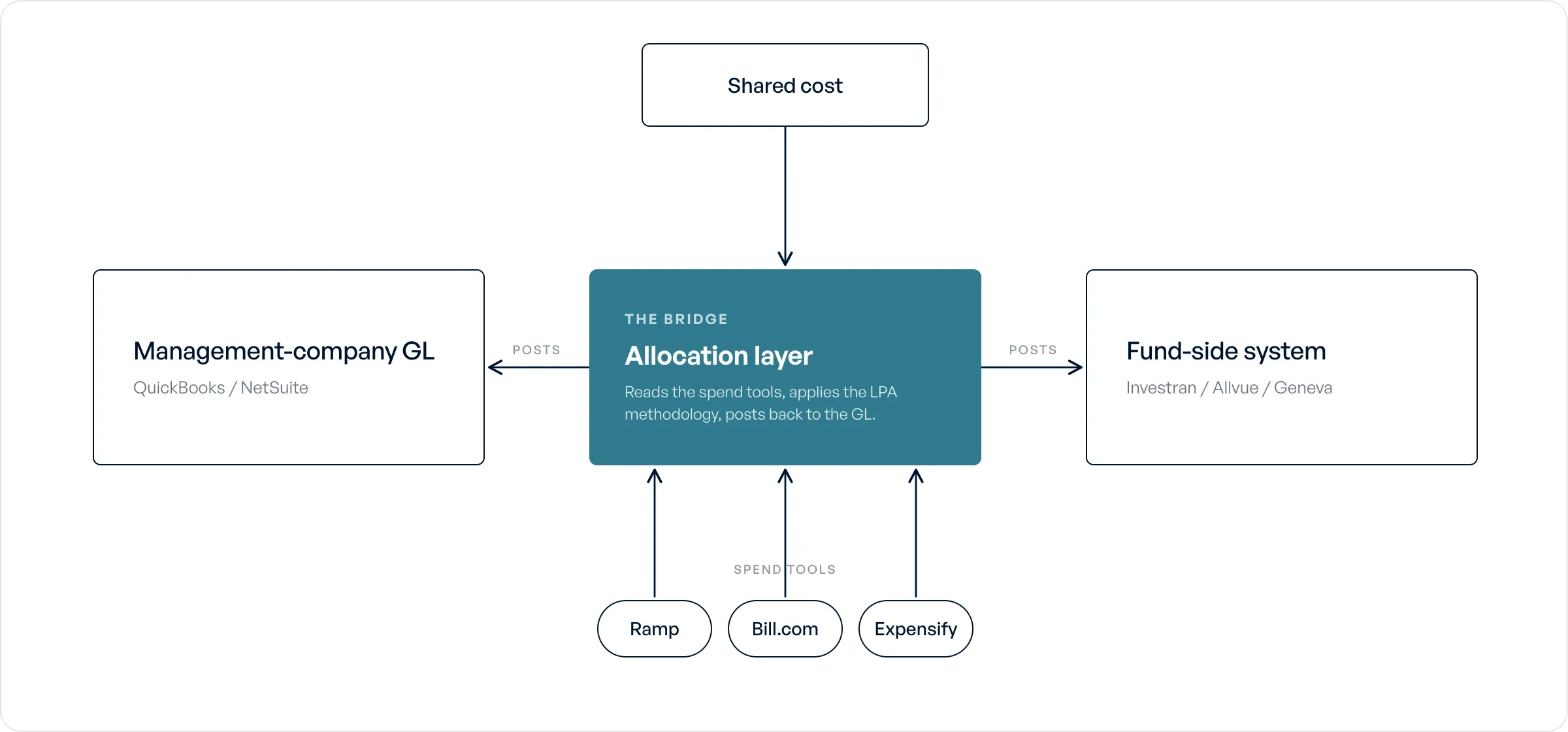
Fund expense allocation software sits between your expense systems and the GL, applying LPA rules per line.
It is not a fund administrator, not an ERP, and not a managed service. It does not calculate NAV, run partnership accounting, or replace your GL. It does not do the allocations for you the way a managed-service provider would. It is software your controller runs to do allocations faster, with a documented trail an auditor can sample.
The Five Platforms Compared
Five platforms cover the serious end of fund expense allocation: Ceviche, Allvue Systems, IVP/EAS, Deloitte Cascade Suite, and Carta. Each solves a different version of the problem, and the right pick depends on your AUM, your team size, and whether you want to keep your GL.
Everything quantified in this comparison comes from the 80 fund finance teams we spoke with in 2026: 81% still allocate in Excel, and 63% name legal-invoice allocation among their toughest problems. The full data is in The State of Fund Expense Allocation 2026.
One theme in those conversations is worth stating before the comparison, because it shapes how you should read every entry below. Teams leaving a legacy allocation platform rarely describe a capability gap. They describe friction. A finance operations lead at a PE firm, mid-migration off a legacy allocation platform, put it this way:
"No one likes the legacy system. It requires a lot of data entry and allocation time, and the program is slow."
That is the failure mode to test for in a demo. Not whether the engine can model your methodology, because most of these can. Whether the daily work of feeding it, reviewing it, and getting entries out is faster than the spreadsheet it replaced.
Ceviche
Ceviche is the purpose-built allocation layer for lean PE and VC finance teams running $500M to $15B in AUM who want to own the allocation process without ripping out their general ledger. Disclosure: Ceviche publishes this article, and the competitor characterizations below come from public sources cited throughout.
The problem Ceviche is built for is the invoice at the top of this page: the mixed-methodology bill no general ledger can split on its own. Ceviche is the layer that does the splitting. It pulls invoices from Ramp, Bill.com, Expensify, Concur, or Brex, applies the allocation rules written into your LPAs, and writes audit-ready journal entries back into NetSuite, QuickBooks Online, or Sage. The audit trail records every line, the methodology applied, and the entity it hit. When an auditor samples a transaction and asks why a fee landed where it did, the answer is one click, not a reconstruction.
Flybridge runs 18+ fund entities on a QuickBooks Online and Bill.com stack. Every allocation traces back to source documentation with a full audit trail, and the controller reviews exceptions instead of rebuilding the model each close. No GL migration, no fund-admin handoff, no managed-service contract.
The reaction we hear most often at go-live is not about features. A finance operations lead who had reconciled allocations by hand for years told us, the day her firm went live, that she was simply relieved someone had finally automated it. That is the honest measure of this category: the work does not get more sophisticated, it stops being carried by a person.
The case for owning this layer is not anecdotal. In Ceviche's 2026 analysis of 80 PE and VC fund finance teams, 81% still allocate expenses in Excel, and 49% have a gap in their allocation audit trail. The gap is not that controllers lack discipline. It is that no tool in their stack was designed to split a legal invoice across funds by rule and prove the math.
Be clear about what Ceviche is not. It is not a fund administrator, it is not an ERP, and it is not a managed service that does the allocations for you. A managed-service vendor like StavPay runs the allocations on your behalf. Ceviche is software your own controller runs to do the same work faster with a full audit trail. You keep control of the methodology, the review, and the GL.
Pick Ceviche if you run a two-to-five-person finance team across multiple fund entities, you want to keep the GL you already trust, and splitting legal and shared invoices is the part of the close that eats the most time. Skip it if you need a system of record for NAV, capital accounts, and LP reporting, or if you want a provider to perform the allocations rather than software your team operates.
Allvue Systems
Allvue is a full front-to-back private capital platform reporting more than $8.5 trillion in assets tracked across its platforms. The platform covers fund and corporate accounting, CRM, portfolio monitoring, business intelligence, and investor portals inside a single Microsoft-based framework. Expense allocation is one module among many, not the product. A firm buys Allvue to run its entire fund accounting operation, and allocation comes along as a feature of that larger system.
The fund accounting module handles fund- and investor-level allocations, automated GL entries, reallocations, and equalization interest, per Allvue's own product demonstrations. Those capabilities target the recurring mechanics of partnership accounting. What no public material shows is how the module handles a mixed outside-counsel invoice split across five fund entities by different methodologies per line.
The trade-off is scope and weight. Public Allvue sources do not confirm per-line audit trails on legal invoices, per-LP-agreement allocation rules, GL write-back to a third-party ledger like QuickBooks or NetSuite, an implementation timeline, or pricing. Apex Group, a major fund administrator, lists Allvue alongside eFront, Investran, and Geneva as a third-party platform it deploys for clients. Allvue is enterprise infrastructure deployed by fund admins, not a tool a three-person finance team installs in a few weeks.
Pick Allvue if you are replacing the entire fund accounting stack, you want accounting, reporting, and investor communication in one system of record, and you have the budget and project resources for a multi-quarter implementation. Skip it if allocation is your actual problem and your GL is fine, because the allocation depth you need is not confirmed in any public source and you would be buying a platform replacement to get it.
IVP/EAS (IntegriDATA)
IVP/EAS, the Expense Allocation System now sold under Indus Valley Partners after the IntegriDATA acquisition, targets large asset managers running complex allocation logic on top of enterprise GL infrastructure. The product is purpose-built for the same problem Ceviche addresses, and it is the most direct functional competitor in this list for firms that have already outgrown spreadsheets at scale.
The allocation engine distributes expenses by AUM, NAV, market value, holdings, deal, strategy, or custom drivers, and supports N-level entity hierarchies for deep multi-fund structures. AI-powered OCR captures and validates AP invoices, and natively tags each as Management Company Paid, Fund Paid, or Recoverable inside one workflow, per the vendors' published product material. LPA policies are digitized in the platform and applied to each allocation automatically. Every user action lands in a complete audit trail, and a centralized Q&A hub logs invoice communications for SEC examination readiness. Named GL integrations cover SAP, Oracle, and QuickBooks, and the platform holds SOC 2 Type 2 certification.
The honest limitation is fit for anyone below the enterprise tier. No source discloses pricing, licensing, or AUM-based fees, and no source publishes an implementation timeline or professional-services requirement. The only named case study is a $40 billion private fund manager. No smaller or mid-market reference appears anywhere in the public material. QuickBooks is named as a supported GL, but no source details the depth of the QuickBooks Online integration or any native Ramp or Bill.com connector.
Pick IVP/EAS if you manage above roughly $10B, sit on an incumbent enterprise GL like SAP or Oracle, run genuinely deep entity hierarchies, and have dedicated implementation and administration resources. Skip it if you are a three-person team on a Ramp-to-QuickBooks-Online stack at $1B AUM, because the absence of any mid-market reference is the answer to whether you are the buyer.
Deloitte Cascade Suite
Deloitte's Cascade Suite is built for large firms with deep time-based allocation needs and an existing Deloitte relationship to manage the engagement. The product handles allocation at the expense line level across named methodologies, and it carries the most complete treatment of employee-driven cost allocation in this comparison.
Cascade supports allocation by AUM, NAV, locations, and employee time, with line-level configurability rather than fund-level defaults. The integrated time tracking portal is the differentiator. It captures compensation, meals, bonuses, taxes, and executive assistant time through a mobile-friendly interface with approvals and overrides. If your hardest allocation problem is splitting employee time and comp across funds rather than splitting a legal invoice, Cascade is purpose-built for that. The suite also digitizes allocation policy and fund agreement terms through a guided UI, posts journal entries, and keeps a full audit trail of every calculation and rule change.
The honest limitation is access. Deloitte delivers Cascade exclusively, either as a licensed implementation you operate or a managed service Deloitte runs. There is no self-serve onboarding, no marketplace listing, and no third-party implementation path. Every inquiry routes through a named Deloitte Managing Director. Deloitte discloses no pricing, no implementation timeline, and no named client references in public sources, so a controller cannot scope cost or duration before a sales conversation.
Pick Deloitte Cascade if employee time and compensation allocation is your hardest problem rather than invoice splitting, you already work with Deloitte, and you have the budget an enterprise engagement requires. Skip it if you want to scope cost and timeline before a sales conversation, or you need to be running in a quarter, because the delivery model alone rules that out.
Carta
Carta fits VC firms already running their cap table and fund administration inside Carta. The allocation product is part of Carta's broader fund administration offering, not a standalone layer you bolt onto an outside stack.
The workflow runs on an AI agent. The agent parses each invoice, extracts line items and amounts, and applies your firm's allocation rules to split costs between the management company and the funds. It accepts plain-English allocation instructions, so you describe the split in natural language and the agent executes it. From there, it generates intercompany bookings and produces what Carta describes as "GL-ready entries for submission to payments and the general ledger". Carta frames the whole thing as tech-enabled fund administration powered by agentic AI.
The open question is where those GL-ready entries actually land. Public sources confirm the entries are generated, but they do not specify whether the output writes back to a third-party GL like QuickBooks Online or NetSuite, or routes into Carta's own ledger. For a firm that wants to keep its existing GL, that distinction decides whether Carta works at all. Treat it as a due-diligence question to settle directly with Carta before you commit, because GL-agnostic write-back is the criterion that separates an allocation layer from a platform you have to migrate into.
Public sources also leave implementation timeline, pricing, allocation-base support, and audit trail format undocumented, so factor that gap into any evaluation.
Pick Carta if your fund administration and cap table already live in Carta and the allocation agent extends a system your team uses daily. Skip it if you run Ramp, Bill.com, and a standalone QuickBooks instance you intend to keep, at least until Carta confirms in writing that entries write back to your ledger rather than into theirs.
Platform Comparison Table
The five platforms split cleanly along the criteria that decide a controller's purchase: implementation timeline, where journal entries land, how the audit trail is captured (the SEC samples 20 to 50 transactions and tests methodology against the LPA), how vendors price, and whether the tool replaces your general ledger or layers on top of it. The table uses each vendor's published sources, marks anything those sources do not confirm, and you should verify GL write-back and pricing directly with each vendor before committing.