TL;DR. QuickBooks and NetSuite run 73% of management-company general ledgers among the 80 fund finance teams we interviewed in 2026 (QuickBooks 51%, NetSuite 23%). On the spend side, Ramp appears in 49% of stacks, Bill.com in 39%, and Expensify in 30%. The recurring shape: a manco GL plus a separate fund-side system behind it.
Key findings
- QuickBooks (Online + Desktop) is the management-company GL for 51% of the fund finance teams we interviewed.
- NetSuite is the GL for 23%; together QuickBooks and NetSuite cover 73% of management-company general ledgers.
- Ramp appears in 49% of stacks, Bill.com in 39%, and Expensify in 30%.
Methodology
This draws on Ceviche's analysis of 80 PE, VC, growth-equity, and credit fund finance teams interviewed across 2026, each of whom walked us through the systems they actually run. Of the 80 teams we spoke with, GL was captured on 75 and spend tools on most.
What general ledger do private funds run their books on?
No one publishes this. Ask which ledger private funds keep their books on and you get vendor self-claims, not a count. So here is ours. Across the 75 teams where we captured a primary management-company GL, QuickBooks (Online and Desktop) is the system for 51%, NetSuite for 23%. Together that is 73% of the general ledgers we saw. Sage Intacct holds a real but smaller third lane at 5%, and the remaining 21% is a long tail: Xero, Carta, Dynamo, MS Dynamics 365, Workday, plus a few firms migrating off Quorum and onto newer ledgers.
| Management-company GL | Share of GL-known |
|---|---|
| QuickBooks (Online + Desktop) | 51% |
| NetSuite | 23% |
| Sage Intacct | 5% |
| Long tail (Xero, Quorum, Campfire, Carta, Workday, Dynamics, and more) | 21% |
The split tracks size more than anything. Smaller managers and emerging funds stay on QuickBooks because it is cheap, familiar, and good enough for a management company's own books. Firms with more vehicles, more reporting demands, or an institutional LP base tend to sit on NetSuite. A finance leader at a multi-strategy fund put the consolidation wish plainly: "ideally you have one system where you can see all these things." Most do not have that today, which is the whole point of this page.
What closing the gap requires is not a ledger swap. It is a layer that reads from whichever GL a firm already runs and posts journal entries back into it.
What spend and AP tools do private funds run alongside the GL?
The spend layer clusters tightly around three names. Of the 80 teams, Ramp came up in 49%, Bill.com in 39%, and Expensify in 30%. Concur trails at 11%. Firms usually name two or three of these, so the mentions overlap rather than sum to a clean 100%. Ramp is the clear momentum leader, and that includes a large share of teams mid-migration toward it: Bill.com to Ramp Bill Pay, Brex to Ramp, and so on. A stack in motion is a reliable sign a firm is rethinking everything downstream of it.
| Spend / AP tool | Mentions (of 80) |
|---|---|
| Ramp | 49% |
| Bill.com | 39% |
| Expensify | 30% |
| Concur | 11% |
One pairing recurs often enough to name: Bill.com plus Expensify feeding QuickBooks Online. Flybridge, a roughly $1B Boston VC and a Ceviche customer, runs that shape across its fund entities and agreed to be named here. The cards and bills live in one set of tools, the books in another, and nothing carries the line-level allocation from the spend side into the ledger on its own. So someone re-keys it.
Closing that gap means a system that reads Ramp, Bill.com, and Expensify, applies the allocation, and writes the entries to the GL with the support attached, so the decision travels the whole stack once.
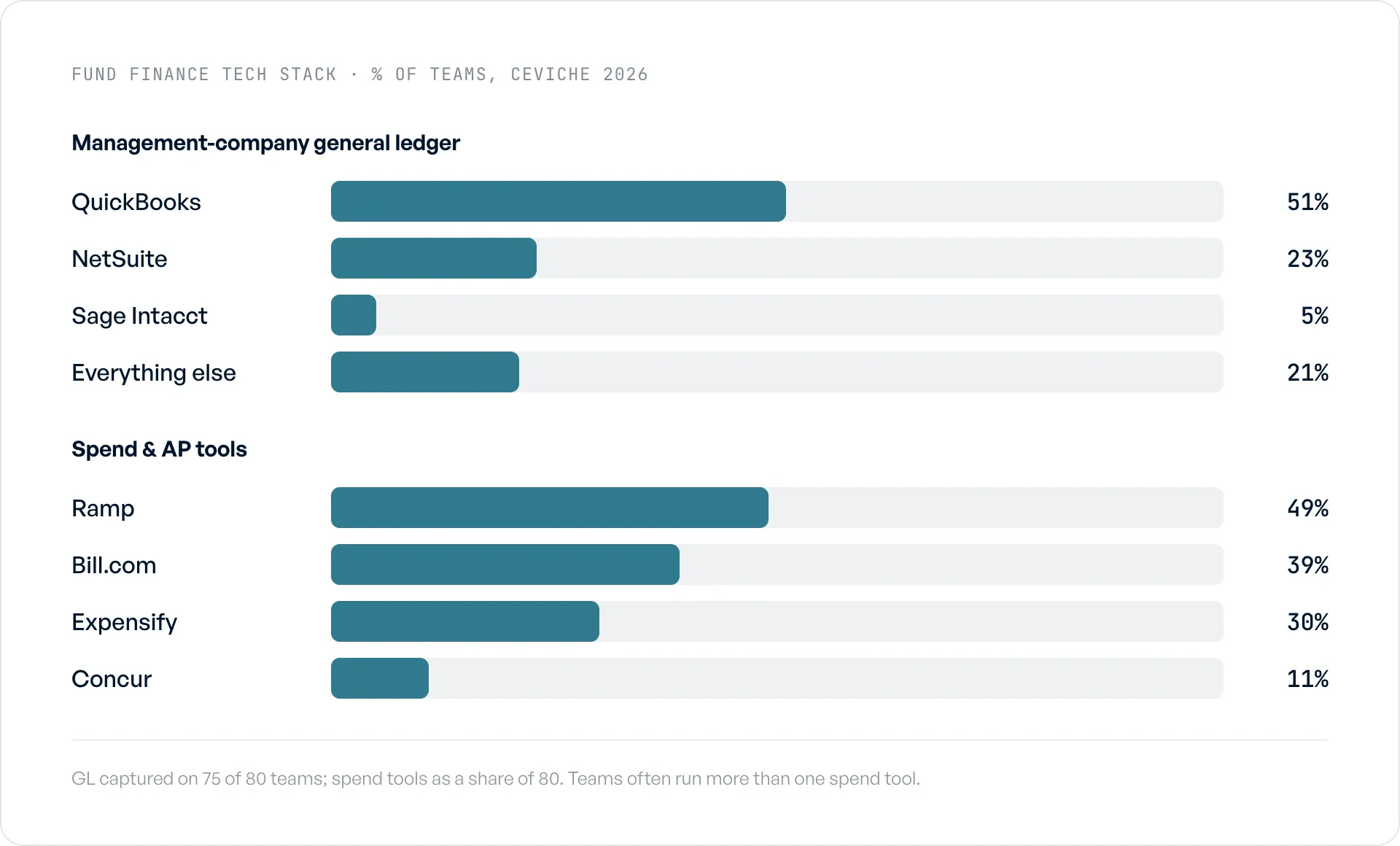
What private funds actually run, across 80 fund finance teams.
Why do funds run two accounting systems instead of one?
This is the structural finding, and it explains the other two. The recurring stack is not a single platform. It is a management-company GL (QuickBooks or NetSuite) for the firm's own books, with a separate fund-side system behind it for the funds themselves: Investran, AllVue, Carta, or Geneva. The manco GL handles payroll, rent, and operating costs. The fund system handles capital accounts, investor reporting, and fund-level books. Shared costs have to be split across both worlds, then posted into each.
A controller at a multi-billion-dollar venture and credit fund reads from NetSuite on the manco side and pushes allocated entries into a fund-side system on a quarterly cycle. The same firm cut its month-end allocation work from roughly ten days of manual reconciliation to a one-to-two-hour run after the two systems started talking. As one operator told us, "all the systems out there don't all do the thing that you want them to do. They each do a piece of the thing."
That is why "what's your tech stack" is the wrong question. The real one is what bridges the two halves. Closing the gap requires consistent methodology applied across both books, journal entries written back to the GL, and an audit trail built as you post, not reconstructed under exam pressure. For the full picture of where this stack breaks during the close, see the hub, The State of Fund Expense Allocation 2026.
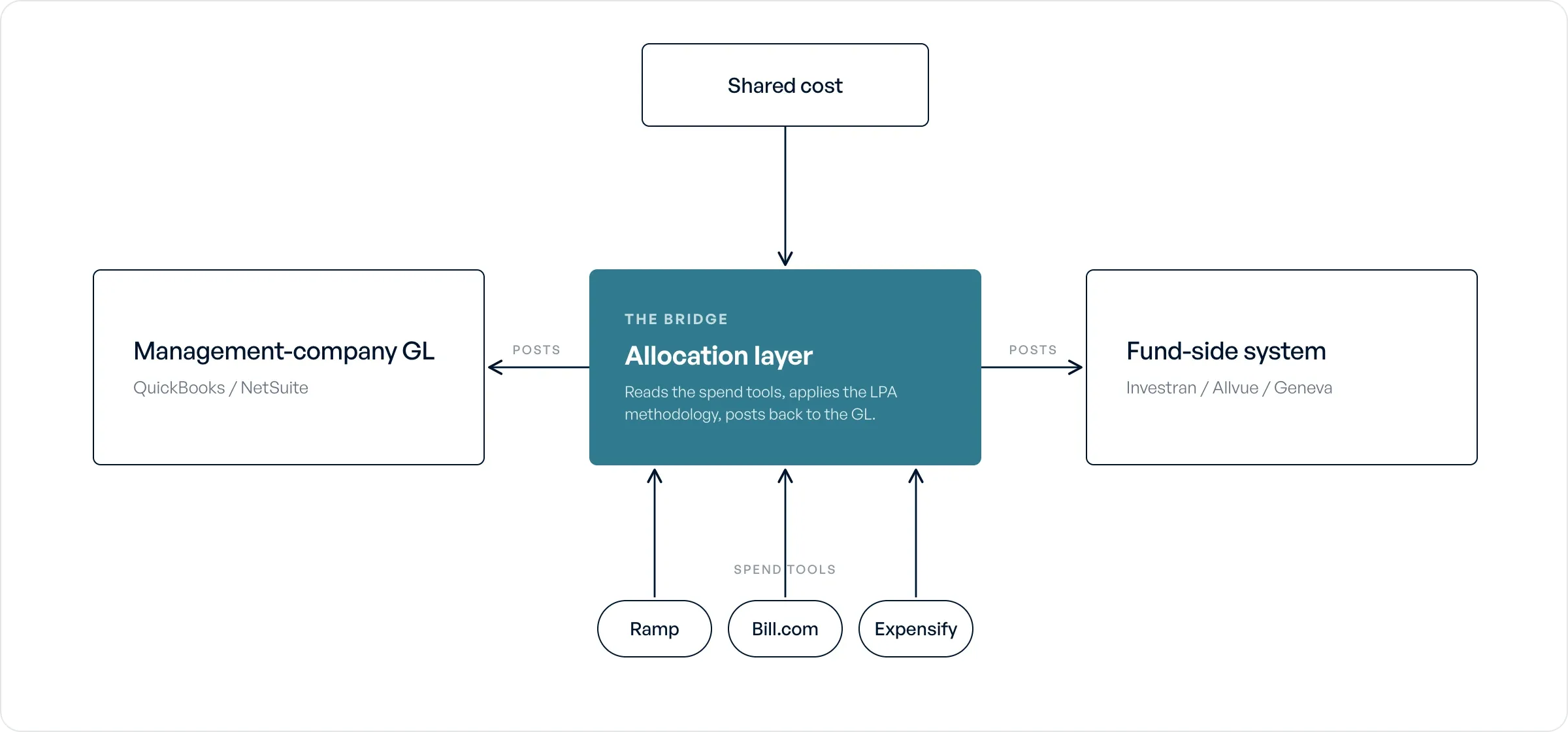
The allocation layer bridges the management-company GL and the fund-side system.
Where does Ceviche fit?
Ceviche sits between the spend systems funds already run (Ramp, Bill.com, Expensify) and the general ledger (QuickBooks, NetSuite, Sage), applies the firm's allocation methodologies, and writes audit-ready journal entries back to the GL with the rationale attached. It is the bridge across the manco-GL-plus-fund-system split this data keeps pointing at, rather than another ledger to migrate onto. Flybridge runs it on QuickBooks Online and Bill.com across its fund entities. You can see how Ceviche handles fund expense allocation.
FAQ
What general ledger systems do private funds use most? QuickBooks (Online and Desktop) and NetSuite, by a wide margin. In Ceviche's 2026 analysis, QuickBooks is the management-company GL for 51% of teams and NetSuite for 23%, so the two together cover 73%. Sage Intacct holds a smaller third lane at 5%, with a long tail of Xero, Carta, Dynamo, Workday, and others making up the rest.
What spend and AP tools do private funds use? Three dominate. Ramp appears in 49% of the stacks we counted, Bill.com in 39%, and Expensify in 30%, with Concur further back at 11%. Most firms run two or three of these at once. Ramp is the momentum leader, and a meaningful share of teams are mid-migration toward it from Bill.com or Brex.
What is the typical fund finance tech stack? A management-company general ledger (usually QuickBooks or NetSuite) plus a separate fund-side system behind it (Investran, AllVue, Carta, or Geneva), with a spend layer of Ramp, Bill.com, or Expensify feeding the manco side. The hard part is not any one tool. It is moving shared costs across both halves and keeping the entries and audit trail clean.