TL;DR. Allocating fund expenses in 2026 is still a manual, multi-system job for almost every private fund: across 80 PE and VC finance teams, 96% wrestle with multi-entity allocation, 81% still use Excel, and 63% name legal invoices their hardest split. The teams that fixed it made the allocation logic consistent and wrote the entries and audit trail back automatically.
This is the first edition of The State of Fund Expense Allocation, a Ceviche Research report. It is built on what fund controllers and CFOs actually told us, not on a vendor survey panel, and it exists because the question "how do private funds allocate their expenses" has had no primary data behind it. The numbers below are the data behind it. For every figure on one page with its source attached, see our fund expense allocation statistics.
Key findings
- 96% of fund finance teams cite multi-entity allocation as a core complexity (77 of 80).
- 92% run allocations across disconnected systems that do not talk to each other (74 of 80).
- 81% still allocate expenses in Excel (65 of 80).
- 63% name legal-invoice allocation one of their hardest problems (50 of 80).
- 49% have a gap in their allocation audit trail (39 of 80).
- One multi-billion-dollar fund cut its month-end allocation work from roughly 10 days to 1 to 2 hours, taking 5 to 10 days off close.
- QuickBooks and NetSuite run 73% of management-company general ledgers; Ramp, Bill.com, and Expensify dominate the spend layer.
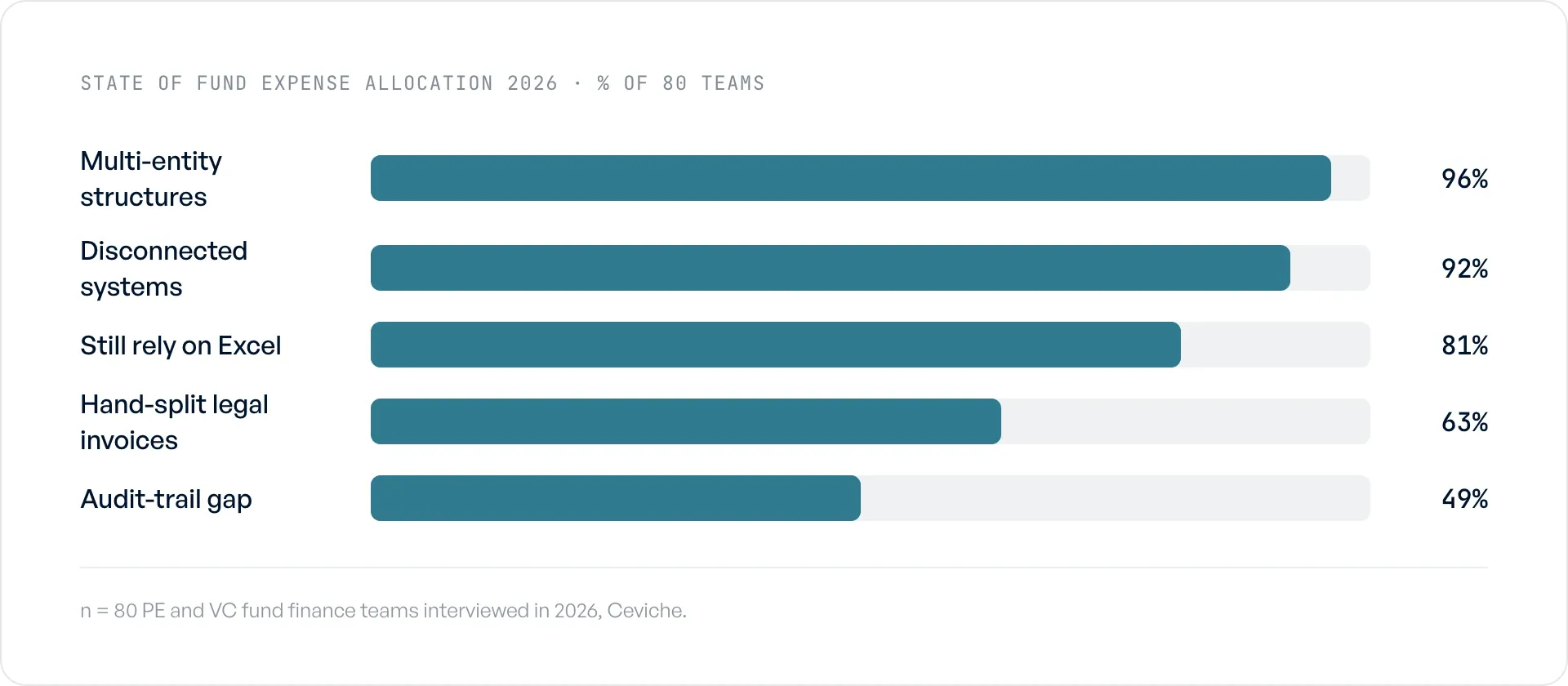
The five pains most often named, across 80 PE and VC fund finance teams.
Methodology
This report draws on Ceviche's analysis of 80 PE, VC, growth-equity, and credit fund finance teams (controllers, CFOs, fund accountants, and the fund administrators who serve them) interviewed across 2026. Every firm is a real organization that walked us through its actual allocation process. We coded each conversation for the same set of pains, systems, and outcomes, then aggregated the results. No single firm is identifiable in any number below, and the only customer named anywhere in this report is one that gave explicit permission.
How complex is multi-entity allocation for funds?
In 2026, 96% of the fund finance teams we interviewed (77 of 80) named multi-entity allocation as a core source of complexity. This is the most universal pain in the dataset, and it scales with structure, not with assets. A firm running three funds, a few co-invest vehicles, a GP entity, and a management company is already splitting shared costs across six or more sets of books, each with its own rules.
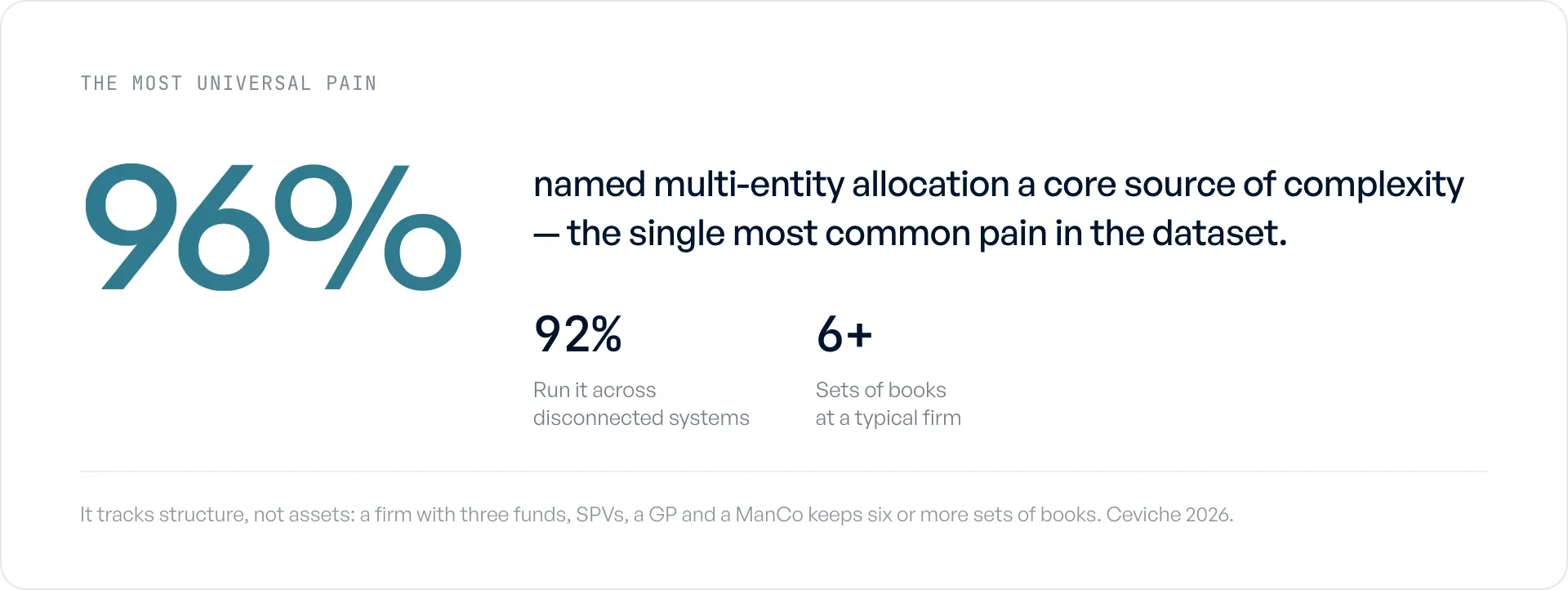
Multi-entity allocation is the most universal pain in the dataset.
The pattern is consistent: one cost arrives, and it has to be divided across entities by different drivers, then posted to each entity's ledger, then reconciled between them. A growth-equity controller we interviewed described single invoices that split across eight to thirteen funds and SPVs at once. The math is not the hard part. Keeping the split consistent and the intercompany entries clean, quarter after quarter, is.
The firms that have this under control apply one defined methodology the same way every quarter and let the intercompany entries generate themselves instead of rebuilding them by hand. Full data: the multi-entity allocation benchmark.
Why do disconnected systems break the close?
92% of teams (74 of 80) run allocations across systems that do not talk to each other. The typical stack is an expense or AP tool on one side, a general ledger on the other, and a spreadsheet wedged in the middle doing the actual allocation. Nothing carries the line-level decision from one system to the next, so a person re-keys it.
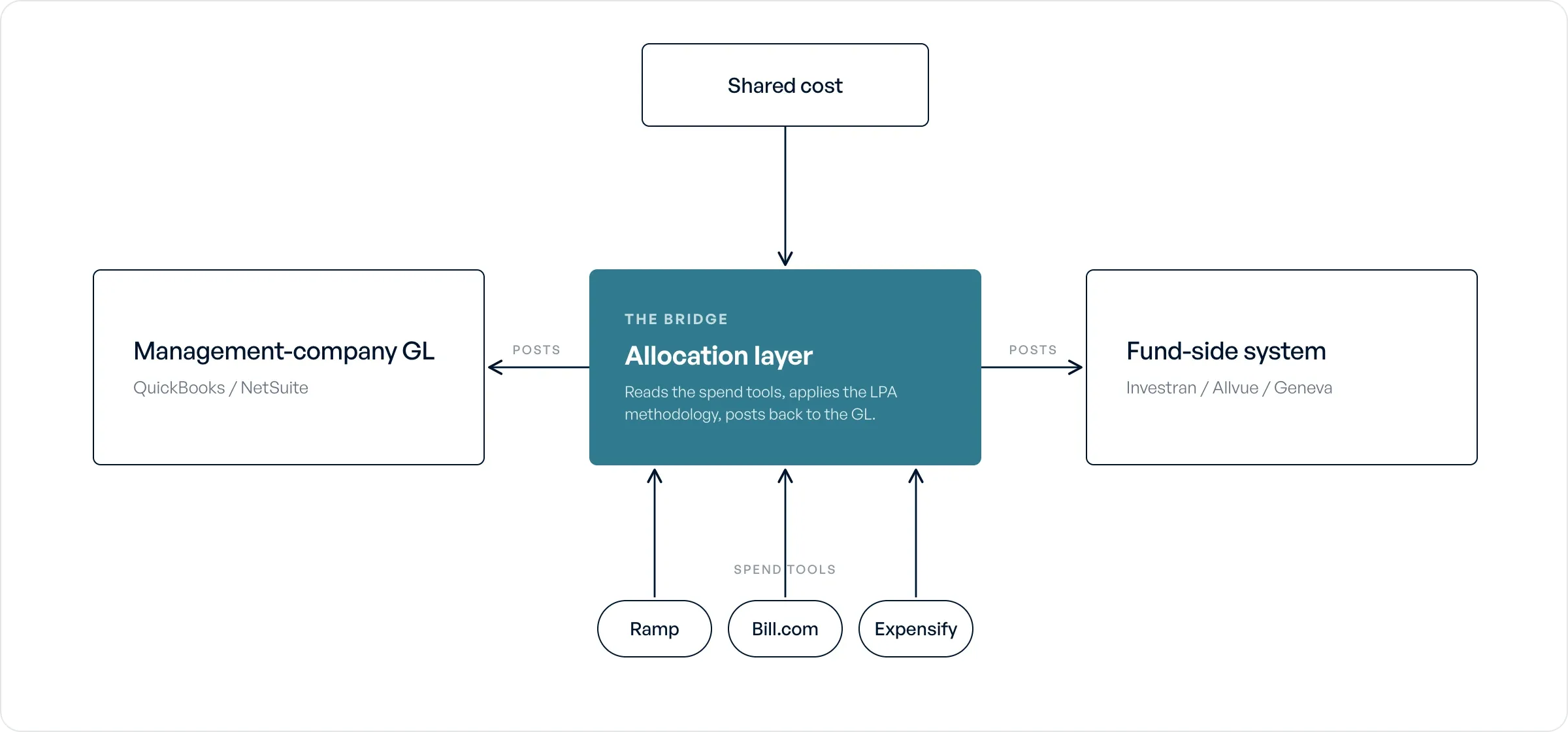
The allocation layer bridges the management-company GL and the fund-side system.
That gap is where the close slows down. One controller told us invoices "sit in email inboxes" and delay the close by two weeks; another described flipping between three or four windows to reconcile a single bill. The cost is not one big failure, it is a hundred small handoffs that each need a human.
The fix is a system that reads the expense and AP tools, applies the allocation, and posts the result back to the GL, so the line-level decision travels the whole stack without anyone re-keying it. Full data: the fund finance tech stack.
How many funds still allocate in Excel?
Most fund finance teams still live in the spreadsheet: 81% (65 of 80) ran their 2026 allocations in Excel. It is the source of truth, it is maintained by one person, and it usually has no audit trail. It works until the entity count climbs or that person leaves.
The teams living this are not unsophisticated. They are running real funds on a tool that was never built to track a defensible, multi-entity allocation. As one controller put it, "we just keep a record of everything in Excel, and I'm sure the SEC will love that when they come knocking." Excel is the real incumbent in this category, far more than any competing software.
Replacing the spreadsheet is less about a fancier calculator and more about moving the methodology into a system that applies it consistently and records who allocated what, when, and on what basis.
How big a problem is legal-invoice allocation?
63% of fund finance teams (50 of 80) name legal-invoice allocation one of their hardest problems, which makes it the sharpest single pain in the dataset after the structural ones. A single outside-counsel invoice can carry dozens of time entries spanning several matters, several funds, the GP, co-invest vehicles, and the management company, and each line can need a different methodology.
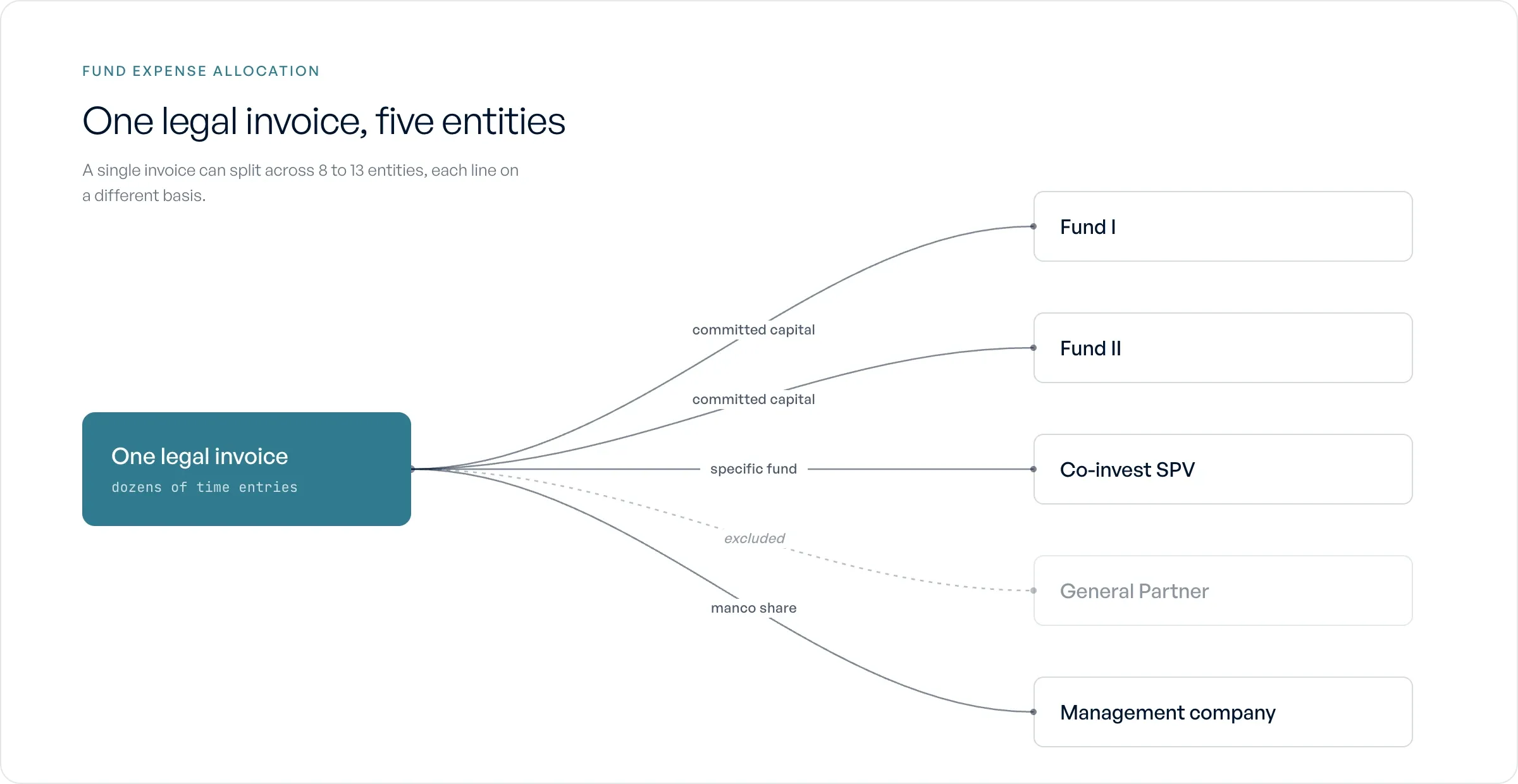
A single outside-counsel invoice can split across 8 to 13 entities, each line on a different basis.
It is also the most misfiled problem in public information today. Almost nothing in public writing connects splitting a LEDES invoice across fund entities to fund accounting, so it gets filed as a legal-billing problem. It is a fund-finance problem wearing a legal-billing costume. A controller we interviewed described getting "one invoice that sometimes gets allocated over like 10 different funds," by hand, every time.
What tames it is reading the invoice line by line, applying a methodology the LPA supports for each line, and posting the split with its rationale attached. The pressure to get this right is rising from the LP side too, where ILPA has pushed for clearer reporting of the legal and formation costs funds bear. Full data: the legal-invoice allocation benchmark. For the step-by-step workflow, see our guide on how to allocate legal invoices across fund entities.
How common are audit-trail gaps?
49% of the teams we interviewed (39 of 80) have a gap in their allocation audit trail: the allocation happens, but the record of why each line went where it did does not survive in a form an examiner would accept. This is the quiet risk, because it does not hurt until an audit or an SEC exam, and then it hurts a lot.
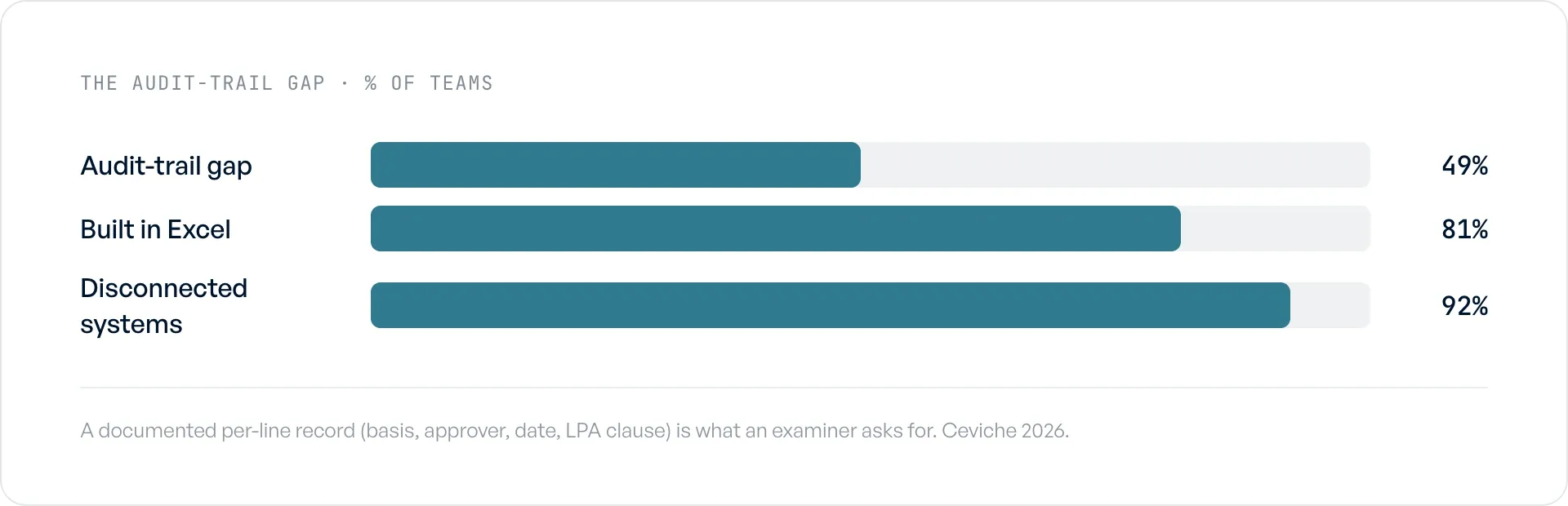
Where the audit-trail gap comes from, across 80 fund finance teams.
The SEC's Division of Examinations has named fee and expense allocation a recurring priority for private fund advisers. In 2025 it charged a private fund adviser over its fee practices, with more than $680,000 returned to investors. The teams without a trail described the support for a past allocation as "somebody writes a paragraph after the meeting." The teams with one described handling an exam request in minutes instead of the week and a half it used to take.
The difference is when the support gets built. The teams that stay calm during an exam build it as they post, so every allocated line already carries its methodology, its approver, and its date before anyone asks. Full data: the audit-trail gap benchmark.
What systems do private funds actually run?
There is no public data on what private funds run their books on, so here is ours. On the general ledger side, QuickBooks (Online and Desktop) is the management-company GL for about half the teams we interviewed, and NetSuite is a clear second; together the two cover 73% of the general ledgers we saw. The recurring structure is QuickBooks or NetSuite for the management company, with a separate fund-side system (Investran, AllVue, Carta, Geneva) behind it.
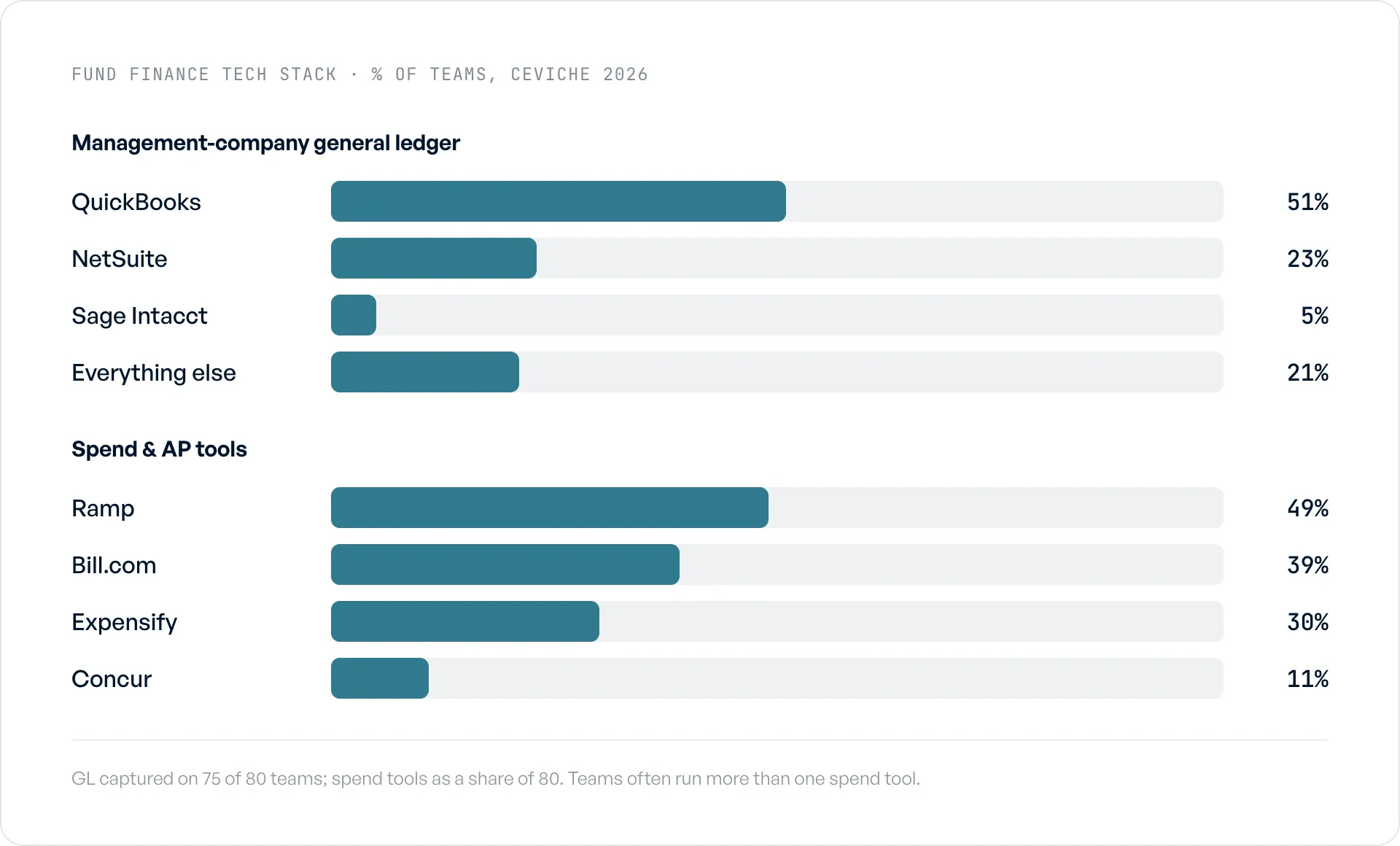
What private funds actually run, across 80 fund finance teams.
On the spend side, three tools dominate: Ramp appears in roughly half of stacks and is the system firms are migrating toward, with Bill.com and Expensify close behind.
| Management-company GL | Share |
|---|---|
| QuickBooks (Online + Desktop) | 51% |
| NetSuite | 23% |
| Sage Intacct | 5% |
| Everything else (Xero, Quorum, Campfire, Carta, Workday, and more) | 21% |
| Spend / AP tool | Mentions (of 80) |
|---|---|
| Ramp | 49% |
| Bill.com | 39% |
| Expensify | 30% |
| Concur | 11% |
The takeaway for anyone building or buying in this space: the work is not migrating funds onto a new ledger, it is bridging the management-company GL they already run and the fund-side system behind it. Full data: the fund finance tech stack.
What does manual allocation cost?
The cost of manual allocation shows up as time, and it concentrates at the close. Teams described spending one to five days a quarter on allocation alone, with legal invoices the most time-consuming because every line needs interpretation before it can be split. One PE controller tracked more than 2,800 invoice line items by hand in a single year.
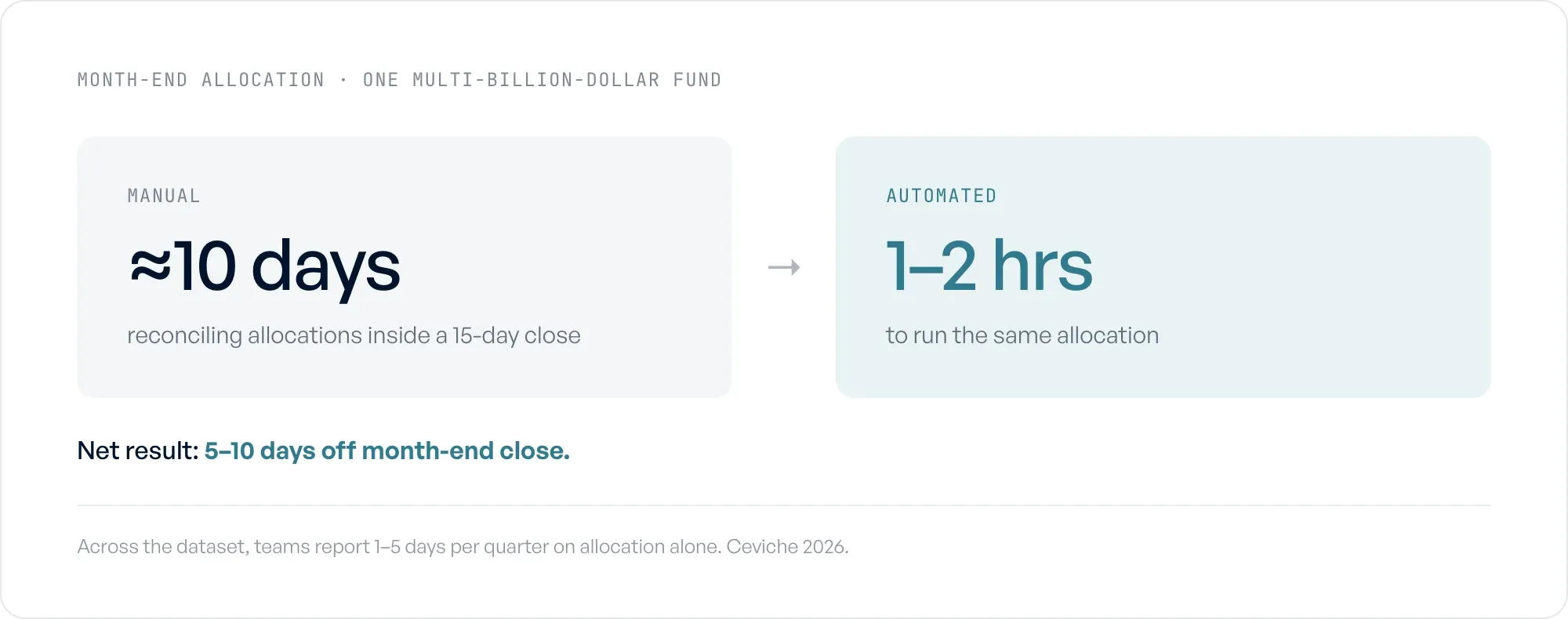
One multi-billion-dollar fund's month-end allocation, before and after automation.
The clearest before-and-after we have: a multi-billion-dollar fund replaced roughly 10 days of manual allocation and reconciliation inside its close with a 1-to-2-hour automated run, taking 5 to 10 days off month-end. No incumbent tool in this category publishes a close-time benchmark, so that number is, as far as we can tell, the first of its kind. Full data: the fund close-time benchmark.
The mechanics of getting there are in how PE firms automate quarterly expense allocation.
Where does Ceviche fit?
Most of allocation is judgment, and judgment stays with the controller. What does not have to stay manual is everything after the decision. Ceviche is audit-grade expense-allocation software that sits between the spend systems funds already use (Ramp, Bill.com, Expensify, Brex, Concur) and the general ledger (QuickBooks, NetSuite, Sage), applies the firm's allocation methodologies per the LPA, and writes audit-ready journal entries back to the GL with the rationale attached.
It is the layer the data above keeps pointing at: consistent methodology instead of a drifting spreadsheet, posted entries instead of a re-key, and a complete audit trail built as you go instead of reconstructed under exam pressure. Flybridge runs it across 18+ fund entities on QuickBooks Online and Bill.com. You can see how Ceviche handles fund expense allocation.
FAQ
What is fund expense allocation? Fund expense allocation is the process of splitting a shared cost across the fund entities, the general partner, co-invest vehicles, and the management company that benefited from it, using a defined methodology per cost and posting the result to each entity's general ledger with a documented rationale.
What percentage of private funds still allocate expenses in Excel? In Ceviche's 2026 analysis of 80 fund finance teams, 81% still allocate expenses in Excel. It remains the real incumbent in the category, ahead of any dedicated software.
What is the hardest expense to allocate for a fund? Legal invoices. 63% of the fund finance teams we interviewed named legal-invoice allocation one of their hardest problems, because a single outside-counsel invoice can split across many funds and entities with a different methodology per line.
How long does fund expense allocation take? Teams report one to five days per quarter on allocation work, concentrated at the close. One multi-billion-dollar fund cut that work from roughly 10 days to 1 to 2 hours after automating it.
What does the SEC look for in fund expense allocation? Whether expenses that benefited the adviser were charged to the funds, whether the methodology is documented and applied consistently, and whether the allocation matches what the fund documents permit. Fee and expense allocation is a standing focus of the SEC's exam program for private fund advisers.
What general ledger systems do private funds use most? QuickBooks (Online and Desktop) and NetSuite together run about 73% of the management-company general ledgers in our 2026 dataset, with QuickBooks roughly half and NetSuite a clear second.