TL;DR. One multi-billion-dollar fund cut its month-end allocation work from roughly 10 days to 1 to 2 hours, taking 5 to 10 days off its close. That is the first close-time benchmark in fund expense allocation: no incumbent tool publishes one. Across the teams we interviewed, allocation alone eats 1 to 5 days a quarter.
Key findings
- One multi-billion-dollar fund cut its month-end allocation work from roughly 10 days to 1 to 2 hours, taking 5 to 10 days off its close.
- Fund finance teams spend 1 to 5 days per quarter on allocation alone, concentrated at the close.
- One PE controller tracked more than 2,800 invoice line items by hand in a single year.
Methodology
Based on Ceviche's analysis of 80 PE, VC, growth-equity, and credit fund finance teams interviewed in 2026, this benchmark reports the time those teams lose to manual allocation and what changes when they automate it.
How long does manual allocation take at a fund?
The honest answer is that nobody publishes this number, so here is ours. Of the 80 teams we spoke with, the ones who quantified it put allocation at 1 to 5 days per quarter, and that range hides a lot. For outside context, the broader finance close is not fast either: APQC benchmarks the monthly close in business days, and one 2025 survey found half of finance teams take six or more business days to close the books. Allocation is a slice of that window, and at a fund it is the slice that scales worst. A firm with three funds and a clean methodology lands near the bottom. A firm splitting one invoice across eight or thirteen vehicles, by hand, lands near the top and sometimes past it.
The work also clusters. It does not spread evenly across the quarter, it piles up at the close, which is exactly when the rest of finance needs those entries posted. A PE controller we interviewed kept a single Excel tracker for the firm's allocations and logged more than 2,800 invoice line items in one year, copying and pasting each split from the spend system into the sheet. Another controller, allocating travel and intercompany costs by hand, told us it took a full day at the end of every quarter before a single fund invoice went out.
The reason it scales so badly is that each line is a small decision. Which fund, which vehicle, which methodology, and is there an LPA cap to watch. None of that is hard once. It is hard 2,800 times, with an auditor reading the result later.
Closing this requires consistent methodology applied per line instead of rebuilt each quarter, with the split posted as a journal entry the moment it is made. Full data on the manual side sits in the state of fund expense allocation hub.
How much does automation actually cut the close?
The clearest before-and-after we have comes from a multi-billion-dollar fund running a 15-business-day close. Inside that window, roughly 10 days went to manual allocation and reconciliation: reading vendor and legal bills, splitting them across the fund complex, keying journal entries, and tying everything back. The controller described the manual process in plain terms. If the team spends ten days doing this, and the system can do it in an hour or two, the math on the close changes fast.
After automating it, that 10-day block became a 1-to-2-hour run, and the firm expected to take 5 to 10 days off month-end close overall. That is the strongest hard-ROI figure in our dataset, and as far as we can tell it is the first close-time benchmark anyone has put in writing for this category. The incumbent allocation tools market on features. None of them publish a quantified before-and-after on close, so there is no published benchmark a team can hold their own close up against.
A second data point is narrower but nameable. Flybridge, a venture firm, runs allocations across 18+ fund entities on QuickBooks Online and Bill.com, and every allocation traces back to source documentation with a full audit trail.
What makes either result possible is the same capability: journal entries written back to the general ledger, not re-keyed by a person, with the allocation logic applied the same way every cycle.
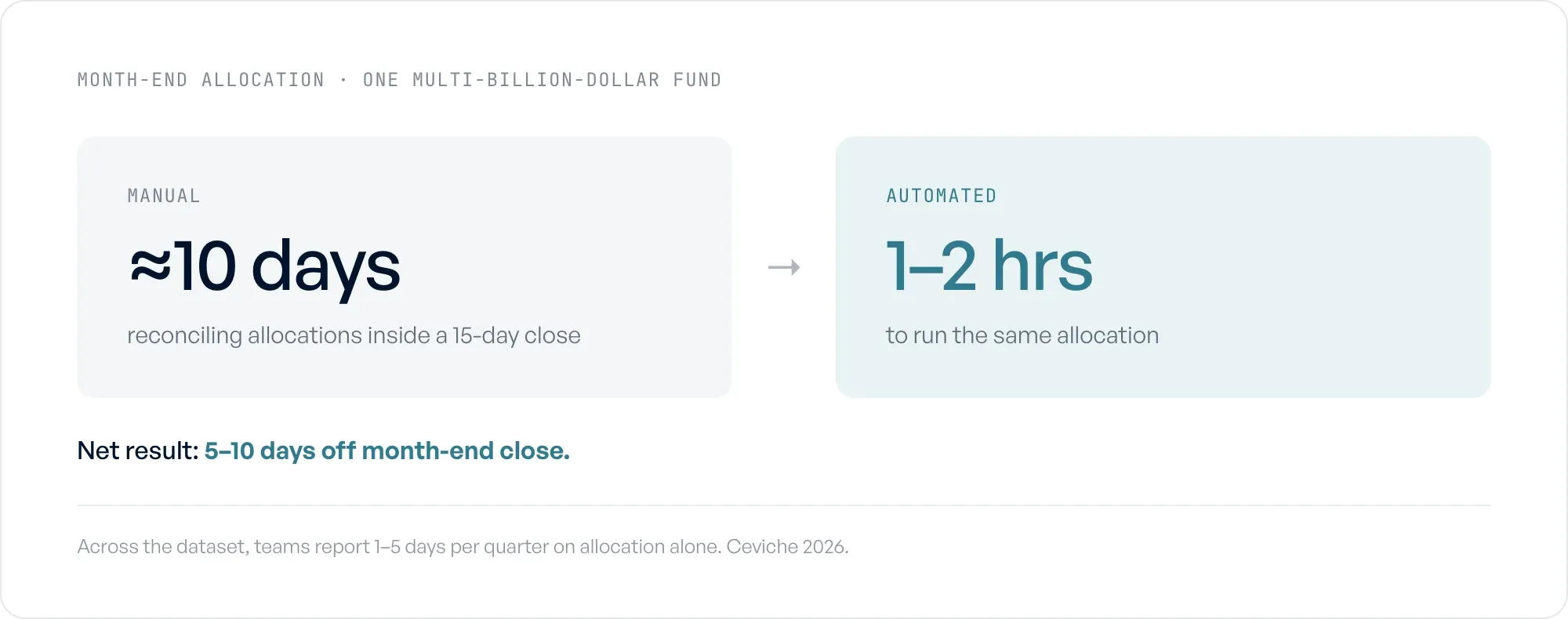
One multi-billion-dollar fund's month-end allocation, before and after automation.
The tools doing the cutting are compared in our financial close automation software study.
Why does the close break at the seams and not the math?
The split itself is rarely the bottleneck. The handoffs are. A bill arrives in one system, the allocation gets worked out in a spreadsheet, and the result gets typed into the GL by hand. Nothing carries the line-level decision across that gap, so a person carries it, and the close waits on that person.
Teams described the cost as a hundred small frictions rather than one failure. Invoices sitting in an inbox until someone notices. Flipping between three or four windows to reconcile one bill. Forgetting whether a vendor was already paid. Each one costs minutes, and minutes stack into the days that show up in the 1-to-5-day range above. A growth-equity controller we interviewed described single invoices that split across eight to thirteen funds and SPVs, each split copied and pasted by hand, which is where a quarter of close time can disappear without anyone deciding it should.
The audit layer makes it worse at exactly the wrong moment. If the support for each allocation is not built as the line gets posted, someone reconstructs it under exam pressure later, and that reconstruction is its own multi-day job. The teams that stay calm during an exam build the audit trail as they post, so the record of who allocated what, when, and on what basis already exists.
The fix is structural: let the line-level decision travel the whole stack on its own, read from the spend and AP tools, allocated by a fixed methodology, and written back to the GL with the rationale attached. The fuller picture of where the days go lives in the state of fund expense allocation hub.
Where does Ceviche fit?
Most of allocation is judgment, and judgment stays with the controller. Everything after the decision does not have to stay manual. Ceviche reads the spend systems funds already use, applies the firm's allocation methodology per the LPA, and writes audit-ready journal entries back to the GL with the rationale attached, which is the capability behind the close-time numbers above. You can see how Ceviche handles fund expense allocation.
FAQ
How long does fund expense allocation take? Among the 80 fund finance teams in Ceviche's 2026 analysis, allocation runs 1 to 5 days per quarter and concentrates at the close. Firms splitting one invoice across many funds by hand sit at the high end. One multi-billion-dollar fund cut that work from roughly 10 days to 1 to 2 hours after automating it.
How long does fund month-end close take? It varies by firm, but the funds we interviewed described closes in the range of two to three weeks. At one multi-billion-dollar fund, manual allocation and reconciliation alone accounted for about 10 days inside a 15-business-day close. The allocation block is often the largest single piece a finance team can compress.
How much can automation cut the fund close? At the clearest example in our dataset, a multi-billion-dollar fund expected to take 5 to 10 days off month-end close by replacing a 10-day manual allocation block with a 1-to-2-hour automated run. The gain comes from writing journal entries straight back to the GL instead of re-keying them, with the methodology applied consistently each cycle.