TL;DR. Multi-entity expense allocation is the work of splitting one shared cost across a firm's funds, co-invests, GP, and management company, then posting it to each ledger. In Ceviche's 2026 study of 80 fund finance teams, 96% (77 of 80) call it a core complexity and 92% (74 of 80) run it across disconnected systems.
Key findings
- 96% (77 of 80) cite multi-entity allocation as a core complexity.
- 92% (74 of 80) run allocations across disconnected systems.
- Single invoices can split across 8 to 13 funds and SPVs at once.
Methodology
Based on Ceviche's analysis of 80 PE, VC, growth, and credit fund finance teams interviewed in 2026, coded for the same set of pains, systems, and outcomes.
What is multi-entity expense allocation?
What is multi-entity expense allocation? It is the process of taking a single shared cost, dividing it across the legal entities that benefited (the funds, the co-invest vehicles, the GP, and the management company), and then posting the split into each entity's books. The dividing is done by a methodology: committed capital for one cost, headcount for another, a fixed schedule for a third.
The reason it gets called the hardest part of fund accounting is that no two costs share a driver. A directors-and-officers premium splits one way, a shared software subscription another, an outside-counsel bill a third. A firm running three funds, two co-invests, a GP entity, and a management company is already maintaining seven sets of books, and every shared invoice touches some subset of them with a different rule.
Among the 80 teams we interviewed, 96% (77 of 80) named this as a core source of complexity. It was the single most common pain in the dataset, more universal than legal invoices, Excel, or audit gaps. And it tracks structure, not size. A $600M firm with twelve vehicles felt it harder than a $3B firm with four.
Closing this requires one thing the spreadsheet cannot give you: a consistent methodology applied the same way every quarter, so the split for a given cost type does not drift when the person running it changes. For the full set of findings, see the state of fund expense allocation.
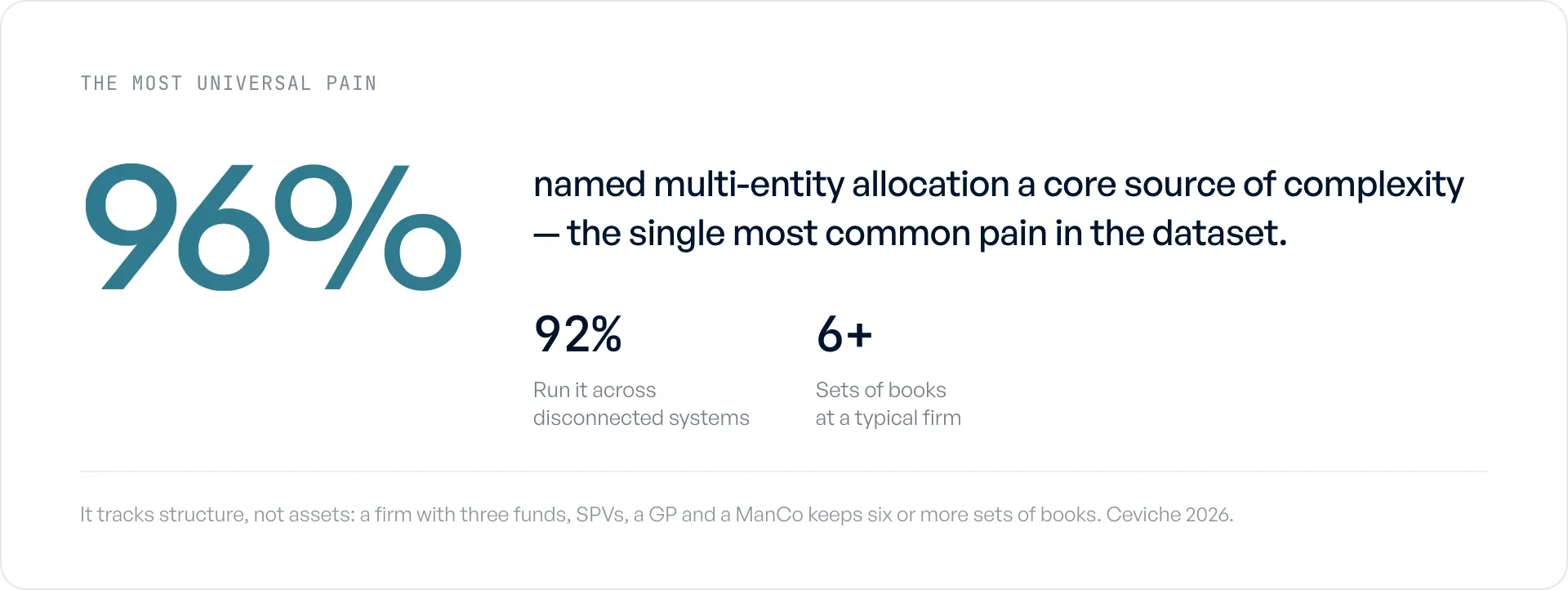
Multi-entity allocation is the most universal pain in the dataset.
Why do funds run multi-entity allocation across disconnected systems?
Because the work spans three layers that were never built to talk to each other. The cost lands in a spend or AP tool, the books live in a general ledger, and the allocation itself happens in a spreadsheet wedged between them. 92% of the teams we interviewed (74 of 80) described exactly this split, and it is structural, not a sign of a sloppy team.
The recurring shape is specific. There is a management-company GL, almost always QuickBooks or NetSuite, and behind it a separate fund-side system (Investran, AllVue, Carta, Geneva) that the fund admin or the team maintains. One cost has to be priced into both. Nothing carries the line-level decision from the spend tool through the spreadsheet and into two different ledgers, so a person re-keys it at every hop. One controller told us the team is "always switching applications" and "trying to compare," which is the disconnected stack in four words.
The cost is not one dramatic failure. It is the re-key, repeated. Closing this requires journal entries written back to the GL automatically, so the line-level decision travels the whole stack once and no human types it twice.
How do funds allocate shared expenses across entities and where does it break?
How do funds allocate shared expenses across entities? They pick a driver for each cost, compute the split, post a journal entry to each entity, and book the intercompany due-to and due-from that balances it. On paper that is clean. In practice the volume is what breaks it.
The breaking point is the single invoice that fans out across the whole complex. A growth-equity controller we interviewed described tracking more than 2,800 invoice line items by hand in one year, copying and pasting each split from the spend tool into a spreadsheet, with single invoices landing across 8 to 13 funds and SPVs at once. The arithmetic is trivial. Doing it 2,800 times without an error, and keeping the intercompany entries clean across every vehicle, is not. Another controller put the daily version of it plainly: "this morning, I only process two invoices and it took me the whole morning."
There is a second failure that surfaces later. When the split lives in a spreadsheet, the reason behind it does not survive in a form an examiner accepts. The SEC's Division of Examinations has kept fee and expense allocation on its priority list for private fund advisers, and a methodology that drifted across quarters, or that nobody can reconstruct, is what an exam pulls on.
Closing this requires an audit trail built as you post: every allocated line carrying its methodology, its approver, and its date before anyone asks. For how that plays out on the sharpest version of the problem, see the state of fund expense allocation.
Where does Ceviche fit?
Ceviche reads the spend and AP systems funds already run, applies the firm's allocation methodology per the LPA, and writes the journal entries (including the intercompany due-to and due-from) back to the GL with the rationale attached. It is the layer that closes the manco-GL-plus-separate-fund-system gap the data above keeps pointing at. Flybridge runs it across 18+ fund entities on QuickBooks Online and Bill.com. You can see how Ceviche handles fund expense allocation.
FAQ
What is multi-entity expense allocation? It is splitting one shared cost across the legal entities that benefited (the funds, co-invest vehicles, GP, and management company), then posting the split to each entity's general ledger with a documented methodology. Different costs use different drivers, so the same firm runs many methodologies at once across its complex.
What share of funds struggle with multi-entity allocation? In Ceviche's 2026 study of 80 fund finance teams, 96% (77 of 80) named multi-entity allocation a core complexity, the most common pain in the dataset. A further 92% (74 of 80) run that allocation across disconnected systems that do not pass the split between them.
How do funds allocate shared expenses across entities? They assign a driver to each cost (committed capital, headcount, a fixed schedule), compute the split, and post a journal entry to each entity plus the balancing intercompany due-to and due-from. The hard part is volume and consistency: a single invoice can fan out across 8 to 13 funds and SPVs, and the methodology has to hold steady every quarter.