
TL;DR. The four standard cost allocation methods are direct, step-down, reciprocal, and activity-based costing: each picks a cost pool and a driver, then splits the pool by that driver. Funds run a different five, mapped to fund structure: pro rata committed capital, NAV-based, invested capital, deal-by-deal, and fixed split.
What is cost allocation?
Cost allocation takes a shared cost that more than one thing benefited from and assigns a defensible piece to each. The classic example is rent for a building three departments use. Nobody can trace a dollar of that rent to one department directly, so you pick a basis, usually square footage, and divide.
Three terms carry the concept. The cost object is the thing you are charging (a department, a product, a fund). The cost pool is the bucket of shared cost you are splitting (the rent, the legal bill, the office overhead). The allocation driver, also called the allocation base, is the measure you split by (square footage, headcount, usage). Pick those three and a method is just the rule connecting the pool to the objects.
Cost allocation assigns a shared cost that cannot be traced to a single cost object directly across the cost objects that benefited from it, using an allocation driver that approximates how each object consumed the cost, so each object carries a defensible share.
How do you choose an allocation driver?
Before you pick a method, you pick a driver, and the driver is where most of the judgment lives. The method is mechanical once the driver is set. Common drivers and what they suit:
| Allocation driver | What it measures | Typical use |
|---|---|---|
| Square footage | Physical space occupied | Rent, utilities, facilities |
| Headcount or labor hours | People or time consumed | HR, IT, payroll-driven overhead |
| Usage or transaction volume | Direct consumption of a service | Software seats, processing |
| Direct cost percentage | Each object's share of traceable cost | General overhead, admin |
| Revenue or sales | Each object's share of output | Corporate G&A in some models |
The driver should track cause. If IT cost rises with the number of people supported, headcount is the honest driver. Allocate IT by revenue instead and a high-revenue, low-headcount unit eats cost it never caused. A wrong driver is the most common way an allocation looks precise and is still wrong.
What are the traditional cost allocation methods?
There are three classic methods for splitting support costs across operating units, plus activity-based costing as a fourth. They differ in how they handle support departments that serve each other (IT supports HR, HR supports IT). Here is each, with the math.
Set up: a firm has two support departments, IT ($100,000) and HR ($60,000), and two operating units, Fund Ops and Deal Team. IT effort splits 20% to HR, 50% to Fund Ops, 30% to Deal Team. HR effort splits 10% to IT, 40% to Fund Ops, 50% to Deal Team.
Direct method. Ignore the support-to-support traffic entirely and allocate each support department only to the operating units, re-based on their share. IT's 50/30 re-bases to 62.5% Fund Ops and 37.5% Deal Team: $62,500 and $37,500. HR's 40/50 re-bases to 44.4% and 55.6%: $26,667 and $33,333. Simplest, least accurate, most common in practice.
Step-down (sequential) method. Rank the support departments, then allocate them one at a time, each to the departments below it. IT goes first across HR and both units: HR picks up $20,000 (now $80,000), Fund Ops $50,000, Deal Team $30,000. Then the loaded HR ($80,000) goes to the two units only, 40/50 re-based: Fund Ops $35,556, Deal Team $44,444. More accurate, because it captures one direction of the support traffic.
Reciprocal method. Solve the full two-way exchange with simultaneous equations. IT = $100,000 + 0.10 (HR); HR = $60,000 + 0.20 (IT). Solving: IT = $108,163, HR = $81,633, then push each loaded department to all consumers at its original percentages. Most accurate, because IT and HR genuinely consume each other. Rarely run by hand, because the algebra grows with every department.
Activity-based costing (ABC). Skip departments as the unit and allocate by the activities that drive cost. Instead of spreading HR by headcount, identify drivers like number of hires or payroll runs and charge each object for the activities it consumed. ABC is the most precise for diverse cost structures and the most data-hungry to maintain. Two variants cut that maintenance: Time-Driven ABC uses one driver, the time each activity takes, so you update the model by adjusting time estimates rather than re-surveying; Rate-based ABC charges a standard rate per activity unit. For a fund, full ABC is usually more machinery than the cost structure needs. The useful part is the mindset, allocating by what drove the cost, not the formal apparatus.
| Method | How it handles support-to-support | Accuracy | Complexity |
|---|---|---|---|
| Direct | Ignores it | Lowest | Lowest |
| Step-down | One direction, in sequence | Medium | Medium |
| Reciprocal | Full two-way | Highest | Highest |
| ABC | By activity, not department | Highest for diverse costs | Highest to maintain |
Organizations that report costs by purpose use a related discipline, functional expense allocation.
Direct vs indirect costs: what actually gets allocated?
Allocation only applies to costs you cannot trace. A direct cost ties cleanly to one cost object and gets charged there with no method at all: a deal-specific diligence fee belongs to the fund that did the deal, full stop. An indirect cost, or overhead, benefits several objects and has no obvious owner: office rent, shared software, a firm-wide audit. Those are the costs that need a method.
The first move in any allocation is sorting direct from indirect. Charge the direct costs directly, then pool the indirect costs and apply a method. Skip this step and firms over-allocate, spreading a cost that should have sat on one fund across all of them, then defending a split that never needed to exist. For funds, the line that matters most is fund expenses versus management company expenses, because that boundary decides whether a cost touches investor capital at all.
How does cost allocation work in a private fund?
Here is where the textbook stops being useful. The generic methods assume you split overhead across departments inside one company, on one ledger, by one driver. A fund splits costs across separate legal entities, each with its own books, its own investors, and its own rulebook. The rulebook is the limited partnership agreement, and it, not accounting convention, decides what can be charged to whom.
In Ceviche's 2026 analysis of 80 PE and VC fund finance teams, 96% named multi-entity allocation a core complexity. A firm with three funds, a few SPVs, a GP, and a management company already splits shared costs across six or more separate ledgers, each governed by a different LPA clause. The driver is no longer square footage. It is committed capital, net asset value, or invested capital, depending on the cost and what the fund documents allow.
A growth-equity controller we spoke with put the reality plainly: a single invoice that "sometimes gets allocated over like 10 different funds," split by hand, every time it lands.
So the question stops being "direct, step-down, or reciprocal" and becomes "which basis does the LPA permit for this cost, and can I apply it the same way next quarter." The five methods below answer that.
The wider context is in our private equity fund accounting guide.
What are the five methods funds actually use?
Funds run a different set of methods than the textbook, mapped to fund structure rather than departments. Most are a form of direct allocation by a fund-specific driver, where the driver does the heavy lifting. Here is each with a worked example.
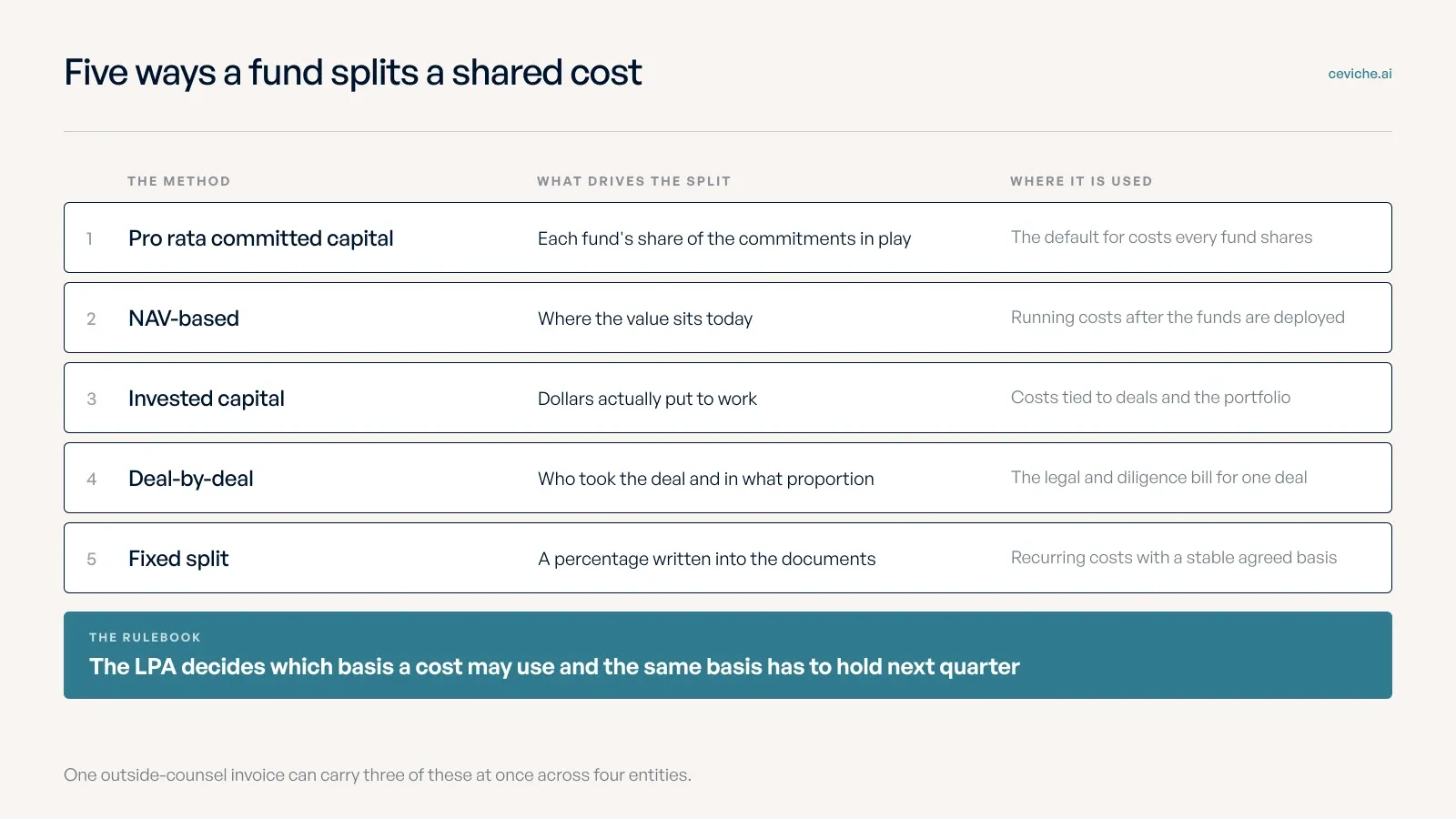
| Method | Driver | Typical use |
|---|---|---|
| Pro rata committed capital | Committed capital share | Default for fund-level shared costs |
| NAV-based | Current net asset value | Ongoing operating costs once funds are deployed |
| Invested capital | Capital actually deployed | Deal and portfolio-related costs |
| Deal-by-deal | Participation in the specific deal | Deal-specific legal and diligence bills |
| Fixed split | Pre-agreed percentages | Recurring costs with a documented, stable basis |
1. Pro rata committed capital. Split by each fund's committed capital as a share of the total committed across the participating entities. A $30,000 cost shared by Fund I ($200M committed) and Fund II ($100M committed) splits two-thirds and one-third: $20,000 and $10,000. The common default for fund-level shared costs.
2. NAV-based. Split by current net asset value rather than commitments, so the burden tracks where value sits today. The same $30,000, if Fund I now holds $120M NAV and Fund II holds $180M, flips to $12,000 and $18,000. Common for ongoing operating costs once funds are deployed.
3. Invested capital. Split by capital actually put to work, not committed or marked. A diligence cost on a deal four funds participated in splits by each fund's dollars invested in that deal. Suits deal-related and portfolio-related costs.
4. Deal-by-deal (specific allocation). Charge the cost to the specific entities that took the deal, by participation. A legal bill for an acquisition Fund II and a co-invest SPV did, 70/30, splits $21,000 and $9,000 of a $30,000 invoice. Direct allocation at the deal level.
5. Fixed split. A predetermined percentage set in the fund documents, applied without recomputation. A 60/40 management-fee-offset split, or a fixed GP-versus-fund formation split, runs the same way every period. Simplest to administer, least responsive to change, and only defensible when the documents specify it.
| Generic method | Fund equivalent | Driver |
|---|---|---|
| Direct | Deal-by-deal, fixed split | Participation, set percentage |
| Direct by driver | Pro rata committed capital | Committed capital |
| Direct by driver | NAV-based | Current net asset value |
| Direct by driver | Invested capital | Capital deployed |
| ABC mindset | Per-line legal allocation | Method per matter or line |
What does allocating a multi-line legal invoice look like?
The hardest case in fund allocation, and the one no generic guide touches, is a single invoice that needs several methods at once. Outside counsel sends one bill covering multiple matters, each benefiting different entities, each line needing the basis its matter calls for. In our data, 63% of fund finance teams named legal-invoice allocation one of their hardest problems, the sharpest single pain after the structural ones.
Take a $48,000 invoice from the fund's law firm with three line groups:
| Line group | Amount | Method | Split |
|---|---|---|---|
| Acquisition diligence (Deal A) | $24,000 | Deal-by-deal | Fund II 70% ($16,800), Co-invest SPV 30% ($7,200) |
| Fund formation work | $15,000 | Specific fund | Fund III only ($15,000) |
| Firm-wide regulatory advice | $9,000 | Pro rata committed capital | Fund I, II, III by commitments |
One invoice, three methods, four entities, and the management company picks up nothing because none of it was a management-company expense. Do that across dozens of invoices a quarter and you see why it dominates the pain data. For the full mechanics, see how to allocate legal invoices across fund entities.
Why is method choice a defensibility decision and not just a math decision?
In a corporation, the wrong allocation method is a management-reporting nuisance. In a fund, it is a question an examiner asks. The SEC's Division of Examinations lists fee and expense allocation as a standing priority for private fund advisers, and what it tests is not your arithmetic. It is whether the method matches the fund documents, whether you applied it consistently, and whether you can show your work.
That last part is where firms fall down. In our dataset, 49% had a gap in their allocation audit trail: the split happened, but the record of which method, on what basis, approved by whom, did not survive in a form an examiner would accept. The method you pick is only half the decision. The other half is recording why, line by line, as you post, so the support exists before anyone requests it. Pick a method the LPA supports, apply it the same way every quarter, and keep the rationale attached to the entry.
Why does Excel break as the entity count climbs?
The generic guides imply a clean system applying these methods. The reality is a spreadsheet. In our data, 81% of fund finance teams still ran their allocations in Excel and 92% across disconnected systems that do not talk to each other. The methods are fine in a spreadsheet at two or three entities. They break on volume and on memory.
The volume is real: one PE controller tracked more than 2,800 invoice line items by hand in a single year, copying and pasting from the AP tool into a tracker fund by fund, and teams reported one to five days per quarter on allocation alone. The memory problem is worse. The methodology lives in one person's head and one person's tabs, so the moment that person is out, or an examiner asks why a 2023 cost split the way it did, the answer is a paragraph someone wrote after a meeting. As one controller said about keeping the record in Excel, "I'm sure the SEC will love that when they come knocking." A consistent method is only as good as the system that applies and records it.
For the fix in practice, see how PE firms automate quarterly expense allocation.
Where does Ceviche fit?
Picking the method is judgment, and that stays with the controller. Applying it the same way every quarter, posting the split, and keeping the audit trail does not have to stay manual. Ceviche is fund expense allocation software that reads from the spend systems funds already run, applies the firm's methodologies per the LPA line by line, and writes audit-ready journal entries back to the general ledger with the rationale attached. Flybridge runs it across 18+ fund entities on QuickBooks Online and Bill.com. You can see how it works.
Frequently asked questions
What are the three methods of cost allocation? Direct, step-down, and reciprocal. Direct assigns support costs straight to operating units and ignores support-to-support traffic. Step-down allocates support departments in sequence. Reciprocal solves the full two-way exchange and is the most accurate. In a fund, the equivalents are deal-by-deal, pro rata committed capital, and NAV-based splits across entities rather than departments.
What are the 4 methods of costing? Costing methods differ from allocation methods. The four common costing methods are job costing, process costing, activity-based costing, and standard costing, which assign total cost to a unit of output. Allocation is the narrower step of splitting a shared cost across the objects that used it. A fund cares about allocation across entities, not unit costing.
What is the most common allocation method? Generically, the direct method, because it is the simplest and good enough for internal reporting. For private funds, the common default is pro rata committed capital for fund-level shared costs, with NAV-based and deal-by-deal used where the cost or the LPA calls for them. The right answer is whichever basis the fund documents permit for that cost.
What are the 4 methods of inventory costing? FIFO, LIFO, weighted average, and specific identification. These value inventory and cost of goods sold, not shared overhead, so they rarely apply to a fund, which holds investments rather than inventory. If you searched this expecting fund allocation, the methods you want are the five above: committed capital, NAV, invested capital, deal-by-deal, and fixed split.
Which cost allocation method do private funds actually use? Five, mapped to fund structure: pro rata committed capital, NAV-based, invested capital, deal-by-deal, and fixed split. Most are direct allocation by a fund-specific driver, where the driver does the work. The cost type and the LPA decide which one applies, and a single legal invoice often needs several at once.
How do you allocate a legal invoice across fund entities? Read the invoice line by line, group the lines by matter, then apply the basis each matter calls for: deal-by-deal for deal lines, the specific fund for formation lines, pro rata committed capital for firm-wide lines. One invoice can carry three or four methods across several entities. Post each split with its method and rationale attached so the allocation survives an exam.
What does the SEC expect from an allocation methodology? That the method matches the fund documents, is applied consistently, and is documented well enough to reconstruct. Fee and expense allocation is a standing focus of the SEC exam program for private fund advisers. Examiners test whether costs that benefited the adviser were wrongly charged to funds, not whether your math is elegant.
How long does fund expense allocation take each quarter? Fund finance teams in our 2026 dataset reported one to five days per quarter on allocation alone, with legal invoices the most time-consuming because each line needs interpretation. One multi-billion-dollar fund cut roughly 10 days of manual allocation to a 1-to-2-hour automated run. The fuller picture is in the state of fund expense allocation 2026.