TL;DR. Legal invoices are the hardest line item in fund expense allocation. In 2026, 63% of fund finance teams (50 of 80) named legal-invoice allocation one of their toughest problems, because a single outside-counsel invoice can split across 8 to 13 funds and entities, with a different methodology on each line.
Key findings
- 63% of fund finance teams (50 of 80) name legal-invoice allocation a top pain.
- A single outside-counsel invoice can split across 8 to 13 funds and entities.
- Legal is the most time-consuming invoice type to allocate, because every line needs interpretation before it can be split.
Methodology
This benchmark draws on Ceviche's analysis of 80 PE, VC, growth-equity, and credit fund finance teams (controllers, CFOs, fund accountants, and the fund administrators who serve them) interviewed across 2026. We coded each conversation for the same set of allocation pains. No single firm is identifiable below, and Flybridge is the only customer named anywhere.
Why is a legal invoice the hardest line item to allocate?
A travel report or a software subscription has one cost and, usually, one driver. A legal invoice has neither. One bill from outside counsel can carry dozens of timekeeper entries spanning several matters: a deal that touched a few funds, a formation cost that belongs to one vehicle, a fund-level dispute, and general advice that lands on the management company. Each of those needs its own basis. Committed capital for the deal lines, specific-fund for the formation work, headcount or a flat manco share for the rest. LP-side bodies like ILPA have pushed for clearer disclosure of the fund-formation and legal costs that funds bear, which is exactly what a defensible line-by-line split produces.
That is why legal sits at the top of the time-cost list in our data. Other invoice types you can route on autopilot once a rule is set. Legal you have to read first. A controller at a growth-equity firm described the structural version of this: "a common occurrence would say we invest in one company and it may be across say eight of our funds and we'll just get one legal invoice, and then we've got to manually split it out, it's quite time consuming." Asked which invoices hurt most, the same controller was blunt: "the legal ones, I would say, are the most complex to allocate."
The volume compounds the interpretation problem. A controller at a multi-billion-dollar fund told us a single invoice "sometimes gets allocated over like 10 different funds," and that every one of those splits was done by hand. What closing this requires is reading the invoice line by line, applying one consistent methodology per line, and writing the resulting journal entries back to the GL with the rationale attached. The hub has the full pain map: the state of fund expense allocation in 2026.
How many funds and entities does one invoice actually touch?
The headline range in our data is 8 to 13. One PE controller walked us through an invoice split "between two, four, six, eight different funds" and, on a separate occasion, across 13 SPVs and funds at once. These are not edge cases at firms with real deal volume. They are the routine ones.
Scale tells the same story from the other end. The same PE team manually tracked more than 2,800 invoice line items across a single year, copying and pasting out of their AP tool into a spreadsheet. A $113,000 audit invoice had to be split and paid across multiple funds by cash availability, one wire at a time. Another team described a quarter where the legal pile alone was "150 invoices" dropped into a system, then "you're completely lost and overwhelmed by how many PDFs you're looking at." None of that is calculation difficulty. It is the cost of doing a per-line judgment hundreds of times, by hand, with no record of why each split landed where it did.
The fix for volume is the same as the fix for complexity: build the audit trail as you post, not afterward, so each of the 8-to-13 splits already carries its methodology, its approver, and its date before an examiner asks. The SEC has charged private fund advisers over how fees and expenses were handled, which is why that trail is worth building as you post. The step-by-step version of the workflow lives in our guide on how to allocate legal invoices across fund entities; this page is the benchmark behind it.
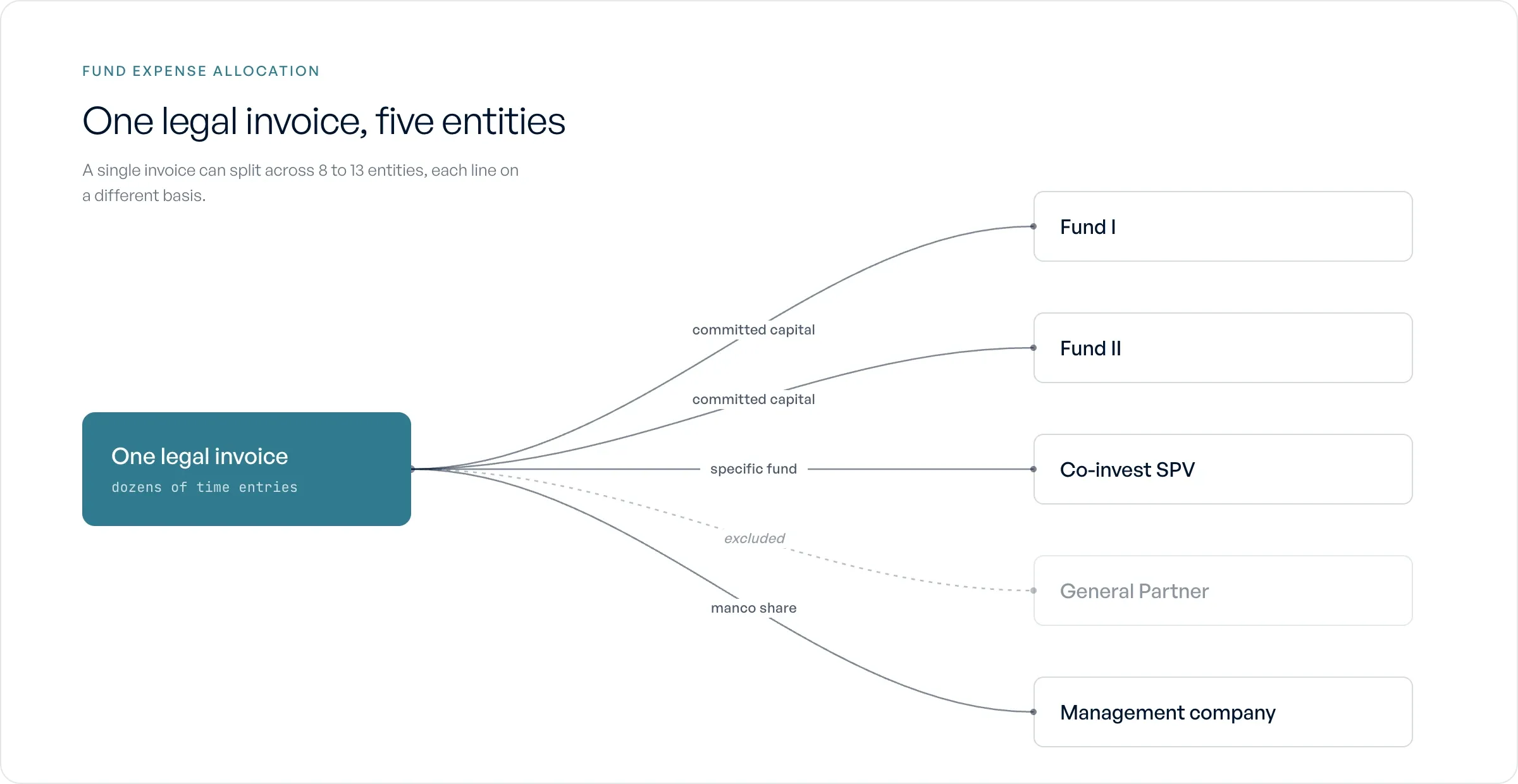
A single outside-counsel invoice can split across 8 to 13 entities, each line on a different basis.
Why does legal-invoice allocation get mis-categorized?
Look for "legal invoice allocation software" and it is easy to land on the wrong category. The phrase reads like a legal-billing problem because the word "legal" is in it, so it gets matched to tools that help a law firm bill its clients. Those tools do nothing for the controller on the other side of the invoice, who has to split that one bill across a fund complex.
The mismatch exists because almost no published content connects "split a LEDES invoice across fund entities" to fund accounting. It is a fund-finance problem wearing a legal-billing costume. The vocabulary that would bridge the two, outside counsel, fund entity, LPA basis, journal entry, LEDES, rarely co-occurs anywhere, so the literal match wins. For a fund controller, that means the most-searched version of their hardest problem surfaces software they cannot use.
What the controller actually needs is the opposite of a billing tool: something that ingests the invoice, applies the firm's allocation methodologies per the LPA, and posts the split back to the general ledger with an examiner-ready record. That capability set, consistent methodology and journal entries written back to the GL, is the thing the search results miss entirely.
Where does Ceviche fit?
Reading a legal invoice and deciding the basis for each line is judgment, and that stays with the controller. Everything after the decision does not have to stay manual. Ceviche reads the invoice line by line, applies the firm's allocation methodologies per the LPA, and writes audit-ready journal entries back to the GL with the rationale attached, including more than one methodology on a single invoice. Flybridge runs this across 18+ fund entities on QuickBooks Online and Bill.com. You can see how Ceviche handles fund expense allocation.
FAQ
What is legal invoice allocation? Legal invoice allocation is the process of splitting one outside-counsel bill across the fund entities, the general partner, co-invest vehicles, and the management company that the work benefited. Each line gets a methodology the LPA supports, and the result posts to each entity's general ledger with a documented rationale.
How big a problem is legal invoice allocation for funds? It is the single hardest line item. In Ceviche's 2026 analysis of 80 fund finance teams, 63% (50 of 80) named legal-invoice allocation one of their toughest problems, ahead of every other invoice type, because each line needs interpretation before it can be split.
How do PE firms split a legal invoice across funds? Line by line, with a different basis per line. Deal-related work usually splits by committed capital across the funds that invested, formation costs go to the specific vehicle, and general advice lands on the management company. A single invoice can carry 8 to 13 of these splits at once.
Is there software for legal invoice allocation across fund entities? Yes, though it is easy to find the wrong category. The obvious matches are law-firm billing tools, which bill a firm's clients and do not allocate. Fund-side software reads the invoice, applies LPA-based methodologies per line, and writes journal entries back to the general ledger with an audit trail.