
TL;DR. Automate expense allocation first. In a fund close it is the largest rule-based block, it feeds capital accounts and LP reporting, and it is the one step a corporate close checklist omits entirely. Bank reconciliations and financial statement assembly matter less, because your general ledger already handles most of them.
The generic checklist covers half your close
Every close checklist you can download runs out around day 3. Cutoff reminders, bank reconciliations, accruals, variance review, financial statements: all real, all covered, all the easy half. A fund's close has a second half those templates have never heard of.
That second half has no revenue to recognize and no inventory to count. It has shared costs that belong to four entities in different proportions, a management fee that creates a payable on one set of books and a receivable on another, capital accounts that have to roll forward per LP, and an administrator's package that someone has to tie out before it reaches an investor. That work appears on no template you can download.
The fund month-end close is the monthly cycle in which a private fund's finance team cuts off transactions, reconciles cash and positions, allocates shared expenses across the funds and the management company, records accruals and investment activity, reviews the administrator's package, and produces financial statements and capital account balances.
The checklist below is the complete version. Take it, cut the rows that do not apply to your structure, and put owners against the rest.
The fund month-end close checklist
Days are business days. Day 0 is the last business day of the month.
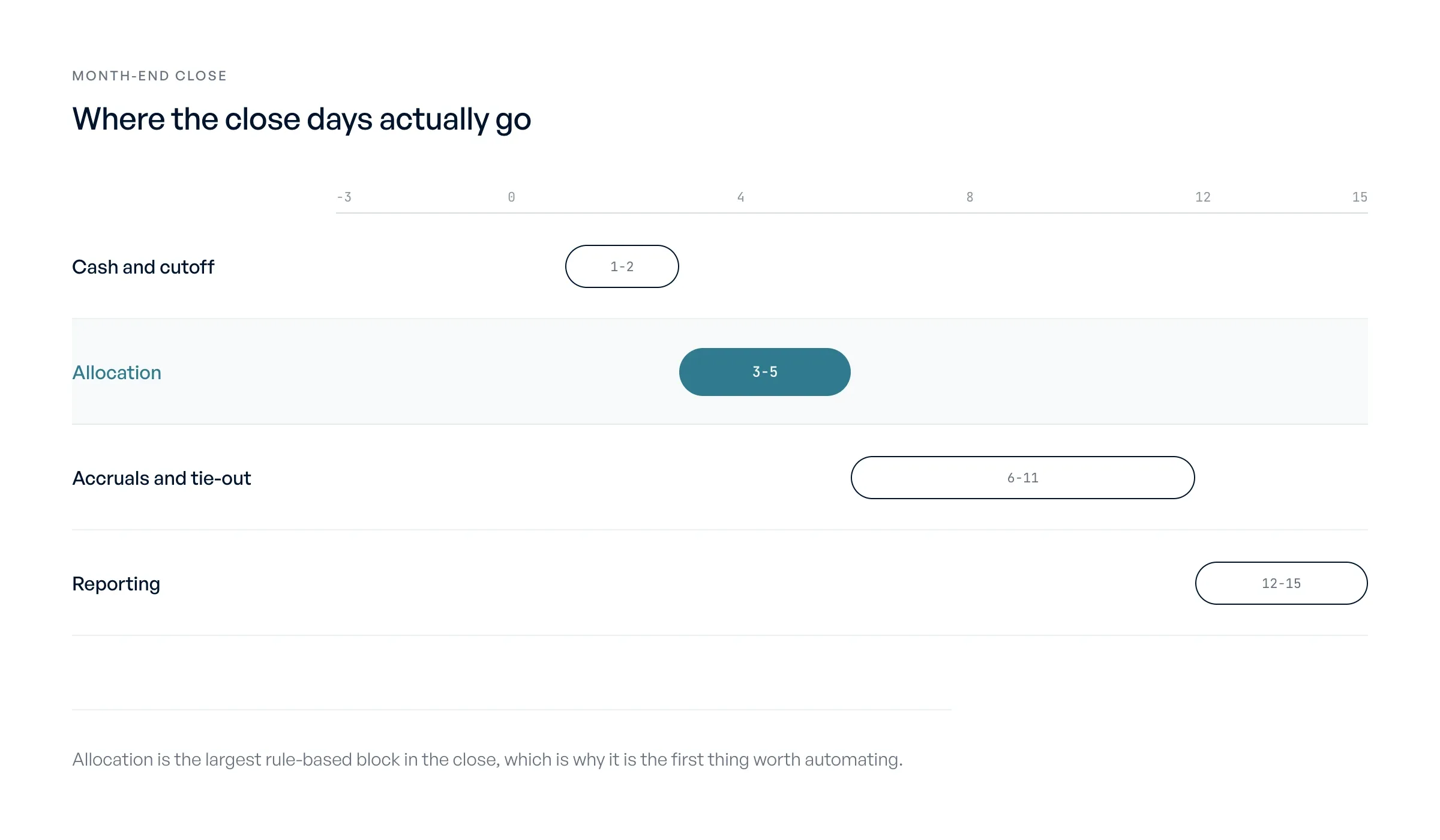
Where the close days go: allocation is the largest rule-based block in the close.
Pre-close on days -3 to 0
| # | Task | Owner | Depends on |
|---|---|---|---|
| 1 | Send AP cutoff notice to the firm, deal teams, and portfolio operations | Controller | Calendar |
| 2 | Chase outstanding vendor invoices, especially outside counsel | AP | Task 1 |
| 3 | Collect and approve outstanding employee expense reports | AP | Task 1 |
| 4 | Confirm every card transaction is coded and memo fields are complete | Controller | Spend tool |
| 5 | Confirm payroll for the period has posted | Controller | Payroll provider |
| 6 | Confirm capital call and distribution activity for the period is final | Fund accountant | GP sign-off |
| 7 | Flag any subsequent close or equalization event in the period | Fund accountant | Fundraising |
Days 1 to 2 for cash and cutoff
| # | Task | Owner | Depends on |
|---|---|---|---|
| 8 | Lock the prior period in the general ledger | Controller | Tasks 1 to 7 |
| 9 | Sync the spend and AP tools into the GL, confirm counts match | Controller | Task 4 |
| 10 | Reconcile the management company operating account | Staff accountant | Bank feed |
| 11 | Reconcile each fund and SPV operating account | Fund accountant | Bank feeds |
| 12 | Reconcile the subscription line balance and accrue interest | Fund accountant | Lender statement |
| 13 | Clear reconciling items carried from the prior month | Controller | Tasks 10 to 12 |
Days 3 to 5 for classification and allocation
| # | Task | Owner | Depends on |
|---|---|---|---|
| 14 | Classify each expense as fund or management company against the LPA | Controller | Task 9 |
| 15 | Split shared invoices line by line across funds, SPVs, and the ManCo | Controller | Task 14 |
| 16 | Apply the documented methodology per line and record the basis for each | Controller | Task 15 |
| 17 | Post allocation journal entries to every affected ledger | Fund accountant | Task 16 |
| 18 | Record the management fee and its intercompany payable | Fund accountant | LPA fee calc |
| 19 | Reconcile intercompany due-to and due-from balances in both directions | Controller | Tasks 17, 18 |
Days 6 to 8 for accruals and investment activity
| # | Task | Owner | Depends on |
|---|---|---|---|
| 20 | Accrue audit, tax, and legal fees incurred but not billed | Controller | Engagement letters |
| 21 | Decide treatment of broken deal costs incurred in the period | Controller | LPA |
| 22 | Record new investments at cost and any follow-on funding | Fund accountant | Deal docs |
| 23 | Post valuation updates and unrealized fair value movements | Fund accountant | Valuation committee |
| 24 | Record realizations, distributions received, and realized gains | Fund accountant | Deal docs |
| 25 | Accrue organizational costs still being amortized | Fund accountant | Fund docs |
Days 9 to 11 for administrator tie-out and capital accounts
| # | Task | Owner | Depends on |
|---|---|---|---|
| 26 | Receive the fund administrator's package | Fund accountant | Administrator SLA |
| 27 | Tie the administrator's fund-level figures to internal records | Controller | Tasks 17 to 25 |
| 28 | Document and resolve every difference, or record why it stands | Controller | Task 27 |
| 29 | Roll forward each LP's capital account | Fund accountant | Task 27 |
| 30 | Recompute the management fee against the LPA and confirm the step-down basis | Controller | Task 18 |
| 31 | Update commitment, called, and uncalled balances per LP | Fund accountant | Task 6 |
Days 12 to 15 for reporting and sign-off
| # | Task | Owner | Depends on |
|---|---|---|---|
| 32 | Produce statements of assets and liabilities, operations, changes in partners' capital, and cash flows | Fund accountant | Task 29 |
| 33 | Run variance review against prior period and budget, explain movements | Controller | Task 32 |
| 34 | Controller review and sign-off on the close | Controller | Task 33 |
| 35 | Prepare LP capital statements and the quarterly reporting package | Fund accountant | Task 34 |
| 36 | Archive allocation support, methodology basis, and approvals for the period | Controller | Task 16 |
| 37 | Log issues and carry-forward items for next month's close | Controller | Task 34 |
Row 36 is the one teams skip when the close runs long, and it is the row an examiner asks about. Fee and expense allocation is a standing focus of the SEC's Division of Examinations, and the test is whether the methodology applied matches what the fund documents permit. Building that record as you post costs minutes; reconstructing it under exam pressure is its own multi-day project, and 49% of the 80 fund finance teams we interviewed in 2026 had a gap in that trail.
What should you automate first?
Rank close tasks by three things at once: hours consumed, error risk, and how rule-based the work is. Automation pays where all three are high. Judgment-heavy, low-volume tasks are the wrong target no matter how annoying they are.
Run the fund checklist through that filter and the order comes out clearly.
| Priority | What to automate | Hours | Error risk | Rule-based |
|---|---|---|---|---|
| 1 | Expense allocation and the entries it produces (tasks 15 to 17) | High | High | High |
| 2 | Spend and AP sync into the GL, with coding (task 9) | Medium | Medium | High |
| 3 | Intercompany balancing between funds and the ManCo (task 19) | Medium | High | High |
| 4 | Recurring accruals (tasks 20, 25) | Low | Low | High |
| 5 | Financial statement assembly (task 32) | Medium | Low | Medium |
| Do not | Fund-versus-ManCo classification calls, valuation, administrator tie-out | Varies | High | Low |
Allocation sits at the top because it is the only line that scores high on all three. It consumes the most hours of any rule-based task in a fund close, its errors flow directly into capital accounts and LP statements where they are expensive to unwind, and the work itself is mechanical once the methodology exists. That last point is what makes it automatable: deciding that diligence costs follow invested capital is judgment, and you should keep it, but applying that rule to 240 invoice lines is not.
The hours are not a guess. Across the fund finance teams we interviewed who quantified it, allocation ran 1 to 5 days per quarter, concentrated at the close. At one multi-billion-dollar fund, roughly 10 days of a 15-business-day close went to manual allocation and reconciliation; after automating it, that block became a 1-to-2-hour run and the firm expected to take 5 to 10 days off month-end close overall.
Note what is not at the top. Bank reconciliation leads almost every generic checklist, and it is largely solved already: bank feeds and matching rules inside the GL do most of it, and a fund's account count is small. Financial statement assembly feels heavy but is templated and runs once. Neither is where a fund's days actually go.
Outsourcing the execution does not move the work
The most common assumption is that a fund administrator removes the allocation block. It does not, and the distinction is worth being precise about: an administrator executes rules, and the rules are yours.
One VC controller told us allocation eats about a week of every monthly close, even with a fund administrator executing the rules. The administrator was doing exactly what it was hired to do. The week went to deciding the splits, answering the administrator's questions about them, and checking the result.
That pattern shows up in the aggregate too. 81% of the 80 teams we interviewed still ran allocation in Excel, and 92% ran it across systems that do not talk to each other. Plenty of those teams had administrators. So if you are weighing administration models, take the allocation block off both sides of the comparison. It is a constant, and it is the block automation actually reaches.
Three habits that shorten the close more than any tool
Move work earlier. Most of the pre-close list can happen before day 0, and every hour moved out of the critical path is an hour off the close. Chasing outside counsel invoices on day 4 is the single most common reason a fund close slips.
Allocate at the line, not the invoice. Teams that allocate whole invoices to one entity and true up later create rework in every subsequent step, including the administrator tie-out and the capital account roll-forward. Line-level splitting costs the same time once and nothing after.
Write the rationale as you post it. Not in a memo after the meeting, not during audit prep. The support is cheap to capture at the moment of decision and expensive at every later moment.
For the tooling side of this, our comparison of financial close automation software covers what each category of tool actually shortens.
Where does Ceviche fit?
Ceviche automates the block at the top of the priority table: tasks 15 through 17, and most of 19 and 36. It reads the spend and AP systems you already run, applies your allocation methodology per invoice line, and writes audit-ready journal entries back to QuickBooks Online, NetSuite, or Sage Intacct with the rationale attached, leaving the classification and valuation judgment with your controller. Flybridge runs it across 18+ fund entities on QuickBooks Online and Bill.com, where quarterly allocation used to run in spreadsheets, and every allocation traces back to source documentation with a full audit trail. See how Ceviche handles fund expense allocation.
Frequently asked questions
What are the steps for a fund's month-end close? Cut off transactions and chase invoices, lock the prior period, reconcile bank accounts and the subscription line, classify expenses as fund or management company, allocate shared costs across entities and post the entries, reconcile intercompany balances, record accruals and investment activity, tie out the administrator's package, roll forward capital accounts, produce financial statements, review and sign off, and archive the allocation support.
How long should a fund's month-end close take? The funds we interviewed described closes in the range of two to three weeks, with allocation alone consuming 1 to 5 days per quarter for teams that measured it. A 15-business-day close is common at multi-entity firms. The length tracks entity count and how much of the allocation work is manual, far more than it tracks AUM.
How do you automate the month-end close? Start where hours, error risk, and rule-based work all sit high, which in a fund is expense allocation. Then connect the spend and AP tools to the general ledger so coded transactions flow without re-keying, automate intercompany balancing, and template recurring accruals. Leave classification calls, valuation, and the administrator tie-out with people; those are judgment, and automating them creates work rather than removing it.
What are the month-end closing entries at a fund? Beyond the standard accruals and reclasses: the allocation entries splitting shared costs across each fund, SPV, and the management company; the management fee expense with its matching intercompany payable; subscription line interest; unrealized fair value adjustments on investments; realized gains and losses on exits; organizational cost amortization; and the period allocation of income and expense to each partner's capital account.
Does a fund administrator shorten the close? It shortens the posting and reporting portion substantially and leaves the allocation portion with you. One VC controller described allocation consuming about a week of every monthly close even with an administrator executing the rules, because deciding the splits, answering the administrator's questions, and reviewing the output all stay in-house. Budget the administrator's turnaround into your timeline as well.
What is the difference between a fund close and a corporate close? A corporate close centers on revenue recognition, accounts receivable, inventory, and payroll. A fund close has none of those and adds fund-versus-management-company expense classification, multi-entity allocation, intercompany balances between the funds and the firm, capital account roll-forwards per LP, administrator tie-out, and LP reporting. The two overlap only on cash reconciliation, accruals, and the mechanics of review.