
TL;DR. Capital call software generates and distributes individual capital call notices to limited partners, tracks who has funded, and records the contributions. None of the product pages reviewed here describes deciding what the call has to cover. Sizing a call that includes reimbursing the management company for fund expenses is an allocation question, settled before any notice is drafted.
A capital call in brief
Limited partners commit capital at closing and transfer it in pieces over the fund's life, as the general partner needs it. The demand that moves the money is the call.
A capital call, or drawdown, is a general partner's formal demand that limited partners transfer a portion of their committed capital to the fund, usually within the notice period the LPA specifies. It funds investments, management fees, and fund expenses. Each call reduces an LP's uncalled commitment and increases its paid-in capital.
Nine of the nineteen other guides define that and stop. The lifecycle around it, including the entries and how a capital account moves, is covered in our guide to capital accounts and capital calls. What this page covers is the part before the notice goes out and after the cash lands.
What does capital call software actually do?
None of the products below is ours. We sell allocation software, and saying so before describing anyone else's seems the least we can do. The category has a clean definition from one of the products in it. Flow, whose page carries a banner saying it is now an Apex Group company, describes capital call software as software "used by private fund managers to automate the process of generating and distributing individualized capital call notices to Limited Partners", allowing "the issuance of multiple rounds of capital calls with custom economics" and giving LPs email alerts and dashboard views. Its own product line is the same shape, generating and distributing call documents with custom economics across multiple rounds.
The specifics differ by product, and so does the buyer each one is built for.
Fundwave has the most detailed feature list of any page on the term and the only one naming the hard case. It brands the notices, signs them digitally through DocuSign, delivers them through a private investor portal, and will "perform investor equalizations and calculate late payment interest at every investor close automatically." Equalization at subsequent closes is genuinely fiddly, and a product saying it does that is telling you something useful.
Juniper Square's treasury service is a different model, people rather than screens. Its own page describes professionals who "manage capital calls, contributions, and distributions" while "automatically keeping GP systems up-to-date", with contribution reconciliation, distribution calculations and notices, and payments "made via check, wire, and ACH". Software plus a team is a real category and it belongs in any honest comparison.
Bite Stream approaches it from investor reporting, putting "capital calls, NAV updates, statements and metrics in one single platform", which suits a firm whose pain is the quarterly package rather than the call itself.
Two more are worth naming for who they are not for. Agora calculates call amounts, sends the notifications and lets investors fund through its portal, and sells primarily to real estate sponsors. Covercy says so outright, describing itself as "the first real estate capital calls platform with true end-to-end capital-raising features for General Partners", with banking built in so money moves "in a matter of minutes". Both are competent. Neither is aimed at a private equity or venture finance team, and half the other guides have the same tilt.
What has to be decided before the notice goes out?
The notice mechanics are well documented elsewhere. Carta's explainer puts the typical funding window at 10 to 14 days and notes that seasoned managers give informal warning earlier so an LP has time to liquidate. FundingStack describes the same notice carrying the amount, the purpose, the wire instructions and a due date aligned to the LPA's notice period. We have no evidence of our own on notice periods, portals or defaults, so we are pointing at those sources rather than paraphrasing them.
The decisions upstream of the notice are where our evidence is. Two of them are arithmetic and one is judgment.
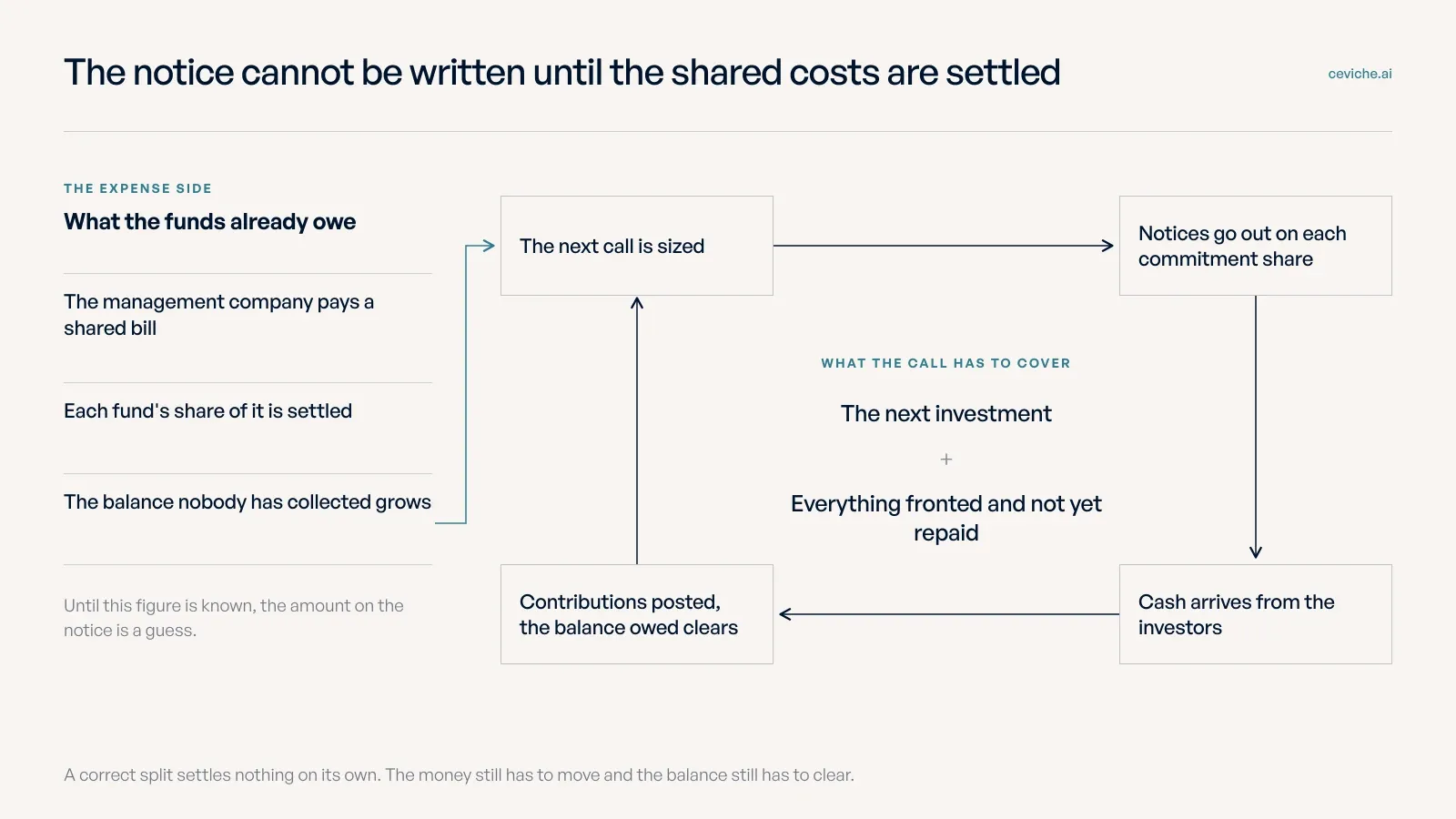
The first is what the call has to cover. If the fund's share of the last three quarters of shared costs has not been reimbursed, this call is carrying it, and somebody has to know what that number is per fund before the amount is fixed.
The second is how the call divides. A private equity CFO put it exactly this way while evaluating an allocation system.
If we did a capital call for $10 million, technically that $10 million should be allocated and split by commitment.
A call is an allocation, run across investors rather than across entities, on a basis that has to match the commitments as they stand on the day. He also wanted to derive those balances on his own side rather than take the administrator's files as given.
The third is timing, and it is a judgment about cash. One venture firm with two funds runs its calls on a quarterly rhythm and deliberately leaves a cushion sitting in the fund account, so that one surprising bill does not force a call off-cycle. Their cushion is $100,000 to $150,000. Treat that as their number and not a benchmark, and take the reasoning rather than the figure.
What is the call often actually for?
Every other guide assumes a call funds an investment. Among the teams we interviewed, plenty of calls fund a reimbursement instead, and that changes who has to be ready before the notice is drafted.
At one lower-middle-market private equity firm, the finance lead walked us through his cycle unprompted. Each quarter his team sends a workbook to the administrator, which accrues the expense off it. Repayment happens later, whenever the next call goes out, which is annually or semi-annually depending on the year, and sooner if the fund happens to be sitting on short-term interest income he can use instead.
We don't have a great process timing-wise for funds paying back expenses. The only result is that we end up floating the funds' expenses a little longer than we should.
Floating is the right word for it. Between the day the management company pays a vendor and the day a call clears the balance, the ManCo is financing the funds, and the size of that float is the sum of every allocation nobody has collected on yet. The due-to and due-from balances are the running record of it.
Not every cost waits for the quarter either. One multi-stage venture firm draws a line at $100,000. Anything larger goes to the funds as soon as it lands, anything smaller waits for the quarterly batch, and the firm therefore runs two cash cycles against one set of allocation rules. That line is theirs and not a convention.
And at the far end of a fund's life the option disappears altogether. Two of one venture CFO's funds are in their fifteenth year, and he explained what that does to the question.
All the capital's been called. The only way we're going to get cash is if we sell a portfolio company. So I can't even call capital if I wanted to.
The management company pays, the due-from grows, and it clears when something sells. No other guide mentions it.
The accounting behind a call
The entries are worth stating once, because the reimbursement leg is the one that lags.
| Step | Entry |
|---|---|
| Allocation booked against the invoice | Debit each entity's fund expense account for its share, credit accounts payable |
| Bill paid | Debit accounts payable, credit cash |
| Cost fronted by the management company | Debit due from the fund, credit the management company's expense account |
| Reimbursement arrives with the call | Debit cash, credit due from the fund |
Four movements, and only the first two happen without someone driving them. The third and fourth are where the intercompany balances between the ManCo and the vehicles live, and they are the reason a clean allocation can still leave a mess on the balance sheet for two quarters.
One more thing that surprises people. The capital account the call feeds is not always in the general ledger. At one partnership the partner capital accounts sit outside the ledger entirely, reconciled into a spreadsheet every two months. A call posts to whatever system holds the accounts, and that system is not always the one the entries above run through.
Fund II has $400M of commitments and the management company has fronted three quarters of the fund's shared costs, $438,000 in total. The next call is $12,000,000 for a new investment plus that $438,000, so $12,438,000 goes out on the notice. An LP holding $20M of the commitments, 5% of the fund, is called $621,900. One holding $50M is called $1,554,750. The arithmetic is trivial and the input is not, because that $438,000 is the sum of nine months of allocation decisions nobody ever systematized. Of the 80 fund finance teams we spoke with in 2026, 81% were still making those decisions in Excel.
What happens after the cash lands?
Computing the split does not move a dollar, and that is the half of this every product page skips.
A VP of finance at a multi-strategy healthcare investor described the payment side plainly. "One invoice may split into like 20 entities. And then when we initiate the wire, we have to initiate 20 wires. Different accounts." Her follow-up question is the one that matters operationally, which is whether the system shows which of the twenty have paid or whether somebody checks them one at a time.
The wires run the other way too. At another firm, a venture CFO watched the administrator key in eleven separate transfers to send one cycle's shared costs from the funds back to the management company. A fund-of-funds manager running more than 70 vehicles pays out of each vehicle by hand and transfers back internally whenever the ManCo fronts something, and even its outside counsel hands the problem back. "We wire it over to our law firm and then they say, how do you want us to allocate this, and that's a very manual process where we have to copy everything over."
A controller at a manager running ten funds skipped the software question entirely and specified the output instead. She wanted one report per invoice, showing the vendor and invoice number, the dollars each fund carries, the project, the ledger line, the approvals behind it, and a way to mark the thing paid once it is. It has to survive indefinitely, because vendors ask about old invoices. Her administrator builds the wires straight off it.
Build the process around that document and the rest follows. Ten entities on one $96,000 invoice becomes a ten-line report, shares running from $2,880 to $28,800, handed over once, executed as ten wires, and matched back so each fund's share shows as paid. Without it, the same work is a spreadsheet, an email and a follow-up two weeks later. This is also where the call cycle collides with the month-end close, since the reimbursement has to be recognized in the right period whether or not the cash has arrived. Our fund close-time benchmark has one example. A VC fund controller cut up to 10 days from month-end close.
Subsequent closes and what they do to earlier splits
A fund with rolling closes changes its own denominator. A controller at a large growth-equity firm raised it as a question about corrections, asking whether the same adjustment mechanism covers subsequent closes, when commitments change across feeder vehicles.
It has to, and the work is larger than it sounds. A call issued after a close is computed against the commitments as they stand that day. Every earlier call and every earlier expense split done on the old percentages is now off, so the fund equalizes, which is why a product advertising automatic equalization and late-payment interest is advertising something real. The expense side of the same problem rarely gets equalized with the same discipline, and one firm's first fund ran rolling closes and rebalances across two years, which is a long time to be re-deriving percentages by hand.
Where does Ceviche fit?
Ceviche fits when the amount a call has to cover depends on shared costs the management company fronted and that number is still being assembled by hand. Ceviche splits those costs across the funds, the SPVs and the management company under whichever basis each fund's documents allow, so the figure is computed and documented before anyone drafts the notice, and each fund's share can be matched back when the money moves. Flybridge used to run that split in spreadsheets across 18+ fund entities, and every allocation now traces back to source documentation with a full audit trail. It generates no capital call notices, runs no investor portal and moves no money, so if that is what you are shopping for, the products above are where to look. It is not a fund administrator, a general ledger or a managed service, and it does not do the allocations for you.
Frequently asked questions
How does a capital call work? The general partner issues a notice to each limited partner stating the amount, the purpose, the wire instructions and a due date set by the notice period in the partnership agreement, typically 10 to 14 days. Each LP wires its share, which is usually its pro rata portion of commitments. Paid-in capital rises, uncalled commitment falls, and the capital account reflects both.
What happens if you don't pay a capital call? The remedies come from the partnership agreement rather than from any general rule. Carta's explainer describes a general partner charging a penalty for each day the money is late, selling the defaulting investor's stake to other investors or to a third party, and holding that investor accountable for liabilities the default caused. Defaults are rare because the reputational cost is high. Read your own LPA before assuming any of it applies.
Should fund expenses be reimbursed through a capital call or from cash already in the fund? Either, and firms decide on cash. Teams we spoke with call for expenses once or twice a year and use cash on hand between times, including short-term interest income, so the call is a cleanup rather than the only route. The longer the gap, the longer the management company finances the funds, and the larger the uncollected balance nobody is watching.
When twenty entities each pay a share, how do you track which ones have paid? Today, usually by hand. The split is computed, a payment report goes to whoever executes, and the wires are initiated per entity from per-entity accounts. Payment status then lives in a bank portal rather than next to the allocation. The fix is a single record carrying each entity's share, when it was paid and how, kept where the split was decided.
What happens to prior allocations after a subsequent close changes commitments? They stop being right. New commitments change every pro rata percentage, so calls and expense splits made on the old figures need trueing up. Fund equalization handles the capital side and some products automate it along with late-payment interest. The expense side is often rebuilt by hand, which is where errors from earlier quarters surface months later.
Can the reimbursement from the funds be automated, or does someone still queue each wire by hand? Someone still queues them. One venture CFO watched eleven transfers go in by hand at the administrator for a single cycle. A correct allocation settles nothing on its own, and the distance between a computed split and a cleared balance is where the float lives. Ask any vendor which of those two problems it actually solves.