TL;DR. Rarely all of it. Bring fund administration in-house when deal timelines outrun your administrator's turnaround, when you correct their output every quarter, or when per-vehicle fees scale faster than the vehicles earn. Most firms should co-source instead: keep the judgment work internal and leave the heavy accounting out.
Every page answering this question sells one of the answers
The question usually arrives at a specific moment: the administrator's fee just scaled with your new SPVs again, or the SLA missed a deal deadline, and a partner asks why this is not a job for two good fund accountants instead. Nearly everything written in answer is published by administrators and accounting firms. The arguments are real. They are also the arguments of an interested party, and none are written by the person who lives with the decision at 9pm on the last day of the quarter.
So here is the other half, from the GP side. The in-house case is narrower than firms think and stronger than the vendor pages admit, the cost math has a wrinkle almost nobody states out loud, and the honest answer for most PE firms is neither pole.
The decision is per function and not per firm
Treating this as one switch is the mistake that makes it hard. Fund administration is a bundle, and the pieces have different economics.
Fund accounting and NAV are the heaviest and the most standardized, which makes them the best candidates to send out. Investor servicing is relationship work, and plenty of firms outsource the mechanics (the portal, the register, subscription documents) while keeping the LP conversation internal. Capital calls and distributions sit in between: the notice generation travels well, the wire timing and the LP phone calls do not. Compliance support is specialized enough that most firms below a few billion buy it. And expense allocation, the fund-versus-management-company line, and the intercompany balances usually stay in-house whether or not anyone decided that on purpose.
If you are unclear on which of those is accounting and which is administration, the definitional split is worth ten minutes before you price anything, because vendors quote different bundles under the same word.
Where does the cost crossover really sit?
The vendor pages say outsourcing converts fixed cost to variable cost. True, and incomplete. The number that decides this is not gross cost. It is who bears it.
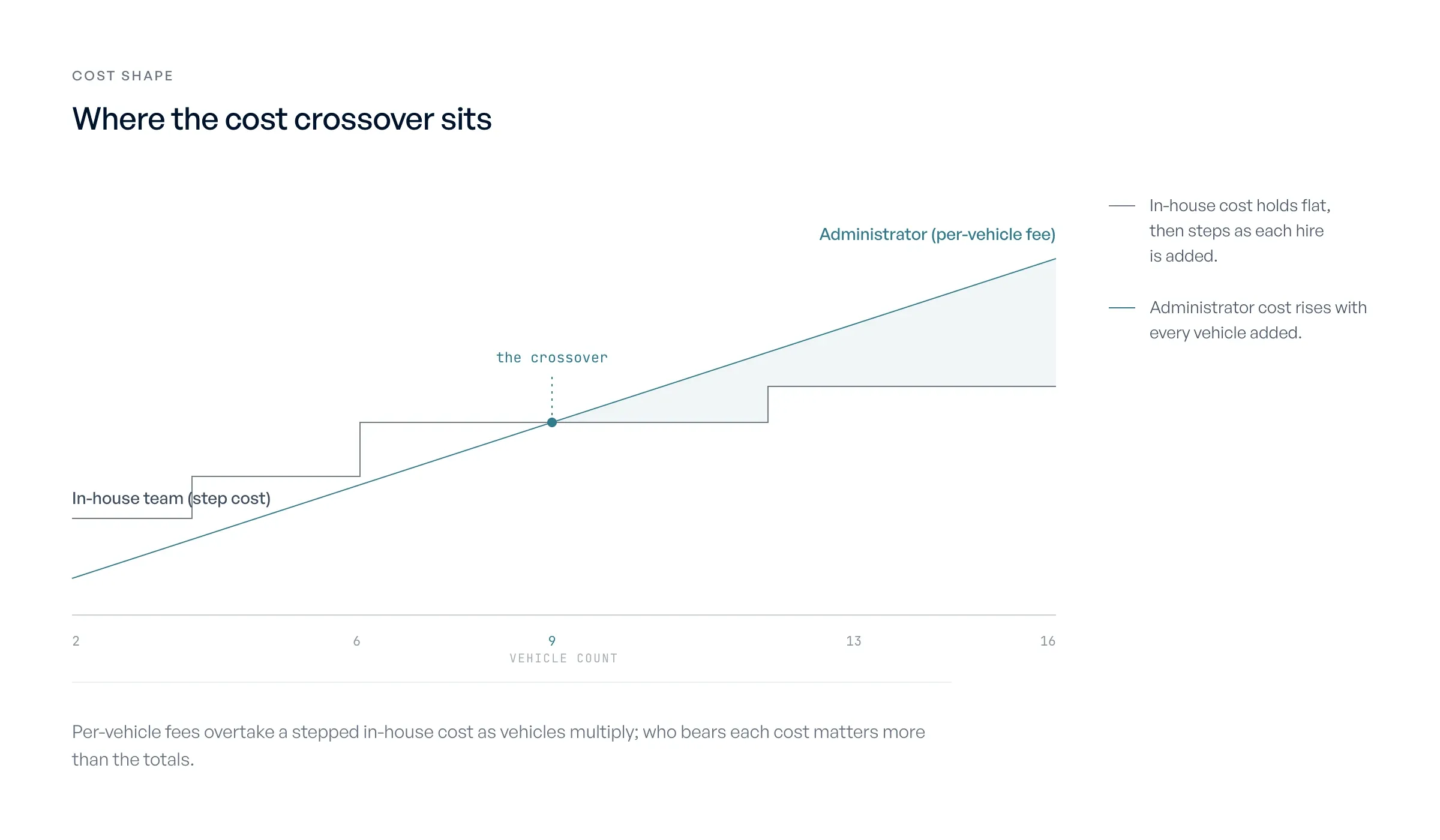
Illustrative cost shapes: per-vehicle fees overtake a stepped in-house cost as vehicles multiply.
Take a firm running three funds, two SPVs, and a management company. Illustrative figures, not published market pricing, because administration is quoted against structure and no honest range survives contact with your actual entity count:
| Annual line | Self-administered | Third-party administrator |
|---|---|---|
| Senior fund accountant, fully loaded | $188,500 | Included in fee |
| Fund accounting software and hosting | $35,000 | Included in fee |
| Controller oversight, 0.2 FTE loaded | $42,000 | $42,000 |
| Administrator fee | $0 | $240,000 |
| Gross annual cost | $265,500 | $282,000 |
On gross cost the two are close enough to call a wash, which is where most analyses stop. Now add the line that matters:
| Self-administered | Third-party administrator | |
|---|---|---|
| Typically borne by | The management company | The funds, where the LPA permits |
| GP out-of-pocket | $265,500 | $42,000 |
Administration fees are generally a permitted fund expense; the salary of an employee doing the same work generally is not. Two options separated by $16,500 of gross cost are separated by roughly six times in what the GP actually pays out of the management fee. That asymmetry, not efficiency, is why so many firms outsource. It is also why the in-house case has to be argued on control and speed rather than on cost, because on cost it usually loses before it starts.
Two caveats keep this honest. Your fund documents govern which costs the fund can bear, and the SEC's Division of Examinations tests fee and expense allocation against those documents, so "the fund pays for it" is a question for your LPA and counsel rather than a default. And the private fund adviser rule's disclosure expectations sit on top of that.
What does the in-house case actually rest on?
Strip out cost and three arguments remain. All three are real.
Speed against your own numbers. An administrator is a vendor with a turnaround. When a deal needs a fund-level position today and the SLA says three business days, that gap has a cost that never appears in a fee comparison. Firms that run fast, concentrated processes feel this more than firms with steady quarterly rhythms.
Methodology you would rather own than explain. If your allocation methodology is unusual, and many are, you will spend part of every close re-explaining it and part of every close correcting the output. At some point the explaining costs more than the doing. That is a genuine trigger to pull work back.
Per-vehicle pricing against a growing vehicle count. Administration is often priced per fund or per entity. A firm that spins up SPVs routinely can find its fee scaling with vehicle count while the vehicles themselves stay small, which is the one scenario where the cost argument flips toward in-house.
Against that, the counter-signals are equally concrete. Institutional LPs frequently require an independent administrator in diligence, and that requirement does not negotiate. Multi-jurisdictional structures need expertise you cannot hire once. And a one-person in-house function is a single point of failure that shows up the week that person resigns, which is the risk the close-time data never captures because it measures good months.
Which functions should you keep and which should you send out?
| Function | Default | Move in-house when |
|---|---|---|
| Fund accounting and NAV | Outsource | Vehicle count is small and stable, and you already employ a fund accountant |
| Capital calls and distributions | Outsource the mechanics | Call frequency is high and LP relationships are concentrated |
| Investor servicing and portal | Outsource the mechanics, keep the relationship | Your LP base is small and expects direct contact |
| Financial statements and audit support | Outsource | Never, for most firms below a few billion in AUM |
| Regulatory and AML/KYC support | Outsource | You have a dedicated CCO with capacity |
| Management company books | Keep in-house | Already the default |
| Expense allocation and methodology | Keep in-house | Already the default, whether or not you chose it |
| Intercompany due-to and due-from | Keep in-house | Already the default |
The bottom three rows are the ones firms discover rather than decide, and they are the reason the in-house-versus-outsourced framing misleads. Some work never had a vendor option.
Outsourcing does not empty your desk
This is the part the page-one results structurally cannot tell you.
Of the 80 fund finance teams we spoke with in 2026, 92% ran allocations across disconnected systems that do not talk to each other, and 81% did the allocation itself in Excel. A meaningful share of those teams already had an administrator. The administrator was posting clean entries on top of a split someone built by hand the night before.
One growth-equity CFO whose firm outsources administration still codes every expense line in Excel before the admin books it. That is not a failure of the administrator. It is the boundary of the product. The administrator executes the entry; the firm decides what the entry should say.
So when you price the two models, take the allocation work off both sides of the ledger. It is a constant. Deciding it belongs to whoever signs the LPA, and no service agreement moves it. The question worth asking any administrator you are evaluating, and the one missing from the standard checklist in most guides to fund administration tools, is what audit trail they hand back on a multi-entity split. If the answer is "you send us the allocation and we post it," that is the honest answer, and it tells you the methodology, the split, and the documented basis are still yours.
What does moving back in-house actually involve?
Firms underestimate the transition in both directions. If you are pulling work back, expect a full parallel cycle where both sides produce the same numbers and you reconcile the difference, a data migration of capital account history that is rarely as clean as the export implies, and a contractual notice period that is usually 60 to 90 days. Budget two quarters, not one.
Do it at a natural boundary. Between a final close and the first capital call of a new fund is the cheapest window. Mid-audit is the most expensive.
Where does Ceviche fit?
The allocation layer stays with the GP under every model on this page, which is the work Ceviche automates. It reads the spend systems you already run, applies your methodologies per the LPA, and writes audit-ready journal entries back to QuickBooks, NetSuite, or Sage, the why attached to every line, whether your administrator or your own team posts the rest. A full day of spreadsheet allocation each quarter is what Flybridge gave up: 18 fund entities on QuickBooks Online and Bill.com, hands-off at about 99% accuracy since a two-week onboarding. See how Ceviche handles fund expense allocation.
FAQ
What is the difference between in-house and outsourced fund administration? In-house, or self-administration, means your own employees keep the funds' books, produce investor reporting, and handle capital activity on systems you license. Outsourced means a third-party administrator does that work under contract for a fee. The functions are identical. What changes is who performs them, who carries the key-person risk, and whether the cost sits with the management company or the funds.
What is an in-house fund? The phrase usually means a self-administered fund: one where the manager has not appointed a third-party administrator and runs the fund accounting, investor reporting, and capital activity internally. It is a description of the operating model, not a fund type. Regulators and LPs care about it because self-administration removes the independent party from the books.
What are the disadvantages of in-house fund administration? Three carry real weight. Key-person risk, because a one-person function fails the week that person leaves. The absence of a SOC 1 or SOC 2 report, which institutional LPs increasingly ask for in diligence. And the cost usually landing on the management company rather than the funds, so the same work costs the GP more out-of-pocket than an administrator's fee would.
Can you bring fund administration back in-house after outsourcing? Yes, and firms do it more often than the vendor content suggests. Plan for a parallel cycle where both teams produce the same numbers, a capital-account history migration that needs manual reconciliation, and a contractual notice period of roughly 60 to 90 days. Time the switch between a final close and a new fund's first capital call, never during an audit.
At what fund size should a PE firm hire a fund administrator? Size is the wrong trigger. Vehicle count, LP composition, and jurisdictional spread decide it. A single $800M fund with ten institutional LPs almost certainly needs one, because those LPs will ask in diligence. A $300M manager running eight SPVs for family-office capital may reasonably self-administer far longer than an AUM rule of thumb would suggest.
Does outsourcing fund administration reduce the finance team's workload? It reduces the posting and reporting load substantially. It does not remove expense allocation, the fund-versus-management-company split, the management company's own books, or the review of what the administrator produced. In our 2026 research across 80 fund finance teams, 81% still allocated expenses in Excel, and many of them already had an administrator.