
TL;DR. Fund administration is the outsourced service that keeps a venture fund's books, runs capital calls and distributions, onboards LPs, and supports tax and audit. Providers price it as a fixed annual fee per fund, a percentage of assets or committed capital, or per investor and per transaction. Expense allocation stays with you.
What is fund administration in venture capital?
The contract gets signed on the understanding that the back office is now somebody else's problem, and the first quarter after it teaches a GP how much of the work is still theirs. An administrator keeps the fund's books. It does not make the decisions that have to happen before those books can be written, and that gap is where the surprise lives. The venture capital back office is the administrator's work and the GP's, together.
Fund administration is the outsourced service a GP buys to run a fund's middle and back office. It covers fund accounting plus investor servicing and onboarding, capital calls and distributions, the investor register and reporting package, AML and KYC checks, and support for audit, tax, and regulatory filings.
Our founder spent years on the GP side of these relationships, and he describes an administrator as an outsourced accounting firm for each fund entity you own. Most of the day-to-day work is capital calls, distributions and keeping cash straight by fund. The accounting itself is not hard, it is manually intensive, and the administrator holds real power because it owns the fund-side books.
Fund accounting is the term people reach for interchangeably, and it is not the same thing as administration. Accounting is the function of keeping the books, administration is the service that performs it and a good deal more, so accounting sits inside administration rather than beside it. We lay the full split out in fund administration vs fund accounting, and it matters here because the contract covers the service, not the judgment.
The work a VC fund administrator actually does
The core scope is consistent across providers. It starts with fund formation and investor onboarding, then runs the capital calls and distributions for the life of the fund. Underneath sits the accounting, NAV and the capital account per LP, which surfaces each quarter as financial statements and an LP reporting package, usually through a portal. Compliance runs alongside all of it, KYC and AML on each investor, tax including K-1s, audit support and regulatory reporting.
Cross-border structures add a layer. Ocorian, a full-service provider, also lists company secretarial work, AIFM services in Ireland and Luxembourg, and depositary services, which matter only if your LPs or your vehicles sit outside the United States. Alter Domus names the three things that drive the burden up as a firm scales, more funds, larger funds, and complex structures such as region-specific vehicles, co-investment vehicles and special purpose entities.
What no scope list tells you is what the relationship feels like. A head of operations who manages every vendor at her venture firm described her provider in one phrase.
A black box. Everything via email, and I have no visibility into anything.
She had one fund and a stack of SPVs, was raising a second, and knew the legal invoices splitting between the fund and an SPV were about to multiply.
One more thing sits inside the scope without appearing on any scope list. When a venture firm already outsources allocation, the work has not gone away, it has been priced in. That is our own read from the evaluations we run rather than anything a provider publishes, and what it means in practice is that the annual service cost already carries people doing the splitting and the review by hand.
The provider groups in 2026
The providers worth shortlisting fall into three kinds, and the kinds behave differently enough that a list ordered by name hides the only distinction a buyer needs.
Full-service global administrators
Ocorian and Alter Domus sit here. They cover the whole lifecycle including the regulatory and cross-border pieces, they carry deep bench strength, and they are the answer when your structure has jurisdictions in it. Ocorian's own page says its "market-leading technology platform, eFront, provides easy access to the information you require, such as NAV calculations and investment data."
Platform administrators
Carta and Juniper Square lead this group, and the pitch is the software and the service arriving together. Carta's fund administration page offers "fund admin at the intersection of world class service and autonomous agents," backed by expert fund accountants, fund tax, SPV and formation work, KYC and AML, and portfolio valuations. Juniper Square sells "pairing a modern fund administration solution with best-in-class technology for fundraising and investor management," staffed by accountants it says understand venture funds specifically.
VC-focused boutiques
Smaller providers built around venture structures, SPV volume and emerging managers. We are not naming any of them here, because we only name a provider whose claims we can quote from its own site, and the boutique tier is mostly described by third parties.
Two things follow. The software-versus-administrator framing is a false binary at the top of the market, since every serious provider runs a platform and the question is only whose. What separates them is not the platform but what comes back out of it. At one venture administrator we have worked with, allocation output does not reach the fund ledger directly at all. It feeds a data layer the administrator maintains, which enriches it and pushes it up into the ledger and the treasury system underneath.
What does a VC fund administrator cost?
No provider publishes a number and we are not going to invent one, so what follows is the shape of the fee and the levers that move it.
Fees are most often structured, in Carta's own description, "as either a fixed annual fee per fund, a percentage of assets under management (AUM) or committed capital, or per-investor/per-transaction charges, usually with minimums that scale with fund size and complexity." Percentage-of-assets pricing is why the fund side of the contract scales with the fund, while management-company services cannot be priced that way at all.
For the total rather than the line item, Carta's analysis of roughly 2,000 private funds found that over their first five years, the median fund between $1 million and $10 million spends about 3.4% of committed capital on operating expenses, against about 1% for funds over $100 million. Administration is one component of that, and the gap is the clearest published evidence that these costs do not scale down gracefully.
The drivers you control are the number of LPs, investments and vehicles under the contract, whether the fund is audited, whether you have non-US investors, and how many separate sets of books the provider maintains. SPV count is the one that surprises people, because SPVs are cheap to form and each one is another entity somebody administers.
Fee model matters as much as fee level. A venture CFO inherited an hourly outsourced provider for management-company bill pay at a five-figure monthly cost, and cut it by moving the management-company books onto the administrator that already ran the funds. His read on hourly billing was simple. Nothing that takes two hours gets done in fifteen minutes when the meter is running.
When does software replace the administrator?
For the things the contract is actually about, it does not. Software does not perform fund accounting, strike a NAV, produce K-1s or stand behind an audit for a fund of any size, and anyone telling a first-time GP otherwise is selling something. The systems that do the fund-side bookkeeping, as distinct from the service wrapped around them, are compared in our VC fund accounting software roundup.
The honest counterweight came from a head of finance who is the whole finance function at her venture firm. She would not bring administration in house, she told us, because the administrator carries the compliance work she has no second person for. She had spent years inside an administrator before taking the seat, so she knew exactly what she was buying.
There is also a structural reason the ledger stays put. Another one-person finance team, at a firm whose vehicle count has doubled since she took the seat, put it in one sentence.
A fund administrator will never open an API to connect into anybody else. They will give it to you for your cap table. They will never give it to you for your general ledger.
What software does take back is the work that never left the GP in the first place. It is the expense allocation across funds, SPVs and the management company, plus the management company's own books, which most administration contracts do not cover. It is also bill pay, card spend, and the intercompany entries that the management fee and the reimbursement cycle create every quarter. Teams are routinely surprised to still be doing all of that after they hire an administrator, because the sales conversation was about the fund side. If the question underneath yours is whether to run the whole function internally, the in-house decision has its own tradeoffs.
What stays yours after you hire an administrator?
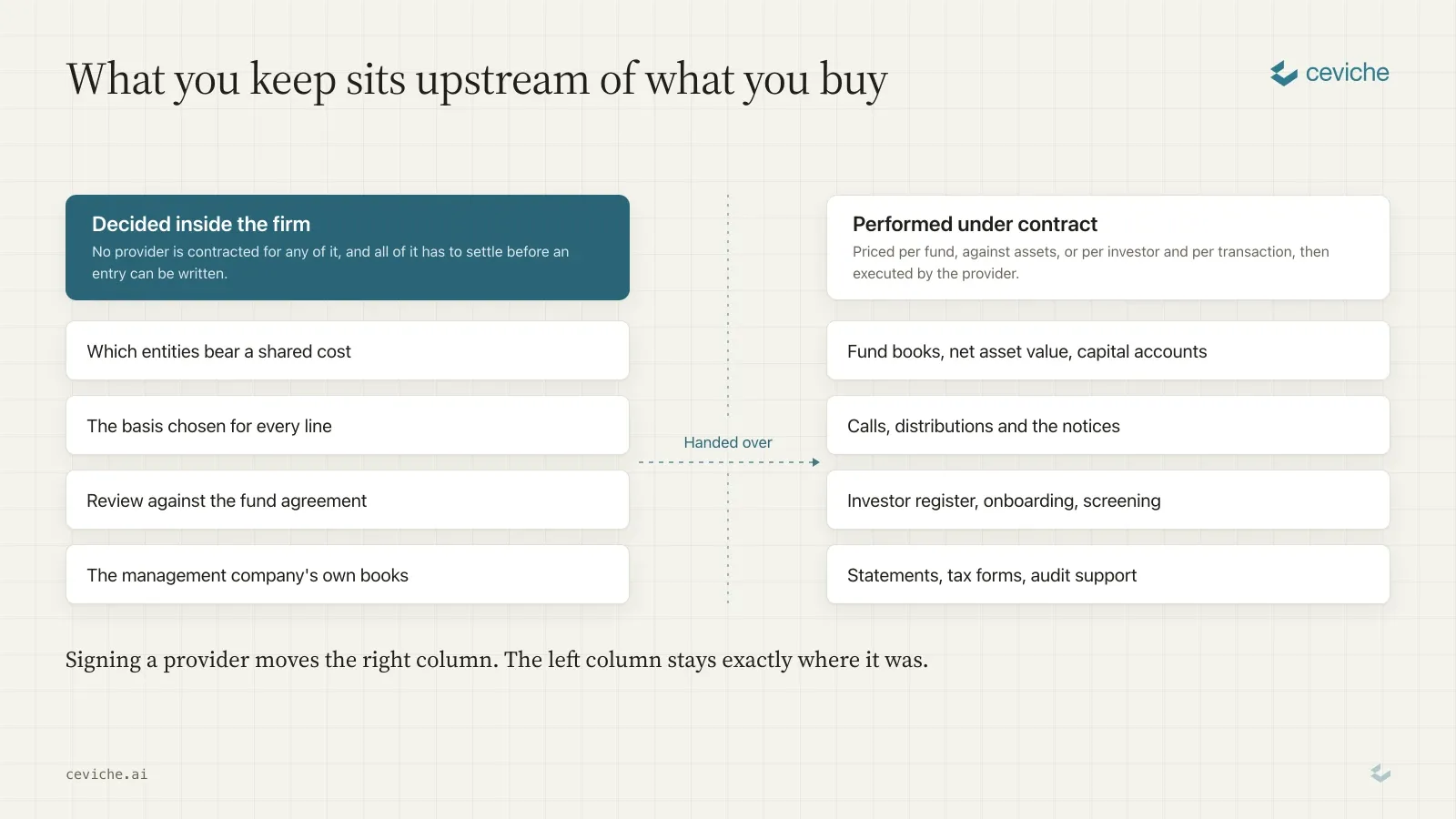
A finance associate at a venture firm whose administrator is paid as a percentage of assets drew the boundary in one sentence.
The decision on how to allocate, laid out in a spreadsheet we could hand the SEC, is done in house. The administrator comes in downstream from that.
Our own data says the same. Of the 80 fund finance teams we spoke with in 2026, 81% still do the split in Excel and 92% run systems that do not talk to each other, the management-company ledger on one side and the fund books on the other. Hiring an administrator moves neither number, because the split happens upstream of the administrator's books. The management company runs on QuickBooks at 51% of teams in our tech stack analysis, while the fund books sit on the administrator's own system, and the allocation lives in the gap between them.
Take one quarter at a venture firm with Fund II ($120M committed), Fund III ($280M committed), one co-invest SPV and a management company, and four shared costs to place.
| Cost | Amount | Methodology | Split |
|---|---|---|---|
| Technology subscription, quarterly slice | $12,000 | Pro rata by committed capital | Fund II $3,600 · Fund III $8,400 |
| Outside counsel, one portfolio company | $16,500 | Invested capital in the deal (Fund III $8.0M, SPV $2.0M) | Fund III $13,200 · SPV $3,300 |
| D&O insurance | $9,000 | ManCo layer per the policy schedule, remainder by committed capital | ManCo $1,800 · Fund II $2,160 · Fund III $5,040 |
| Annual meeting venue | $7,500 | Specific identification | Fund III $7,500 |
Which rolls up to four sets of entries.
| Entity | Amount |
|---|---|
| Fund II | $5,760 |
| Fund III | $34,140 |
| Co-invest SPV | $3,300 |
| Management company | $1,800 |
| Total | $45,000 |
The administrator books the fund-side entries and the resulting due-to and due-from balances, and it does that well. What it cannot do is decide that the counsel work follows invested capital in the deal rather than committed capital across the funds, or that the annual meeting belongs to Fund III alone. Those four methodology choices are made in house, before anything reaches the administrator, and they are the lines an examiner asks about.
The total due per fund is not what the administrator books from either. The CFO at that same firm, the one whose administrator runs its own data layer, told us his provider needs the breakout by fund and by expense account, because that is the shape of the entry on the fund side, and his phrase for what he wanted was to spoon feed them the entries. At two of the venture firms we work with the administrator was given read-only access to the allocations, invoices and support directly, which beats a quarterly file and a round of email.
Most firms are not managing one relationship either. One venture finance team told us its legacy funds stay with a full-service administrator running an institutional fund ledger while its SPVs move to a platform administrator, and the same full-service provider holds the management-company QuickBooks license and prepares the intercompany schedule for review. A CFO running two administrators at once asked us for API or SFTP drops feeding a single database on a normal cadence, because neither provider's portal was the system of record. Every additional provider is one more place an allocated cost has to land and one more reconciliation nobody owns.
The cost of not solving it is measured in weeks, and a director of finance at a large venture firm described the rhythm.
We spend a lot of time at the end of the quarter, into the following quarter, two to three weeks, capturing as much as we can so we can push it through the funds.
Then it goes quiet until the next quarter forces the same rush. One fund-side controller told us his team spends hours per fund checking the management company's allocations against the billback invoices, and what he wanted was not faster math. He wanted to book what arrived without re-verifying it.
When should you engage one and how do you choose?
Carta's guide puts the timing at "ideally six to 12 months from your first close," which is right and incomplete. The three events that force the decision are a first institutional LP asking who keeps your books, a second vehicle landing so the intercompany balances stop being trivial, and an audit requirement arriving in a side letter. A CFO at a venture firm that keeps fund accounting in house told us LPs pushed back during her last raise with exactly that question, and she had to answer it rather than dismiss it.
Her own firm is the case against outsourcing. It runs fund accounting entirely in house, on a team where nobody has been in their seat under fifteen years, and does its allocations with a calculator rather than a spreadsheet. The three models are full outsourcing, co-sourcing where the provider works inside your systems, and keeping it in house, and firm size predicts the choice far less well than team tenure does.
On selection, the criteria that matter are the technology platform and what it exports, the depth of expertise on your specific structures, the service model and who your named accountants are, audit support, how the provider handles growth in vehicle count, and what a future migration would cost. That last one is easier to price once you have mapped the VC finance stack around the provider, because the cost of moving is mostly the cost of what connects to it. Add one criterion the checklists miss. You are buying a team, not a brand. At a venture firm running five funds and a stack of SPVs, the management-company finance lead moved providers because the people she worked with left one for another, and she followed them.
Do not expect the provider to help you choose the rest of your stack. One private equity controller told us the administrators in his market will not recommend software, because recommending something that goes wrong is a blame risk they will not take, while elsewhere he had seen administrators suggest tools actively. If you are waiting for your administrator to tell you what to buy, that may be a function of geography, and our fund administration software comparison ranks the providers one by one for anyone doing that work themselves.
Where does Ceviche fit?
Ceviche is the allocation layer that sits between the spend systems you already run and the ledgers on both sides of the administrator relationship. It fits when you have an administrator and a general ledger you are keeping, and the shared costs across funds, SPVs and the management company still land in a spreadsheet before anyone can book them. It is not a fund administrator, a general ledger or a managed service, and it does not do the allocations for you, so a firm that needs fund accounting, NAV, K-1s or audit support evaluates the providers above instead. Flybridge, a venture firm with 18+ fund entities, kept its Bill.com and QuickBooks Online stack and moved its quarterly allocations out of spreadsheets into Ceviche, which posts to QuickBooks Online with a full audit trail back to source documentation. The product walkthrough shows the mechanics.
Frequently asked questions
How much does a fund administrator cost? No provider publishes rates, and the fee shape is a fixed annual fee per fund, a percentage of assets or committed capital, or a per-investor and per-transaction charge. What moves your number is LP count, investment count, vehicle count, audit requirements, non-US investors, and how many separate sets of books the provider maintains. Ask any provider to price the structure you actually run, every vehicle included, rather than the flagship fund on its own, because that is where the quotes diverge.
What is venture capital fund management? Fund management is the investing business, sourcing, diligence, portfolio support and exits, plus the firm-level decisions about strategy and capital. Administration is the back-office service supporting it. A GP manages the fund and buys administration, and the two words get used interchangeably by people outside the finance function, which causes real confusion in vendor conversations.
What is the difference between fund administration and fund accounting? Fund accounting is a function, the work of keeping a fund's books and computing NAV and capital accounts. Fund administration is a service you contract, and it performs that function plus investor servicing, capital activity, compliance and reporting. Every administrator does fund accounting. No administrator does only fund accounting, and you can do fund accounting without an administrator.
Can software replace a fund administrator? Not for fund accounting, NAV, K-1s or audit support. What software does replace is the manual work sitting upstream and alongside the administrator, expense allocation and the management company's own books, most of which never moved to the provider in the first place. Most GPs find that out in the first quarter after signing.
When should a VC fund hire a fund administrator? Six to twelve months before a first close is the common answer and a good default. In practice the trigger is an institutional LP asking who keeps the books, a second vehicle making intercompany balances real, or an audit requirement in a side letter. Firms that wait past those three end up migrating mid-life, which is more expensive than starting with a provider.
Who handles expense allocation, the fund administrator or the GP? The GP decides, the administrator books. Choosing that a legal invoice line follows invested capital while a formation line follows specific identification, and that both survive an examiner reading them against the LPA, is judgment your controller exercises. The administrator posts the split it is given and reflects it in the quarterly package. That is why 81% of fund finance teams are still in Excel after hiring an administrator.