
TL;DR. Core go-live takes 2 to 4 weeks and runs in four stages: connect your AP and expense systems read-only, capture your allocation methodology as it exists in the LPA and your current spreadsheet, run a full cycle in parallel against your existing process, then go live with journal entries written back to your GL. Flybridge's quarterly allocations across 18+ fund entities now run through Ceviche and post to QuickBooks Online.
Buying software you cannot see inside is a bad trade
Go looking for what an allocation implementation actually involves and you find capability lists and a Managing Director's phone number. No timeline, no scope, no description of what your team has to do. Every vendor in this category, ours included until now, has asked controllers to book a call to find out.
That is a reasonable thing to be annoyed by, particularly if you have been through one enterprise implementation that ran two quarters past its estimate. So here is the whole process, including the parts that can go wrong.
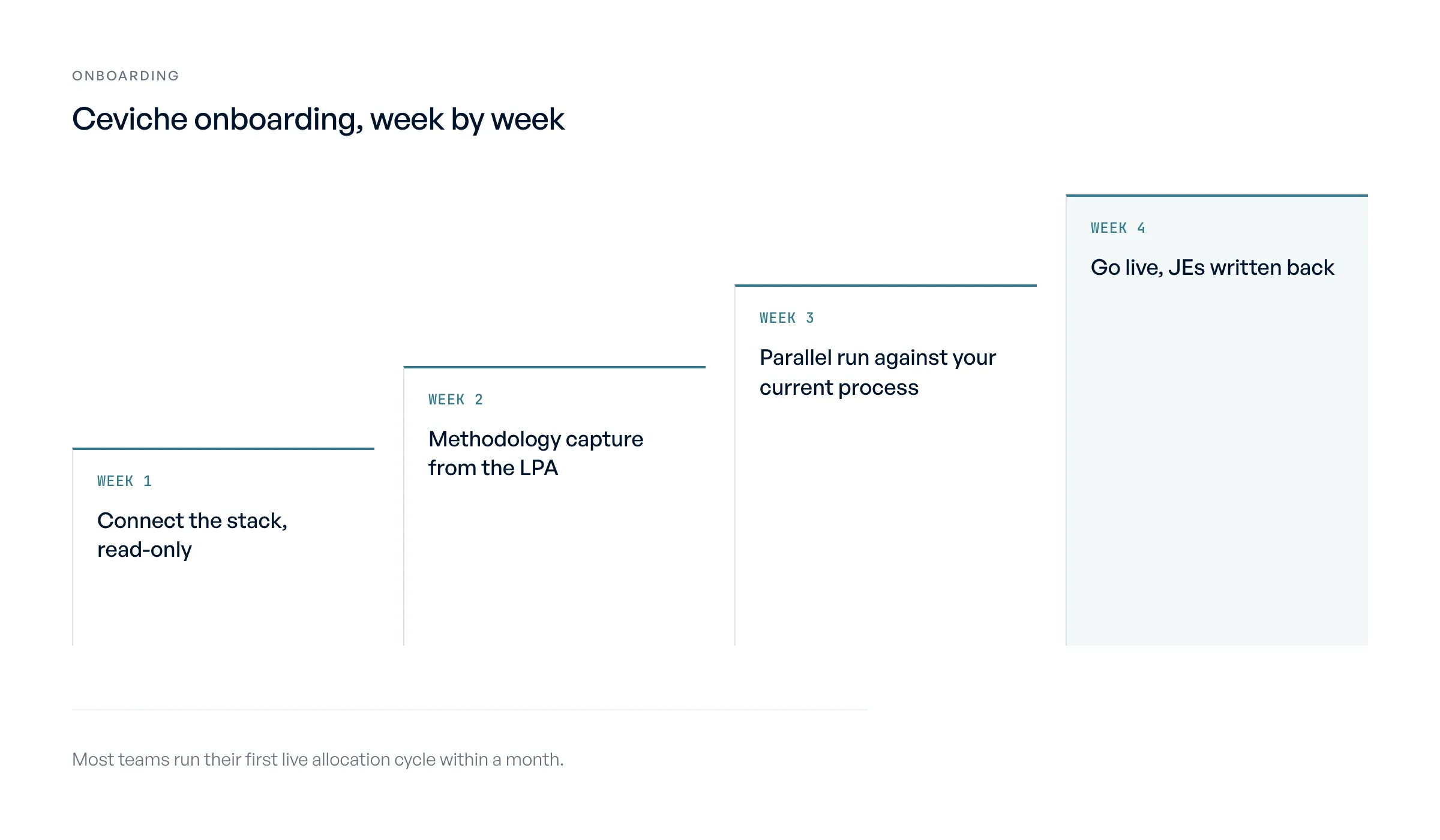
Ceviche onboarding week by week: most teams run their first live allocation cycle within a month.
Step 1: Connect the stack read-only
Week 1. We connect to the systems where your expenses already live: Ramp, Bill.com, Brex, Expensify, or SAP Concur on the spend side, and your general ledger on the other, whether that is QuickBooks Online, NetSuite, or Sage Intacct.
Every connection starts read-only. Nothing writes to your ledger until you have seen a full cycle and approved it, which is stage three. The read-only period is not a formality; it is how we learn the shape of your data without any ability to change it.
What you do in this stage: authorize the connections and tell us which entities matter. That is most of it. Our security posture, subprocessors, and controls are published at trust.ceviche.ai rather than described in a sales conversation.
Step 2: Capture the methodology
Week 2, and the part that decides everything. Your allocation methodology already exists. It is in your LPA, in the spreadsheet your controller maintains, and in decisions someone made three funds ago that never got written down. We capture it as it is, not as a template thinks it should be.
That means sitting with the person who currently does the allocation and going through the real cases: which costs are fund expenses and which the management company bears, which methodology applies to which cost type, how a legal invoice with mixed matters gets split, how a new SPV inherits rules, and where the documented exceptions are.
The output is your methodology written down, per cost type, mapped to the clause or precedent that supports it. For many teams this artifact is the first time the logic exists anywhere other than in one person's head. That is not surprising: 81% of the 80 fund finance teams we interviewed in 2026 were running allocation in a spreadsheet, and a spreadsheet records what was decided, not why.
If your methodology is genuinely undecided in places, this stage surfaces it. We will not invent a rule for you. Those go on a list for you and your counsel.
Step 3: Run one cycle in parallel
Week 3. We run a full allocation cycle on real invoices, alongside your existing process, and compare line by line.
Two outcomes are useful here. Where the numbers match, you have evidence the rules were captured correctly. Where they differ, one of two things is true: the rule was captured wrong, or the manual process had been doing something undocumented. Both are worth knowing, and the second happens more often than firms expect.
You review the differences. We adjust the rules. Nothing is posted to your ledger during this stage.
Step 4: Go live with entries written back
Week 3 to 4. Once you approve a parallel run, we turn on write-back. Ceviche posts audit-ready journal entries into your GL with the methodology, the source document, and the rationale attached to each line.
From then on the cycle is: invoices arrive in your spend systems, Ceviche applies your methodology per line, your controller reviews the exceptions rather than rebuilding the model, and the entries post. The audit trail is built as you go, which is the point that matters when an examiner samples a transaction two years later.
Flybridge, a venture firm with 18+ fund entities, ran its quarterly allocations in spreadsheets on top of QuickBooks Online and Bill.com. Those allocations now run through Ceviche and post to QuickBooks Online, and every allocation traces back to source documentation with a full audit trail. A finance lead at a global PE firm who was evaluating allocation tools told us we were the fastest implementation they had compared.
2 to 4 weeks is the honest general window for core go-live, which covers your entities, methodologies, rules, and import and export. New GL connections and historical data are scoped separately. The low end takes a clean stack and a decisive owner.
Everything you need ready before we start
| What | Why | Roughly how long |
|---|---|---|
| Admin access to your spend and AP tools | To authorize read-only connections | 30 minutes |
| Admin access to your GL | Same, plus chart of accounts mapping | 30 minutes |
| Your entity list, with which are active | To scope the allocation universe | 1 hour |
| The current allocation spreadsheet | The real methodology, as practiced | Send as-is |
| The relevant LPA expense sections | To tie each rule to its basis | Send as-is |
| One person who owns allocation | Stage 2 needs their judgment, not their availability in theory | 3 to 5 hours total |
| A recent month of invoices you already allocated | The comparison set for the parallel run | Already exists |
Total customer time across the engagement is usually under ten hours, concentrated in stage two. If your allocation owner cannot give us three uninterrupted hours in week two, the timeline slips, and that is the single most common cause of delay.
Ceviche is not an ERP or an administrator or a managed service
Worth being blunt about, because the category is muddled.
It is not an ERP or a general ledger. We do not replace QuickBooks Online, NetSuite, or Sage Intacct. We write into them. If you are looking to migrate your ledger, that is a different project and we are not part of it.
It is not a fund administrator. We do not produce NAV, maintain capital accounts, file your taxes, or service your LPs. If you have an administrator, you keep it, and the split between administration and accounting stays exactly as it was.
It is not a managed service. We do not do the allocations for you. A managed-service model like StavPay performs the work on your behalf; Ceviche is software your controller operates. You keep the methodology, the review, and the sign-off. If you want the work done for you rather than done faster, we are the wrong shape.
It does not decide your methodology. It applies the one you have. Where your fund documents are ambiguous, that is a conversation with your counsel, and no software resolves it.
Four things that can make this take longer
In rough order of frequency.
No single owner of allocation. When three people each know part of the methodology and none owns it, stage two becomes a scheduling problem rather than a capture problem.
A methodology that turns out to be undecided. Sometimes the parallel run reveals that two cost types have been handled inconsistently for years. Fixing that is worth doing and takes as long as it takes.
A stack mid-migration. If you are moving from Bill.com to Ramp, or QuickBooks to NetSuite, during onboarding, we can connect to both, but the parallel run gets harder to interpret. Where possible, finish the migration first.
Entity data that does not agree between systems. Near-duplicate fund names, entities in the spend tool that do not exist in the GL, and retired vehicles still receiving costs all have to be reconciled before rules can be applied cleanly. This is usually a week-one discovery and a week-two cleanup.
None of these are unusual, and all of them surface by the end of week one, which is when the timeline conversation happens. But a page that claimed nothing ever slows down would be the kind of page this one was written to replace.
If you want the category context before the process, our comparison of fund expense allocation software covers the alternatives honestly, including where other tools fit better. Otherwise, the product page is the shortest path to what it does.
Frequently asked questions
What access does Ceviche need to our systems? Read-only connections to your spend and AP tools and to your general ledger, authorized by an administrator on your side. Write access to the GL is enabled only after you approve a parallel run, and only for posting journal entries. Our controls, subprocessors, and security documentation are published at trust.ceviche.ai.
What if our general ledger is QuickBooks Desktop rather than Online? Desktop is a harder integration than Online and we handle it differently, so raise it in the first conversation rather than after a contract. Several firms in this position use onboarding as the trigger to move to QuickBooks Online, which is a smaller project than a NetSuite migration. Ask us directly about your version before assuming either way.
Can our fund administrator keep executing the allocations? Yes, and several customers run exactly that arrangement. Ceviche produces the split and the supporting rationale; your administrator posts and reports as it always has. One firm gives its administrator read-only access to the output so both sides work from the same numbers. The methodology and review stay with your controller in either configuration.
What happens to allocations we have already booked? Nothing. We do not restate history. Ceviche starts with the cycle you go live on, and prior periods stay as your ledger and your administrator recorded them. If you want historical allocations reviewed, that is a separate exercise and usually a question for your auditor rather than for us.
How much of our team's time does onboarding actually take? Usually under ten hours in total, most of it from whoever currently owns the allocation, concentrated in the methodology capture in week two. Connection setup is about an hour of administrator time. The parallel run needs a review session and whatever time you want to spend checking differences, which is entirely up to your comfort level.
What if our methodology is not written down anywhere? That is the normal case, not an obstacle. Most of the teams we work with have the logic in a spreadsheet and in one person's memory. Stage two exists to reconstruct it from the LPA, the current spreadsheet, and the decisions your controller makes in practice, and the written methodology you end up with is one of the more useful things the engagement produces.