
TL;DR. NetSuite's Expense Allocation feature moves balances out of expense accounts and spreads them across departments, classes, locations and subsidiaries on a schedule, generating a journal entry each run. A fund's split happens one level below that, per invoice line, on a basis that changes by line and by quarter, so most fund teams keep that work outside the ledger.
What does NetSuite's expense allocation actually do?
The Expense Allocation feature "lets you account for fixed expenses without having to split them among individual departments or locations in advance of incurring the expenses." An administrator enables it, Accounting Periods has to be on as well, and the role doing the work needs the Create Allocation Schedules permission.
The mechanism is the allocation schedule. Expense allocation "is managed by allocation schedules", which "allocate, or transfer, balances from expense accounts into one or more other accounts" on a date and frequency you choose, and for each scheduled allocation "a journal entry is automatically created." The schedules documentation adds that schedules "distribute expenses across departments, locations, classes, and custom segments, saving you the time required to enter complex journal entries".
One design detail is worth knowing before you build a schedule. Naming a credit account on the source creates an offsetting credit, so the amount lands in the destinations and the original balance stays where it was, which lets you read the same expense two ways on the income statement. Leave it blank and the source account is reduced to zero.
Weights come in two kinds. With fixed rate allocation "you must specify the fixed allocation weight for the entire life cycle of any allocation schedule." Dynamic Allocation depends on the Statistical Accounts feature and calculates the weight from a statistical account balance when the allocation journal is generated, which is how headcount or floor area becomes a driver. Design that one carefully, because if you want to allocate cost by subsidiary and department, "the statistical account must also be segmented by subsidiary and department."
The destinations are NetSuite's classifications. Departments, classes and locations are the built-in ones, "you can create an unlimited number of custom segments and add them to specific record types", and in OneWorld subsidiaries are the primary classification, so a fund complex can be modeled either as subsidiaries or as segment values.
Costs shared between subsidiaries get their own schedule type. Intercompany allocation schedules "allocate a balance from one source subsidiary to multiple destination subsidiaries for costs that are shared between subsidiaries on a regular basis, such as rent utilities." An advanced intercompany journal entry then lets you "select the originating subsidiary and can then define multiple receiving subsidiaries", and "when you save the journal entry, the ledger of each subsidiary is appropriately debited and credited." Elimination journals reverse the intercompany effect in consolidation, and approval can be required before anything posts. That is a competent multi-entity allocation engine, and fund teams do run allocations on it successfully.
Fund expense allocation is the work of dividing a shared cost across the fund entities, SPVs, and management company it served, applying the methodology each vehicle's governing documents support, producing the resulting journal entries, and recording the basis for each split in a form an auditor or examiner can sample.
Balances and periods versus invoices and entities
Everything above shares one assumption. The thing allocated is an account balance over a period, and the split is a weight decided in advance. That is the correct model for rent and for a shared services charge that behaves the same way every quarter. It is not the model a fund controller works in when a bill arrives and four vehicles have a claim on different parts of it.
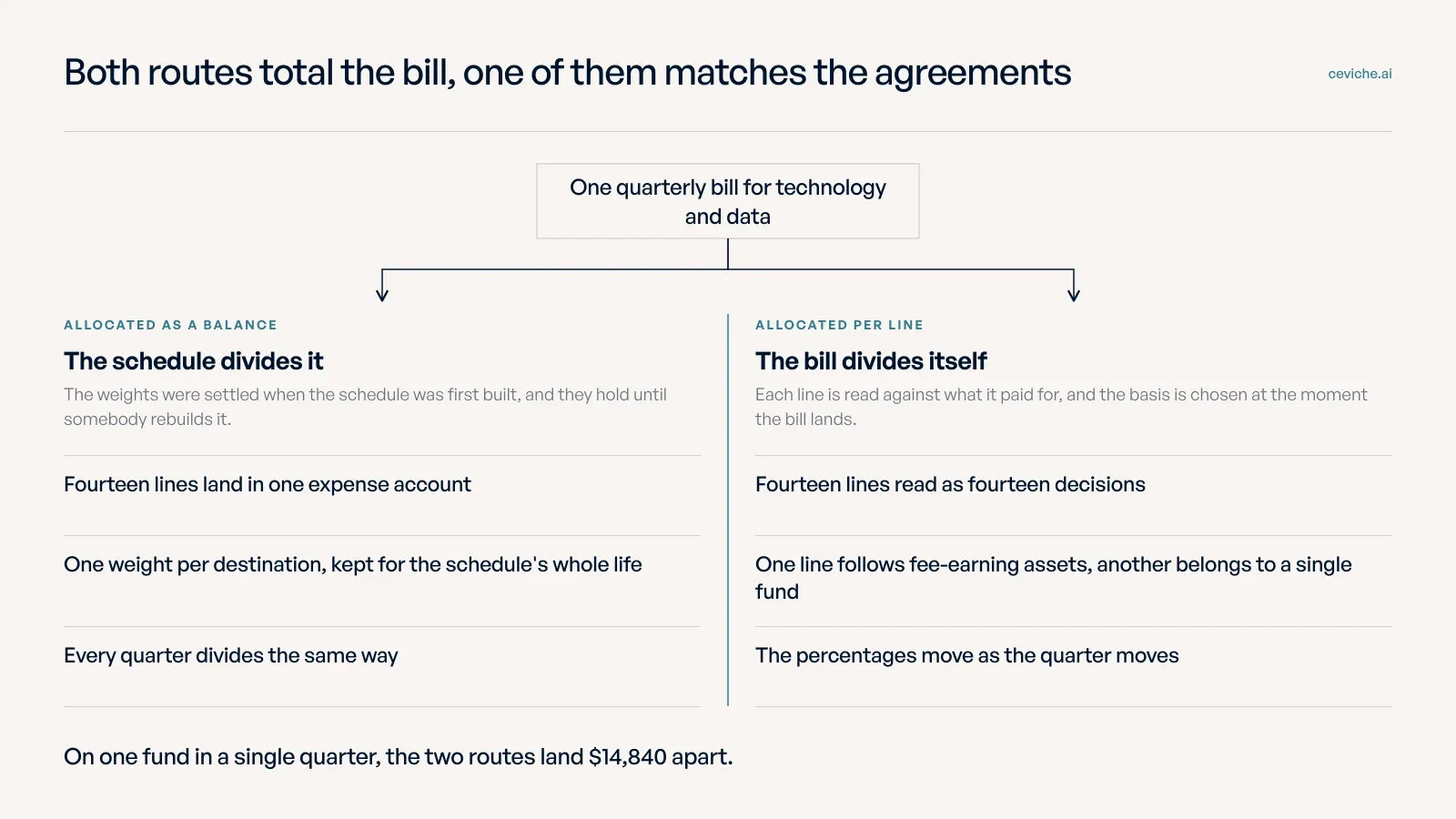
Take a quarterly technology and data bill of $52,400 in one unallocated expense account, fourteen subscription lines, with Fund III, Fund IV, a co-invest SPV and the management company in scope. Run it as an allocation schedule on the weights set when the schedule was built, 45% to Fund III, 30% to Fund IV, 10% to the SPV and 15% to the management company, and the entry writes itself.
Now run the same bill line by line, the way the fund documents support. The market data platform is $28,000 and is used across the active funds, so it follows fee-earning assets under management as they stand this quarter, Fund III at $420M, Fund IV at $520M and the SPV at $60M. The deal-sourcing database is $16,000 and only Fund IV is investing, so it goes there whole. The remaining $8,400 is payroll and human resources tooling, a management company cost the funds cannot bear.
| Entity | Allocation schedule | Line by line | Difference |
|---|---|---|---|
| Fund III | $23,580 | $11,760 | $11,820 |
| Fund IV | $15,720 | $30,560 | $14,840 |
| Co-invest SPV | $5,240 | $1,680 | $3,560 |
| Management company | $7,860 | $8,400 | $540 |
| Total | $52,400 | $52,400 |
Both columns are arithmetically correct and both total the invoice. Only one of them can be defended against the partnership agreements, and it is not the one the schedule produced. The gap on Fund IV alone is $14,840 in a single quarter, on a bill nobody would call complicated.
The second version needs things the first one does not. Somebody has to know the fee-earning assets under management as of this quarter rather than last, that the sourcing database belongs to the fund in its investment period, and which clause makes payroll tooling a management company cost. NetSuite holds the resulting entries perfectly well. The judgment that produced them lives in a spreadsheet.
Of the 80 fund finance teams we spoke with in 2026, 92% were running allocations across systems that do not pass the split between them, and 96% named multi-entity allocation a core source of complexity. NetSuite is the management-company general ledger for 23% of those teams and QuickBooks for 51%, 73% between them.
Does NetSuite record why the split was made?
A controller at a growth-equity firm running the private-equity module put the gap in one sentence.
There's no methodology within the screen to say, we did this based on capital commitment, we did this based on closing, we did this based on whatever. It just kind of goes in however.
A percentage lands in the field and nothing beside it says where the percentage came from. That is a narrower and fairer complaint than saying NetSuite has no audit trail, because the same controller was clear that the support does exist. It is just nowhere near the person reviewing the work. To get from a line on a billback report back to the evidence, "you have to find the invoice, then you have to find the journal, then you get back to the source document. So it's just not all in one place."
A controller at a venture firm reached the same conclusion independently, looking at the fund invoices her team generates out of the ledger. The document comes out correctly. What does not come out with it is any richer record of how that allocation was arrived at. A third, a private equity firm running the packaged private-equity bundle, described the same absence structurally.
Of the teams in the 2026 study, 49% had a gap in their allocation audit trail, and the gap is rarely the entries. It is the basis behind them. Committed capital, invested capital, ownership at closing and specific identification are all defensible, and which one applies can differ line by line inside one invoice, so a percentage recorded without its reason is a number nobody can re-derive later. Where the reimbursable expense module comes up in a buying conversation, the side by side sits on our NetSuite REMS page rather than here.
What does the quarterly billback produce?
The most precise account of the limit came from a senior accountant at a private equity firm running the packaged bundle on NetSuite, and it is structural rather than a complaint about configuration. Where his firm knows the allocation up front, from a business purpose or a specific deal, the cost is recorded and billed directly to that fund, and that half works. The shared and after-the-fact costs are the ones his team bills quarterly, and what the bundle gives them for those is a report.
We don't really have a billback feature. So it's essentially just a general ledger report of our quarterly billing. It's not like each transaction is tagged as needs to be billed and create an invoice to that specific fund. It's more handled just from journal entries and deposits when they pay.
Recording a split and recovering the money are two different jobs, and the ledger only does the first. Oracle's documentation does not describe a billable object hanging off each transaction, and at this firm no charge was linked to the recovery that cleared it. The funds receive a report, pay the balance on it, and the balances between the management company and each fund clear when the deposit arrives. Two years later, proving which charge sat behind which recovery is a reconstruction job.
None of which means the ERP cannot raise a document. A finance lead at a very large private equity firm told us their system generates real invoices and sends them to portfolio companies, and that part is automated. The funds get something else, because they want a file rather than a document. "They prefer, like, Excel download so that they can book it in their GL. So we just run one report with all their line item Excels and send it to them."
What the funds are refusing is not the ERP's document, it is re-keying somebody else's document into their own books, a different ledger that a different party often owns. The intercompany entries afterwards are the easy part. Moving line-item detail into a form the receiving ledger can book is the work.
Three routes on NetSuite and what each one trades
There are three honest ways to handle this on NetSuite.
The first is native allocation schedules, which cost nothing extra and are already in your account. They fit recurring shared costs that split the same way each period, and they trade away per-line basis and the reason for the split. If your shared costs are rent, subscriptions and a services charge that never moves, stop here.
The second is a SuiteApp installed inside your own instance. A NetSuite implementation partner has written publicly about the Transaction Line Distribution SuiteApp, which applies a distribution template at the transaction level rather than in a period-end batch and generates the intercompany entry behind it. That trade is real, it keeps everything inside the ledger, and it depends on a template existing for the spend in front of you.
The third is an allocation layer above the ledger, which reads the transactions, applies a methodology per line and posts entries back. Ceviche is a vendor in that third category, so weigh this paragraph accordingly. The trade is another system in the stack and a dependency on the write path, in exchange for the per-line basis and the record of why. None of the three replaces the ledger, and any of them can be wrong for a given firm.
What has to be true upstream?
Whichever route you take, the entry only lands correctly if the transaction reached NetSuite correctly, and that is where the quiet failures live. A controller at a large venture platform described the coding step upstream of the ledger.
There are four different fields that people need to choose in [the expense tool] to make sure that it syncs over properly to NetSuite. The four clicks is too much to do, but I don't know a better way to do it.
The entity list is the worse half. Somebody at that firm types the investable entities into the expense tool, so a company that went active this week may not be on the picklist yet and the charge against it has nowhere to land. Nothing about that surfaces in a review, because a review catches wrong numbers rather than missing ones.
Which transactions are in scope is a query rather than a folder, and it is worth writing down before any tooling touches them. Typically it is every bill, card charge and check that carries the billable flag and still points at an unallocated placeholder for entity or project. Miss the billable flag on a bill and it never joins the population, which reads as silence rather than as an error. Refunds sit in their own transaction class, so somebody books a correcting entry by hand unless they are netted against the charge they reverse.
One question belongs in the pre-purchase conversation. Getting an audit link onto each journal entry line means adding a custom field, in the manner of the receipt links a card platform hangs off its entries, and only an administrator inside your own instance can add it. Nobody schedules that step, which is how a two-week integration becomes a six-week one.
Where does Ceviche fit?
Ceviche fits when NetSuite is your general ledger and you are keeping it, the schedules handle your recurring shared costs correctly, and what still runs on a spreadsheet is the per-invoice split where the basis moves by line and the reasoning has to survive a year of turnover. That is the work Ceviche does, reading unallocated transactions out of NetSuite, deciding each line under whichever basis the fund documents support, and posting adjusting entries back with the support attached to each one. If your shared costs are recurring, evenly split and stable between periods, allocation schedules are the right tool and you already own them. It is not a fund administrator, a general ledger or a managed service, and it does not do the allocations for you.
Frequently asked questions
Can NetSuite do fund expense allocation? Mechanically, yes. Allocation schedules split account balances across subsidiaries and segments, and the packaged private-equity flow produces a quarterly billback to the funds. Oracle's documentation does not describe storing the methodology behind each split, which is the part an LP audit or an SEC exam samples. Firms running it well keep the basis, the approval and the support alongside it.
Does NetSuite have an expense module? Two different things carry that name. Expense reporting handles employee reimbursements and card spend. The Expense Allocation feature is separate, is enabled alongside Accounting Periods, and moves balances out of expense accounts into departments, classes, locations, custom segments or other subsidiaries. A fund shopping for allocation wants the second one, and demos blur them.
If the allocation runs outside NetSuite, does the entry still land in NetSuite cleanly? It should, and the shape of the entry matters more than the fact of it. A fresh journal entry credits the unallocated amount, debits each fund's share into that fund's entity, and carries a link to the split detail on every line. The original transaction reads exactly as it synced and the unallocated bucket ends at zero.
How do I tell whether our NetSuite configuration is the problem or the module is? Ask what your split needs and see which half is missing. If shared costs divide the same way every period and the entries are still manual, that is configuration, and schedules fix it. If the basis changes by line or by quarter, or you cannot show why a percentage was chosen, no configuration reaches it.
What happens to invoices where no distribution template exists? They get handled one line at a time by a person, which is where most of the quarter goes. Any template-driven approach covers the spend shapes someone anticipated and leaves the exceptions manual, and the exceptions are usually the expensive ones. Ask in a demo where the reasoning for a one-off split gets stored.
We administer eight funds on different general ledgers. Can one allocation approach cover all of them? The allocation logic travels, the write path does not. Methodologies live at the fund level and apply the same way whatever the ledger, so one set of rules runs across a book of clients. Posting differs, because QuickBooks, NetSuite and Sage each accept entries their own way and a paid bill constrains the shape.