TL;DR. QuickBooks gives a fund classes, locations, customers and journal entries to allocate with, and the Enterprise tier adds an intercompany allocation where you enter a percentage per company. Intuit's documentation describes entering that percentage, not working it out from committed capital or checking it against the clause permitting the charge. That part stays outside the ledger.
Two different things are called fund accounting
Search this topic and the first result is Intuit's page on fund accounting for non-profits, which defines it as "an accounting method used by non-profits in which funds are allocated to expenses before the money is actually spent", handled through "Class tracking and banking sub-accounts to track individual funds". That page is accurate and useful, and it is written for a charity, where a fund is a pot of restricted money. A private fund means something else by the word, and nothing on that results page is written for it.
Fund accounting is an accounting method that segregates resources into separate funds by source and restriction, tracking each fund as its own self-balancing set of books. For private funds, each vehicle (a fund, an SPV, the GP, the management company) is a fund, and shared costs must be allocated across them under the rules in the partnership agreement.
Where QuickBooks strains under the private-fund version of that job is covered in our piece on fund accounting in QuickBooks, so this page spends its space on the other half of the question, which is what sits on top of the ledger and what has to be true for that to work.
What does QuickBooks give you to allocate with?
Four things, and it is worth being precise about each.
Classes come first. Intuit's guidance is to "use classes to track income, expenses, or profitability by business segment", available "in QuickBooks Online Plus and QuickBooks Online Advanced", with the advice that "it's best to keep it simple. Too many classes can be time consuming to work with." Location tracking is the companion tag, for categorizing "data from different locations, offices, regions, outlets, or departments of the same company". Customers and projects are the third and fourth, pressed into service when two tags run out.
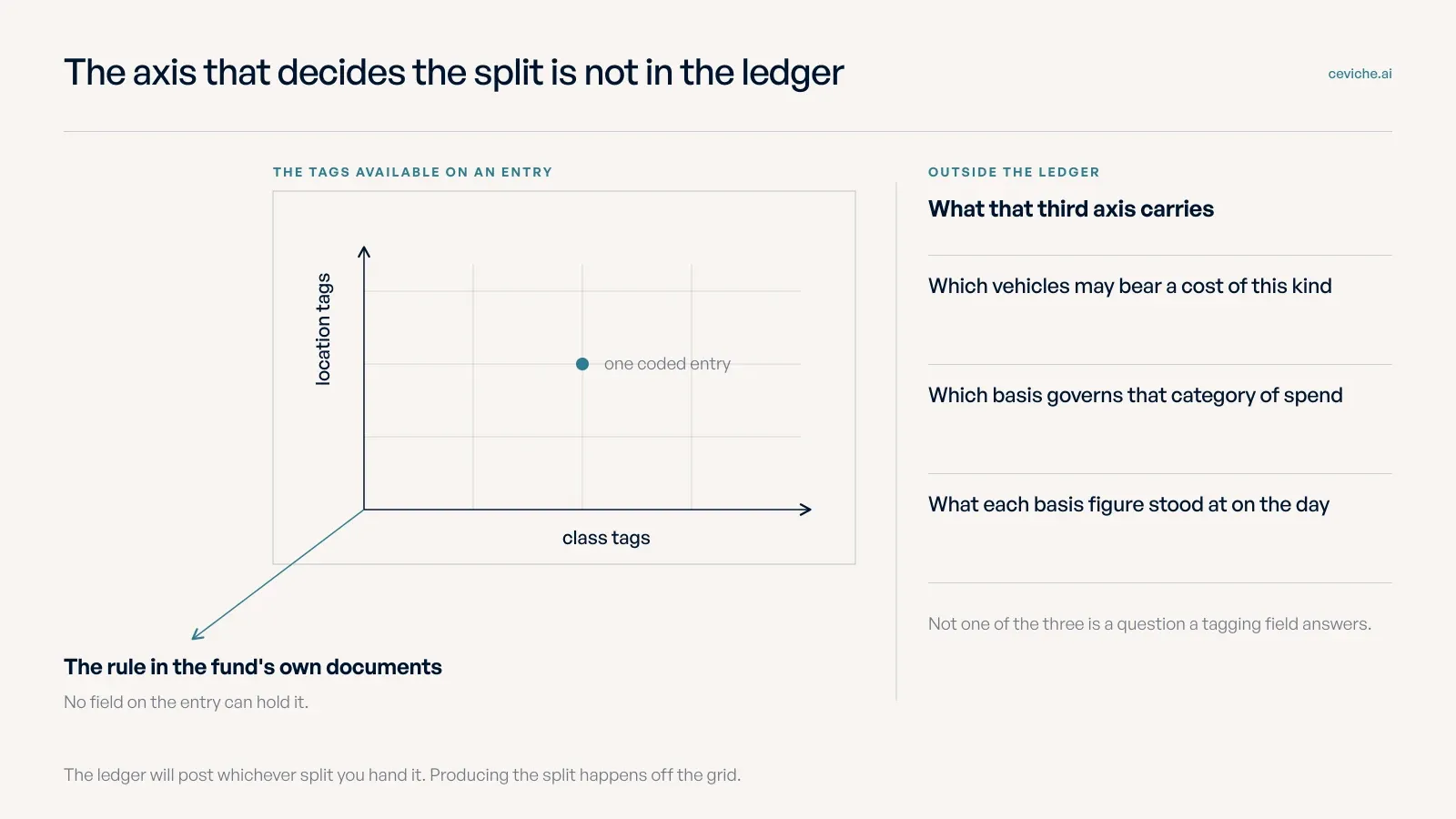
Read those descriptions closely and the constraint shows itself without anyone having to argue it. Both classes and locations are framed as reporting segments of one company, while a fund complex needs to tag an entry by entity, by fund, by deal and by cost type at the same time. A chief financial officer at a growth-equity firm put the result plainly.
"We've jerry-rigged our way there, because they've got classes, they've got names, and we're basically picking at whatever they've given us the option to pick, and we treat that as a dimension."
The journal entry is how a split actually lands, whichever tags carry it. And this is the majority case rather than an edge one. Of the 80 fund finance teams we spoke with in 2026, QuickBooks was the management-company general ledger for 51%, with NetSuite at 23%.
Give QuickBooks its due, since most pages on this topic will not. A chief financial officer at a small multi-vehicle manager described his month without flattering himself or the software. "We have QuickBooks open, and I'm going through there, and I'm either allocating to funds or to portcos or back to employees. Relatively manual, but there are schemes in QuickBooks you can set up, so if every month you have publication charges that get distributed equally, QuickBooks lets you tag that and it does the allocations for you." His qualifier came straight after. "But it's all of the one-off travel things where you really have to pay attention and make sure it's getting allocated to the right place." Recurring and evenly split is handled fine, and everything else is the work.
Does Intuit Enterprise Suite solve it?
Partly, and more than most competitors will admit.
Intuit's own documentation states that "With Intuit Enterprise Suite, you can directly allocate portions of a transaction directly from your bank feed, expense, check, or bill form to the different companies involved in the transaction. Just enter a percentage to allocate to each business in the allocation form and Intuit Enterprise Suite handles the correct accounting based on your intercompany account mapping." It names five things around that allocation, and each answers a real objection to doing this in a ledger:
- an audit log
- attachments on the intercompany allocation, reviewable on individual companies during an audit
- item-level allocation
- support for dimensions and projects
- the ability to edit an allocation without deleting and re-creating it
Read together with the intercompany account mapping behind it, that is real due to and due from machinery rather than a marketing claim, and funds are noticing. One fund finance leader running the tier described "additional dimensional slices" beyond class and location, and told us he had turned one of them into an allocation flag, a bare yes or no marking whether a transaction needs splitting at all. Scoping the work that way costs nothing and beats a rule engine at the first pass. Elsewhere, a chief financial officer treated the tier as a substitute for migrating rather than a step toward it, upgrading while the larger platform question stayed open.
So the dimension constraint moves on this tier. What does not move is the sentence in the middle of Intuit's own description. Just enter a percentage. Nobody hands you the percentage.
Check who holds the keys before assuming the tier settles it. Intuit's shared chart of accounts documentation states that you "can only consolidate, add, or edit the chart of accounts from the parent company" and that "You must be the Primary Admin." At a fund whose books are outsourced, the parent company is frequently not the firm.
The part the ledger never sees
Fund expense allocation is the work of dividing a shared cost across the fund entities, SPVs, and management company it served, applying the methodology each vehicle's governing documents support, producing the resulting journal entries, and recording the basis for each split in a form an auditor or examiner can sample.
Take a $24,000 annual compliance-software subscription paid by the management company and allocable to the funds, on a committed-capital basis. Fund I is at $150 million, Fund II at $300 million and a co-invest vehicle at $150 million, so a $600 million denominator gives 25%, 50% and 25%, which is $6,000, $12,000 and $6,000. Those three numbers are the only thing the ledger ever receives.
Now run the next quarter. Fund III closes at $200 million and joins the pool, so the denominator is $800 million and the shares become 18.75%, 37.5%, 18.75% and 25%, or $4,500, $9,000, $4,500 and $6,000. Nothing about the expense changed. The structure underneath it did. And if the co-invest vehicle's own documents do not permit that category of cost, it drops out and the remaining three re-split on a $650 million base, changing every number again.
That is three judgments before a percentage exists. Someone has to establish which entities are eligible under their governing documents, which basis applies to this category of cost, and what the basis figures were on the relevant date. A ledger will post any split you give it, and none of those three is a ledger question. It is why 81% of the same teams were still doing this work in Excel and 92% were running allocations through systems with no connection between them, whichever ledger sat at the end of the chain. The shape of the problem across ledgers is in our guide to multi-entity accounting software.
The boundary between the ledger and the layer
A controller at a private equity firm gave us the cleanest account of why a native intercompany function gets dropped, and arithmetic has nothing to do with it. She used the built-in allocation and the entry landed correctly. What did not follow it across was the paperwork. She was still opening the fund file, approving the journal entry there and attaching the invoice herself. Once she was doing all of that by hand anyway, she said, the function had stopped saving her anything.
That is the boundary question, and buyers ask it sharply once a ledger is actually connected rather than during a demo. The four we hear most are worth writing down. Does a comment stay in the allocation tool or go to the ledger too? Where does a correcting entry get made? What is going into the ledger right now and what is not? And can you show me what those entries look like from the ledger's side, in the ledger's own reports?
Two answers separate a layer from a dependency. A correction belongs in the ledger, which is why editing an allocation rather than deleting and re-creating it matters. And the toughest requirement anyone has handed us came from a chief financial officer on QuickBooks, who refused a link back to the vendor's system as the audit trail. He wanted the working attached to the journal entry as a file, sitting in the ledger, on the grounds that the ledger will still be his in ten years and the vendor might not be. Support that only resolves inside the tool that produced it does not survive losing the tool. That is the working version of the audit-trail gap 49% of teams told us they have.
One unglamorous detail out of our own engineering, of the sort nobody meets until month two. Rebuild a bill in QuickBooks and its line identifiers do not survive the rebuild. Anything fastened to a line, an approval, a split, a comment, comes loose the first time that happens. Track allocation at line level and you have to mint and keep your own line identity to do it.
Who owns your QuickBooks?
Frequently not you, and it decides more than it sounds like it does.
At one venture firm a single provider handles fund administration and the management-company books alike, and the QuickBooks Online license sits with that provider. It posts the entries, drafts the intercompany schedule, and sends it over for review and sign-off, sometimes twice before it settles. The controller had already walked into the consequence: an earlier attempt to connect another tool to QuickBooks Online failed, because a license she does not hold means an app connection she cannot authorize.
Anyone planning to put a layer on QuickBooks has to settle that first, working out who the Primary Admin on the file is, whose approval authorizes a connection, and how a change gets requested. It is a conversation with your administrator rather than a software question, and it belongs at the front of an evaluation instead of in week six.
Should you move off QuickBooks?
Both answers are defensible. Two finance leaders we spoke with want off it and are planning around a migration. A third runs QuickBooks in house, with bill pay and an expense tool feeding it and journal entries carrying the allocations, and was asked whether he expected to stay. "For the next few years, yeah. It does what we need it to do. Sure, five or eight years down the line we might think about it, but for now, QuickBooks."
He allocates by assets under management or deal count through manual journal entries, which means his ledger is doing its job and his quarter is still expensive. A migration replaces the system that records the answer. It does not touch the work of producing the answer, which is where the time goes. If the reason you are shopping for a new ledger is that allocation hurts, a new ledger will not fix it, and you will find that out a year and a chart-of-accounts rebuild later. The products built for the work itself are ranked in our guide to the best fund expense allocation software.
Ceviche publishes this page and sells software in the expense allocation category, so read our own entry with that in mind.
Where does Ceviche fit?
Ceviche fits when you are staying on QuickBooks, the ledger is not what is failing, and the work still landing in a spreadsheet is deciding which entities bear a shared cost and in what proportion. On exactly this stack, Bill.com feeding QuickBooks Online, Flybridge moved its quarterly allocation across 18+ fund entities out of spreadsheets without migrating its ledger. On the Enterprise tier, with a short list of percentages that hold steady quarter to quarter, the feature already in your subscription will post them and you should not buy anything. That layer is our own fund expense allocation software.
FAQ
Can you do fund accounting in QuickBooks? For a private fund, partly. You can keep separate books per entity, tag transactions with classes and locations, and post the intercompany entries a split produces. Intuit's documentation does not describe deciding the split itself, and that methodology comes from each vehicle's governing documents while the basis figures move every time a vehicle closes. Intuit's own fund accounting page addresses the nonprofit meaning of the word.
If an allocation is wrong, can I correct the journal entry in QuickBooks, or do I have to reverse and re-post? The correction belongs in the ledger, which is the right instinct. On the Enterprise tier, Intuit's documentation states you can edit an allocation rather than delete and re-create it. On standard QuickBooks a correcting or reversing journal entry is the mechanism. Either way, ask any tool in front of the ledger what a correction does to its own record of the original split.
Does the allocation write back upstream to the bill-pay and card tools, or only downstream into QuickBooks? Downstream. The spend and payables tools are where the expense originates, and the ledger is where the allocated entries land. Buyers frequently assume the flow runs both ways, so a recode after the fact updates the ledger rather than the card or bill-pay record. Confirm the direction explicitly before assuming your upstream tools will reflect a change.
If our administrator runs our QuickBooks, whose decision is it to connect anything to it? Theirs, in practice. Whoever holds the license and the Primary Admin role authorizes app connections, and at firms whose books are outsourced that is the administrator rather than the firm. Ask early who the Primary Admin is and how a connection gets approved. This routinely determines the timeline more than the software does.
Once an expense is allocated outside QuickBooks, what does it look like inside QuickBooks? It should look like ordinary journal entries, coded to the entities that bore the cost, with the supporting document and the arithmetic attached to the entry rather than parked in another system. Ask to see the ledger's own reports rather than a vendor screen during evaluation. If the split only makes sense inside the vendor's interface, the ledger has the number without the reasoning.
Do we have to replace QuickBooks to fix allocation? No, and the reason is structural. The allocation happens before the ledger sees anything, in the decision about which entities are eligible and on what basis, so moving the ledger moves the recording and leaves the deciding where it was. Firms that migrate for this reason usually find the spreadsheet survived the migration intact.