
TL;DR. A capital call is a GP's formal demand that LPs send in part of their committed capital, usually on 10 to 30 days' notice. The fund books a subscription receivable and credits each LP's capital account pro rata at notice, then records cash on receipt. Expenses and gains are allocated back against those same accounts each period.
The lifecycle in one pass
Five events, repeated for ten years. An LP signs a subscription agreement and commits capital, which creates an obligation and moves no cash. The GP finds a deal and issues a capital call against that commitment. The LP wires the money and the fund records a contribution. The fund deploys the cash, incurs fees and expenses, and allocates the results back to each partner's capital account. Eventually the fund realizes an investment and distributes proceeds, which reduces those capital accounts again.
Every other explanation stops after step three. The accounting starts there, so that is where most of this article sits.
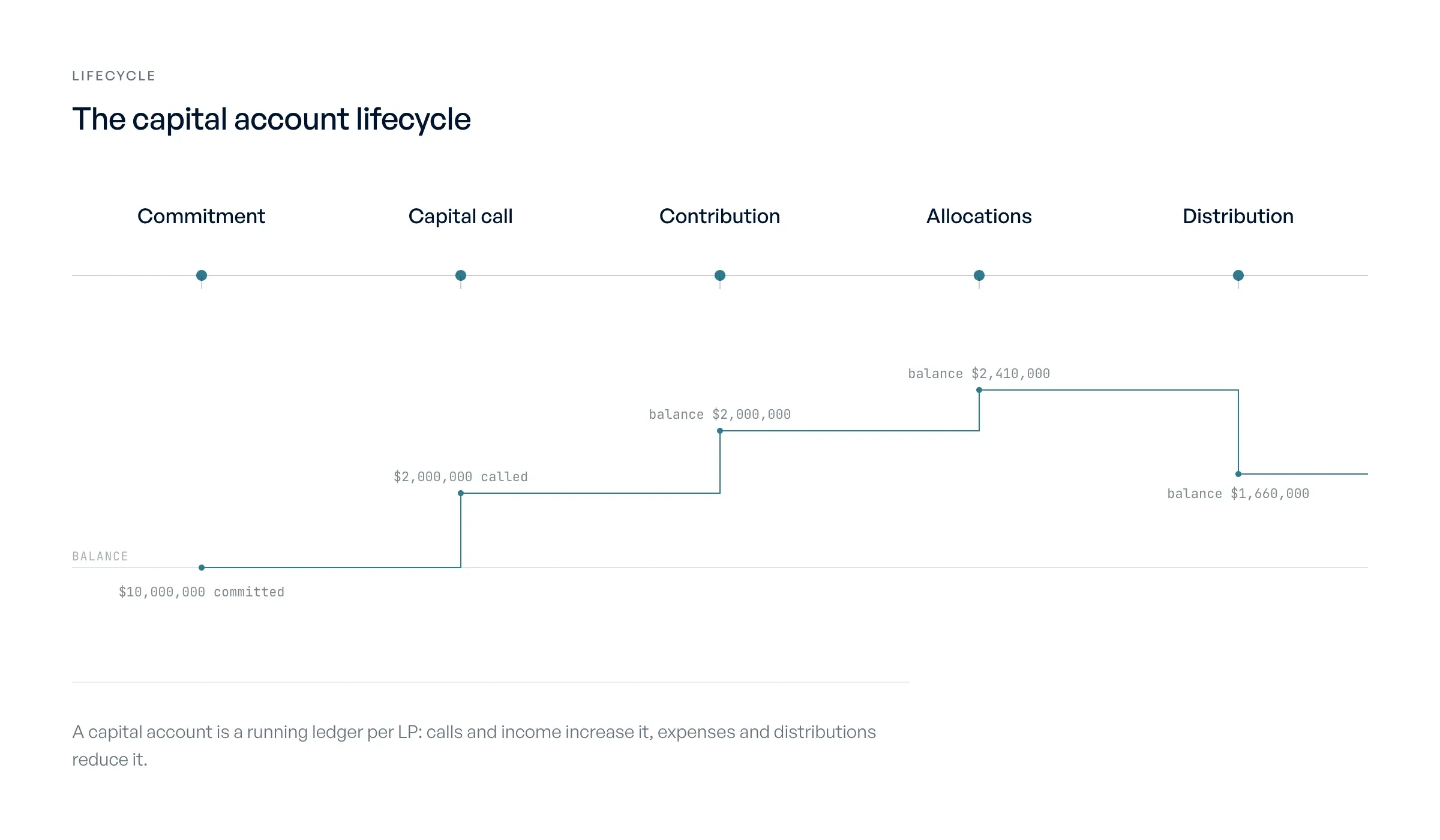
A capital account is a running ledger per LP: calls and income increase it, expenses and distributions reduce it.
What is a capital call?
A capital call, or drawdown, is a general partner's formal demand that limited partners transfer a portion of their committed capital to the fund, usually within the notice period the LPA specifies. It funds investments, management fees, and fund expenses. Each call reduces an LP's uncalled commitment and increases its paid-in capital.
The vocabulary matters because the four terms get used loosely and mean different things on a capital statement. Commitment is what the LP promised in the subscription agreement. Called or drawn is the cumulative amount the GP has demanded. Paid-in or contributed is what actually arrived, which differs from called whenever a wire is outstanding. Uncalled or dry powder is commitment less called, and it is the number LPs track for their own liquidity planning.
The reason funds work this way is straightforward. A GP cannot deploy $50 million on day one because the deals do not exist yet, and capital sitting in the fund's bank account earns close to nothing while dragging on the internal rate of return the fund reports. Calling capital as deals close keeps the denominator small. The tradeoff lands on the LP, who has to hold liquidity against a call that can arrive with two weeks' notice.
Notice periods, permitted uses, default remedies, and whether the GP may recycle returned capital are all LPA terms, not market conventions. Read the document rather than an article, this one included, before relying on any of them.
Subscription credit facilities complicate the picture and are worth knowing about. A fund borrows against its LPs' uncalled commitments to close a deal quickly, then calls capital later to repay the line. This smooths call cadence and flatters early IRR, since the clock on LP capital starts later. It also adds interest expense that has to be allocated, and it means the calendar of calls no longer matches the calendar of deals.
What is a capital account?
A capital account is the running record of one limited partner's economic position in a fund: capital contributed, that partner's share of income, expenses, and realized and unrealized gains, less distributions received. It is maintained per partner for the life of the fund and is the basis for the partner's capital statement and Schedule K-1.
A capital account is not one number, it is a roll-forward. Opening balance, plus contributions, plus or minus the partner's allocated share of the period's income, expenses, and gains, less distributions, equals closing balance. Do that per partner, per period, for the life of the fund.
Three versions of the balance exist at once and get confused constantly. GAAP capital follows the AICPA's investment companies guide and carries investments at fair value. Tax capital follows partnership tax rules and drives the K-1. Distributable capital reflects what the waterfall says a partner would receive if the fund liquidated today, which is where carried interest enters. They rarely agree, and reconciling them is a normal part of the year-end file rather than a sign anything is wrong.
The statement LPs receive against these accounts increasingly follows ILPA's reporting template, which is also why fee and expense presentation has become a more exacting exercise than it was a decade ago.
Worked example where Fund I calls $2 million across four LPs
Fund I closed on $50 million from four limited partners. This is the fund's first call.
| Limited partner | Commitment | Pro rata share |
|---|---|---|
| LP A | $20,000,000 | 40% |
| LP B | $15,000,000 | 30% |
| LP C | $10,000,000 | 20% |
| LP D | $5,000,000 | 10% |
| Total | $50,000,000 | 100% |
The GP calls $2,000,000: $1,800,000 to fund an investment in a portfolio company, $150,000 for the quarterly management fee, and $50,000 for audit and legal costs. Allocated by commitment percentage:
| Limited partner | Called this cycle |
|---|---|
| LP A | $800,000 |
| LP B | $600,000 |
| LP C | $400,000 |
| LP D | $200,000 |
| Total | $2,000,000 |
Step 1: Book the call at notice
| Account | Debit | Credit |
|---|---|---|
| Subscriptions receivable | $2,000,000 | |
| Partners' capital, contributions | $2,000,000 |
This is a policy choice worth deciding once and documenting. Some funds record the receivable when the notice goes out, which shows the commitment on the balance sheet and matches the period the call belongs to. Others record nothing until cash lands, which keeps the balance sheet clean but understates the fund's position at a quarter-end that falls inside a call window. Auditors accept either; what they object to is a fund that switches between them.
Step 2: Record the contributions as cash arrives
| Account | Debit | Credit |
|---|---|---|
| Cash | $2,000,000 | |
| Subscriptions receivable | $2,000,000 |
In practice this is four entries, not one, because four wires arrive on four days. Until the last one clears, subscriptions receivable carries a balance and the fund is short of the cash it just committed to a closing.
Step 3: Deploy the capital
| Account | Debit | Credit |
|---|---|---|
| Investments at fair value, Portfolio Co | $1,800,000 | |
| Cash | $1,800,000 |
Step 4: Accrue the management fee and fund expenses
| Account | Debit | Credit |
|---|---|---|
| Management fee expense | $150,000 | |
| Due to management company | $150,000 | |
| Professional fees expense | $50,000 | |
| Cash | $50,000 |
The management fee credit lands in an intercompany payable rather than straight to cash, because the fee is owed to a related entity. That balance is one half of a pair: the management company carries the matching receivable on its own books, and the two have to agree at every close. This is the due to and due from relationship that quietly accumulates errors when nobody reconciles it, and the intercompany accounting problem that grows with each vehicle added.
Step 5: Allocate the period's expenses to partners' capital
Total expenses of $200,000 allocated by the same pro rata percentages:
| Account | Debit | Credit |
|---|---|---|
| Partners' capital, LP A | $80,000 | |
| Partners' capital, LP B | $60,000 | |
| Partners' capital, LP C | $40,000 | |
| Partners' capital, LP D | $20,000 | |
| Expense allocation | $200,000 |
The capital account roll-forward
After one cycle, from a standing start:
| LP | Commitment | Contributions | Expenses allocated | Capital account | Uncalled |
|---|---|---|---|---|---|
| LP A | $20,000,000 | $800,000 | ($80,000) | $720,000 | $19,200,000 |
| LP B | $15,000,000 | $600,000 | ($60,000) | $540,000 | $14,400,000 |
| LP C | $10,000,000 | $400,000 | ($40,000) | $360,000 | $9,600,000 |
| LP D | $5,000,000 | $200,000 | ($20,000) | $180,000 | $4,800,000 |
| Total | $50,000,000 | $2,000,000 | ($200,000) | $1,800,000 | $48,000,000 |
The check is in the last two columns. Total partners' capital of $1,800,000 equals the investment carried at cost, which it should, because every dollar called either bought an asset or paid an expense that was charged back to the partners. Uncalled commitments fell by exactly the amount called. If either of those ties fails, the allocation is wrong before anyone gets to a K-1.
Run that table forward eight years, add unrealized fair value movements, follow-on investments, recycled proceeds, a subsequent close with equalization interest, and a partner who transferred half its interest in year four, and you have the actual job.
The wire that does not arrive on time
The example above assumes money moves when the notice says it will. One PE firm we spoke with described a vendor payment caught at the last step because a line was not in US dollars, which sent it back to the start of the approval chain and left it outstanding for another 30 to 45 days; capital-call cash has the same exposure whenever a wire fails validation, and the accounting sits open the whole time.
That gap is more expensive than it looks. Subscriptions receivable stays on the balance sheet across a reporting date. The fund may be drawing on a subscription line to cover a closing it has already funded on paper. The LP's capital account shows a contribution that has not arrived, or does not show one that has, depending on the policy chosen in step 1. And if the delay crosses a quarter-end, someone explains the reconciling item to an auditor.
Predictable cadence is the practical defense. A fund calling on a set quarterly rhythm, with the same notice window each time, gets fewer late wires than one that calls opportunistically, because LP operations teams can plan against it.
Expense allocation feeds the capital account
Step 5 above is where this connects to the harder problem. The entry was clean because the example had one fund and one expense pool. Real firms have neither.
A single outside-counsel invoice routinely serves Fund I, Fund II, a co-invest SPV, and the management company, at different methodologies per line. Before anyone can allocate expenses to partners' capital, someone has to decide how much of that invoice belongs to this fund at all. That decision is upstream of every entry on this page, and it is the one that fails: of the 80 fund finance teams we spoke with in 2026, 81% were still making it in a spreadsheet.
The consequence lands in the capital accounts. Allocate too much of a shared cost to Fund I and every LP in Fund I carries a capital account that is wrong, quietly, until someone tests it. Fee and expense allocation is a standing focus of the SEC's Division of Examinations, and the test is whether the methodology applied matches what the fund documents permit. The capital account is where the answer shows up.
Distributions and why the waterfall is a separate problem
When Portfolio Co is sold for $3,000,000, the fund books the realization:
| Account | Debit | Credit |
|---|---|---|
| Cash | $3,000,000 | |
| Investments at fair value, Portfolio Co | $1,800,000 | |
| Realized gain on investment | $1,200,000 |
Allocating that $1,200,000 is where the simple pro rata math ends. The LPA specifies an order: return of contributed capital, then a preferred return to LPs, then a GP catch-up, then a split of the remainder. Carried interest means the GP's share of the gain is not its share of the commitments, so the gain allocation and the contribution allocation use different percentages, and a clawback provision may reverse part of it years later.
That is partnership accounting rather than capital call mechanics, and it is the reason firms outgrow spreadsheets for capital accounts before they outgrow them for anything else. Our guide to partnership accounting software covers the tooling side.
Where does Ceviche fit?
Ceviche handles the step that feeds the entries on this page: applying the firm's rules for how a shared cost splits across funds, SPVs, and the management company before anything reaches a partner's capital account. It reads the spend and AP systems the firm already runs, applies the methodology each LPA supports per invoice line, and posts audit-ready journal entries to QuickBooks Online, NetSuite, or Sage Intacct, each carrying its documented basis. Flybridge ran this exact change across 18+ fund entities, moving quarterly allocation out of spreadsheets on top of QuickBooks Online and Bill.com and into Ceviche, which posts to QuickBooks Online with a full audit trail. See how Ceviche handles fund expense allocation.
Frequently asked questions
What is a capital call in private equity? A formal demand from the general partner that limited partners transfer part of the capital they committed at subscription. The GP issues it when the fund needs cash for an investment, management fees, or fund expenses, and the LPA sets the notice period and permitted uses. Each call converts uncalled commitment into paid-in capital and increases the LP's capital account.
How is a capital call recorded in the fund's books? Two entries. On notice, debit subscriptions receivable and credit partners' capital for the amount called. When each wire arrives, debit cash and credit subscriptions receivable. Some funds skip the first entry and record only on receipt, which is acceptable if applied consistently. Each LP's share is then tracked in that partner's individual capital account.
What is the difference between a capital call and a capital contribution? The call is the demand; the contribution is the money. A GP calls $2 million and receives four contributions totaling $2 million, usually over several days. The distinction matters at a reporting date, because called-but-unfunded amounts sit in subscriptions receivable, and paid-in capital reflects only what has actually arrived.
What happens if you don't respond to a capital call? The LPA's default provisions apply, and they are deliberately harsh to protect the other partners. Common remedies include interest on the overdue amount, forfeiture of a portion of the defaulting partner's capital account, loss of voting rights, forced sale of the interest at a discount, and exclusion from future investments. GPs generally negotiate before enforcing, since a default is a problem for the fund's own liquidity.
What is an example of a capital call? A fund with $50 million in commitments calls $2 million to fund a $1.8 million investment plus $200,000 of fees and expenses. An LP that committed $20 million, or 40% of the fund, wires $800,000 and sees its uncalled commitment fall from $20 million to $19.2 million. Its capital account rises by $800,000 and then absorbs its 40% share of the period's expenses.
What is a capital call in private credit? Mechanically identical, with a different rhythm. Credit funds deploy into loans that fund and repay on their own schedules, so calls tend to be more frequent and smaller than in buyout funds, and many credit vehicles recycle repaid principal rather than distributing it. Subscription lines are used heavily to bridge loan closings, which means the calls often follow the deployment rather than preceding it.