TL;DR. Fund accounting is a function: keeping a fund's books, computing NAV, maintaining capital accounts. Fund administration is the outsourced service that performs that function plus investor servicing, capital activity, and compliance. Accounting is a subset of administration. Hiring an administrator moves the posting off your desk, not the allocation judgment behind it.
Three different things get called the same two words
Ask five people in fund finance to define these terms and you get five answers, because the words carry three separate meanings and nobody signals which one they are using.
The first is a function: the work of keeping a fund's books. The second is a service: the third-party firm you pay to do that work and a good deal more. The third is a job title: the person at the administrator posting your entries is a fund accountant, and their manager is in fund administration, and both work at a company that calls itself a fund administrator.
So "we do fund accounting in-house" and "we use a fund administrator" are not opposites, and they are not even claims about the same category. The first describes who performs a function. The second describes a commercial relationship. A firm can truthfully say both at once, and most do.
Hold that distinction, because it decides the only question that matters when you are signing an administration contract: what is still yours after the ink dries.
What is fund accounting?
Fund accounting is the function of keeping an investment fund's books: recording transactions, maintaining the general ledger, computing net asset value and performance, maintaining each partner's capital account, and producing the financial statements LPs and auditors rely on. It is work, not a vendor. A GP can perform it in-house or buy it as part of administration.
In private funds the term means something narrower than it does in the nonprofit world, which is worth saying because the two SERPs bleed into each other. A nonprofit does fund accounting to segregate donor-restricted money into separate reporting funds. A private fund does fund accounting because a closed-end vehicle with a ten-year life, drawdown capital, and a waterfall cannot be described by a single corporate P&L.
The mechanics that follow from that: committed versus called versus uncalled capital tracked per LP, a capital account per investor maintained across the fund's life, management fees and carry computed against the LPA, and distributions run through a waterfall. Financial statements come out under the AICPA's investment companies guide. None of that is optional and none of it depends on who performs it.
What is fund administration?
Fund administration is the outsourced service a GP buys to run a fund's middle and back office. It covers fund accounting plus investor servicing and onboarding, capital calls and distributions, the investor register and reporting package, AML and KYC checks, and support for audit, tax, and regulatory filings.
The bundle is wider than the books. Investor servicing is the piece GPs underestimate: subscription documents, the register, the LP portal, and the queries that arrive the week after every quarterly package goes out, increasingly formatted against ILPA's reporting template. Compliance is the other: AML and KYC on each investor, FATCA and CRS reporting, and the assembly work behind Form PF and the annual audit.
The administrator does not sign your audit opinion or file your tax return. It reconciles and assembles what the auditor and the tax preparer need, which is most of the labor and none of the liability.
Fund administration vs fund accounting at a glance
| Fund accounting | Fund administration | |
|---|---|---|
| What it is | A function (work performed) | A service (a firm you contract) |
| Scope | GL, NAV, capital accounts, fees, statements | Fund accounting plus investor servicing, capital activity, compliance, governance |
| Who performs it | In-house team, an administrator, or both | A third-party administrator |
| What you buy | Software, or headcount | A contract with an SLA and a fee |
| Relationship | One function inside the mandate | The mandate |
| What it does not cover | Deciding how a shared cost splits | Deciding how a shared cost splits |
The last row is the one page one leaves out, and it is the reason this comparison is worth 1,800 words instead of a sentence.
What stays in-house when you outsource administration?
Every page-one result for this term is published by a firm that sells administration or sells software to administrators. That shapes what gets written. The honest version, from the GP side of the table:
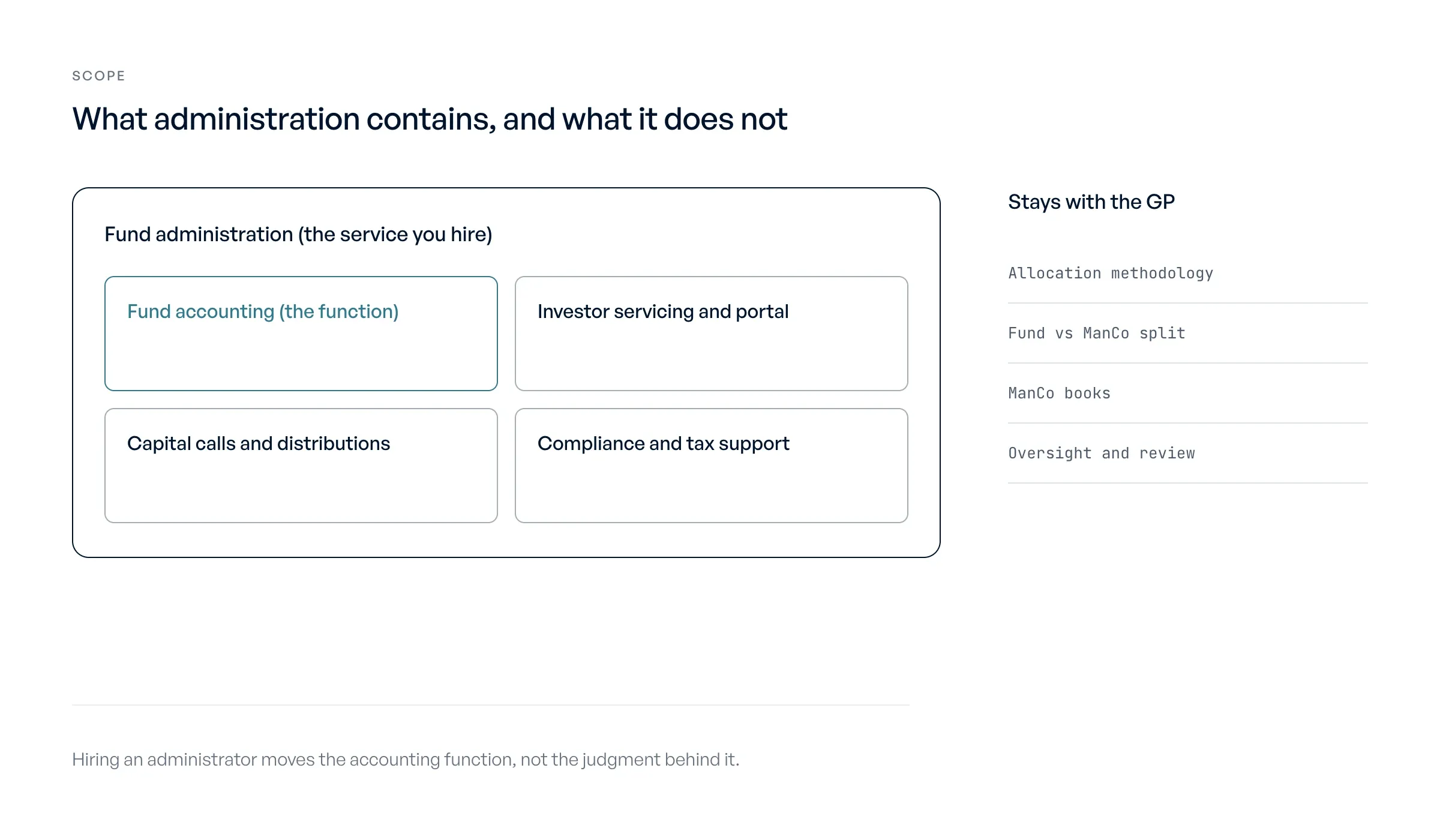
Hiring an administrator moves the accounting function, not the judgment behind it.
Allocation methodology stays yours. The administrator posts the split you hand it. Deciding that a diligence line follows invested capital while a formation line follows specific identification, and that both are supported by the LPA, is a judgment call your controller makes. Of the 80 fund finance teams we spoke with in 2026, 81% still ran that judgment through a spreadsheet, and plenty of them already had an administrator posting clean entries on top of it.
The fund-versus-management-company line stays yours. Which costs the fund bears and which the ManCo absorbs is written into fund documents you negotiated, not into your administrator's service agreement. 96% of the teams we interviewed named multi-entity allocation a core complexity of their close.
The management company's own books usually stay yours. Most administration contracts cover the funds. Payroll, rent, the firm's own operating costs, and the intercompany due-to and due-from between the ManCo and the vehicles typically sit on a general ledger your team runs.
Oversight stays yours. Someone has to review what the administrator produced before it goes to LPs, which means someone in-house understands the numbers well enough to catch a wrong one.
One VC firm's fund administrator was onboarded to their allocation tooling with read-only production access. The admin executes, and the in-house controller still owns methodology and review. That is the shape of a working relationship, and it is what "outsourced" actually means in practice: the labor moved, the accountability did not.
The structural reason this work does not travel is that it sits between systems rather than inside one. 92% of the teams we interviewed run allocations across disconnected systems that do not talk to each other. An administrator is one more node on that chain, not the thing that connects it.
One invoice with two jobs and one judgment call
An outside-counsel invoice arrives at 14 lines and $61,400. The firm runs Fund II ($150M committed), Fund III ($250M), Fund IV ($100M, closing now), a co-invest SPV, and the management company.
Four blocks of work, four methodologies:
| Block | Amount | Methodology | Result |
|---|---|---|---|
| Deal diligence, one portfolio company | $28,000 | Invested capital in the deal (Fund III $21M, SPV $7M) | Fund III $21,000 · SPV $7,000 |
| Fund IV formation | $19,400 | Specific identification | Fund IV $19,400 |
| General fund matters | $9,600 | Pro rata by committed capital across active funds | Fund II $2,880 · Fund III $4,800 · Fund IV $1,920 |
| Employment law advice for the firm | $4,400 | Management company expense per the LPA | ManCo $4,400 |
Which rolls up to five entity-level entries:
| Entity | Amount |
|---|---|
| Fund II | $2,880 |
| Fund III | $25,800 |
| Fund IV | $21,320 |
| Co-invest SPV | $7,000 |
| Management company | $4,400 |
| Total | $61,400 |
Now separate the three things we defined. Fund accounting is posting those five entries and the resulting due-to and due-from balances. Fund administration is the service that performs the posting and then reflects it in the quarterly package. Deciding that the diligence block follows invested capital rather than committed capital, that the employment advice is a ManCo cost the fund cannot bear, and that all four choices survive an examiner reading them against the LPA: that is neither, and it is the part that took your controller an evening.
Fee and expense allocation is a standing focus of the SEC's Division of Examinations, and what an exam samples is the reasoning behind those splits. Your administrator documents what it posted. It cannot document why you chose it.
Which one do you actually need to buy?
The question is usually asked as "administration or accounting software," and it is the wrong shape, because they answer different needs.
Buy administration when the constraint is headcount and credibility: you are raising from institutional LPs who expect an independent party on the books, you do not want to hire two fund accountants ahead of the next close, or you need multi-jurisdictional coverage a single fund cannot justify. Choosing the right fund administration software or administrator is its own evaluation, and the question worth adding to the standard checklist is how they handle multi-entity expense allocation and what audit trail they hand back.
Buy fund accounting software when you are performing the function yourself and the constraint is the system: you have outgrown a spreadsheet for capital accounts, or your GL cannot handle the entity count.
Buy neither, and instead fix the layer between them, when the books are fine and the close still breaks on splitting costs across entities. That is a third category most buyers do not know exists, and it is where the retained work above actually lives.
If the real question underneath is whether to run administration internally at all, the in-house decision has a different set of tradeoffs, and most growing firms land on a hybrid rather than either pole. For the wider view of what an administrator does in private equity specifically, see our guide to fund administration in private equity.
Where does Ceviche fit?
Ceviche is the allocation layer that sits between the spend systems funds already run and the general ledger, which is the work administration hands back to you. It applies your methodologies per the LPA, writes audit-ready journal entries to QuickBooks, NetSuite, or Sage with the rationale attached, and leaves your administrator to do what it does. Flybridge runs it across 18 fund entities on QuickBooks Online and Bill.com, went from a full day of spreadsheet allocation each quarter to a hands-off run at about 99% accuracy, and onboarded in two weeks. See how Ceviche handles fund expense allocation.
FAQ
What is the difference between a fund administrator and fund accounting? A fund administrator is a firm; fund accounting is a function. The administrator performs fund accounting for you, along with investor servicing, capital calls and distributions, reporting, and compliance support. Fund accounting is one line item inside that mandate. You can perform fund accounting without an administrator, but you cannot hire an administrator that does not perform fund accounting.
What are the three types of fund accounting? That question comes from the nonprofit and government sector, where fund accounting segregates money into unrestricted, temporarily restricted, and permanently restricted funds. Private funds use the term differently. There is no three-type taxonomy; the work splits by vehicle type instead, with private equity, venture, credit, and real estate each carrying different capital-account and valuation mechanics.
Does a fund administrator handle expense allocation? An administrator posts the allocation. It does not decide it. The methodology for splitting a shared or legal invoice across funds, the management company, and co-invest vehicles, plus the audit trail behind each line, stays with the GP. In our 2026 research across 80 fund finance teams, 81% still ran that allocation in Excel, and many of them already had an administrator.
Is fund accounting a subset of fund administration? As a function inside a service contract, yes. Every administrator performs fund accounting, and no administrator performs only fund accounting. The containment breaks down when you treat the terms as job categories rather than scopes, which is why a fund accountant at an administrator and a fund accountant at a GP can do very different work under the same title.
Do I need fund accounting software if I already have an administrator? Often yes, for the management company's own books, which most administration contracts do not cover. The firm's payroll, rent, and operating costs still need a general ledger, and the intercompany balances between the ManCo and the funds get maintained there. The administrator's system holds the fund side, not both sides.
What is the difference between a fund accountant and a fund administrator as job titles? A fund accountant posts transactions, reconciles positions, computes NAV, and prepares statements for a set of funds. A fund administrator, used as a job description rather than a company name, covers the wider operational role: investor onboarding, capital call and distribution processing, reporting cycles, and compliance checks. At a large administrator these are separate teams; at a small one, the same person.