
TL;DR. A VC finance team runs seven layers: banking, cards and spend, bill pay, a general ledger, fund administration rails, expense allocation, and close and LP reporting. Across 80 fund finance teams in 2026, that usually means Ramp or Brex, Bill.com, QuickBooks Online, and an administrator, with allocation still in Excel.
Two kinds of "VC stack" article and neither is about your job
Search for the tools a VC finance team uses and you get two genres, both written for somebody else.
The first is the VC tech stack: relationship-intelligence CRM, sourcing databases, expert networks, data rooms, portfolio monitoring, meeting notes. Directories index 300 to 600 vendors in these categories. Useful, and entirely about the investment team.
The second is the startup finance stack: how a Series A company should set up banking, bookkeeping, payroll, and forecasting. Also useful, and written for your portfolio companies rather than for you.
The two or three people who close the books across your funds, your SPVs, and your management company are not the audience for either. This is that page. Everything quantified below comes from the 80 PE, VC, growth-equity, and credit fund finance teams we interviewed across 2026, with the venture-specific reading called out where it differs.
The seven layers
| Layer | Purpose | What venture firms run |
|---|---|---|
| 1. Banking | Operating and fund accounts, capital call receipts, wires | Mercury, JPMorgan, First Citizens, regional banks |
| 2. Cards and spend | Employee spend, vendor cards, receipt capture | Ramp 49%, Brex, Expensify 30% |
| 3. Bill pay and AP | Invoice intake, approvals, payment | Bill.com 39%, Ramp Bill Pay, SAP Concur 11% |
| 4. General ledger | The management company's books, often fund cash too | QuickBooks 51%, NetSuite 23%, Sage Intacct 5% |
| 5. Fund administration rails | Formation, SPVs, capital accounts, K-1s, LP portal | Carta, AngelList, an independent administrator |
| 6. Expense allocation | Splitting shared costs across funds, SPVs and the ManCo | Excel, for 81% of teams |
| 7. Close and LP reporting | Consolidation, capital statements, quarterly package | GL reporting plus the administrator plus spreadsheets |
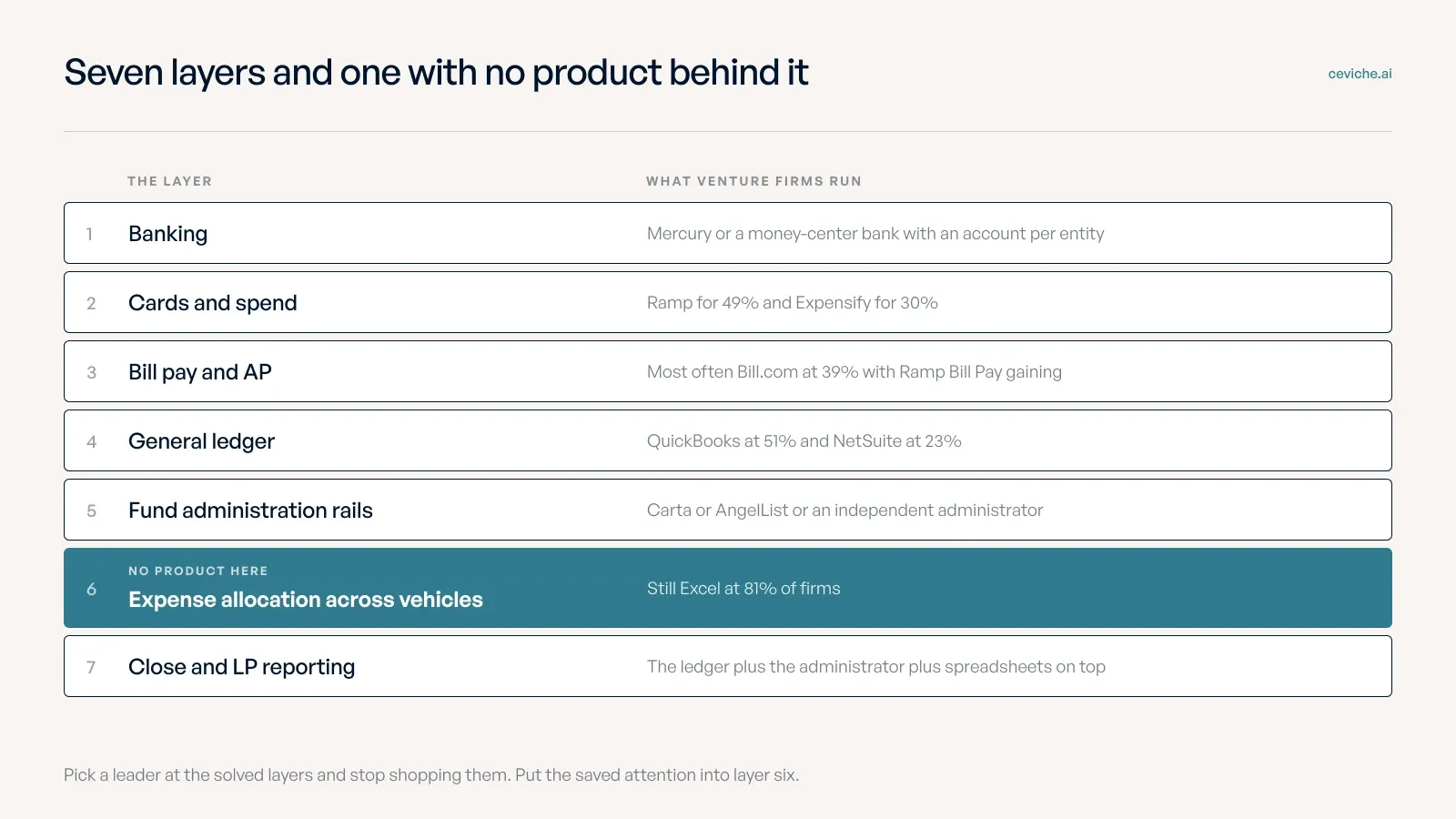
Six of those seven layers have real products with real competition. One is still run in Excel at 81% of firms, which is the whole reason this article has a point of view.
Layer 1: banking
The least interesting layer and the one most likely to change under you.
Venture firms need operating accounts for the management company, separate accounts per fund and often per SPV, clean handling of capital call receipts, and wire discipline that survives an audit. Mercury has taken a real share of the emerging-manager segment, and larger firms sit with money-center or regional banks, frequently in more than one relationship after the 2023 bank failures taught everyone about concentration.
What matters downstream is account-per-entity hygiene. A firm running twelve vehicles with commingled operating cash creates allocation work that no software fixes later. If you are setting up now, separate accounts per vehicle are cheaper than the reconstruction.
Layer 2: cards and spend
This layer is genuinely well served, and a VC CFO should spend very little time shopping it.
Across the 80 teams, Ramp appears in 49% of stacks and Expensify in 30%, with Brex holding a meaningful venture-specific share. Ramp is the momentum leader, and a real portion of that is migration in progress: Brex to Ramp, Bill.com to Ramp Bill Pay. Card issuance, receipt capture, policy enforcement, and accounting sync are commodity capabilities now, and the differences between the leaders are smaller than the switching cost.
The failure mode at this layer is not the tool. It is the data the tool collects.
One venture firm we interviewed pushes roughly 800 card transactions a month through its spend platform. The system works. What breaks is the memo field: when it is blank or wrong, employees end up coding transactions to the wrong entity, and the finance team absorbs the cleanup at close. Eight hundred transactions a month across a dozen vehicles is not a volume problem. It is a metadata problem that surfaces as a volume problem.
The practical control is to make entity selection structural rather than optional. Cards issued per entity, vendors mapped to a default entity, policy rules that reject a submission with no memo. That is cheaper than reviewing 800 lines.
Layer 3: bill pay and AP
Bill.com appears in 39% of stacks and remains the default for invoice intake and approval routing, with Ramp Bill Pay taking share and SAP Concur present at 11%, mostly at larger firms.
The recurring pairing worth naming is Bill.com plus Expensify feeding QuickBooks Online. Flybridge, a venture firm and a Ceviche customer, runs that shape across its fund entities.
Where this layer struggles in venture specifically is invoices that belong to more than one entity, which in a venture firm is most of the meaningful ones. Legal, audit, tax, insurance, data subscriptions, and conference sponsorships routinely serve several funds and the management company at once. AP tools are built to route an invoice to an approver and pay it, not to divide it. So the invoice gets coded to one entity and a journal entry moves the rest later, or it gets split by hand at close.
Layer 4: the general ledger
QuickBooks, Online and Desktop combined, is the management-company GL for 51% of the teams where we captured a primary ledger. NetSuite covers 23%, Sage Intacct 5%, and the remaining 21% is a long tail including Xero, Carta, and Workday.
The venture-specific reading is that QuickBooks persists further up market than its reputation suggests, and it is usually the correct choice. A venture management company is, structurally, a small professional-services shop: payroll, rent, software, travel, professional fees. An ERP records those no better than QuickBooks does.
The migration pattern clusters on QuickBooks Online to NetSuite, and the trigger is entity count and reporting demand rather than AUM. One multi-stage firm we interviewed was mid-migration from QuickBooks Online to NetSuite while simultaneously onboarding a new card platform. Two foundational layers moving at once, which is worth remembering when you read any stack article, including this one: the stack is never static, and a recommendation is a snapshot of a firm that is already changing.
Layer 5: fund administration rails
Venture is the one asset class where the administration layer is genuinely productized. Carta and AngelList cover formation, closings, SPVs, capital accounts, K-1s, and an LP portal, and independent administrators cover the same ground as a service. The providers, their costs, and where software replaces the administrator are in our venture capital fund administration guide.
The decision is mostly about where you want the fund records to live and how easily they come out. A firm that runs its cap table, SPVs, and fund admin in one place gains genuine consolidation and accepts a dependency. A firm with an independent administrator keeps more portability and spends more time on coordination. Neither is wrong, and the comparison across options is in our guide to VC fund accounting software.
What both models share is the boundary. The administrator or the platform maintains capital accounts and posts what it is given. It does not decide how a shared cost divides across your vehicles. That question belongs to layer six.
Layer 6: expense allocation is the layer still run in Excel
Fund expense allocation is the work of dividing a shared cost across the fund entities, SPVs, and management company it served, applying the methodology each vehicle's governing documents support, producing the resulting journal entries, and recording the basis for each split in a form an auditor or examiner can sample.
This is the layer where the stack stops. Start with the audit trail: 49% of the 80 teams we interviewed have a gap in it. Behind that sit the rest of the numbers: 81% still allocate in a spreadsheet, 92% run the work across disconnected systems, and 96% call multi-entity complexity a core problem.
The mechanics of that gap are unglamorous. One firm we spoke with copies memo fields out of its expense reports into Google Sheets by hand in order to allocate intercompany costs. The data exists. It is captured, structured, and sitting in a system. It just cannot get to the ledger with the allocation attached, so a person retypes it into a sheet, applies percentages, and types the result back.
That pattern is the whole story of layer six. Layers two and three hold the transaction. Layers four and five hold the accounts. Nothing carries the decision between them, so a person does, and the close waits on that person.
A worked example with one invoice and four vehicles
A venture firm runs Fund IX ($180M), an opportunity fund ($60M), two active deal SPVs, and the management company. The annual technology and data subscription renews at $54,000, covering a research database the investment team uses, a portfolio monitoring seat, and the firm's document management.
The methodology in the firm's expense allocation policy treats research and monitoring tools as fund expenses attributable to the vehicles they serve, and document management as a management-company cost.
| Component | Amount | Basis | Allocation |
|---|---|---|---|
| Research database | $30,000 | Committed capital across active funds, $180M and $60M | Fund IX $22,500, opportunity fund $7,500 |
| Portfolio monitoring | $15,000 | Positions held per vehicle at year end | Fund IX $9,750, opportunity fund $3,750, SPVs $1,500 |
| Document management | $9,000 | Firm-level, not fund attributable | Management company $9,000 |
| Total | $54,000 |
Three components, three bases, one invoice, and a management-company line that has to stay on the management company because an LP reading the fee and expense disclosure will look for exactly that. The arithmetic takes two minutes. Deciding it, documenting why portfolio monitoring follows positions rather than committed capital, and being able to reproduce that reasoning at audit is the part that takes a controller an afternoon and does not exist in any system afterward.
Layer 7: close and LP reporting
The top of the stack shows every weakness below it.
Consolidation across entities, capital account statements, the quarterly LP package, and the audit support file. Some of this comes from the GL, some from the administrator, and a meaningful share from spreadsheets sitting on top of both. Teams that quantified the allocation portion put it at one to five days per quarter, concentrated at exactly the moment the rest of finance is waiting on those entries.
The close is not slow because anyone's math is weak. It is slow because a person hand-carries every decision between systems, and each carry waits on that person.
Spend your attention on layer six
The buying advice most stack articles will not give: at layers one through five, pick a leader and stop thinking about it. The differences between Ramp and Brex, or between two competent administrators, will not decide your quarter. The switching cost of chasing a marginally better tool at a solved layer is real and the payoff is small.
Spend the attention you save on layer six and on the data quality feeding it. Entity structure in your card program, vendor-to-entity defaults, memo enforcement, and a written allocation methodology are worth more than any additional tool. If your firm has more vehicles than finance people, that ratio is the thing to design around, which is the argument in our guide to fund management software for lean teams.
Where does Ceviche fit?
Ceviche is layer six. It reads the spend and AP systems venture firms already run (Ramp, Bill.com, Brex, Expensify, SAP Concur), applies the allocation methodology each vehicle's documents specify per line, and writes audit-ready journal entries back into QuickBooks Online, NetSuite, or Sage Intacct, rationale on every line, which the administrator in layer five then works from. It is not a ledger, not an administrator, and not a managed service. Flybridge moved quarterly allocation for 18+ fund entities off spreadsheets this way; it now runs through Ceviche on the same QuickBooks Online and Bill.com stack, with a full audit trail back to source documentation. You can see how Ceviche handles fund expense allocation.
Frequently asked questions
What software do VC finance teams use? Most run a spend platform (Ramp in 49% of the stacks we counted, or Brex), Bill.com for AP (39%), QuickBooks Online as the management-company ledger (51%, with NetSuite at 23%), and either Carta, AngelList, or an independent administrator for fund administration. Expense allocation across those vehicles is still done in a spreadsheet at 81% of the teams we interviewed.
What is the difference between a VC tech stack and a VC finance stack? The tech stack serves the investment team: CRM, sourcing, diligence, portfolio monitoring, data rooms. The finance stack serves the two or three people closing the books: banking, cards, AP, the general ledger, fund administration, allocation, and reporting. They share almost no vendors and are usually written about separately, which is why finance teams find so little useful material.
What general ledger do VC firms use? QuickBooks, more often than the category's marketing suggests. Across the 80 fund finance teams in our 2026 research, QuickBooks (Online and Desktop) covers 51% of management-company ledgers and NetSuite 23%. The migration path when a firm outgrows it is typically QuickBooks Online to NetSuite, driven by entity count rather than AUM.
Do VC firms need a fund administrator and accounting software? Usually both, doing different jobs. The administrator maintains capital accounts, allocations to LPs, and K-1s on its own platform. The general ledger holds the management company's books and often the funds' cash and accruals. The reconciliation between them is a recurring task, and it grows with the number of vehicles rather than with assets.
How do VC firms allocate expenses across funds and SPVs? By methodology per cost type, following each vehicle's governing documents: committed capital for general fund costs, specific identification for costs attributable to one vehicle, positions or invested capital for deal and monitoring costs, and a management-company share for anything firm-level. Nearly all of it is currently done in spreadsheets, which is why the audit trail is the weakest part of the process.
How much does a VC finance stack cost to run? Software is the small line. Cards, AP, and a general ledger run in the low thousands per year for a small firm. Fund administration is the material cost and scales with fund and entity count rather than AUM, so ask for a quote against your actual vehicle list. The largest real cost is finance time, and most of it lands on allocation and the close.