
TL;DR. Allvue is licensed software your team or your administrator operates. Carta is fund administration delivered as a service, by Carta's own accountants on Carta's platform. Decide first whether you are licensing a system or hiring a team, because the contract shape, the onboarding path and how much of the work stays with your own team all follow from that.
Allvue and Carta are two different purchases
A controller comparing these two is usually a few weeks into a decision forced on them by a new chief accounting officer, a first institutional LP, or a fund count that outgrew the spreadsheet. One buyout controller we spoke with in 2026 was looking at both of them in the same month, and he told us the question his firm actually faced was not which vendor is better. It was whether to consolidate the management-company ledger and fund accounting onto one platform, or keep best-of-breed systems and connect them. Every ratings grid skips that question.
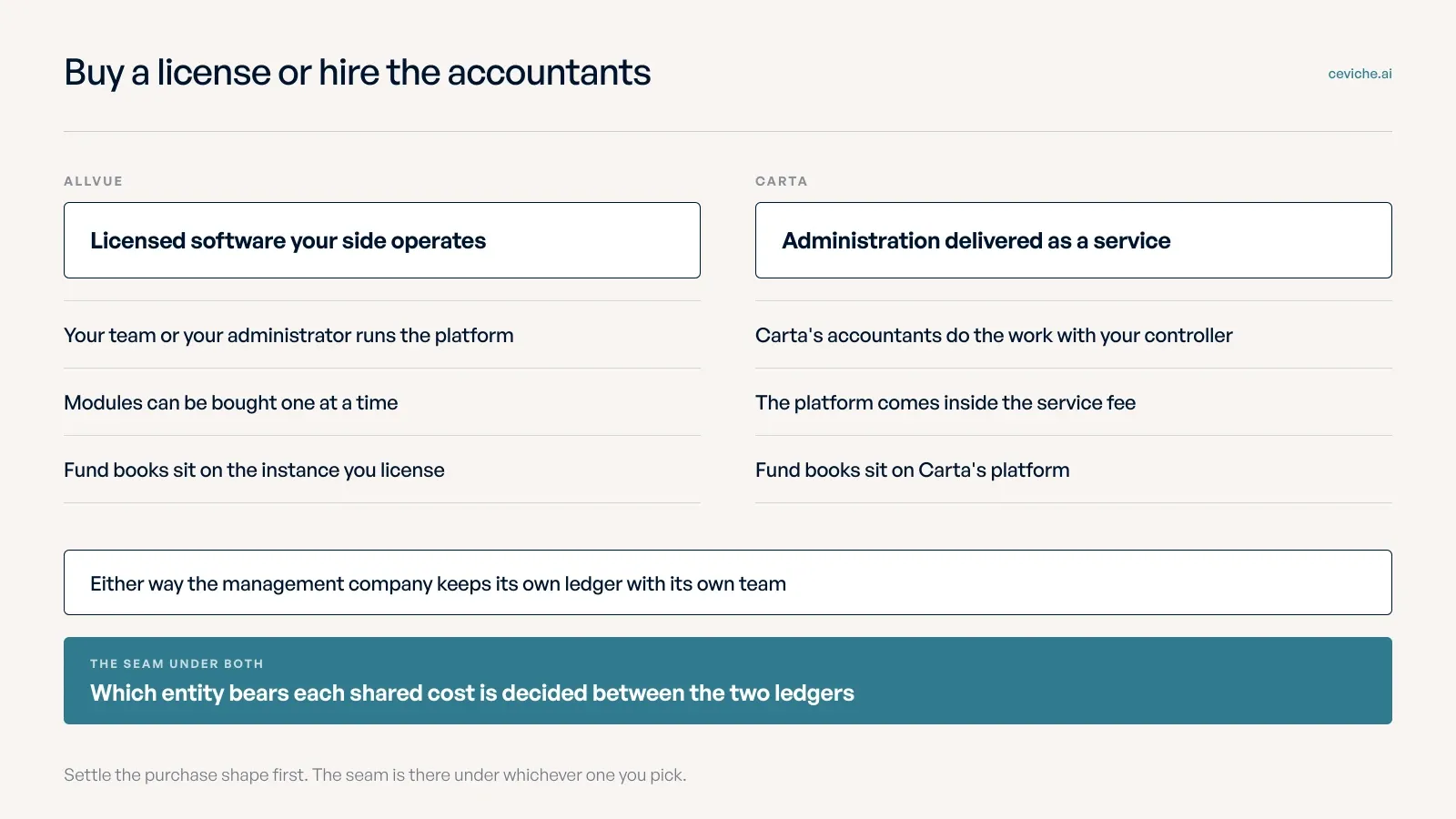
The two products answer it differently because they are not the same kind of transaction. Allvue licenses you a platform and your own team runs it, or your administrator does. Carta sells the administration itself, with the software underneath included and its own accountants doing the work. That is the difference between buying fund accounting software and buying fund administration, and it has a settled meaning.
Fund administration is the outsourced service a GP buys to run a fund's middle and back office. It covers fund accounting plus investor servicing and onboarding, capital calls and distributions, the investor register and reporting package, AML and KYC checks, and support for audit, tax, and regulatory filings.
If that line is doing new work for you, our longer treatment of fund administration vs fund accounting separates the function from the service before you sit through either demo. One disclosure first. Ceviche is the product we build and a vendor in this category, so where it sits waits until the end of this piece rather than running through it.
Allvue in its own words
Allvue's private equity page describes a platform that combines its Fund Accounting solution with Portfolio Monitoring and an out-of-the-box Investor Portal. Fund Accounting is "a complete back-office solution that combines detailed financial statement reporting, a true general ledger, cash management and workflow standards." The page lists nine elements in total, including Portfolio Management, Fundraising, Business Intelligence, Investment Accounting, and Corporate Accounting, which it calls "management company accounting software that's designed especially for private capital GPs." Those modules "can be purchased independently," though the page says the software was built as an end-to-end system.
It runs on Microsoft Dynamics 365 Business Central and Azure, and the page says Allvue "aligns with industry-specific compliance standards, such as SOC1 and SOC2." For smaller managers there is a packaged set, Equity Essentials, aimed at "startup private equity managers poised for growth with less than $1 billion in assets under management." The page claims more than $8.5T in assets tracked, over 21,000 funds and over 500 clients globally. Nothing there states a price, and the only route to one is a contact form.
Carta in its own words
Carta's fund administration page opens with "fund admin at the intersection of world class service and autonomous agents." The service promise is explicit. You "partner with expert fund accountants" with secure messaging and one-to-one sessions, and the page names Fund Tax, SPVs, Fund Formations, KYC/AML services, Deal and LP CRM and Portfolio valuations as core features, with real-time net and deal IRR, TVPI and DPI. It reports more than $220B in private capital fund assets under administration and points to a plans page rather than stating a number.
Onboarding is the clearest published difference. Carta says you start running fund operations "in a matter of weeks," offers "committed onboarding timelines," and says a fund can be formed, closed and calling capital in six weeks. The one integration the page singles out is with a spend tool, under the heading "Connect Ramp to Carta, and see expenses flow from card swipe to general ledger."
A head of finance who runs her firm's books through Carta as administrator gave us the operating detail the page does not. She described the allocation module as relatively straightforward and recently improved, with line-item breakouts instead of a comment on the invoice, pro rata by commitment computed off the commitments already in the system, dollar splits typed in when the methodology is anything else, and the fund-side journal entry booked once she picks the owing entity. It is included in what she already pays. What still costs her time is the invoice that fits no formula, and she gave us a recent one, a ten-thousand-dollar tax bill covering ten entities at amounts that matched no rule, keyed in by hand.
The buyout controller evaluating both platforms raised the open question that matters for a private equity structure: whether the module works when the fund general ledger sits somewhere else. The page does not address it. Ask the vendor directly and take the answer in writing.
Allvue and Carta across six lines of the decision
| Allvue | Carta | |
|---|---|---|
| What you are buying | Licensed software, modules that "can be purchased independently" | Fund administration as a service, platform included |
| Who operates it day to day | Your team, or the administrator that holds your instance | Carta's own fund accountants, alongside your controller |
| Scope on the page | Nine elements, fund accounting through investor portal, fundraising and corporate accounting | Six core features, fund tax, SPVs, formations, KYC/AML, CRM, valuations |
| Fund size named | Equity Essentials for managers under $1B AUM; $8.5T tracked overall | No size band stated; venture, private equity and private credit named |
| Implementation | ✕ No timeline stated on the page | ✓ "A matter of weeks," committed timelines, formations in six weeks |
| Cross-entity expense allocation | ✕ The page does not use the word allocation | ✕ Expenses appear only in the card-to-GL integration line |
Vendor details change. Five of the six rows come from the two pages linked in this piece, verified as they read on 2026-09-01. The operator row does not, because neither vendor states it plainly, and it comes instead from the buyers quoted through this piece.
Fund size and stage and who each one is built for
The published signals point in opposite directions. Allvue names an under-$1B package alongside the scale figures above, so it is sold to emerging managers and to firms far past that band on the same platform. Carta's page names venture capital, private equity and private credit, and states no size band at all.
Buyers draw the line differently. A venture CFO who spent years inside a fund administrator put the market shape to us plainly. Below roughly ten billion in assets, essentially every venture firm and most private equity firms run QuickBooks Online at the management company, and the administrator keeps its own general ledger on the fund side. Bills land at the management company, show up as a receivable from the fund, and get trued up at quarter end. That is one experienced buyer's characterization rather than a count, and it matches what we see, including that the combined ledger setup turns up most often at smaller venture firms.
Firms also rarely hold one relationship. We see them place special purpose vehicles with one administrator and keep the main funds with another, and each additional relationship multiplies the number of places an allocated cost has to land.
The seam neither one publishes is expense allocation across entities
Allvue's private equity page does not use the word allocation once, and Carta's mentions expenses only inside the Ramp integration line. That is an observation about what each vendor publishes, not a claim about what either product can do, and the fix is to ask each of them directly.
Our own data describes the shape of the gap. Of the 80 fund finance teams we spoke with in 2026, 92% run allocations across disconnected systems that do not talk to each other, 96% name multi-entity allocation a core complexity, and 81% still do the split in Excel. The reason is structural rather than lazy. QuickBooks is the management-company general ledger for 51% of the teams in our tech stack analysis and NetSuite for 23%, while the fund books sit somewhere else, on a licensed platform or at an administrator. The allocation lives between the two systems, so it belongs to neither vendor's product surface.
This came most directly from a CFO four weeks into a new seat. Who owns which piece of the allocation, he asked, when there is a management-company team and a fund finance team, and how do we codify the methodology so it stays consistent? Neither vendor's page addresses that, because it is a governance question with a systems consequence.
It matters most at audit, where the question is whether anyone trusts the number. Asked what he weighed most heavily in a tool, the buyout controller put trust ahead of everything.
If you don't have trust, everything is broken. Time savings goes out the window.
Another CFO described the standard the allocation has to meet, and it is not efficiency. His fund documents give him discretion on a reasonable basis, the control is his own sign-off that the expense is valid and defensible, each fund is audited standalone, and the auditor asks where the number came from. Across our 2026 interviews, 49% of teams had a gap in exactly that record.
One invoice on a real stack
A large share of the firms running either platform did not choose it. Their administrator did. One private equity controller described the arrangement in one sentence.
The administrator has the platform, and we do QuickBooks in the shadow.
Another told us her team never touches the platform from the client side and re-keys the Excel packages it receives instead. Both firms count as users of a fund accounting system, and in neither case does the system hold the allocation.
Take one outside-counsel invoice into that stack. Twelve lines, $37,000, mixed timekeeper fees and disbursements, arriving at a firm running Growth Fund III ($300M committed), Growth Fund IV ($180M committed) and a co-invest SPV.
| Block | Amount | Methodology | Result |
|---|---|---|---|
| Deal diligence, one portfolio company | $19,800 | Invested capital in the deal (Fund III $12.0M, SPV $4.5M) | Fund III $14,400 · SPV $5,400 |
| Fund IV formation work | $9,600 | Specific identification | Fund IV $9,600 |
| General fund matters, both funds | $5,400 | Pro rata by committed capital | Fund III $3,375 · Fund IV $2,025 |
| Filing fees and courier | $2,200 | Follows the matter it attaches to | Fund III $1,200 · Fund IV $550 · SPV $450 |
That rolls up to three entity-level entries.
| Entity | Amount |
|---|---|
| Growth Fund III | $18,975 |
| Growth Fund IV | $12,175 |
| Co-invest SPV | $5,850 |
| Total | $37,000 |
The management company paid the bill, so QuickBooks now carries the cash and three due-from balances, and the fund-side platform carries three expense entries someone has to key or upload. Neither system carries the reasoning, which is the row an auditor asks about. One firm we spoke with had built a custom export whose only job was to put allocation output into a format its administrator could load into the fund platform.
Two more shapes show why a built-in pro-rata feature does not close this. The platform's own subscription is itself an allocated expense, and at one firm running more than twenty vehicles the funds carry 85% of it and the manager carries 15%. Compliance work billed per investor, the AML, FATCA and CRS checks, cannot be split by investment or by commitment at all, because it splits by which funds each investor sits in, rolled up to a pro rata share of the whole invoice. Neither axis appears on either vendor's page.
Ceviche fits when
Ceviche fits when you have already chosen your general ledger and your administrator, you run more than a handful of entities, and the work still landing in a spreadsheet is splitting shared costs across funds, SPVs and the management company. It is the allocation layer on top of the systems you keep, applying the methodology each LPA specifies per line and writing audit-ready journal entries back to QuickBooks Online, NetSuite, or Sage Intacct with the rationale attached. Flybridge runs it across 18+ fund entities on its existing Bill.com and QuickBooks Online stack. Its quarterly allocations used to run in spreadsheets and now post to QuickBooks Online, each one traceable to source documentation with a full audit trail. If you are choosing your first fund administrator, or you need a general ledger, this is not the product to evaluate and the two above are. What Ceviche does and does not do is set out plainly.
More comparisons
If Allvue is the incumbent you are trying to move off, or the platform your administrator is pushing you onto, the deeper treatment of the field around it is in our guide to Allvue alternatives, which weighs FundCount, Carta, LemonEdge and Entrilia against the same criteria. For the administrator side of the decision rather than the software side, our roundup of fund administration software covers who each provider actually fits, and the FundCount alternatives comparison covers the partnership accounting lane.
Frequently asked questions
Who owns the allocation when the management company and the fund team are on different systems? Whoever signs off on the methodology, which in practice is the controller or the CFO, not the platform. A CFO asked us exactly this, and the answer that holds up is a written methodology per vendor, one named owner per relationship, and a standing quarterly review. Both teams then execute the same rule rather than negotiating it invoice by invoice.
Who are Allvue's main competitors? In private fund accounting the names buyers put next to it are FundCount, BlackRock eFront, FIS Private Capital Suite, LemonEdge, Entrilia and Dynamo, with Carta and Juniper Square competing on the administration side rather than the license side. Our guide to Allvue alternatives, linked above, covers the full field and who each one genuinely fits.
How much does Allvue cost? Allvue does not publish prices. Its private equity page routes to a contact form and says the modules "can be purchased independently," so scope drives the quote, with the Equity Essentials package aimed at managers under $1B in assets. Any figure quoted elsewhere is somebody else's contract rather than a rate card.
Who owns Allvue Systems? Vista Equity Partners. Reuters reported in August 2026 that Vista was exploring a sale of the business at around $3 billion. Ownership is worth raising in a multi-year platform commitment, because roadmap priorities, support models and contract terms all sit downstream of it.
Can Carta replace a fund administrator? Carta's fund administration page describes it as a fund administrator rather than a replacement for one, and the service it sets out covers fund accounting, tax, formations, KYC and AML, and LP reporting. The page does not describe the management company's own books, which the controllers we spoke with all still run themselves, and it does not address which entity bears a shared cost.
Do Allvue and Carta handle expense allocation across fund entities? Ask each of them, and take the answer in writing. As their pages read on 2026-09-01, Allvue's private equity page does not use the word allocation, and Carta's fund administration page mentions expenses only in its card-to-GL integration line. One Carta customer we spoke with uses an allocation module inside the platform at no extra charge.