TL;DR. A two-to-three person fund finance team should not buy a platform suite it cannot administer. The stack that works is a general ledger you already know, one spend tool, your administrator's rails, and a narrow allocation layer. Add tooling when vehicle count grows faster than headcount, not before.
The software is priced for a team you do not have
Every platform demo assumes a person who owns the system. Someone to configure the chart of accounts across entities, maintain the allocation rules, run the upgrade, and answer the vendor's implementation questions for two quarters. At a firm with three people in finance, that person is your controller, and their capacity is already spoken for by the close.
This is the cost nobody quotes. License fees are visible and negotiable. The internal ownership a suite requires is invisible until month four, when the project stalls because the one person who understands both the fund structures and the software is doing month-end.
So the lean-team question is not which platform is best. It is which pieces you can absorb, in what order, without a hire.
One scoping note before the substance. Search this term and half the results are nonprofit fund accounting: Aplos, Blackbaud, MIP, restricted and unrestricted donor money. Different discipline, different software, no overlap with private funds. If you run a partnership with LPs and capital accounts, none of those tools apply, and the SERP is not going to tell you that.
The four things not to buy
A front-to-back platform suite, unless you are replacing everything at once. Allvue, Dynamo, and FundCount are real products that do what they say. They are also bought by firms with an implementation runway and a project owner. Buying one to solve a narrow problem means paying for a system of record you will use a fraction of, and administering all of it.
A second general ledger you did not need. The most common expensive mistake is migrating the management company's books to solve a fund-side problem. The migration consumes a year of capacity and the original problem, which usually lives between systems rather than inside one, survives it intact.
Anything that requires a consultant to change a rule. Your allocation methodology changes when you launch a vehicle, which is more often than you think. If updating it means a support ticket and a scoping call, the tool will fall out of date and the spreadsheet will come back to fill the gap.
Anything priced on AUM when your constraint is entity count. These scale differently. A $600M firm with fourteen vehicles has a harder operational problem than a $3B firm with three, and AUM-based pricing charges the second one more.
The minimal stack that scales
Four layers, in the order a lean team can absorb them.
| Layer | What lean teams run | Buy this when |
|---|---|---|
| Management company GL | QuickBooks Online, or NetSuite past a certain complexity | Day one, and change it as rarely as possible |
| Spend and AP | One of Ramp, Bill.com, or Expensify. Not three | Card and bill volume outgrows manual entry |
| Fund books and LP servicing | Your administrator's platform, or a fund accounting system if you self-administer | At the first institutional LP, or the second fund |
| Allocation and audit trail | The layer between the two above | Vehicle count outgrows headcount, per the math below |
That ordering is not arbitrary. It follows what our own data says firms actually run. Across the 80 fund finance teams we interviewed in 2026, QuickBooks was the management company GL for 51% and NetSuite for 23%, together covering 73% of general ledgers, while Ramp appeared in 49% of stacks, Bill.com in 39%, and Expensify in 30%. The pattern holds at surprising scale: QuickBooks persists well above its weight class at multi-billion firms, because it works and replacing it costs a year.
The layer most teams are missing is the fourth one, which is also the only one that has no default.
Fund expense allocation software sits between a fund's expense systems and its general ledger. It applies the allocation methodology each LPA specifies to every invoice line, splits shared costs across fund entities and the management company, and writes audit-ready journal entries back to the ledger the firm already runs. It is not a general ledger and not a fund administrator.
Sometimes "we are too simple for this" is the right answer
Five-person funds with a handful of vehicles and low invoice volume tell us, correctly, that they are too simple for allocation tooling. We agree with them, and it is worth saying plainly on a page published by a vendor in the category.
If you run two funds and a management company, the shared costs are an audit fee, an annual legal bill, and some software, and the split is the same three percentages every quarter, then a maintained spreadsheet is the right tool. It costs nothing, everyone understands it, and the reconstruction risk is low because the logic fits on one screen.
The failure mode is not being too small. It is staying on the spreadsheet through the growth that invalidates it, because no single quarter is the one where it obviously breaks.
The threshold where manual breaks
The calculus flips when entity count multiplies faster than headcount. Here is the arithmetic, because "it depends on complexity" is not an answer anyone can act on.
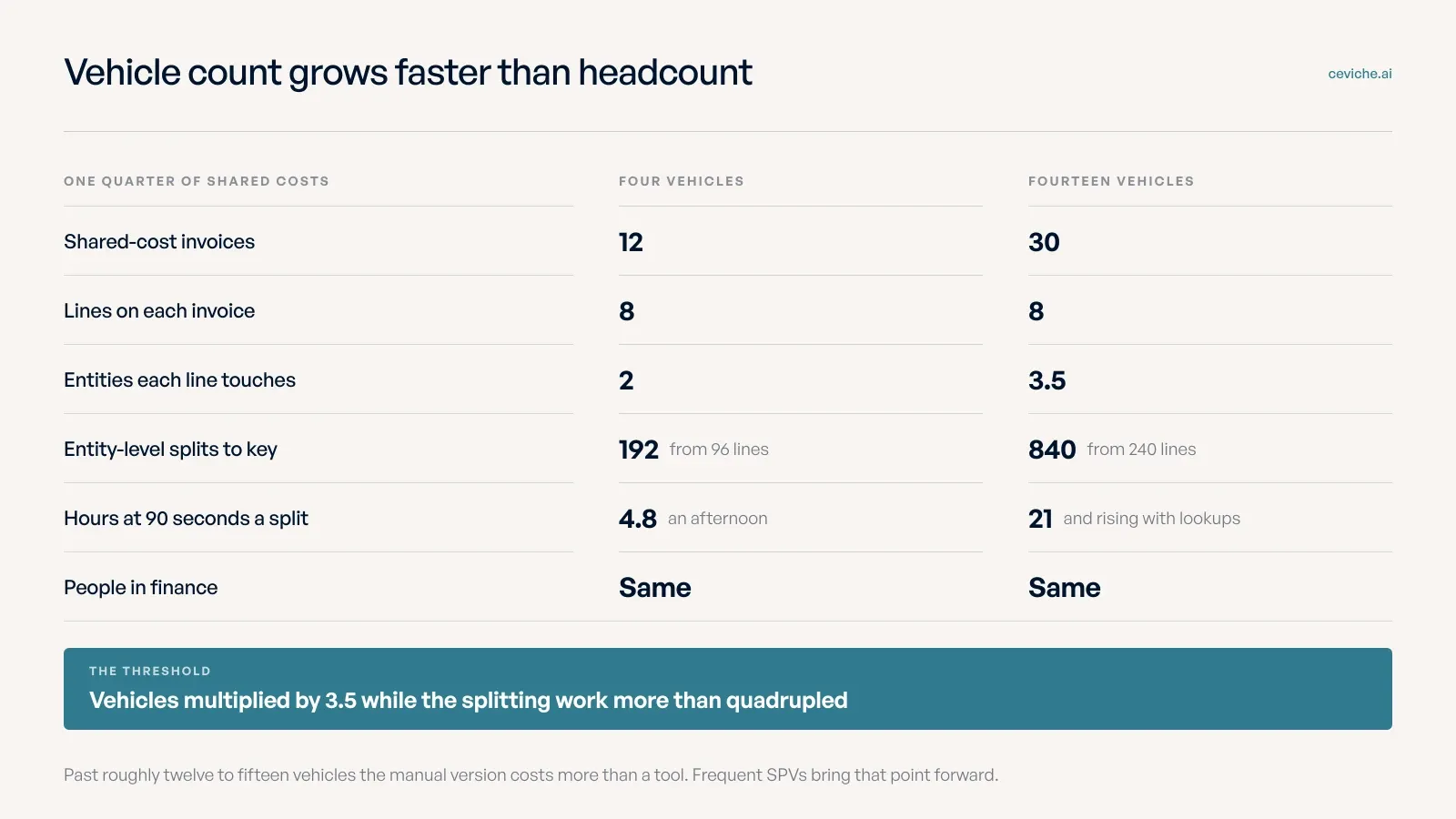
Manual allocation work scales as the number of shared-cost invoices multiplied by the lines on each and the entities each line touches. Headcount, meanwhile, stays flat.
A four-vehicle firm. Twelve shared-cost invoices a quarter, roughly 8 lines each, most lines touching 2 entities. That is 96 lines and about 192 entity-level splits. At 90 seconds per split, including the lookup and the keying, roughly 4.8 hours a quarter. An afternoon. Correctly handled in Excel.
The same firm at fourteen vehicles. Thirty shared-cost invoices a quarter, still 8 lines each, now averaging 3.5 entities per line. That is 240 lines and about 840 splits. At the same 90 seconds, roughly 21 hours, and the 90 seconds is optimistic because near-duplicate entity names slow every lookup down.
Vehicle count grew 3.5 times. The allocation work grew more than four times, and the finance team is the same size. That second figure lands inside the 1-to-5 days per quarter that fund finance teams reported spending on allocation alone, which is the sanity check that the model matches what firms actually live.
Three practical thresholds fall out of it:
- Under 5 vehicles with stable methodology: a spreadsheet is correct.
- 6 to 12 vehicles: the spreadsheet still works and the audit trail starts failing first. This is where documenting the methodology matters more than automating it.
- Past roughly 12 to 15 vehicles, or any vehicle count with frequent SPVs: the manual version costs more than the tool, and the error rate rises faster than the hours.
Effort is not the only signal. A 15-year bookkeeper we spoke with runs 40-plus funds and does every entry manually by choice. The workload is survivable only because she is exceptional at it, and it still fills her month. A process that depends on one irreplaceable person is a risk the hours never show, and it is the argument that usually persuades a CFO when the time argument does not.
The QuickBooks question
Three of the four related questions on this search are some version of "can QuickBooks do this," so here is the direct answer.
QuickBooks is a capable management company general ledger and a poor multi-entity fund system. It handles the firm's own books, payroll, rent, and vendor payments well. It has no mechanism to read a 20-line invoice, split each line across four vehicles by different methodologies, and post the result with the reasoning attached. That is not a configuration gap, it is outside what a small-business GL is built to do, and running fund accounting on QuickBooks is mostly an exercise in knowing which parts to work around.
The useful conclusion for a lean team: keep it. Migrating to NetSuite is the common next step and it is a real project, so do it when the ManCo's own accounting has outgrown the system, not because allocation hurts. Allocation is a different layer, and solving it does not require moving the ledger.
Sequencing it over two years
If you can absorb one system change a year, sequence it this way. Consolidate the spend layer first, because one tool feeding the GL cleanly removes more manual entry per dollar than anything else, and it is the easiest change to reverse. Then add the allocation layer, which is narrow enough to run in parallel with the spreadsheet for a quarter and gives you the audit trail as a side effect. Leave the GL alone until it is genuinely the constraint.
For the wider category view, our comparison of fund management software covers the segments and who each one actually fits.
Where does Ceviche fit?
Ceviche is the fourth layer for teams that cannot take on a fifth system. It reads the spend tools you already run, applies your allocation methodology per invoice line, and writes audit-ready journal entries back to QuickBooks, NetSuite, or Sage, documentation included, without touching your GL or your administrator. Flybridge kept its QuickBooks Online and Bill.com stack, put its 18 fund entities on Ceviche in a two-week onboarding, and turned a full day of quarterly spreadsheet allocation into a hands-off run at about 99% accuracy. See how Ceviche handles fund expense allocation.
FAQ
Can QuickBooks be used for fund accounting? For the management company, yes, and a slim majority of the fund finance teams we interviewed run exactly that. For fund-level accounting across multiple vehicles it falls short: no native multi-entity allocation, no capital account tracking, and no per-line audit trail tying a split to the LPA that governs it. Most firms pair it with an administrator or a fund-side system rather than replacing it.
What are people replacing QuickBooks with? NetSuite, most often, and the migration usually happens because the management company's own accounting outgrew the system rather than because of anything fund-side. In our 2026 research across 80 fund finance teams, NetSuite held 23% of management company general ledgers against QuickBooks at 51%, with Sage Intacct a smaller third lane. Plenty of multi-billion-dollar firms stay on QuickBooks deliberately.
How many fund entities before a spreadsheet stops working? Around twelve to fifteen for most firms, earlier if you spin up SPVs frequently. The reason is that allocation work grows with vehicles multiplied by shared-cost invoices while headcount stays flat, so the workload rises faster than the entity count does. The audit trail usually degrades before the hours become unbearable.
Do we need fund accounting software if we already have a fund administrator? Usually yes, for the management company's books, which most administration contracts exclude. Your administrator holds the fund side; payroll, rent, software, and the intercompany balances between the firm and the vehicles still need a ledger you run. Expense allocation across both sides also stays with you regardless of who administers the funds.
What is the best fund accounting software for a small fund? There is no single answer because the term covers several different products. Nonprofit fund accounting tools are a separate category that does not apply to private funds at all. Among private-fund options, the right pick depends on whether you need a general ledger, fund-side books, or the allocation layer between them, which our guide on how to choose fund accounting software works through by lane.
How much internal time does implementing fund software actually take? Budget for the internal side, not just the vendor's timeline. A narrow tool touching one workflow is a few weeks of part-time attention. A platform suite replacing your system of record is quarters of a named owner's time, including chart of accounts design, entity setup, historical data migration, and parallel running. For a three-person team, that second commitment is the constraint that decides the purchase.