
TL;DR
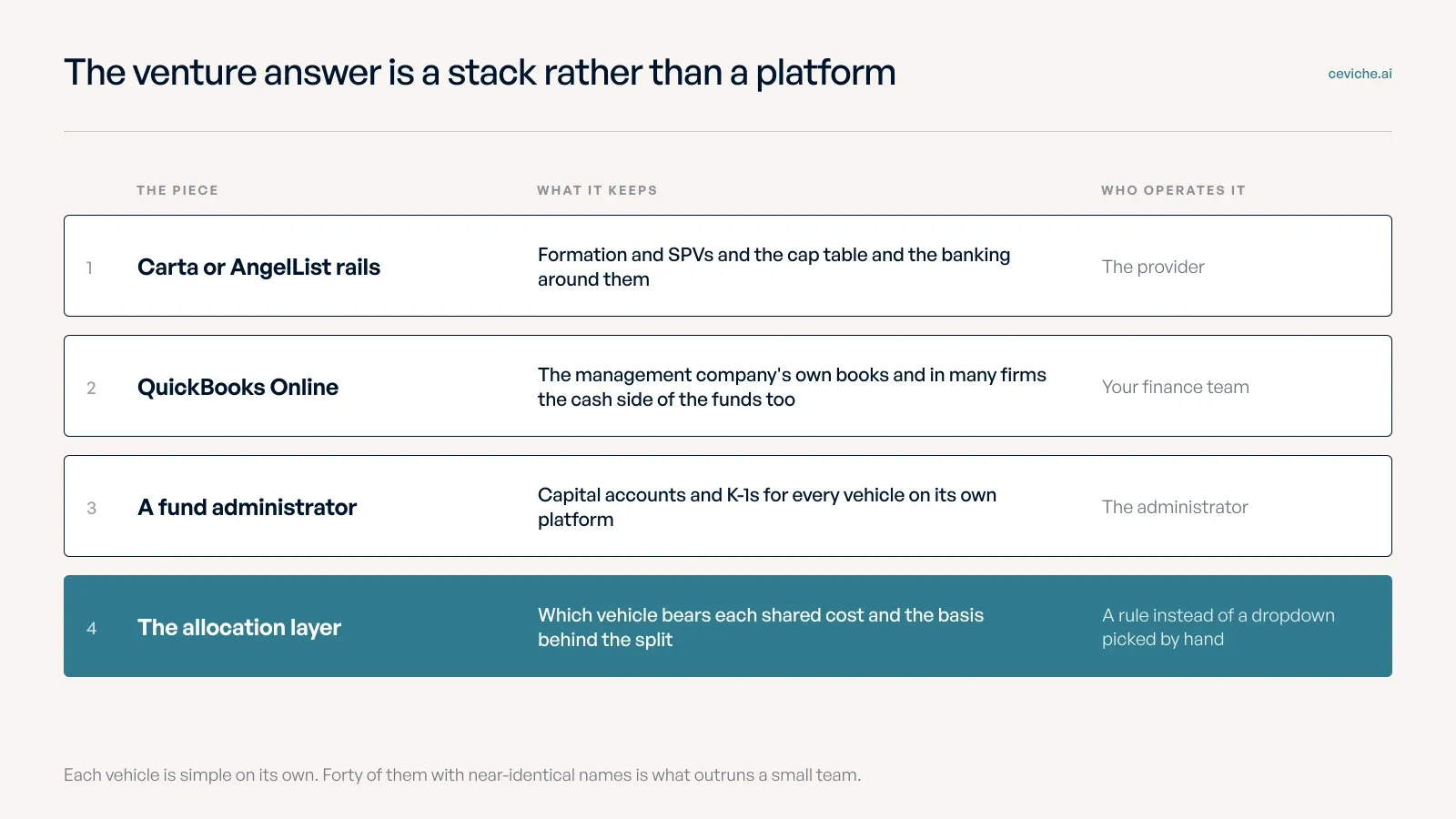
The venture answer is a stack, not a platform: QuickBooks Online plus an administrator, Carta or AngelList rails, and Ceviche as the allocation layer once vehicle count outruns the team, which is the part that actually breaks. LemonEdge and Allvue fit only structures complex enough to justify a platform.
VC Accounting Is Not Complex but Repetitive
A venture fund's books are simple. Forty venture funds' books are not, and at most firms they are the same books wearing near-identical names. That repetition, not accounting complexity, is what defines VC fund accounting, and almost nothing written about this category starts from it. It is also why most venture capital accounting software is built for a problem venture teams do not have.
Half of what gets recommended to venture firms is enterprise platforms built for private equity complexity and relabeled for venture: deep waterfalls, multi-currency books, tiered carry across a decade-long fund. The other half is portfolio monitoring software presented as accounting, which tracks portfolio company KPIs and does not maintain a ledger at all. The most honest answer we found is in a Reddit thread where practitioners say they hear QuickBooks, Xero, and Sage, and that they are on QuickBooks Desktop and moving to QuickBooks Online.
That thread is closer to reality than any vendor list. A venture fund's individual entity is simple: a few dozen investments, a handful of expense categories, a straightforward preferred-return-and-carry structure, cash that moves a few times a quarter. What makes venture accounting hard is that there are so many of them, and they look alike.
A bookkeeper of 15 years at a VC firm running more than 40 funds described it to us plainly:
"I'm not kidding you, I have funds in Roman numerals, an Eight, an Eight-B in a second family with almost the same name. I've got a lot of funds with very similar names."
That is the actual failure mode. Not a waterfall the software cannot model. A dropdown with four options that differ by one character, selected by a human, forty times a month. Every recommendation below should be read against that problem rather than against a feature list.
What Should VC Fund Accounting Software Handle?
The criteria that matter for venture differ from the PE checklist in three specific ways.
Entity volume comes first. A VC firm with a $200M main fund may run an annex, an opportunity fund, a crossover vehicle, and twenty deal SPVs, several of them formed and wound down inside two years. The system has to make adding, naming, and closing vehicles cheap and hard to get wrong.
SPV lifecycle is second. Deal SPVs are formed fast, hold one position, and need their own books, their own K-1s, and their own share of shared costs. A platform that treats each vehicle as a full fund implementation does not fit.
Third is the management company. Venture firms run leaner than PE firms, so the boundary between fund expenses and management-company expenses gets crossed constantly and by fewer people. That boundary is where LP scrutiny concentrates.
The rest of the standard checklist still applies: capital accounts per LP, capital calls and distributions, preferred return and carry, K-1s, GAAP-basis financial statements, and an audit trail. If you are earlier in the process and still scoping requirements, start with our guide on how to choose fund accounting software. If the decision is really about who keeps the books, our fund administration software comparison covers that side.
The Options and Who Each One Fits
Disclosure: Ceviche publishes this article and sells fund expense allocation software, which is adjacent to this category. Vendor characterizations come from each vendor's public material.
Ceviche (the Allocation Layer)
Ceviche is not a ledger and not an administrator. It covers the step that gets harder with every vehicle a venture firm adds: splitting a shared cost across the funds, the SPVs, and the management company by your rules, and proving it later.
Ceviche reads the spend and AP systems venture firms already run (Ramp, Bill.com, Brex, Expensify, SAP Concur), applies the allocation methodology each LPA specifies per line, writes audit-ready journal entries back into QuickBooks Online, NetSuite, or Sage Intacct, and keeps the basis for each split on the line. The entity selection stops being a dropdown a person picks from forty times a month and becomes a rule the system applies.
Flybridge, a venture firm, runs it across 18+ fund entities on QuickBooks Online and Bill.com. Quarterly allocation used to run in spreadsheets; it now runs through Ceviche and posts to QuickBooks Online, and every allocation traces back to source documentation with a full audit trail.
It fits venture and growth firms with a two-to-five-person finance team and more vehicles than people. It does not fit if you need capital accounts, NAV, or K-1s, which are the administrator's job.
Carta
Carta covers more of the venture stack than anything else here, though the draw is coverage rather than accounting depth. It reports being trusted with more than 9,000 funds and SPVs, and it markets event-based accounting at the core of the fund product.
The surface is broad: a fund admin portal, fund tax covering the return and partner K-1s, fund formations executed in six weeks, fund forecasting, portfolio valuations, an LP portal, and management company administration as a separate line. Carta pairs the software with a dedicated team of fund accountants, so this is administration as a service rather than a platform you operate. Named references on its own site include a director of finance at a seed-stage firm and a CFO at a multi-stage firm, both citing responsiveness and LP self-service rather than accounting capability specifically.
Carta fits venture firms that already run their cap table on Carta and want fund administration, tax, and SPVs from one vendor. The tradeoff is that the fund's books live inside Carta's system. If you intend to keep an independent management-company ledger or want fund records portable later, settle the extraction path before signing. Ask specifically whether allocated journal entries write back to a third-party GL or stay in Carta.
AngelList
AngelList is the other set of venture rails, and it is strongest exactly where Carta is: formation, SPVs, banking, and the administrative machinery around a fund rather than a general ledger you operate.
For a firm running many small vehicles, particularly syndicates and deal-by-deal SPVs, it removes real operational work. What it does not do is decide how costs shared across your funds and your management company should split, which is a controller's job regardless of which rails you use. We cover that boundary in detail in does the AngelList stack handle expense allocation.
QuickBooks Online Plus a Fund Administrator
This is what most venture firms actually run, and it deserves more than a footnote.
QuickBooks Online holds the management company's books and often the funds' cash and accruals. An administrator maintains capital accounts, allocations, and K-1s on its own platform. In our 2026 research across 80 fund finance teams, QuickBooks covers 51% of management-company general ledgers, well above what its reputation in this category would suggest.
It fits because a venture management company is a small business, and paying for an ERP to record payroll, rent, and software subscriptions buys nothing. The migration path when it stops fitting is usually QuickBooks Online to NetSuite, and the trigger is rarely AUM. It is entity count and the volume of shared costs crossing between the funds and the ManCo.
The weakness is exactly the one the bookkeeper described. QuickBooks has no concept of your fund family. Forty near-identical entity names in a dropdown is a data-entry surface, not a control.
LemonEdge
LemonEdge is the most technically interesting option here, and the most over-scoped for a typical venture firm.
Its general ledger models whole fund structures rather than individual entities, and supports closed-ended, open-ended, and hybrid structures in one system. Two features stand out for venture. A split-transaction capability automates the allocation of a complex transaction across investments. And Algorithms, its embedded spreadsheet technology, lets a firm bring existing Excel calculations into the platform where they generate accounting entries and investor allocations directly, with every action, including imported workbooks, audited and time-stamped. For a team whose real logic lives in spreadsheets, that is a more honest migration path than most vendors offer.
LemonEdge fits larger venture and growth firms with genuinely unusual structures, and administrators servicing them. As a newer platform it carries less public reference material than the incumbents, and it publishes no pricing, so weight your own diligence accordingly.
Allvue Systems
Allvue offers venture firms the same front-to-back platform it sells to private equity, with fund accounting built on Microsoft Dynamics 365 Business Central and Azure, alongside portfolio monitoring, investor portal, and management-company accounting.
It fits the largest venture and crossover firms, and administrators. For a fund under a few billion with a two-person finance team, it is a platform replacement measured in quarters to solve problems a smaller stack handles. See Allvue alternatives if that is where you have landed.
Standard Metrics and Visible.vc (Monitoring Rather Than Accounting)
Both get listed as fund accounting software and neither is, which is worth stating plainly because the category confusion costs evaluation time.
Standard Metrics collects portfolio company financials and KPIs, with native integrations to QuickBooks and Xero, more than 10,000 companies reporting through it, and benchmarking across that set. Visible.vc covers LP reporting and portfolio updates. These are genuinely useful products for the investment team and the LP reporting cycle. Neither maintains capital accounts, produces a K-1, or posts a journal entry.
If your problem is that LP updates take three weeks to assemble, these help. If your problem is that the close is late, they do not.
Comparison Table
| Option | What it is | Entity volume fit | GL write-back | Published timeline |
|---|---|---|---|---|
| Ceviche | Allocation layer on your existing GL | Strong, rules replace manual selection | Yes: QuickBooks Online, NetSuite, Sage Intacct | About 2 to 4 weeks |
| Carta | Administration service on own software | Strong, SPVs included | Not confirmed in public sources | Weeks; formations in six weeks |
| AngelList | Fund and SPV rails | Strong for syndicates and SPVs | Not confirmed in public sources | Not disclosed |
| QuickBooks Online plus administrator | Ledger plus outsourced fund books | Weak; entity selection is manual | N/A, it is the GL | Immediate |
| LemonEdge | Licensed platform | Strong, structure-level modeling | Own ledger | Not disclosed |
| Allvue | Licensed front-to-back platform | Strong | Own ledger | Not disclosed |
| Standard Metrics / Visible.vc | Portfolio monitoring and LP reporting | Not applicable | No ledger | Not disclosed |