
TL;DR. Partly. AngelList's fund administration keeps a general ledger per fund and allocates that fund's expenses pro rata to its LPs. Splitting one shared cost across several funds, SPVs, and the management company is not in its published scope; AngelList assigns that to the fund manager. Controllers add that layer themselves.
Allocation means three different things here
The confusion in this question is a vocabulary problem before it is a product problem, and AngelList is not being evasive about it. The word does three jobs across their documentation.
Deal allocation is how much a person or fund gets to invest in a given round. That is the meaning in most of the platform's help content, and it has nothing to do with expenses.
LP-level expense allocation is splitting one fund's costs pro rata across that fund's limited partners. AngelList does this, and their fee economics guide describes it plainly: fund administration fees and management fees are fund expenses allocated to LPs on a pro rata basis. If your question is "how does a $30,000 audit fee land in each LP's capital account," the platform answers it.
Entity-level expense allocation is splitting one shared cost across several fund entities, SPVs, and the management company before any of it reaches an LP. This is what a controller usually means, and it is the one the platform does not claim.
A VC controller asking whether AngelList handles expense allocation almost always means the third and gets answers about the first two. So the rest of this is about where that boundary actually sits, sourced from AngelList's own published scope rather than from anything we tested.
What does AngelList's fund administration cover?
AngelList publishes a scope of service document for fund administration, which is more transparency than most administrators offer, and worth reading before you form an opinion about the platform.
The covered set is wide. Fund formation, Delaware filings, and the EIN. Form D and state Blue Sky filings. Fund bank account setup, wire processing, and treasury tracking. Investor closing, KYC and AML checks on investors and control persons, commitment records, and support for capital calls and distributions. A GP dashboard carrying capital balance, valuation, performance, and carry calculations, plus an LP portal. On the accounting side: general ledger and account record maintenance, expense tracking and payment for the fund, investment tracking by cost and value, and unaudited financial and capital account statements. On tax: filings for the fund with income and expense tracking and allocation by tax characteristic, Form 1065, and K-1s and K-3s to investors.
That is a real back office. For a manager running one fund and a handful of SPVs, it covers most of what a fund administrator would.
The document also carries a boundary clause that decides this whole question: services not listed are fund manager responsibilities and are not included. Cross-entity expense allocation is not listed.
What can be charged to the fund and who decides?
The upstream question is not how a cost gets split. It is whether the fund should bear it at all, and AngelList's help center addresses that directly.
Their summary of common permitted fund expenses: legal and accounting connected to fund matters, annual audits, formation costs, regulatory filings such as Form D, wind-down costs, fund marketing materials, and diligence on prospective investments. Typically not permitted: meals and entertainment with LPs or prospective LPs, travel to meet prospective LPs, computers and phones used by the manager's team, Form ADV filings, and conferences held to meet LPs.
Two things follow. First, the platform is documenting a general pattern, and says so: every fund agreement differs, and the expense section is negotiated. Your LPA governs, not a help article. Second, applying that list is judgment, performed per line, by a person who has read your fund documents. A partner's dinner is a management company cost; the same restaurant on a diligence trip may be a fund cost. No administration platform makes that call for you, and the SEC's Division of Examinations tests fee and expense allocation against the fund documents when it samples transactions.
Fund expense allocation is the work of dividing a shared cost across the fund entities, SPVs, co-invest vehicles, and the management company that the cost served, applying the methodology each fund's LPA supports, and recording the basis for each split so an auditor or examiner can test it later.
Where does the allocation work start?
Each AngelList vehicle has its own ledger. That is the correct design for per-fund reporting and clean LP statements, and it is also the exact structural reason cross-entity splitting stays manual: a cost that belongs to three ledgers has no home until someone decides how much goes to each.
The problem scales with vehicle count rather than with AUM, which is why it bites VC harder than the fund sizes suggest. A firm running a flagship fund, an opportunity fund, two annual vintages, and eleven SPVs has fifteen ledgers and one law firm. Of the 80 fund finance teams we spoke with in 2026, 96% named multi-entity complexity a core difficulty of their close, and 81% were doing the split in Excel.
Near-duplicate entity names make it worse in a way nobody designs for. When a firm runs Ventures VIII, Opportunity VIII, and Opportunity VIII-B, the allocation is not conceptually hard, and it still produces miscodings at 11pm, because three of the fifteen ledgers have nearly the same name.
The management company line is the other half. Most AngelList vehicles are funds; the firm's own operating entity generally is not on the platform, and payroll, rent, and software sit on a separate general ledger, usually QuickBooks. Any cost that serves both the funds and the firm has to be split across two systems that were never connected.
The admin rails and the allocation layer
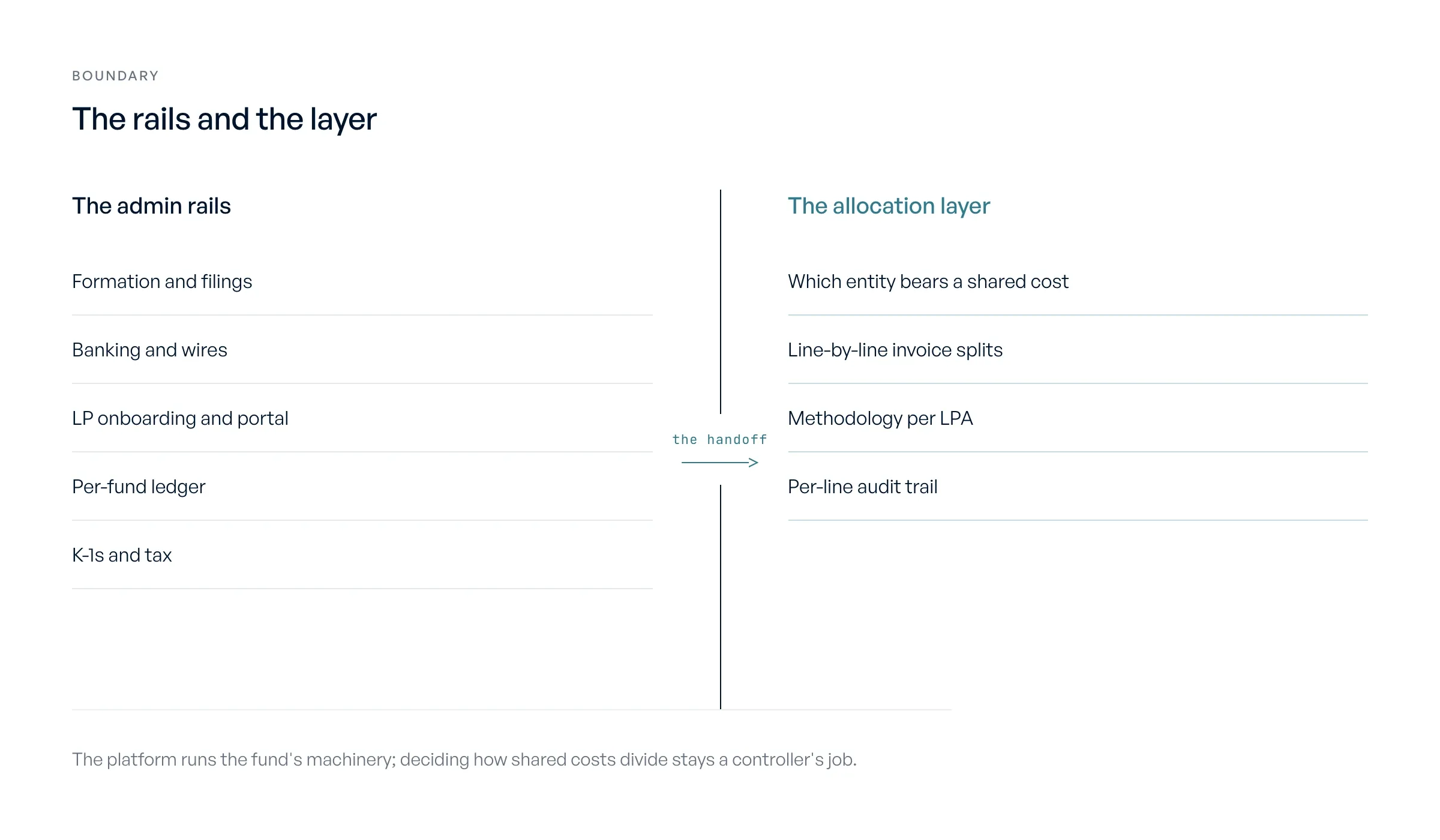
The platform runs the fund's machinery; deciding how shared costs divide stays a controller's job.
| Work | Fund admin rails (AngelList) | Allocation layer |
|---|---|---|
| Fund formation, filings, EIN | Yes | No |
| Banking, wires, treasury | Yes | No |
| LP onboarding, KYC/AML, portal | Yes | No |
| Capital calls and distributions | Yes | No |
| Per-fund general ledger | Yes | No |
| Expense tracking and payment for a fund | Yes | No |
| Splitting one fund's expenses across its LPs | Yes | No |
| Deciding which entity bears a shared cost | Fund manager responsibility | Yes |
| Splitting one invoice across funds, SPVs, and the ManCo | Fund manager responsibility | Yes |
| Per-line audit trail of the methodology used | Fund manager responsibility | Yes |
| Writing the resulting entries to the ManCo GL | No | Yes |
The two columns are not competing. The right-hand column is work that exists whether or not you use a platform, and the left-hand column is a service you would still want if you solved it.
One invoice across three vehicles and one shared cost
Outside counsel sends a 9-line invoice for $18,600. The firm runs Ventures VII ($40M committed), Ventures VIII ($60M committed), Opportunity VIII, and a management company.
| Block | Amount | Methodology | Result |
|---|---|---|---|
| Ventures VIII formation work | $7,400 | Specific identification | Ventures VIII $7,400 |
| General partnership matters serving both vintages | $6,300 | Pro rata by committed capital (40/60) | Ventures VII $2,520 · Ventures VIII $3,780 |
| Side-letter negotiation for one Opportunity-fund LP | $2,900 | Specific identification | Opportunity VIII $2,900 |
| Employment advice for the firm | $2,000 | Management company expense | ManCo $2,000 |
| Entity | Amount |
|---|---|
| Ventures VII | $2,520 |
| Ventures VIII | $11,180 |
| Opportunity VIII | $2,900 |
| Management company | $2,000 |
| Total | $18,600 |
Once those four numbers exist, the platform does its part well: it pays and records $11,180 against Ventures VIII, tracks it in that fund's ledger, and allocates it pro rata across Ventures VIII's LPs at the capital-account level. The $2,000 never enters the platform at all, because it belongs to a management company ledger the platform does not hold.
What produced the four numbers is a controller reading nine lines against three LPAs. That is the layer under discussion, and it sits upstream of everything AngelList does.
What do VC controllers layer on top?
The teams that have this working share a pattern, and none of it involves leaving their admin platform.
They write the methodology down once, per cost type, mapped to the LPA clause that supports it, instead of re-deriving it each quarter. They allocate at the invoice-line level rather than the invoice level, because a single bill routinely serves three vehicles and a firm. They capture the rationale as the split is made, not during audit prep, which is the difference between answering an examiner in a minute and reconstructing a quarter. And they post the resulting entries into both worlds: the fund side where the platform holds the books, and the management company GL where the firm's own costs live.
That is the shape of the VC finance stack at firms with many vehicles: platform rails underneath, an allocation layer on top, and a management company ledger alongside. If you are still assembling the pieces, our comparison of VC fund accounting software covers the adjacent decision, and the wider allocation software category covers this one.
Where does Ceviche fit?
Ceviche is the allocation layer described in the right-hand column, built to sit on top of rails like AngelList's rather than replace them. It reads the spend and AP systems the firm already runs, applies the methodology each LPA supports per invoice line, and writes finished journal entries, basis attached, into the ledger that holds the management company's books. Flybridge's 18+ fund entities run on QuickBooks Online and Bill.com; quarterly allocation there used to run in spreadsheets and now runs through Ceviche, with every allocation traced back to source documentation. See how Ceviche handles fund expense allocation.
Frequently asked questions
Does AngelList split one invoice across multiple funds? Not as a documented service. AngelList's published scope of service covers general ledger maintenance and expense tracking and payment for the fund, and states that anything not listed is a fund manager responsibility. Deciding how much of a shared cost each vehicle bears sits with the manager, who hands the resulting figures to the platform.
What does AngelList's fund administration include? Fund formation and Delaware filings, EIN, Form D and Blue Sky filings, banking and wire processing, investor closing with KYC and AML checks, capital call and distribution support, a GP dashboard and LP portal, per-fund general ledger and expense tracking, unaudited financial and capital account statements, and tax filings including Form 1065 and K-1s. Their scope of service document lists it in full.
What is capital allocation in accounting, and is it the same thing? No. Capital allocation describes how a firm deploys capital across investments or projects. Expense allocation describes how a cost already incurred gets divided across the entities that benefited from it. The two share a word and nothing else.
What is the management fee for AngelList? AngelList publishes current fees on its venture funds pricing page, including a one-time implementation fee billed at first close alongside annual costs, and pricing changes over time. Note the separate concept: your fund's own management fee to your LPs is set in your partnership agreement, and both are fund expenses allocated pro rata to LPs.
Can we keep AngelList and add an allocation layer? Yes, and that is the common configuration at firms with many vehicles. The platform keeps doing formation, banking, LP servicing, capital activity, and per-fund books. The allocation layer sits upstream of the entries, applying your rules to each shared cost and documenting the split, then posting the results. Neither replaces the other.
How do management company expenses work if the funds are on AngelList? They generally sit outside it. The platform administers fund entities, while the firm's own payroll, rent, and software run on a separate general ledger, most often QuickBooks. Costs that serve both, including much of what outside counsel bills, have to be divided between the two worlds and posted in each, which is where most of the manual work at VC firms actually accumulates.