A guide to partnership accounting software for private equity fund complexes, covering capital accounts, waterfalls, and the expense allocation that feeds them.
TL;DR
Before investment partnership accounting software can allocate anything to capital accounts, something has to split each shared cost across the funds. That layer, Ceviche, is the piece most firms are missing. For the capital accounts themselves, the credible options in private equity partnership accounting software are FundCount, FIS Private Capital Suite, and Allvue, or an administrator running one of them.
Most Partnership Accounting Software Is Built for Family Offices
Partnership accounting breaks in the same places at every firm: a capital account that has to survive a later closing, a partial transfer, and a side letter, maintained per partner for a decade. The software built for that job is real. Most of what ranks for it, though, is answering a different question than a PE controller is asking.
The first result targets family offices, fund administrators, and asset managers. The second runs outsourced family office accounting for multi-generational structures with trusts, LLCs, and operating businesses. The third handles family investment partnerships at the partner or ultimate-beneficial-owner level. Further down, the page turns into small-business bookkeeping: QuickBooks, Xero, Aplos, guidance for two-person LLCs.
Family office partnership accounting and private equity partnership accounting overlap in mechanics and diverge in shape. A family office has one complex ownership structure with many entities, mixed asset classes, and a long horizon. A PE firm has several parallel funds, each with its own LPA and its own LP roster, plus co-invest SPVs, feeder and blocker entities, a GP entity taking carry, and a management company that shares costs with all of them. The capital account math is similar. The number of independent rule sets is not.
That difference is why a PE firm evaluating this category should treat family-office references as directional rather than decisive, and why the shortlist below is scoped to fund complexes.
What Is Partnership Accounting in a Private Equity Fund?
Partnership accounting is the maintenance of a separate capital account for each partner in a fund: recording commitments, capital calls and contributions, distributions and returns of capital, and each partner's allocated share of income, expense, gain and loss, then applying the waterfall that determines what the GP and the LPs receive. The capital account, not the fund's cash balance, is the record of what each investor owns.
The mechanics that decide whether software works are the ones that break spreadsheets. Allocations have to respect side letters and fee arrangements that differ by LP. A later closing triggers equalization, so investors who came in early are made whole and the whole roster rebalances. Partial LP transfers split one capital account mid-life. Distributions run through preferred return, catch-up, and carry tiers that vary by vehicle. And US tax adds a parallel set of books: Section 704(b) capital accounts, 704(c) built-in gain and loss tracking on contributed property, and 754 elections with step-up basis adjustments, all of which have to reconcile to the K-1s.
None of that is optional, and none of it is available in a general ledger by itself. That is the case for buying something purpose-built.
What Should Partnership Accounting Software Handle?
Use this as the demo checklist. Every product below claims most of it; the differences show up in the edge cases.
| Capability | Why it matters |
|---|
| Capital accounts per partner | The core record of ownership; everything else derives from it |
| Commitments, calls, drawdowns, recallable amounts | Closed-end funds track called versus uncalled capital for a decade |
| Contributions and distributions | Including return of capital versus income characterization |
| Waterfall and carry | Preferred return, catch-up, carry splits, multi-vehicle tiers |
| Partial transfers and equalization | Mid-life LP changes and later closings rebalance the roster |
| Section 704(b), 704(c), 754 | Tax capital accounts and step-up basis feeding the K-1 |
| Side pockets and series LLCs | Structures that break simple pro rata models |
| Intercompany and consolidations | Multi-entity postings and eliminations across the complex |
| GL posting | Whether allocations post as journal entries or export to a separate ledger |
The last row separates the field more than any other. A platform that produces allocations and posts them to the same ledger that holds cash and accruals reconciles by construction. A platform that produces allocations and hands you a file leaves somebody reconciling two versions of what a partner owns.
Limited Partnership Accounting Software for Multi-Fund Structures
Limited partnership accounting means a capital account per partner, the 704 allocations behind it, and the waterfall that decides what each partner is owed when cash comes back. Every platform on this page handles those three. None of them decides how one outside-counsel invoice splits across Fund II, Fund III and the co-invest vehicle before any of it reaches a capital account, and in a multi-fund structure that split is the number every downstream allocation depends on. Run several funds off one management company and every error in the expense allocation lands in the partnership ledger.
The Platforms and Who Each One Fits
Disclosure: Ceviche publishes this article and sells expense allocation software, which is adjacent to this category rather than in it. Vendor characterizations come from public material. For the broader ledger decision, see our comparison of private equity fund accounting software.
Ceviche (the Layer Feeding the Capital Account)
Ceviche does not do partnership accounting. It does not maintain capital accounts, run a waterfall, or produce a K-1. It leads this comparison because of the input every product below depends on.
Before an expense can be allocated to partners, it has to be allocated to funds. A $61,000 outside-counsel bill is not one number that flows into a capital account; it is a set of line blocks belonging to different vehicles by different methodologies. Ceviche reads the spend and AP systems funds already run, applies the allocation methodology each LPA specifies per line, and posts finished journal entries to QuickBooks Online, NetSuite, or Sage, with the reasoning stored on every line. What reaches your partnership accounting system is then a number with a documented basis rather than a spreadsheet total.
On a plain QuickBooks Online and Bill.com stack, Flybridge runs 18+ fund entities through it, having moved quarterly allocation out of spreadsheets, and every allocation traces back to source documentation with a full audit trail.
FundCount
FundCount is the strongest match for the head term, and the reason is architectural: the capital accounts and the general ledger are the same record rather than two systems that have to agree.
Its partnership engine covers commitments and capital calls with drawdowns, recallable amounts and funding schedules, contributions and distributions, management fees, preferred return, catch-up and carry splits, and multi-vehicle waterfalls. The edge cases are named explicitly: partial LP transfers, side pockets, series LLCs, and look-through reporting across funds and vehicles. On tax, it handles Section 704(b) capital accounts, 704(c) built-in gain and loss, and 754 elections with step-up adjustments, with K-1s generated from the same ledger that holds the capital activity rather than from a separate workbook. Distribution and waterfall notices come out of the same engine.
FundCount fits fund administrators, family offices, and PE and multi-entity managers who want one audited source rather than best-of-breed modules reconciled at quarter end. It publishes case material on the family-office side, including a single-family office that cut a three-day workflow to one day after consolidating partnership and portfolio accounting onto one ledger. Pricing and implementation timelines are not disclosed publicly. Our FundCount alternatives comparison covers the tradeoffs against the enterprise field.
FIS Private Capital Suite (Investran)
Waterfalls are where generalist systems die, and Investran spent two decades building its reputation on getting them right. Now sold as FIS Private Capital Suite, it is the incumbent at large PE managers and administrators, and partnership accounting is the part it is best known for.
Its differentiators are depth on the private-capital mechanics: fund and partnership accounting in one platform, digital waterfall administration, and automated carried-interest calculation, which is where most generalist systems fail. The LP-facing side carries analytical dashboards and integrated benchmark data on more than 11,000 private capital funds.
It fits large managers and administrators with complex, tiered waterfalls across many vehicles, and a systems team to run the deployment. FIS publishes neither pricing nor timelines. A lean finance team is not the buyer.
Allvue Systems
Allvue handles fund and investor-level allocations, automated GL entries, reallocations, and equalization interest as part of a front-to-back private capital platform that also covers portfolio monitoring, investor portal, and management-company accounting.
The advantage for a PE buyer is that the partnership accounting sits in the same system as everything else, including a ManCo module, so the two-ledger problem is at least contained inside one vendor relationship. The tradeoff is scope: this is a platform replacement measured in quarters, usually with real implementation resources or an administrator deploying it. No public pricing or timeline. See Allvue alternatives if you are not ready for that.
Archway Platform
Archway calculates book account, tax account, and disparity values for each partner as ownership changes and P&L allocations occur, and it runs on a single general ledger holding the whole structure.
What is distinctive is the delivery model. Archway offers the same platform three ways: licensed technology for firms with in-house staff, a fully outsourced engagement where its accountants run the books, and a hybrid split wherever the client wants it, with both teams working on the same ledger so there is no reconciliation step between them. That flexibility is genuinely useful for a firm that wants to bring work in-house gradually. It is also the honest middle path most vendors in this category pretend does not exist.
The orientation is family office rather than PE fund complex, so validate fit against parallel funds and co-invest vehicles specifically before shortlisting it.
Asset Vantage
Asset Vantage covers family investment partnerships at either the partner or the partnership level, tracking contributed assets, capital subscriptions and redemptions, and capital calls and distributions of underlying investments. It can split partnerships by ownership or by profit share, and report at the partner or ultimate-beneficial-owner level, with per-fund and per-investor performance.
It fits family offices and HNW structures with mixed portfolios. For a PE fund complex it is the wrong scope, and we include it because it ranks for this term and controllers will encounter it.
QuickBooks or NetSuite Plus an Administrator
Worth naming because it is what most PE firms actually run. The general ledger holds the management company and the funds' cash and accruals; the administrator maintains capital accounts, allocations, and K-1s on its own platform.
It works, and further up market than the search results suggest. What it does not give you is a single source: the capital account lives at the administrator, the ledger lives with you, and reconciling the two is a recurring task rather than a property of the system. When that reconciliation stops fitting in one person's week, that is the signal to buy.
Comparison Table
| Platform | Primary buyer | Capital accounts and waterfall | Section 704 and K-1 | GL posting | Pricing disclosed |
|---|
| Ceviche | Lean PE and VC finance teams | No | No | Writes to your GL | Not disclosed; not AUM-based |
| FundCount | Admins, family offices, multi-entity managers | Yes, incl. side pockets and series LLCs | Yes, 704(b)/(c), 754, K-1s | Same ledger | Not disclosed |
| FIS Private Capital Suite | Large managers and administrators | Yes, incl. digital waterfall and carry | Not confirmed in public sources | Own ledger | Not disclosed |
| Allvue | Large GPs and administrators | Yes, incl. reallocations and equalization | Not confirmed in public sources | Own ledger, plus ManCo module | Not disclosed |
| Archway Platform | Family offices | Book, tax and disparity values per partner | Tax accounts tracked | Same ledger | Not disclosed |
| Asset Vantage | Family offices and HNW | Partner and UBO level | Not confirmed in public sources | Own ledger | Not disclosed |
| QuickBooks plus administrator | Most PE firms | Administrator's system | Administrator's system | Split across two | QuickBooks published |
The Allocation That Happens Before the Capital Account
Every platform above starts working once it has a number. The question nobody on this SERP asks is where the number comes from.
Take a firm running roughly 30 vehicles. One we spoke with in our 2026 research had automated a real portion of its books using home-grown Zapier flows connecting QuickBooks and Ramp. It worked, which is the interesting part. What it cost was ownership: maintaining the automation became its own job, breaking whenever a tool changed, absorbing a person's attention that was supposed to go to the close. And it did not solve the actual problem. The pain the team named as unsolved was intercompany accounting between entities, which is exactly the work of deciding what one entity owes another when a cost is shared.
That is the general case. Of the 80 fund finance teams we interviewed in 2026, 96% named multi-entity complexity a core problem and 81% were still allocating in Excel. Their partnership accounting was frequently fine. The step before it was not.
A Worked Example: The Line Nobody Produced
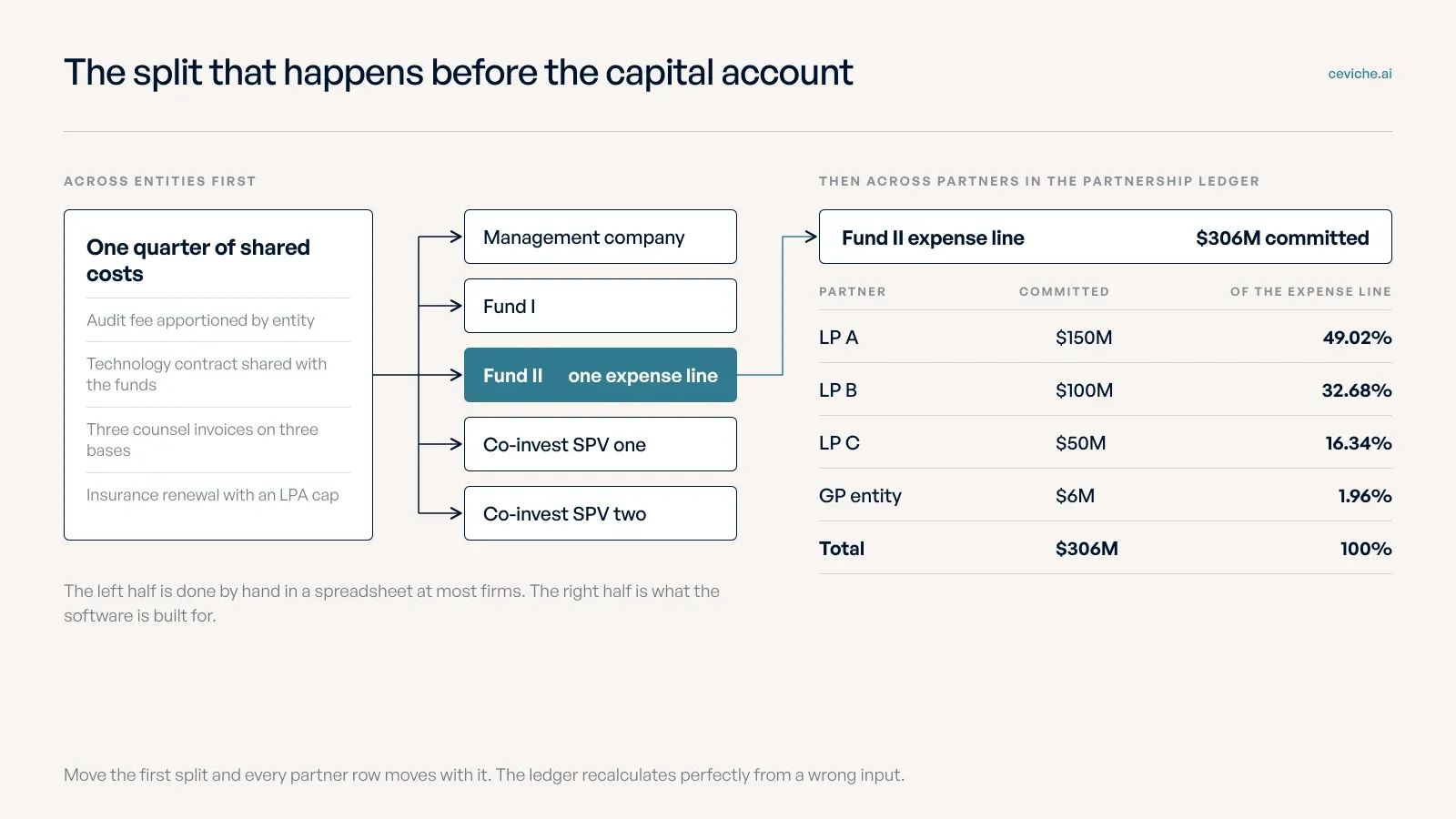
Fund II has three LPs and a GP entity. Committed capital: LP A $150M, LP B $100M, LP C $50M, GP $6M, total $306M. The quarter's capital account roll-forward includes a fund expense line of $47,900.
Allocating that $47,900 across partners is the easy half, and it is what partnership accounting software does well:
| Partner | Committed | Share | Expense allocated |
|---|
| LP A | $150M | 49.02% | $23,480 |
| LP B | $100M | 32.68% | $15,654 |
| LP C | $50M | 16.34% | $7,827 |
| GP entity | $6M | 1.96% | $939 |
| Total | $306M | 100% | $47,900 |
The hard half already happened. That $47,900 is what was left after a quarter of shared costs got split across the management company, Fund I, Fund II, and two co-invest SPVs: an audit fee apportioned by entity, a technology contract split between the ManCo and the funds, three outside-counsel invoices with deal, formation, and general lines allocated on three different bases, and an insurance renewal with an LPA cap to check on one fund.
Change that $47,900 to $52,400 and every row above changes, the capital accounts change, and the LP statements change. Your partnership accounting system will recalculate all of it flawlessly from the wrong input. That is why the allocation feeding it, and the audit trail behind it, is worth treating as its own control rather than a spreadsheet step. The related mechanics are covered in intercompany accounting for funds and due to and due from accounting.
Frequently asked questions
What is the accounting software for partnership firms?
For investment partnerships, the purpose-built options are FundCount, FIS Private Capital Suite, Allvue, Archway, and Asset Vantage, depending on whether the structure is a fund complex or a family office. For an ordinary operating partnership, QuickBooks or Xero plus a CPA handles it. The dividing line is whether you need capital accounts, waterfalls, and Section 704 allocations.
How do you do accounting for a partnership?
Maintain a capital account per partner, then record contributions, distributions, and each partner's allocated share of income, expense, gain and loss against it. In a private fund, allocations follow the LPA rather than simple ownership percentages, distributions run through a waterfall with preferred return and carry, and a parallel set of tax capital accounts under Section 704(b) feeds the K-1s.
Does partnership accounting software handle expense allocation?
It allocates expenses across partners once the fund-level amount exists. It does not decide how a shared invoice divides across funds, SPVs, and the management company in the first place, which is a different calculation governed by each LPA. In our 2026 research, 81% of the 80 fund finance teams still did that step in a spreadsheet.
Do we need partnership accounting software if we have a fund administrator?
Usually not, since maintaining capital accounts and producing K-1s is the administrator's job and it runs its own platform. What stays with you is the methodology for shared costs, the intercompany logic, and the audit trail behind each split. Firms bring partnership accounting in-house when they want the capital accounts and the ledger in one place rather than reconciled.
What software do most CPAs use?
For general practice, QuickBooks, Xero, and professional suites like Thomson Reuters Accounting CS. For fund and partnership work, CPAs read from whatever the fund runs, typically an administrator's platform or FundCount, Investran, or Allvue. The relevant question at audit is not the software. It is whether the support for each allocation exists in a form the auditor can sample.
Can capital accounts and the general ledger live in one system?
Yes, and it is the main architectural argument in this category. FundCount and Archway both post partnership allocations to the same ledger that holds cash and accruals, so statements and K-1s reconcile by construction. Platforms that keep the two separate work fine, but the reconciliation between them becomes a recurring task somebody owns.
