
TL;DR. Due from is an asset (money another entity owes you, a debit); due to is a liability (money you owe, a credit). They are mirror accounts that net to zero across related entities. In a fund, they record a cost one entity fronts for others, like a shared legal invoice the management company pays.
What do due to and due from mean?
Two accounts, one relationship. Due from is a receivable: it sits on the asset side, tracks money another related entity owes you, and carries a debit balance. When Fund I owes the management company for a cost the ManCo paid, the ManCo books a Due From Fund I. Due to is the payable on the other side of that same transaction: a liability, credit balance, the money you owe. The fund that owes books a Due To Management Company.
Due to / due from accounts are paired intercompany accounts that record money owed between related entities under common control. Due from is the receivable (an asset, debit balance) on the books of the entity owed; due to is the matching payable (a liability, credit balance) on the books of the entity that owes. One entity's due from is always another's due to.
The term also shows up in two adjacent worlds. In international banking, the same idea wears different names: a nostro account is your money held at another bank (a due from), a vostro is their money held at yours (a due to). In government and nonprofit fund accounting, interfund due to / due from balances move money between restricted and unrestricted funds. Same mechanic. The rest of this post is the version a private fund runs.
Why does one fund's due from equal another's due to?
This is the rule that makes the accounts useful and the rule that breaks first when something is wrong.
Every intercompany transaction touches two sets of books. The entity that fronts the cash records a due from; the entity that owes records a matching due to, same amount, opposite sign. So if you line up the related-party balances, the due froms and due tos have to wash out to zero. A dollar one entity is owed is a dollar another entity owes.
That netting is also the control. When the pair does not net to zero at quarter-end, you have a missing or mismatched entry somewhere: one side posted at the wrong number, one side never posted, or a settlement got recorded once instead of twice. The accounts are designed so the error announces itself. The trouble, as any controller running this across a dozen entities knows, is finding which of the dozen it lives in.
Due to / due from journal entries: a worked fund example
Here is the entry no other explanation shows. A management company pays a shared legal invoice on behalf of two funds and a co-invest SPV, then the funds settle up later. Outside counsel bills the management company $30,000 for deal work that benefited three vehicles. The split, by committed capital: Fund I $15,000, Fund II $9,000, the co-invest SPV $6,000. The ManCo fronts the full payment.
Step 1: The management company pays the invoice and records what each vehicle owes it. On the management company books:
| Account | Debit | Credit |
|---|---|---|
| Due From Fund I | 15,000 | |
| Due From Fund II | 9,000 | |
| Due From Co-Invest SPV | 6,000 | |
| Cash | 30,000 |
The ManCo is out $30,000 in cash and owed $30,000 across three due-from accounts. No expense hits the management company, because the cost was not its expense. It was the funds' expense, paid through the ManCo.
Step 2: Each fund records its own expense and what it owes the management company. On Fund I's books:
| Account | Debit | Credit |
|---|---|---|
| Legal Expense | 15,000 | |
| Due To Management Company | 15,000 |
Fund II books the same entry at $9,000, the SPV at $6,000. Now the mirror holds: the ManCo's $15,000 Due From Fund I equals Fund I's $15,000 Due To Management Company, same for the other two. The expense lands where it belongs, on each fund, not on the adviser.
Step 3: The funds settle. When Fund I wires the management company its $15,000, both sides reverse the intercompany balance. On Fund I's books:
| Account | Debit | Credit |
|---|---|---|
| Due To Management Company | 15,000 | |
| Cash | 15,000 |
The management company books the mirror: debit Cash $15,000, credit Due From Fund I $15,000. After all three settle, every due to and due from is back to zero, the ManCo's cash is whole, and each fund carries the legal expense it actually bore. Front, record, settle, net to zero.
Notice the shape: one $30,000 invoice became three due-from / due-to pairs plus three settlements, all of which have to tie out. This is the link everyone else misses. The allocation decision, how you split the $30,000, is what produces the intercompany entries. Get the split right and the entries follow; get it wrong and you are chasing a netting error that started life as a misallocated invoice line. For the workflow that produces the split, see how to allocate legal invoices across fund entities.
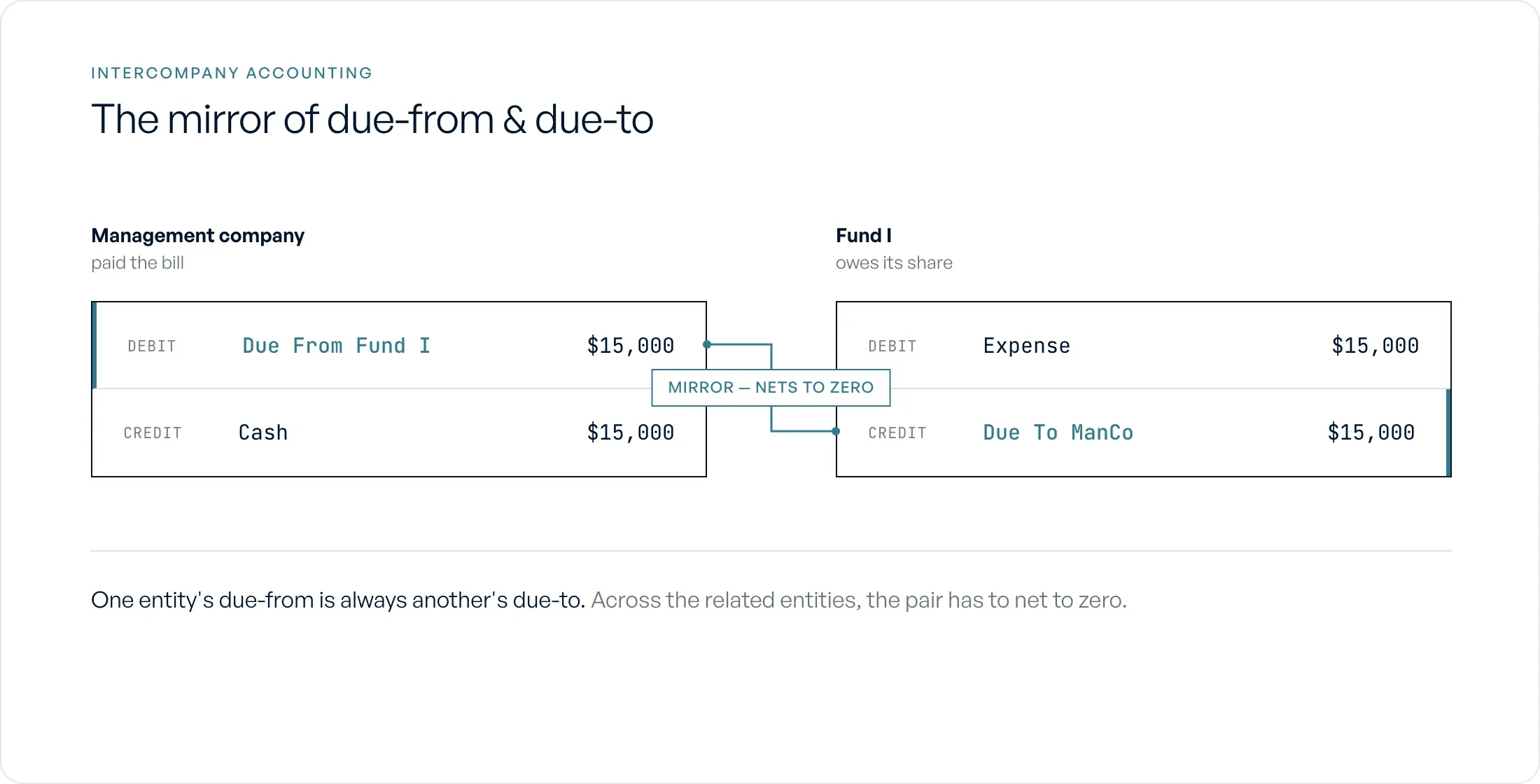
One entity's due-from is always another's due-to; the pair nets to zero.
How are due to / due from different from transfer accounts?
People mix these up, and the help-desk pages do not draw the line cleanly.
A due to / due from pair records a payable-receivable expected to settle. One entity owes another, and the balance carries forward on the balance sheet until cash moves. The legal-invoice example above is the canonical case: real money, real settlement, accounts zero out when the wire clears.
A transfer account is different in intent. It moves resources between funds or fund balances without creating a debt to repay, and at year-end it closes to fund balance rather than carrying forward as a receivable. The plain test: if you expect a wire to settle it, use due to / due from. If you are moving an allocation between fund balances with no repayment, use a transfer account. Most private-fund intercompany activity, the shared invoices and fronted costs, is the first kind.
Where do due to / due from accounts live in your chart of accounts?
You have a real choice here, and entity count decides it.
The clean default is a paired account per related entity, on each entity's books: Due From Fund I, Due From Fund II, Due From SPV, and the mirror Due To accounts. With a handful of entities this is the most legible structure, because every counterparty has its own line and the netting is obvious at a glance. Due from sits in assets, due to in liabilities, and you read the related-party balances straight off the trial balance. Smaller structures sometimes run a single intercompany account per fund group instead, which keeps the chart shorter but makes you decompose the balance by hand to see who owes whom, and that trade gets worse fast as vehicles multiply. Whichever you pick, name the accounts consistently across every entity's chart, because reconciliation depends on matching them by name across books that may live in different systems.
Why do due to / due from accounts break at fund scale?
Two entities are easy. A management company with several funds and dozens of SPVs is where the mirror rule turns into a quarter-end manhunt. The generic guides never reach this part, and it is what our own data is about.
Of the 80 fund finance teams we spoke with, 96% named multi-entity allocation a core source of complexity and 92% run allocations across disconnected systems, typically a management-company GL on one side and a separate fund accounting system on the other (multi-entity expense allocation benchmark). Fund accounting software for private equity covers which systems those are. When the two sides do not talk, the due from in the ManCo's ledger and the due to in the fund system are two manual entries that have to agree by hand. The most common reason a pair does not net: one side got keyed and the other did not, or got keyed at the wrong number.
It compounds because 81% of those teams still allocate in Excel. Pairs that should be GL-native get computed in a spreadsheet, then transcribed into two systems, and every transcription is a chance for the two halves of a mirror to drift apart. One growth-equity controller described single invoices that split across eight to thirteen funds and SPVs at once, by hand, every time. At that fan-out, one fat-fingered line surfaces at quarter-end as a balance that will not close, and you are reconciling backward to find the entry that broke it. An allocation posted to Due From Fund I when it belonged in Fund II throws off two balances at once and they hide each other. None of this is exotic. It is what happens when a relationship that must stay symmetric is kept by two manual hands in two systems.
Clearing these balances is close work, and tooling decides how long it takes: see the financial close software for funds comparison from our 80-team study.
What audit trail does an examiner expect behind an intercompany entry?
The entry is half the job. The support behind it is the half that matters when someone asks.
Of the 80 teams we spoke with, 49% have a gap in their allocation audit trail: the entry exists, but the record of why each line went where it did does not survive in a form an examiner would accept. For intercompany entries this is sharper, because a due from to a fund is by definition a related-party transaction, and that is where fee-and-expense scrutiny lives. The SEC's Division of Examinations has named fee and expense allocation a recurring priority for private fund advisers, and a misallocated intercompany entry is the exact fact pattern an exam looks for: a cost that benefited the adviser charged to a fund, or a split the fund documents do not support.
What an examiner wants behind a single Due From Fund I is the chain: the underlying invoice, the methodology that produced the $15,000 (committed capital, here), the approval, the date, the person. Teams that handle an exam request in minutes built that chain as they posted. Teams that lost a week and a half were reconstructing it afterward from email and memory. The accounts net to zero either way. Only one version survives a sample of twenty to fifty transactions.
Where does Ceviche fit?
The judgment, deciding how a shared cost splits across the funds, stays with the controller. What does not have to stay manual is the part after the decision: posting the matching due-from and due-to pairs into both sides, keeping them netted, carrying the rationale on every line. Ceviche reads the spend systems and the GL a fund already runs, applies the firm's methodology, and writes the audit-ready intercompany entries back, so the mirror holds without two hands in two systems. One multi-billion-dollar fund cut its month-end allocation and reconciliation work from roughly ten days to one to two hours after automating it. Flybridge runs the same workflow across 18+ fund entities on QuickBooks Online and Bill.com. See how Ceviche handles fund expense allocation, and the full data in the state of fund expense allocation.
Frequently asked questions
What is the difference between due to and due from? Due from is a receivable: money a related entity owes you, an asset with a debit balance. Due to is the matching payable: money you owe a related entity, a liability with a credit balance. They are two sides of one intercompany transaction, so one entity's due from equals the counterparty's due to.
How do you use due to and due from accounts? When one entity pays a cost on behalf of another, the payer books a due from and the entity that benefited books a due to. When the debt settles in cash, both sides reverse and the pair returns to zero. In a fund, the management company fronts a shared invoice, books a due from against each fund, and each fund books a matching due to plus its share of the expense.
What is a due to / due from journal entry? The paired entry that records an intercompany debt. On the entity owed: debit Due From [counterparty], credit Cash. On the entity that owes: debit Expense, credit Due To [counterparty]. The two entries mirror each other at the same amount, which lets the balances net to zero across the related entities.
Is due from a debit or a credit? A debit. Due from is a receivable, a receivable is an asset, and asset accounts carry debit balances. Its mirror, due to, is a liability with a credit balance. A due-from showing a credit balance usually means something posted backward.
How do you reconcile due to and due from accounts? Match each due-from balance against the counterparty's due-to balance; they should be equal and offsetting. Any difference points to a missing entry, a one-sided settlement, or a posting to the wrong entity. Reconciliation is hardest when the two sides live in different systems, because each balance was keyed by hand and has to agree without an automatic link.
What is the difference between due to / due from and transfer accounts? A due-to / due-from pair records a payable-receivable expected to settle in cash, carried on the balance sheet until it does. A transfer account moves resources between funds without creating a debt to repay, and closes to fund balance at year-end. Use due to / due from when a wire will settle it; use a transfer when you are shifting an allocation with no repayment.