
TL;DR. Fund management software runs the front office: deal pipeline, portfolio monitoring, fundraising, and the LP portal. Fund accounting software runs the back office: general ledger, NAV, capital accounts, and financial statements. Most firms need one of each, and the manual work collects in the gap between them.
You were sold two categories and still have a gap
The practical version of this question is not definitional. It is a controller with a demo scheduled, a vendor claiming to cover everything, and a suspicion that the thing currently eating a week of the close will still be eating it afterward.
That suspicion is usually correct, and the reason is structural. These two categories were built from opposite ends of a fund's operation, and neither was designed for the seam where they meet. Definitions first, then the buyer's map, then the seam.
One scoping note, because the term itself causes confusion. "Fund accounting" names four unrelated disciplines. Nonprofits use it for donor-restricted money. Governments use it for appropriations. Institutional asset managers use it for NAV and multi-asset portfolio accounting. Private funds use it for partnership books and capital accounts. The label covers all four, so church accounting software and a system built for a $10B buyout firm share one name. Everything below is the private funds meaning only.
What is fund management software?
Fund management software covers the front-office and investor-facing systems a private fund runs: deal pipeline and CRM, portfolio company monitoring, valuation tracking, fundraising and investor relations, the LP portal, and reporting to investors. It manages relationships, positions, and information rather than the general ledger.
The work it supports is forward-looking. Which deals are in the pipeline and at what stage. What the portfolio companies reported last quarter. What a position is worth and how that valuation was derived. Which LPs are in the current raise, what they have seen, and what they have asked for. Where the quarterly reporting package is in its review cycle.
Vendors here include Juniper Square on the investor relations and portal side, Dynamo and Altvia on deal and relationship management, and portfolio monitoring tools that aggregate company KPIs. The unifying trait: they hold data about deals, companies, and people, and they are used by people who are not accountants.
What is fund accounting software?
Fund accounting software maintains a private fund's books and records: the general ledger, NAV and valuations, partnership and capital account accounting, management fee and carried interest calculations, and the financial statements LPs and auditors rely on. It is the system of record for the numbers, not for the relationships.
The work it supports is backward-looking and evidentiary. What happened, in what period, posted to which entity, supportable to an auditor. It maintains a capital account per LP across a ten-year fund life, computes the waterfall, and produces statements under the AICPA's investment companies guide.
Vendors here include Allvue and FundCount in private capital, Investran and Geneva at the enterprise tier, and, for a large share of firms, a management company general ledger like QuickBooks or NetSuite sitting alongside whatever the fund administrator runs.
The two categories side by side
| Fund management software | Fund accounting software | |
|---|---|---|
| Primary user | Deal team, IR, CFO | Controller, fund accountant |
| Orientation | Forward-looking | Evidentiary, period-based |
| Core objects | Deals, companies, contacts, commitments | Entities, accounts, transactions, partners |
| Typical outputs | Pipeline reports, portfolio KPIs, LP updates | Trial balance, NAV, capital accounts, financial statements |
| Governed by | Internal process | The LPA, GAAP, audit, SEC examination |
| Fails when | Data goes stale | Numbers are wrong |
| Does not cover | The general ledger | Deciding how a shared cost splits |
The last row is the one to sit with. Neither category owns it.
The overlap is a marketing artifact
Category boundaries blur in vendor positioning long before they blur in architecture. A platform that started in investor relations adds accounting; a platform that started in accounting adds a portal; both then market themselves as end-to-end.
Sometimes that is real. Front-to-back platforms genuinely do cover both halves, which is their entire proposition and the reason they carry implementation weight to match. Often it is a module rather than a product, and the test is not whether the capability appears on a feature grid. Three questions settle it:
Which half is the system of record? If both, ask which one wins when they disagree, because they will. Does the accounting half maintain capital accounts per LP with a waterfall, or does it produce a management-level P&L and call that fund accounting? And does the platform write journal entries into the ledger you actually keep your books on, or only into its own?
That third question decides more purchases than any other, and public sources frequently do not answer it. Ask it directly in the demo, and ask for it in writing.
Which one do you need?
Map the need to the category rather than the other way around.
| If your problem is | You need | Not |
|---|---|---|
| Deals are tracked in a spreadsheet and nobody knows the stage | Fund management (CRM/pipeline) | Fund accounting |
| Portfolio company KPIs arrive by email and get re-keyed | Fund management (monitoring) | Fund accounting |
| LPs ask for documents you have to dig up | Fund management (portal) | Fund accounting |
| You cannot produce a capital account balance per LP on demand | Fund accounting | Fund management |
| The waterfall lives in a spreadsheet only one person understands | Fund accounting | Fund management |
| The audit takes longer every year | Fund accounting | Fund management |
| One invoice has to split across four entities every month | Neither, see below | Both |
| The management company's books and the fund's books disagree | Neither, see below | Both |
The last two rows are not a rhetorical device. They are the two most common answers when we ask fund finance teams what actually consumes their close.
Five demo questions that settle it
If a vendor claims to cover both categories, these five questions expose the depth in one call. Which half is the system of record, and which one wins when they disagree? Does the accounting half maintain a capital account per LP with a waterfall, or a management-level P&L wearing the label? Do journal entries write back into the ledger we actually keep our books on, or only into yours? What happens to our records, in what format, if we leave? And who, in your reference accounts, decides how a shared cost splits before it reaches your system? The fifth one has only one honest answer, which is the subject of the next section.
The seam is where the manual work lives
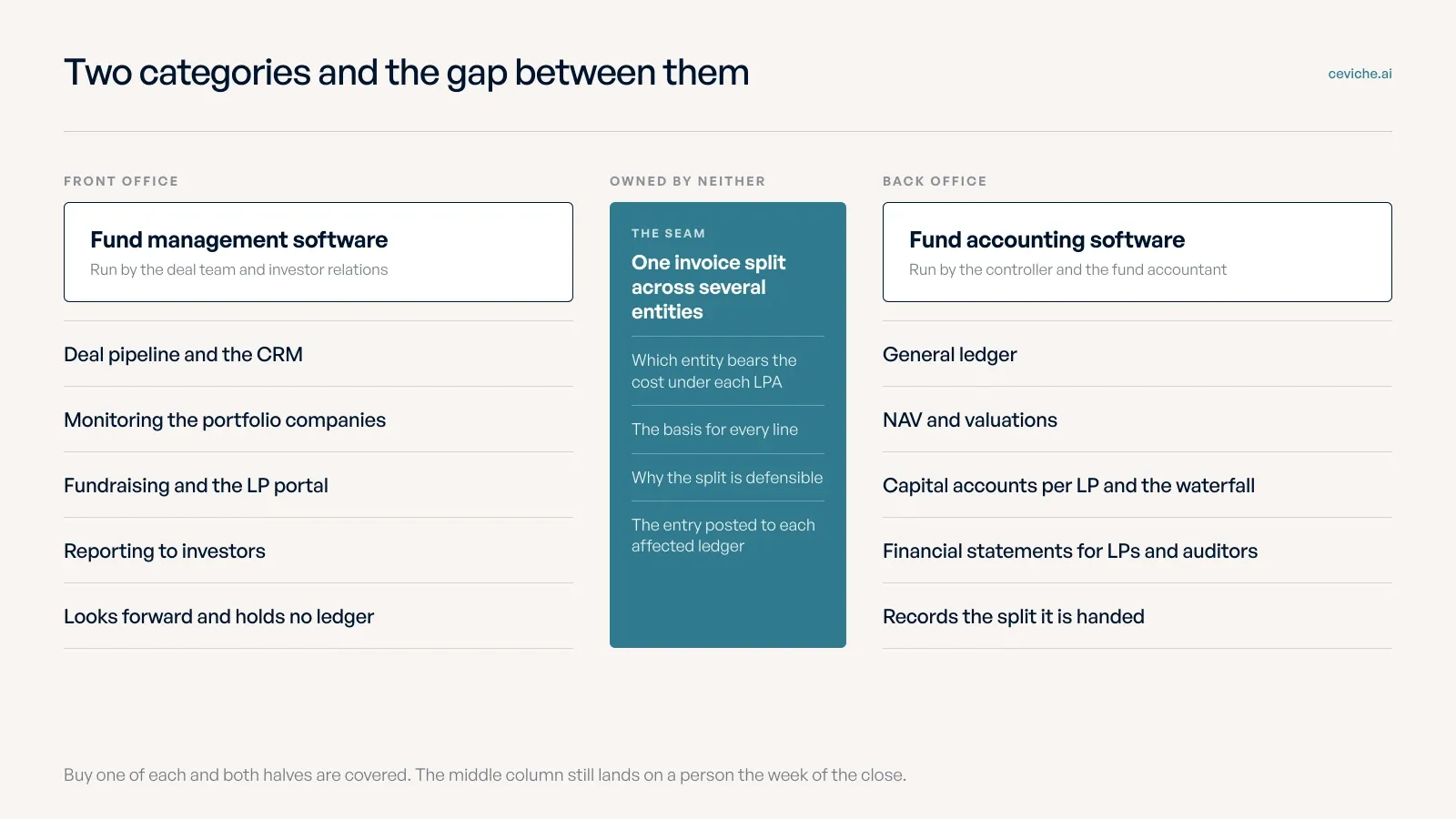
Buy one of each and you have covered both halves of the operation. You have also created a seam, and the seam has no owner.
Of the 80 fund finance teams we interviewed in 2026, 92% ran allocations across disconnected systems that do not talk to each other, and 81% did the allocation itself in Excel. Those are not firms that failed to buy software. They are firms that bought the two categories on this page and found that the work between them belonged to neither.
The work in the seam is specific. Deciding which entity bears a shared cost, per the LPA. Splitting one invoice line by line across funds, SPVs, and the management company at different methodologies. Recording why each split is defensible. Posting the result into every affected ledger and keeping the intercompany balances agreeing in both directions.
Fund management software does not do it, because it holds no ledger. Fund accounting software does not do it, because it records the split you hand it rather than deciding the split. So a person does it, usually in a spreadsheet, usually the week of the close.
For how these layers sit together in a working stack, our guide to the private equity tech stack maps the whole back office layer by layer.
Where does Ceviche fit?
Ceviche is the seam layer. It sits between the spend systems a firm already runs and the general ledger, applies the allocation methodology each LPA supports per invoice line, and writes audit-ready journal entries back to QuickBooks Online, NetSuite, or Sage Intacct with the supporting basis written into each entry, which means it complements both categories on this page rather than replacing either. For Flybridge that meant keeping QuickBooks Online and Bill.com and moving quarterly allocation across 18+ fund entities out of spreadsheets, with every allocation traced back to source documentation and posted to QuickBooks Online. See how Ceviche handles fund expense allocation.
Frequently asked questions
What is fund management software? Software covering the front office and investor-facing side of a private fund: deal pipeline and CRM, portfolio company monitoring, valuation tracking, fundraising, the LP portal, and investor reporting. It holds data about deals, companies, and people. It is used mainly by deal teams and investor relations rather than by accountants, and it does not keep the fund's books.
Which software is used for fund accounting? It depends on tier and structure. Private capital platforms such as Allvue and FundCount serve firms replacing a full back-office stack; Investran and Geneva sit at the enterprise end; many firms run a management company general ledger like QuickBooks or NetSuite alongside whatever their fund administrator uses. Our guide on choosing fund accounting software works through the lanes, and the fund management software comparison covers the adjacent category.
What is the difference between a fund manager and a fund accountant? A fund manager makes and oversees investment decisions and carries responsibility for the fund's performance to its LPs. A fund accountant keeps the fund's books: posting transactions, reconciling, computing NAV, maintaining capital accounts, and preparing statements. The manager decides what the fund does; the accountant records what it did. They use the two software categories on this page respectively.
Can one platform do both? Front-to-back platforms genuinely cover both halves, and they carry the implementation weight that implies. The thing to verify is depth rather than presence: whether the accounting half maintains per-LP capital accounts and a waterfall, and whether it writes entries into the ledger you actually use or only its own. Ask both questions in the demo and get the answers in writing.
Do we need both if we already have a fund administrator? Often you need less of the accounting category and just as much of the management category. The administrator supplies the fund-side books, so what remains is a general ledger for the management company's own costs. Nothing about the administrator relationship covers deal pipeline, portfolio monitoring, or the LP portal, and nothing about it covers the allocation seam either. The related question of what administration leaves on your desk covers that boundary in full.
Does fund accounting software handle expense allocation? A ledger records whatever split it is given; producing the split is upstream work. It posts the numbers you hand it, and most fund accounting systems support allocation rules at the fund or investor level rather than line-by-line across several entities and the management company. That cross-entity decision, and the documented basis behind it, sits upstream of both software categories.