A segmented comparison of fund management software, separating front-office, back-office, investor relations, and wealth platforms before ranking anything.
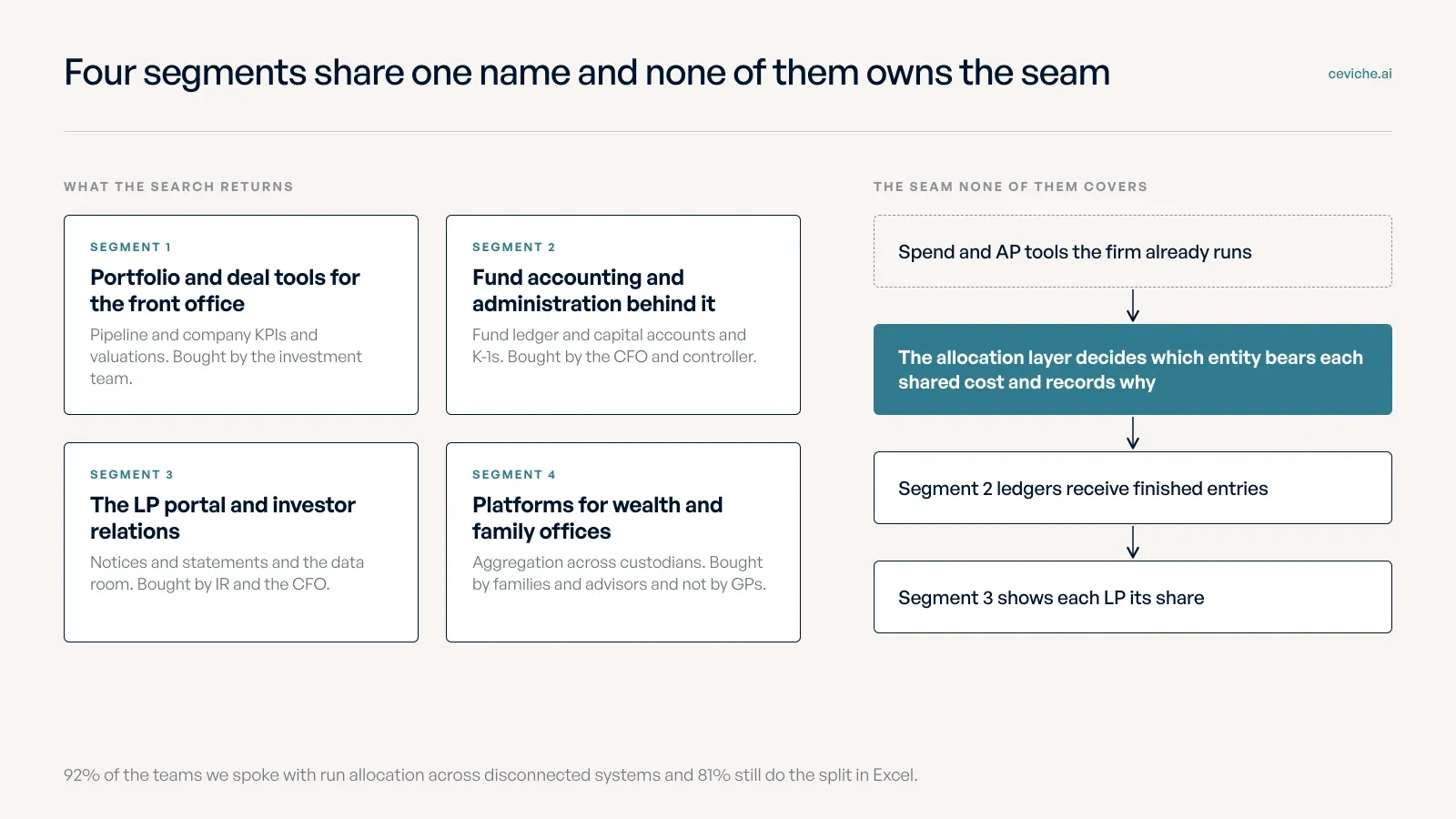
There is a fifth category that no vendor list includes, and it is the seam between the second and third rows. We come back to it.
How Did We Evaluate These?
Three criteria, applied within segments rather than across them.
Fit to the buyer, because a platform sold to a family office and a platform sold to a GP solve genuinely different problems and one will not do the other's job. Integration reality, because almost no firm runs a single segment and the value of a product depends heavily on what it can read from and write to. And disclosure, because a vendor that publishes neither pricing nor an implementation timeline costs you a sales cycle before you can even scope the decision.
Disclosure: Ceviche publishes this article and sells fund expense allocation software, which sits in the fifth category described below. Vendor characterizations come from public material, and where a source does not confirm something we say so.
Segment 1: Front-Office Portfolio and Deal Management
This is the segment most "fund management software" content is actually about, and it is bought by the investment team rather than by finance.
Allvue Portfolio Management covers KPI and financial collection from portfolio companies, analytics, and reporting, and its real advantage is sitting in the same platform as Allvue's fund accounting. Firms already running Allvue on the back office get one data model across both. Firms that are not are buying a monitoring product on its own merits.
Dynamo pairs portfolio monitoring with a deal and LP CRM, and fits firms that want the front office consolidated with investor relations.
Cobalt, from FactSet, is the analytics-forward option: portfolio and fund performance aggregation in role-based dashboards, AI-assisted document ingestion that extracts and normalizes data from portfolio company files regardless of format, and a valuation workflow integration so financials flow into a valuation platform and results return automatically. It fits firms that value institutional-grade valuation and benchmarking depth.
Standard Metrics and Visible.vc are the venture-native options, strongest on collecting portfolio company financials at scale and turning them into LP-facing reporting.
None of these products maintains a general ledger, posts a journal entry, or produces a K-1. If your problem is the close rather than the portfolio review, this segment is not where the answer is.
Segment 2: Back-Office Fund Accounting and Administration
This is where a CFO's version of the question lands, and it is covered in depth in our PE fund accounting comparison and our comparison of fund administration software. The short version:
FundCount keeps capital accounts and the general ledger as the same record, which means statements and K-1s reconcile by construction. It fits administrators, family offices, and multi-entity managers who want one audited source.
Allvue is front-to-back private capital infrastructure with fund accounting, management-company accounting, investor portal, and monitoring in one platform. It fits firms replacing the whole stack with implementation runway to do it. If that is more than you need, see Allvue alternatives.
FIS Private Capital Suite, formerly Investran, is the incumbent for complex, tiered waterfalls and automated carry at large managers and administrators.
Carta delivers administration as a service on its own software, with fund tax, SPVs, formations, and an LP portal alongside. It fits venture and emerging PE managers.
An administrator on QuickBooks or NetSuite remains the most common real answer. The ManCo ledger stays with you, the fund books go to a specialist, and no fund accounting license gets bought at all.
Segment 3: Investor Relations and the LP Portal
Often bought separately, and increasingly bundled. Our guide to private equity reporting software compares the reporting side of this segment, the tools that produce the LP statements.
Juniper Square is the strongest standalone in this segment, combining investor experience with administration services, with a heavy base among real estate sponsors and growing coverage in PE and VC. Carta and Allvue both include portals as part of larger platforms. Investorflow targets investor experience for asset and investment managers specifically.
The evaluation question here is not features, since every portal shows commitments, contributions, and documents. It is where the data comes from. A portal fed by your administrator updates on the administrator's cycle. A portal inside your accounting platform updates when you post. That difference decides whether LP self-service actually reduces your inbound queries or just relocates them.
Segment 4: Wealth and Family Office Platforms
These get called fund management software because family offices genuinely use that name, and because they now hold meaningful private markets exposure. They are worth understanding even if you are not the buyer, because your LPs may be using one to look at you.
Masttro and Addepar are the reference platforms for multi-asset aggregation across custodians, with reporting and visualization built for wealth owners rather than fund accountants. SS&C Black Diamond serves advisors. Altoo and Landytech compete in the same wealth-reporting space. Canoe and Arch are narrower and more interesting for private markets specifically: both automate the intake of alternative investment documents, capital call and distribution notices, and statements that arrive as PDFs, which is the LP-side mirror of the GP-side problem this article is really about.
The buying criteria in this segment, per the vendors themselves, are custodian integration breadth, illiquid asset support, reporting flexibility, and whether pricing is AUM-based or fixed. If you are a GP, none of these products keeps your fund books.
Segment 5: The Allocation Layer
Here is the category no vendor directory lists, and the reason this comparison exists.
Firms do not buy one product from one segment. They buy a monitoring tool, a general ledger, an administrator, and a portal, and each one is competent at its job. Of the 80 fund finance teams we interviewed in 2026, 92% run their expense allocation across disconnected systems that do not talk to each other, and 81% do that allocation in Excel. A finance leader at one multi-strategy fund put the wish plainly: "ideally you have one system where you can see all these things." No segment on this page provides it.
The seam that matters most is between segment two and everything upstream of it. A shared cost arrives in a spend or AP tool with no concept of your fund complex. It has to reach a ledger that has accounts but no concept of why the cost belongs to Fund II rather than Fund I. Something has to carry that decision across, apply the methodology each LPA specifies, and record why. That is the allocation layer.
Ceviche is the product in that category. It reads the spend and AP systems funds already run (Ramp, Bill.com, Brex, Expensify, SAP Concur), applies the allocation methodology per line, and writes audit-ready journal entries back into QuickBooks Online, NetSuite, or Sage Intacct with the rationale attached. It is not a GL, not a fund administrator, and not a portfolio monitoring tool, and it does not replace anything in segments one through four.
Flybridge runs it across 18+ fund entities on a QuickBooks Online and Bill.com stack. Quarterly allocation used to run in spreadsheets; it now runs through Ceviche and posts to QuickBooks Online, and every allocation traces back to source documentation with a full audit trail.
A Worked Example of the Seam
A firm runs Fund III ($500M committed), Fund IV ($750M committed), a co-invest SPV ($150M committed), and the management company, with monitoring in one platform, books in NetSuite, and fund administration outsourced.
The annual portfolio-monitoring and data platform contract renews at $132,000, covering the investment team's seats, the valuation module, and per-vehicle position tracking. The firm's methodology charges 35% to the management company for firm-level seats and administration, then allocates the remainder by positions tracked per vehicle at renewal: 24 for Fund III, 36 for Fund IV, and 8 for the SPV.
| Entity | Basis | Share of total | Amount |
|---|
| Management company | Firm-level seats and administration | 35.0% | $46,200 |
| Fund III | Positions tracked, 24 of 68 | 22.9% | $30,282 |
| Fund IV | Positions tracked, 36 of 68 | 34.4% | $45,424 |
| Co-invest SPV | Positions tracked, 8 of 68 | 7.7% | $10,094 |
| Total | | 100% | $132,000 |
Trace the work. The monitoring platform never sees this cost. NetSuite records the payment and, if someone tells it, four allocated entries. The administrator books the fund-side impact once it receives the numbers. The portal shows LPs a fee and expense line that includes their share.
Three systems touched the transaction, and a fourth never saw it. None of them produced the 35%, checked it against the LPAs, or stored why 35% and not 30%. That calculation, and the documentation behind it, is what a controller builds in a spreadsheet, and it is what an examiner asks about first. 49% of the teams we interviewed have a gap in exactly that trail.
The Two Most Common Buying Mistakes
The first is buying across segments to solve one problem. A firm whose close runs long buys a front-to-back platform, because the vendor demonstrating it can show every part of the firm on one screen. The close was long because allocation was manual, and the new platform is no better at deciding allocations than the old one was. The purchase was real, the migration took three quarters, and the specific pain that triggered it is unchanged. Diagnose which segment the pain lives in before shortlisting anything.
The second is treating consolidation as a value on its own. One vendor across three segments genuinely reduces reconciliation, and it also means your fund records, your LP portal, and your monitoring data all live with a party you now depend on for extraction. That is a fair trade for some firms and a bad one for others, and it should be a decision rather than a default. The question to ask in the demo is not what the platform covers. It is what leaving looks like: which records come out, in what format, and how long it takes.
Both mistakes have the same root. The segments are invisible in vendor marketing, so buyers evaluate breadth instead of fit. Naming the segment first makes both avoidable.
Best-Fit Summary
- Allocation layer: Ceviche, for lean teams whose ledger and administrator are settled and whose shared-cost allocation is still manual.
- Front office: Allvue Portfolio Management if you already run Allvue, Cobalt for valuation and benchmarking depth, Standard Metrics or Visible.vc for venture portfolio reporting.
- Back office: FundCount for one ledger with capital accounts, Allvue for a full replacement, FIS for complex waterfalls at scale, Carta for venture and emerging PE, an administrator plus QuickBooks or NetSuite for everyone else.
- Investor relations: Juniper Square standalone, or the portal inside whichever back-office platform you chose.
- Wealth and family office: Masttro or Addepar for aggregation, Canoe or Arch for alternatives document intake. Not GP products.
Frequently asked questions
What is the best software for managing investments?
It depends which job you mean. For tracking portfolio company performance, Allvue, Cobalt, Standard Metrics, and Visible.vc. For fund books, FundCount, Allvue, FIS Private Capital Suite, or an administrator. For aggregating a family's assets across custodians, Masttro or Addepar. These are three separate purchases, and no product leads in more than one.
What software do most financial advisors use?
Advisors typically run Orion, Envestnet, eMoney Advisor, SS&C Black Diamond, or Addepar for portfolio management and client reporting. Worth noting because these are also sold as fund management software: an advisor manages client portfolios, while a GP manages funds with capital accounts, LPAs, and K-1s. The products do not overlap.
What is the best fund accounting software?
For fund-level books with capital accounts and waterfalls, FundCount, Allvue, and FIS Private Capital Suite lead. For a management company outgrowing QuickBooks, Sage Intacct or NetSuite. Most private funds below a few billion in AUM keep QuickBooks and hire an administrator. Our comparison of fund accounting software for private equity covers the tradeoffs.
Who do billionaires use to manage their money?
Single and multi-family offices, usually running a wealth platform like Masttro, Addepar, or Altoo to aggregate holdings across custodians, banks, and private funds. Those platforms carry the same label because family offices are a real buyer of what they call fund management software. They are a different product from what a GP needs.
What is the difference between fund management software and fund accounting software?
Fund management is the umbrella term covering front-office, back-office, and investor-facing systems. Fund accounting is one segment inside it: the books and records, capital accounts, and financial statements. Vendors blur the two because the umbrella term is the one more buyers use. We separate them in detail in fund management software vs fund accounting software.
Do we need one platform or several?
Almost every firm runs several, and the honest question is which seams you are willing to own. A single-vendor stack reduces reconciliation and increases dependency. A best-of-breed stack does the reverse. In our 2026 research, 92% of teams ran allocation across disconnected systems, which is the specific seam that costs the most, and the one worth solving deliberately rather than tolerating. The full stack map is in our guide to the private equity tech stack.
