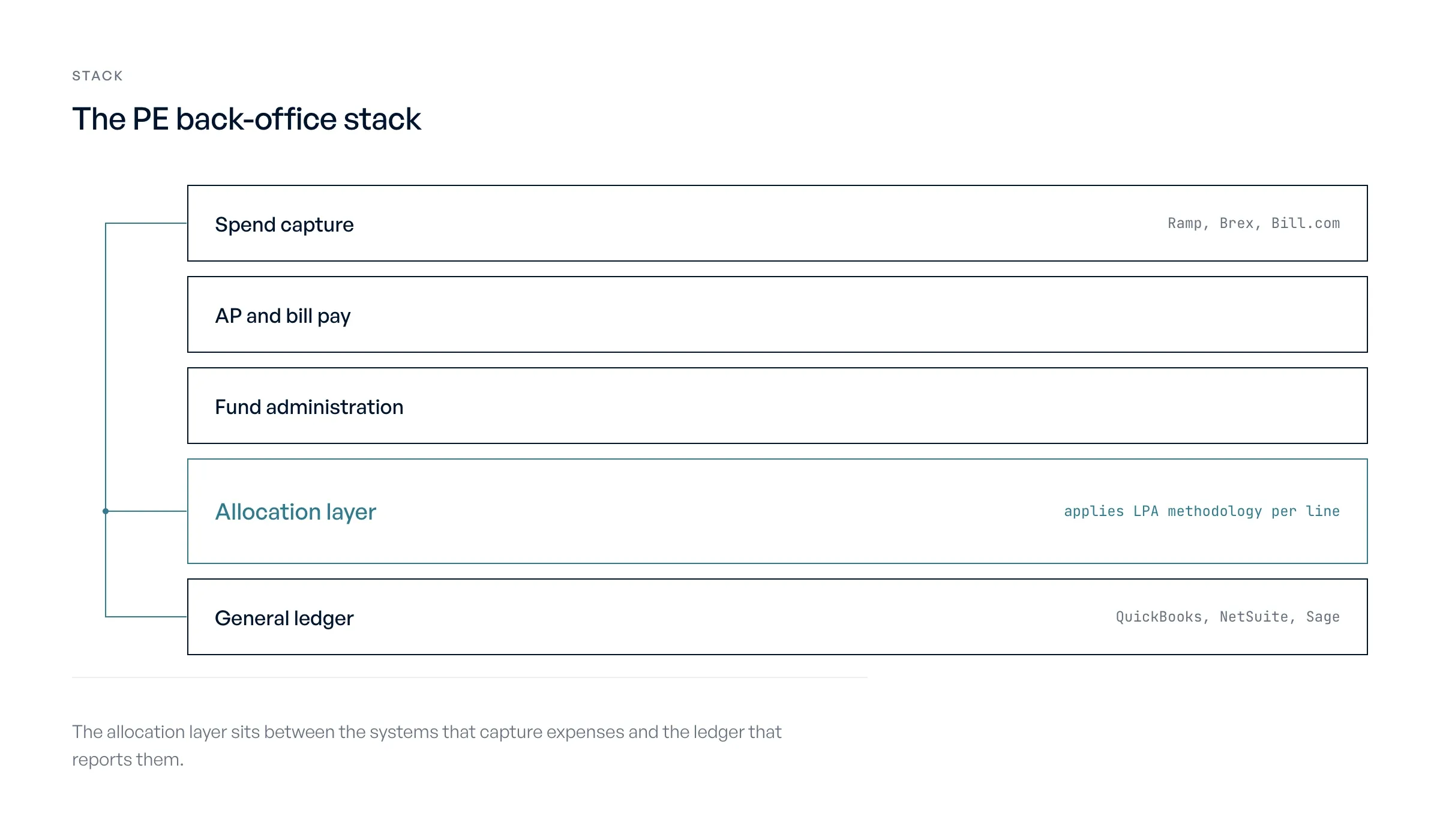
A layer-by-layer guide to the private equity back-office tech stack, built on adoption data from 80 fund finance teams rather than a vendor directory.
| Layer | What it does | What firms run |
|---|
| 1. Management company GL | The firm's own books: payroll, rent, operating costs | QuickBooks 51%, NetSuite 23%, Sage Intacct 5% |
| 2. Spend and AP | Cards, bills, employee expense capture | Ramp 49%, Bill.com 39%, Expensify 30%, Concur 11% |
| 3. Fund accounting or administrator | Capital accounts, NAV, LP reporting, fund books | Investran, Allvue, Geneva, FundCount, Carta, or an outsourced administrator |
| 4. Allocation layer | Splitting shared costs across funds, SPVs and the ManCo | Excel, for 81% of teams |
| 5. Close and reporting | Consolidation, LP packages, audit support | The GL's reporting plus spreadsheets |
The layers are not equally mature. One, two, and three are real product categories with real vendors and real budgets. Five is a mix of native reporting and spreadsheets. Four is the one nobody names, which is why it is the one that stays manual.
Layer 1: The Management Company General Ledger
This is the firm's own P&L, and it is the layer people are most surprised by.
QuickBooks, Online and Desktop combined, is the management-company GL for 51% of the teams where we captured a primary ledger. NetSuite covers 23%. Together that is 73%. Sage Intacct holds a real but smaller third lane at 5%, and the remaining 21% is a long tail: Xero, Carta, Dynamo, Microsoft Dynamics 365, Workday, plus firms migrating off older systems.
The surprising part is not the shape. It is how far up market QuickBooks goes. It persists well above its reputational weight class, including at multi-billion-AUM firms, and the reason is structural rather than lazy: a management company is a small services business. Payroll, rent, technology, travel, professional fees. It does not need an ERP to record that. The complexity in private equity lives in the funds, and the funds are not on this ledger.
The migration pattern we see most often is QuickBooks Online to NetSuite, and it clusters. Firms do not move because the ledger broke. They move when entity count and reporting demands crossed a line at roughly the same time, usually alongside an institutional LP base that started asking for more.
What matters for the rest of the stack: whichever ledger you run, everything downstream has to write into it. A tool that cannot post a journal entry back to your GL leaves a person re-keying, and that person is your bottleneck at close.
Layer 2: Spend and AP
The spend layer clusters tightly around three names, and it is the most competitive layer in the stack.
Ramp appears in 49% of the stacks we counted, Bill.com in 39%, and Expensify in 30%, with Concur further back at 11%. Firms usually name two or three, so mentions overlap rather than sum. Ramp is the momentum leader by a clear margin, and that includes a meaningful share of teams mid-migration toward it, from Bill.com to Ramp Bill Pay, from Brex to Ramp, and so on.
One pairing recurs often enough to name: Bill.com plus Expensify feeding QuickBooks Online. Flybridge, a Boston venture firm and a Ceviche customer, runs that shape across its fund entities.
A stack in motion at this layer is a reliable signal that a firm is rethinking everything downstream of it, which is why spend-tool migrations so often surface allocation problems that were tolerable before. The new tool captures data the old one did not, someone notices the memo fields are empty, and the question of who was coding these to which entity becomes unavoidable.
The structural limit of this layer is worth stating plainly. Spend tools capture the transaction. They can tag a card swipe to a department or a class. What they cannot do is read a 25-line legal invoice and split each line to a different fund by the methodology that fund's LPA specifies. That is not a gap in Ramp or Bill.com. It is outside the job they do.
Layer 3: Fund Accounting or the Administrator
Behind the management-company ledger sits a second set of books, and this is where private equity stops resembling any other business.
The fund side carries capital accounts per LP, committed versus called versus uncalled capital, income and expense allocations across partners, waterfall and carried-interest math, NAV, and the financial statements LPs and auditors read. Firms answer this layer in one of three ways.
They hire a fund administrator, which is the most common answer, and inherit whichever platform that administrator runs. They license a fund accounting platform and run it in-house: Investran (now FIS Private Capital Suite), Allvue, SS&C Advent Geneva, FundCount, or LemonEdge. Or they run it inside a bundled provider like Carta, where administration and the ledger arrive together.
The decision is less about software than about where you want judgment to live, and the honest version of that tradeoff is in our guide to fund administration software and the deeper PE fund accounting comparison.
What this layer does not do, in any of its three forms, is decide how a shared cost splits. The administrator posts what you hand it. The platform records the entry you configured. The methodology is upstream, which brings us to the layer nobody names.
Layer 4: The Allocation Layer
This is the layer no vendor directory lists, no stack diagram includes, and 81% of fund finance teams staff with a spreadsheet.
The allocation layer is the part of the stack that decides how a single shared cost divides across fund entities, co-invest vehicles, and the management company: applying the methodology each LPA specifies per line, producing the resulting journal entries, and recording the basis for every split in a form an auditor or an examiner can sample. It sits between the spend systems that capture the cost and the ledgers that record it.
Its existence follows from the two layers around it. The spend tools hold an invoice with no concept of your fund complex. The ledgers hold accounts with no concept of why a cost belongs to Fund II rather than Fund I. Something has to carry the decision across, and at most firms that something is a person with a workbook.
The numbers on how well that works are consistent. 96% of the teams we interviewed named multi-entity complexity a core problem. 92% run the allocation across disconnected systems that do not talk to each other. 63% named legal invoice allocation one of their hardest problems. And 49% have a gap in their allocation audit trail: the split happened, but the documented reason each line landed where it did does not survive in a form an examiner accepts. One controller described the support for a past allocation as somebody writing a paragraph after the meeting.
The time cost concentrates rather than spreads. Teams that quantified it put allocation at one to five days per quarter, and it lands at the close, exactly when the rest of finance is waiting. One PE controller kept a single Excel tracker for the firm's allocations and logged more than 2,800 invoice line items in a year, copying each split from the spend system into the sheet by hand.
A Worked Example of What Layer 4 Does
A firm runs Fund I ($350M committed), Fund II ($700M committed), a co-invest SPV, and the management company. Outside counsel sends a bill for $61,400 across 18 lines.
The lines are not one expense. Nine timekeeper lines totaling $34,000 cover diligence on a deal Fund II led with the SPV alongside it, split by invested capital in that deal at 75/25. Four lines totaling $15,200 are fund-formation work on a new vehicle, allocated by specific identification to that fund, subject to whatever organizational-expense cap its LPA sets. Three lines totaling $8,400 cover general regulatory work benefiting Fund I and Fund II together, allocated pro rata by committed capital at 33.3% and 66.7%. Two disbursement lines totaling $3,800 follow whichever matter they supported.
| Line block | Amount | Methodology | Result |
|---|
| Deal diligence (9 lines) | $34,000 | Invested capital in the deal | Fund II $25,500, SPV $8,500 |
| Fund formation (4 lines) | $15,200 | Specific identification | New fund $15,200, subject to LPA cap |
| General regulatory (3 lines) | $8,400 | Committed capital, $350M vs $700M | Fund I $2,800, Fund II $5,600 |
| Disbursements (2 lines) | $3,800 | Follows the underlying matter | Split across the blocks above |
That is three allocation bases, an organizational-expense cap, and a disbursement rule packed into one PDF. Every system in layers one, two, three, and five can record the result. None of them produces it. That is the whole argument for treating allocation as its own layer rather than a task.
Layer 5: Close and Reporting
The top of the stack is the least tooled and the most visible, because it is what LPs and auditors see.
Consolidation across entities, the quarterly LP package, capital account statements, the audit support file, and increasingly a reporting format measured against ILPA's template for fees and expenses. Some of this comes from the GL's native reporting, some from the administrator, and a meaningful share from spreadsheets built on top of both. The private equity reporting software guide compares the dedicated tools for this layer.
The close is where every weakness below it surfaces at once. Funds we interviewed described closes running two to three weeks. At one multi-billion-dollar fund on a 15-business-day close, roughly 10 days went to manual allocation and reconciliation: reading vendor and legal bills, splitting them across the fund complex, keying journal entries, and tying everything back. After automating that block, the same work ran in one to two hours, and the firm expected to take five to ten days off month-end close overall. The full benchmark is in our fund close-time data.
What that result shows is that the close is rarely slow because the math is hard. It is slow because the handoffs are manual. A bill arrives in one system, the allocation gets worked out in a spreadsheet, and the result gets typed into the ledger by a person. Nothing carries the line-level decision across those gaps on its own, so somebody carries it, and the close waits on that person.
Why Do Funds Run Two Accounting Systems Instead of One?
This is the structural finding underneath everything above, and it explains why the stack has a hole in the middle.
The recurring shape is not a single platform. It is a management-company GL for the firm's own books, with a separate fund-side system behind it for the funds themselves. The ManCo ledger handles payroll, rent, and operating costs. The fund system handles capital accounts, investor reporting, and fund-level books. Neither was built to know about the other, and shared costs have to be split across both worlds and posted into each.
That is what 92% of teams running disconnected systems means in practice. A controller at a multi-billion-dollar venture and credit fund reads from NetSuite on the management-company side and pushes allocated entries into a fund-side system on a quarterly cycle. The same firm cut its month-end allocation work from roughly ten days of manual reconciliation to a one-to-two-hour run once the two systems started talking. As one operator put it to us, all the systems out there each do a piece of the thing, and none of them does the thing.
The consolidation wish comes up constantly in these conversations, usually phrased as wanting one system where everything is visible. Almost nobody has it, and the firms that chase it by buying a bigger platform generally find they have replaced two systems with two systems, because the fund side and the firm side answer to different rules. The productive question is not which single platform wins. It is what bridges the two halves, and the answer is a layer rather than a ledger.
What Does the Front Office Run?
The deal side is well covered elsewhere, and this is the short version so the map is complete.
Relationship-intelligence CRM is the anchor: Affinity and DealCloud dominate, with Salesforce-based options like Navatar and 4Degrees behind them. Company research and sourcing runs through Grata, SourceScrub, and PitchBook. Expert networks (GLG, AlphaSights, Tegus) support diligence. Portfolio monitoring is its own category now, with Cobalt (FactSet), Allvue's monitoring module, and Standard Metrics on the venture side.
The relevant point for a finance team is that these tools do not touch your books, with one exception worth watching. Portfolio monitoring and fund accounting have begun overlapping in vendor marketing, and a platform that does both will be sold to you as one purchase. It is not. Evaluate the accounting on the accounting, which is the argument in our comparison of fund management software.
How Should You Sequence a Back-Office Stack?
If you are building or rebuilding this, the order matters more than the vendor choices.
Start with the ledger, because everything writes into it, and pick the smallest one that fits. Most firms are correct to stay on QuickBooks longer than they expect. Add the spend layer next, since it is the highest-adoption, lowest-friction improvement available and it is where clean data starts. Settle the fund-side question third: administrator or in-house, which is mostly a question of whether you want to own the accounting or the oversight of it.
Only then does the allocation layer make sense to solve, because it depends on the three below it being stable. And close tooling comes last, since most close pain is a symptom of the layers underneath rather than a reporting problem.
The mistake we see most often is inverting this: buying an enterprise platform to fix a close that was slow because of manual allocation, then discovering the new platform records allocations exactly as well as the old one did.
Where does Ceviche fit?
Ceviche is layer four. It reads the spend and AP systems in layer two (Ramp, Bill.com, Expensify, Concur, Brex), applies the allocation methodology each LPA specifies per line, and writes audit-ready journal entries back into the layer-one ledger, each entry carrying its documented basis, which your administrator in layer three then works from. It is not a GL, not a fund administrator, and not a managed service. Flybridge's allocation now runs hands-off at about 99% accuracy across 18 fund entities, on the QuickBooks Online and Bill.com stack it already ran; the spreadsheet version took a full day every quarter, and onboarding took two weeks. You can see how Ceviche handles fund expense allocation.
Frequently Asked Questions
What technology is private equity using?
Two stacks. The front office runs relationship-intelligence CRM (Affinity, DealCloud), sourcing and research (Grata, SourceScrub, PitchBook), expert networks, and portfolio monitoring. The back office runs a management-company GL (QuickBooks for 51% of the teams we interviewed, NetSuite for 23%), spend and AP tools (Ramp 49%, Bill.com 39%, Expensify 30%), and either a fund administrator or a fund accounting platform behind them.
What is a private equity tech stack?
The full set of systems a PE firm runs, across two halves that rarely connect. The deal side covers sourcing, diligence, and portfolio monitoring. The finance side covers the general ledger, spend and AP, fund accounting or administration, expense allocation, and close and reporting. Most published stack guides cover only the deal side.
What general ledger do private equity firms use?
QuickBooks and NetSuite, by a wide margin. In our 2026 research across 80 fund finance teams, QuickBooks (Online and Desktop) is the management-company GL for 51% and NetSuite for 23%, together 73%. Sage Intacct holds 5%. The fund side typically sits on a separate system such as Investran, Allvue, Geneva, or the administrator's platform.
Do PE firms need fund accounting software if they have an administrator?
Usually not for the fund books, since that is what the administrator runs. What firms still need is the layer feeding it: the methodology for splitting shared costs, the journal entries, and the audit trail behind each split. The administrator posts allocations, it does not decide them, so that work stays in-house regardless.
What is the biggest gap in the private equity back-office stack?
Expense allocation. The spend tools capture the cost, the ledgers record it, and nothing in between decides how a shared cost divides across funds and the management company by the methodology each LPA requires. 81% of the 80 teams we interviewed still do that in a spreadsheet, and 49% have a gap in the resulting audit trail.
How long does a fund close take with this stack?
The funds we interviewed described closes of roughly two to three weeks. Allocation alone accounts for one to five days per quarter for most teams, and at one multi-billion-dollar fund it consumed about 10 days inside a 15-business-day close before automation cut it to one to two hours.