
TL;DR. An LP portal holds capital account balances, fund documents, K-1s and capital call history, and gives investors self-serve access to them. What decides whether it is right is what feeds it, since the balance an investor opens the portal to see is a rendering of how the fund's expenses were split.
What does an LP portal actually hold?
The content set is consistent across the category. Carta's own buyer's guide lists a portal's job as giving investors a direct line to their capital account balances, fund documents, K-1s and capital call history without going through the general partner every time. Its evaluation criterion is the sharpest sentence written on the topic, asking whether a portal gives investors genuine self-serve access or is "primarily a document repository", and telling the buyer to judge it from the investor's side rather than the firm's.
Around that core, the products differentiate on distribution and control. Allvue's investor portal automates "document and report distribution, tailored to each LP's delivery preferences", carries a communication grid for setting those preferences, brands the dashboard and the documents, and tracks "document views, report requests, and investment commitments". Juniper Square leads on scale and security, describing "the #1 portal, trusted by over 650,000 LPs with over $1T of equity" and access protected by "two-factor authentication, bank-grade encryption standards, and SOC-2 certification". LemonEdge offers a white-label portal built by the same developers as its accounting system, positioned as something a service provider can extend to its own clients. Flow describes its white-labeled portal as a single destination for LPs across a fund's lifecycle.
One structural fact belongs here and is easy to miss. The portal an investor logs into is often not built by the firm whose name is on it. Platform Eleven sells investor servicing to fund administrators as separate modules for document distribution, the portal, digital transactions and onboarding, and says its clients keep it "no matter which accounting systems, data-warehouses and other data solutions you use." A GP evaluating an administrator is therefore often evaluating two vendors, and only one of them appears in the contract.
The portal is also a line item on the funds
No other guide mentions the other half of it. The portal is a system your investors use and an expense your funds bear, and somebody inside the firm has to split it.
A controller at a real-estate and credit manager walked us through how her firm handles that. The investor portal is allocated across the vehicles on assets under management, and other cost types run on percentages of their own, so one subscription is never one line on one set of books. Different cost types take different bases inside the same firm, and staying consistent about which basis governs which cost is the work. That makes the portal a multi-entity allocation problem long before it is an investor-experience one.
The arithmetic is worth seeing, because two bases inside one firm produce different answers for the same four vehicles. Take an annual portal subscription of $84,000 allocated by fund size, and a $36,000 diligence cost on one deal allocated by each vehicle's commitment to it.
| Vehicle | Fund size | Portal share | Commitment to the deal | Deal expense share |
|---|---|---|---|---|
| Fund A | $600M | $42,000 | $10M | $9,000 |
| Fund B | $300M | $21,000 | $20M | $18,000 |
| Fund C | $150M | $10,500 | $6M | $5,400 |
| Co-invest SPV | $150M | $10,500 | $4M | $3,600 |
| Total | $1.2B | $84,000 | $40M | $36,000 |
Fund B carries a quarter of the portal and half the deal cost, and both numbers land in its capital accounts and show up, eventually, in the portal it just paid a share of. Get the basis wrong on either and the portal renders the error faithfully.
What feeds the number an LP sees?
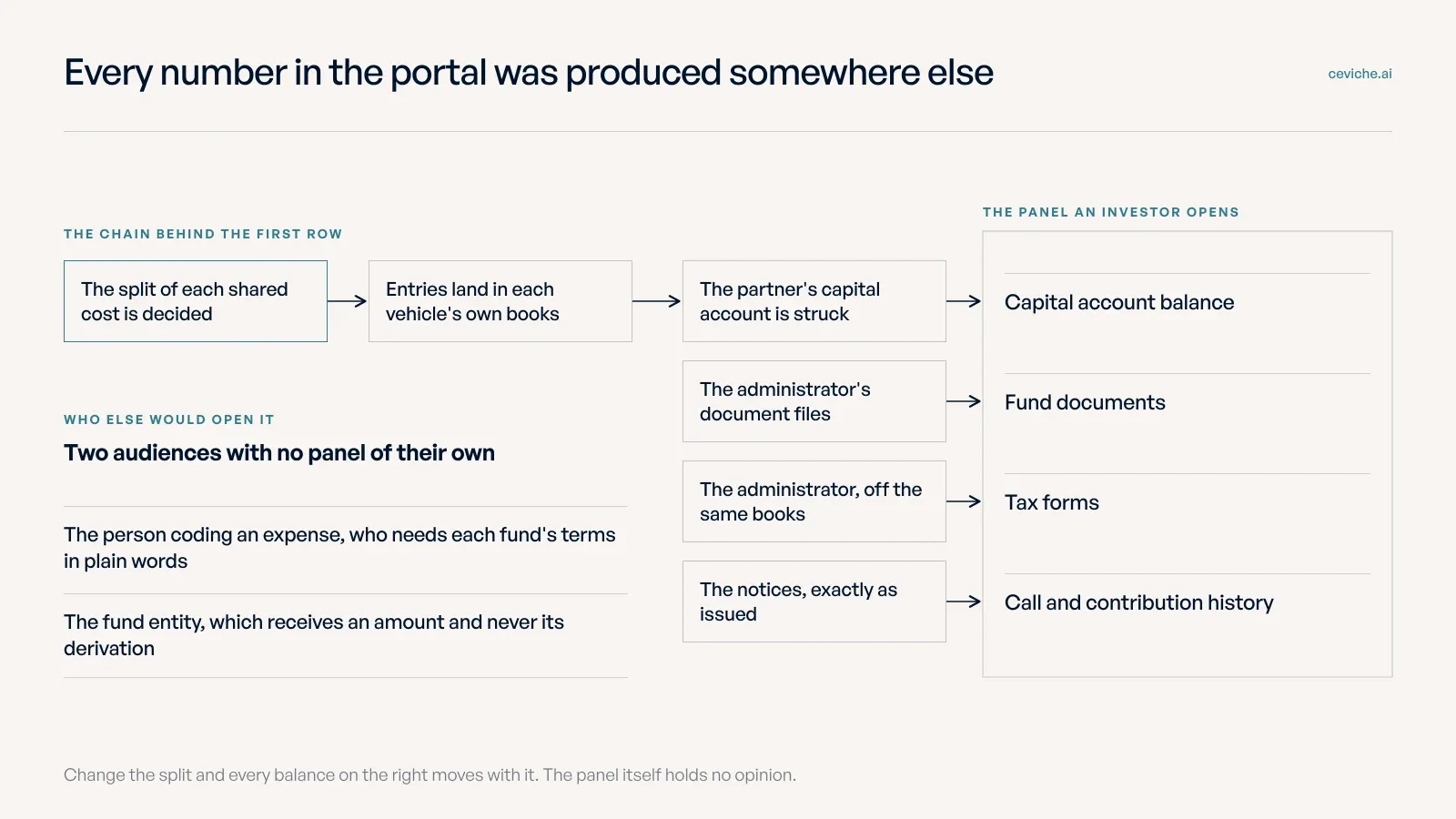
A capital account is the running record of one limited partner's economic position in a fund: capital contributed, that partner's share of income, expenses, and realized and unrealized gains, less distributions received. It is maintained per partner for the life of the fund and is the basis for the partner's capital statement and Schedule K-1.
That definition contains the answer. A portal is a display layer over a calculation, and "that partner's share of expenses" is the clause where fund expense allocation enters the investor's statement. Of the 80 fund finance teams we spoke with in 2026, 81% were producing those splits in Excel, and 92% were running them across disconnected systems.
Now go looking for the record underneath one of those numbers. At one real assets manager no paper passes between the funds at all. A shared legal bill leaves $14,000 on one fund's trial balance and $9,000 on another's, the administrator maintains both, and what backs them up is a screenshot of the split sitting next to the original invoice. Nothing joins the two halves into one document, and one document is what an audit sample asks for. 49% of the teams in our research had a gap in that trail.
A controller at a manager running ten funds had the specification ready when we asked for it, and what she described is a record rather than a report. Every charge has to stay findable indefinitely with everything that explains it attached, from the invoice it came off to the payment that cleared it. Anything you hand somebody a login to has to be sitting on top of that.
There is a prior question here, and it is about your own access rather than your investors'. One controller told us her administrator runs a full fund accounting platform that nobody on her team has ever logged into. What arrives instead is an Excel package. A controller at a firm that had moved onto a bundled platform named her gain differently, as statements and partner capital accounts reaching the portal straight out of the accounting system instead of through a two-step publish. Whether a human has to publish is the test worth applying, and it is the one thing a demo will not show you.
Three audiences and the category names one
Every product in this category is built for the investor. In a fund there are three audiences for a portal, and no product in this category is built for the other two.
The first missing one faces inward. A controller at a venture and credit firm asked us for something he called an admin portal. He wanted each fund's partnership-agreement characteristics written out in plain language in one place, so that whoever codes an expense can see for themselves why one cost belongs to that fund and another does not, and so his team can stop re-reading the documents every time the question comes up. No product in this category sells that.
We build an allocation layer rather than a portal, and we hit the same requirement from the reviewer's side while building it. Reviewing somebody else's allocations means opening a large bill once the month is finished and answering two questions. How was it split, and do the pieces add back to what the vendor charged. That view had to work at the invoice line rather than at the bill, because in a real review some lines are still unallocated and a bill-level summary hides them.
The second missing audience is the fund entity. A year later the same controller pushed the idea outward, wanting each entity to log in as a customer and read everything billed to it. His reasoning is the argument of this whole page. A fund receives a PDF out of the ledger showing a number, when what it can use is the derivation, the methodology and the date the split was struck. Those travel with the allocation rather than with the ledger, so a portal fed only by the ledger arrives with them already stripped out.
What happens when the portal and the ledger come as a bundle?
Almost nobody goes shopping for a portal by itself. Ledger and portal are usually bought together, so the portal arrives attached to whichever platform wins the ledger decision, and the allocation work is untouched by either. That is why a portal on its own is rarely something a vendor will quote for.
Consolidating the ledger and the portal is a real gain, and it is worth being precise about what it does not reach. The decision about what each fund bears does not move, and that decision sets every capital account balance the new portal will display. Smaller managers end up further apart still. A fractional CFO who oversees the administrators for several emerging funds thinks of a portal as a warehouse, somewhere people walk in and take what they came for, and her clients keep the ledger in one system and a separate portal in another. Price is the reason she gives, because in her experience the platforms that would join the two cost more than a small fund can carry. Choosing among the bundles themselves is a separate evaluation, covered in our guide to fund administration software, and the difference between the service and the function it performs is covered in fund administration versus fund accounting.
Why do portal launches fail?
Not on features. A controller described the day after her firm launched a new investor portal, when more than 30% of limited-partner mailing preferences turned out to be wrong and nobody had checked. Three investors had already noticed. The rest of the day went on fixing it before the others did.
That figure is one firm's bad morning and nobody should quote it as a rate. The lesson generalizes anyway. What breaks in a migration is the investor record, meaning contact rows, delivery preferences and entitlements, and no vendor page on the topic raises it. Put a preference check into the migration plan and run it against real investors while there is still time to fix things quietly.
How do you check a balance you do not produce?
An investor holds the general partner responsible for a balance the general partner's own systems did not calculate. One CFO, who is also his firm's chief compliance officer, described the arrangement he wanted instead.
The fund administrator is obviously responsible for the official books and records, but it would be great if there were some sort of tool that I can use to do some sort of shadow accounting. If it allows me to spit out LP capital balances on my side, and then I can check that against what my fund administrator is producing on their end, it would help kind of bulletproof my process.
He wants to check the administrator rather than replace it, which is a different and much cheaper requirement.
There is also a layer below the fund that almost no portal displays. Side letters create per-investor exceptions to expense allocation. Where a side letter caps one investor's contribution to a cost at $50,000 and the pro-rata math would have charged $100,000, someone works out the override, keeps the remaining cap balance moving forward, and posts the difference somewhere. The exceptions themselves are ordinary. One foundation will not fund fossil-fuel energy. Another investor caps what it will pay toward private air travel, and a third sits out a whole research category. Honoring any of them means keeping the investor register and tracking allocated amounts one level under the entity, which is an allocation decision sitting upstream of every portal on the market. Firms that enforce it usually have a side-letter clause tight enough to force the granularity. The rest charge the fund as a whole and reflect it in the capital accounts at that level.
Where does Ceviche fit?
Ceviche fits when the portal and the ledger are settled and the split behind the numbers they display is still assembled by hand. That split is the work Ceviche does, reading each line of a bill against the methodology that fund's LPA supports and keeping the basis, the approval and the support attached to every entry it posts. It is not an LP portal and it produces no capital account statements or K-1s, so a firm shopping for a portal should buy one from the platforms above. It is not a fund administrator, a general ledger or a managed service, and it does not do the allocations for you. What it changes is the number the portal ends up showing.
Frequently asked questions
If the administrator owns the official books, how do I check the LP capital balances myself? Run shadow accounting alongside them. Keep your own allocation record per fund and per investor, produce capital balances from it, and reconcile against the administrator's output each quarter rather than at audit. The point is not to duplicate the administrator's work. It is to hold a second, independent derivation of the numbers you are accountable for.
Does the portal pull from the fund ledger, or does someone publish to it? Ask it exactly that way in a demo, because the answer separates the category. In a bundled platform, statements and capital accounts reach the portal directly from the accounting system. In a stitched stack, someone exports, formats and uploads, which is where version drift and delay come from. The display looks identical either way, so the question has to be asked.
Can a small fund buy an LP portal without buying a full platform? Rarely on the terms you want. Portals mostly ship as part of an administration or accounting platform, and standalone portals exist but sit outside the system holding the numbers. Emerging managers we spoke with run a general ledger in one place and a third-party portal in another and accept the disconnect, because the bundles that would join them cost more than the fund will carry.
Can the fund entities and the administrator log in and see what was billed to them, and how it was allocated? That view rarely exists today, and it is the one controllers ask for. What reaches a fund from the ledger is a PDF carrying an amount. What the fund needs is the methodology behind it, the basis, the date and the supporting invoice. If you are specifying a portal, specify an entity-facing view as well as an investor-facing one, and say what each line has to carry.
Years from now, can I still see what was charged to this fund, on what basis, and when it was paid? Only if something kept it. Ledger entries survive and the reasoning behind them usually does not, so the question is whether one durable record holds the split and everything that justified it, in a form somebody can pull up years later without reconstructing it. Ask any platform where that record lives and how long it stays there.