TL;DR
Choose FundCount when you need integrated partnership accounting in-house: capital accounts, waterfalls, and portfolio records in one engine. Choose something else when your GL already works and expense allocation is the broken part. The alternatives worth a look are Ceviche, Allvue, Carta, LemonEdge, and Entrilia.
What does FundCount do and where do PE/VC teams hit friction?
FundCount runs the ledger, the partnership allocations, and the investment records in one engine. Capital accounts, tax schedules, fund performance, and nested entity structures live in a single system of record, so there is no quarterly reconciliation between a portfolio system and an accounting system. It is also one of the few vendors here that publishes indicative starting prices: private equity from $25,896 per year, the family-office band from $21,928, and single family office from $30,812. FundCount's own customer materials cite a fund administration firm running it as core infrastructure for more than 12 years.
Those are real strengths and worth stating before any criticism. Integrated partnership accounting, published pricing, and long-tenured customers are why FundCount is the most-cited name in fund accounting.
The friction is not with the product. It is with what adopting it costs a small team. Bringing FundCount in as your general ledger is a ledger migration: rebuild the chart of accounts, convert historical data, re-create every entity, re-wire the AP feeds, run both ledgers in parallel for at least a quarter, and walk your auditor through a new system of record. Two to five people absorb all of that on top of a close that still has to happen.
Most PE and VC management companies are not shopping for a ledger. Of the 80 fund finance teams we spoke with for the State of Fund Expense Allocation 2026 report, 51% run QuickBooks and 23% run NetSuite. Three quarters of them are on a general-purpose GL that works fine. What does not work is management-company expense allocation, and one broken workflow does not justify replacing the ledger underneath it.
Fund accounting platform vs allocation layer. A fund accounting platform is the authoritative ledger for your funds: it holds capital accounts, partnership allocations, and portfolio records. An allocation layer computes how a shared expense splits across fund entities by LPA methodology, then posts the resulting journal entries to whatever GL you already run. The platform is the book of record. The allocation layer decides the split.
FundCount alternatives at a glance
- Ceviche for PE/VC management-company teams whose GL works and who need audit-grade expense allocation on top of QuickBooks, NetSuite, or Sage. About three to four weeks to onboard, no ledger migration.
- Allvue Systems for larger PE/VC firms that want fund-level operations and management-company accounting in one institutional suite and can absorb a multi-quarter implementation.
- Carta for VC firms that want cap table, fund administration, and LP reporting bundled as a service.
- LemonEdge for teams that genuinely need in-house partnership accounting but want a cloud-native platform instead of FundCount's setup weight.
- Entrilia for lean fund admin and back-office teams automating fund operations rather than replacing a core ledger.
Why do PE/VC management companies look for a FundCount alternative?
Almost everyone landing on this search is trying to fix one workflow, not replace a ledger. Four things push them off FundCount.
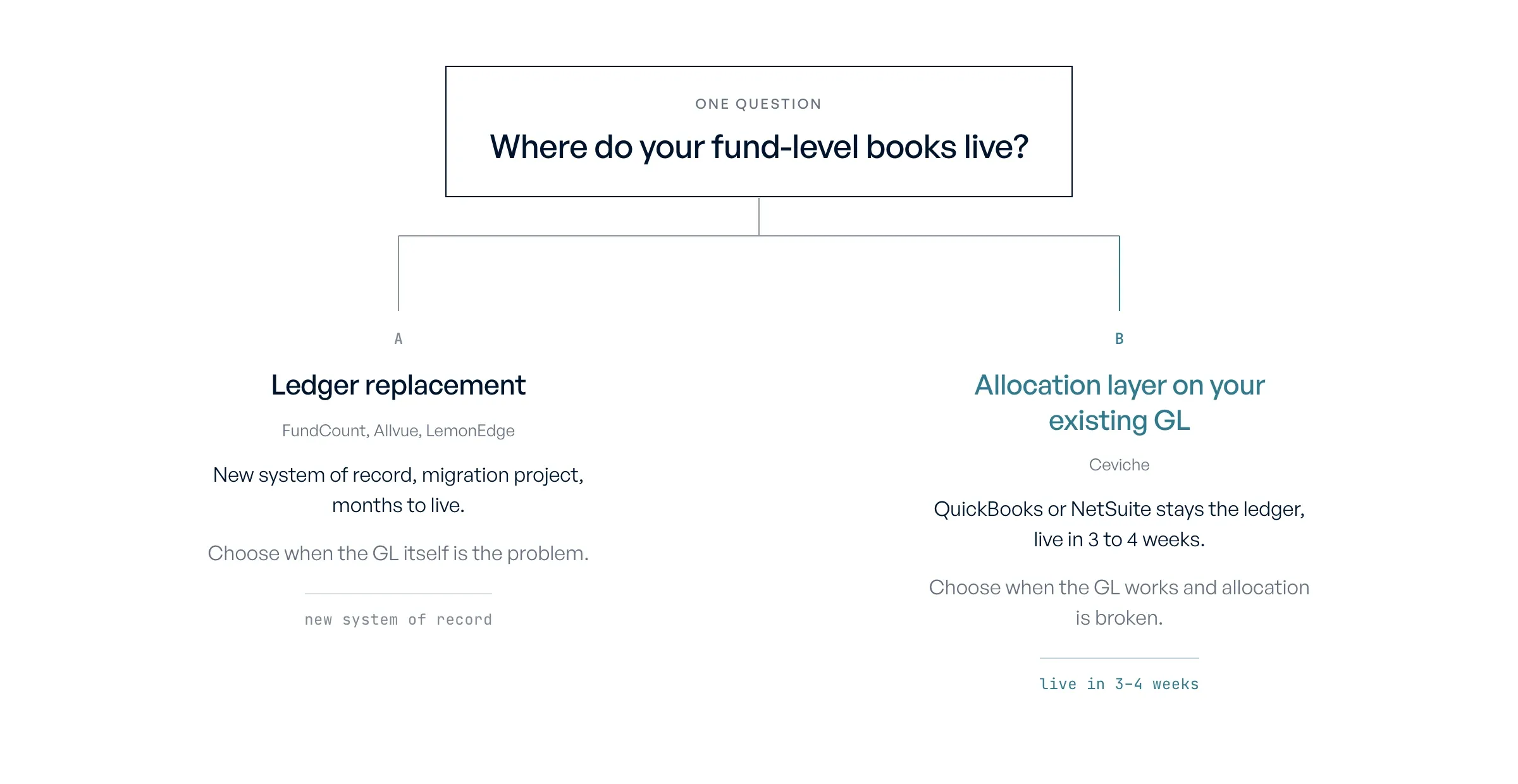 The question behind every FundCount evaluation: replace the ledger, or add the allocation layer your ledger is missing.
Migration weight is the obvious one, and it is the same list as above: chart of accounts, historical conversion, parallel quarter, auditor walkthrough. A lean team has no slack to absorb a broken close mid-conversion.
Price is second. The published private equity tier starts at $25,896 per year. That is a fair number for a full accounting platform and a hard number to sign for a single broken workflow.
Third is module sprawl. FundCount grew up in the hedge fund market and now serves family offices across HNW, single-family, and multi-family segments. A PE/VC management company never touches most of that surface. You pay for it and you learn around it.
The fourth reason is the one that usually decides it. At most PE and VC firms the fund-level books are not in-house at all. Capital accounts, NAV, waterfalls, and investor allocations already live with the fund administrator. The in-house pain is on the management-company side, where one shared outside-counsel invoice touches several funds, a couple of SPVs, the GP, and the manco, each on an LPA-dictated basis, computed in Excel and posted by hand. Buying a partnership accounting engine does not touch that invoice.
The survey numbers say the same thing. 81% of those 80 teams still allocate expenses in Excel, and 49% have a gap in their allocation audit trail. When the GL works and allocation is the broken part, the fix is a layer between the AP tools and the existing ledger. We laid out how that comparison usually goes in our roundup of the best fund expense allocation software.
The visibility problem shows up verbatim in our interviews. A CFO at a multi-billion-dollar PE firm described what happens when allocation lives fund-side only: "If it gets bifurcated where the funds are paying a part of it, and it's only being booked on their GL and not the management company's GL, I lose the visibility onto the macro spend because now they're in two different systems."
The alternatives in depth
Four of the five below solve fund-level or ledger-level problems. Ceviche solves the management-company allocation problem without touching your ledger. Where a spec is not verifiable in public sources, the entry says so.
Ceviche
Here is the invoice this was built for. Outside counsel sends 27 lines. Line 3 is litigation work belonging to Fund I alone. Line 11 is $40,000 of formation cost shared between Fund II and its co-invest SPV pro rata by committed capital, which this quarter is 65/35, so $26,000 to Fund II and $14,000 to the SPV. Line 18 is fund-level diligence split across Fund I and Fund II by NAV. Line 22 is manco overhead. Four lines, four methodologies, and the controller still has to build the splits, key roughly a dozen journal entries, and get the due-to and due-from to tie. Then a new closing shifts committed capital, 65/35 becomes 61/39, and next quarter's version of line 11 is $24,400 and $15,600.
Ceviche computes those per-line splits, records the LPA basis behind each one, and writes the journal entries back to the general ledger. It reads from Ramp, Bill.com, Expensify, Concur, and Brex, and writes to QuickBooks Online, NetSuite, and Sage. Your chart of accounts, your entities, and your close process do not move. Only the allocation step changes.
My own view, from years on the PE investing side before building this: most firms over-engineer the decision. They start evaluating ledger platforms because allocation hurts, then find out a year later that the ledger was never the problem. Answer one question before you shortlist anything. Are your fund-level books in-house, or at an administrator? If they are at an administrator, you are shopping in the wrong category.
Be clear about what Ceviche does not do. It is not a fund administrator, so it does not keep capital accounts, compute NAV, or run investor-level waterfalls. It is not an ERP or a general ledger. It is not a managed service: a controller runs it, and it does not do the allocations for you the way an outsourced operations team would.
Onboarding runs about three to four weeks rather than a multi-quarter rollout. Flybridge is the public reference: 18+ fund entities on QuickBooks Online and Bill.com, no ledger migration, and every allocation traces back to source documentation with a full audit trail. Ceviche does not publish pricing tiers, so cost is a scoping conversation tied to entity count and invoice volume.
Skip Ceviche in three cases. If you need partnership accounting in-house you need a ledger, and FundCount or LemonEdge fits better. If you want someone else to perform the allocations, you want a managed service. If your allocation is genuinely one rule across two entities, a spreadsheet still handles it.
Allvue Systems
Allvue is the alternative for larger firms that want fund-level operations and management-company accounting inside one institutional suite. FundCount grew out of the hedge-fund and family-office world; Allvue targets institutional private-capital managers running fund administration, portfolio monitoring, LP reporting, and accounting as a connected platform. If you have dedicated fund-ops staff and want fewer vendors, Allvue is in that bracket.
Most of what a buyer wants to compare is not public. Allvue does not publish pricing, and deployment detail surfaces in a sales process rather than on a pricing page. We would rather say that than invent a number.
The split with FundCount comes down to buyer size. FundCount sells one integrated accounting engine at published entry tiers in the low-to-mid five figures, and a lean team can run it. Allvue is a broader platform for firms that have outgrown a single engine, and the implementation matches: multi-module data conversion, workflow configuration, and a rollout measured in quarters. Our Allvue alternatives breakdown goes deeper if Allvue is the incumbent you are actually evaluating.
Carta
Carta fits VC firms that want cap table management and fund administration in one place. It started as equity software for startups and extended into fund administration for the venture funds investing in them, so a GP already tracking portfolio cap tables in Carta removes a handoff by running fund admin on the same account.
The structural fact that matters: Carta runs fund administration as a service, not as software you operate. Carta's team keeps the fund books, produces capital account statements, and handles LP reporting, and the GP reviews and approves. That suits a lean VC back office with no dedicated fund accountant, and it is the opposite of FundCount, where you own and run the ledger yourself.
What Carta does not do is replace your management company's GL. The manco still keeps its operating books in QuickBooks Online or NetSuite, and Carta's fund-admin engine does not run those entities or their expense allocation. If your broken workflow is splitting one outside-counsel invoice across fund entities by different LPA methodologies, Carta is not where that gets solved.
Carta's fund administration pricing is not disclosed in public sources and typically scales with fund size and entity count. Buy it if you run venture funds, want cap table and fund admin under one roof, and prefer someone else keeping the fund books.
LemonEdge
LemonEdge is the closest competitor to FundCount on this list, because it chases the same buyer: a firm that wants partnership accounting and fund-level books in one place. The structural difference is that LemonEdge is cloud-native and low-code, so a fund team can model entity structures and allocation logic without filing a change request for every adjustment. Firms with unusual entity structures or bespoke waterfall math tend to like that. If LemonEdge is the platform you are leaving rather than considering, our guide to LemonEdge alternatives sorts them by the job being replaced. Whether it holds at your scale depends on how much configuration your team is willing to own.
Public sources do not disclose LemonEdge's pricing, target AUM range, or a verifiable feature list. Treat any specific number you find elsewhere as unconfirmed until it is in writing. FundCount publishes its floor. With LemonEdge you have to request one.
Both platforms ask you to run a ledger, so both carry migration weight. Adopting LemonEdge to fix one allocation workflow costs the same disproportionate effort as adopting FundCount for it.
Entrilia
Entrilia targets lean fund administrators and back-office teams automating fund operations without adding headcount. Its specific modules, pricing, and deployment model are not disclosed in public sources we could verify for this piece.
The overlap with FundCount is the back office. Both serve fund administrators and teams supporting many fund entities, and both promise to cut manual work across partnership-level activity. The divergence is in what each one replaces. FundCount asks you to migrate the general ledger. Entrilia is automation aimed at fund-ops teams, though its exact scope against an existing GL is not disclosed either. The same test applies: if your fund-level books already live with your administrator, an admin-focused tool solves a problem you do not own.
Ceviche vs FundCount
Most teams landing here run QuickBooks or NetSuite, the GL is fine, and allocation is the broken part. The question is whether you replace the ledger or add a layer on top of it.
Replacing it means a multi-quarter conversion running alongside a close that still has to happen. For a two-person finance team the risk is concentrated: if the close breaks mid-migration, nobody absorbs it.
Adding a layer means Ceviche installs between the AP tools and the GL, reads the 27-line invoice, applies the LPA-dictated basis per line, and posts journal entries back to QuickBooks or NetSuite with the audit trail attached. The ledger does not change. Flybridge made that trade across 18+ fund entities on QuickBooks Online and Bill.com.
FundCount wins when the ledger itself is the failure. Integrated partnership accounting in-house, capital accounts, investor-level allocations, complex waterfalls, or consolidating fund administration internally: an allocation layer solves none of those, and FundCount is a legitimate answer. If you are still deciding which category you are shopping in, our guide to choosing fund accounting software walks the same fork.
FundCount and the alternatives side by side
The table covers what public sources verify and marks the rest as undisclosed. FundCount's pricing comes from its published pricing page. The other vendors do not publish comparable specs.