Corporate spend platforms, fund allocation systems and accounting suites all rank for this term. They solve different problems, and only one of them decides which entity bears a cost.
TL;DR
Three categories rank for this term. Corporate spend platforms govern whether a purchase is allowed, fund allocation systems decide which entities bear a permitted cost, and accounting suites record the result. Most funds already own the first and are searching because they need the second.
What Do Private Equity Firms Mean by Expense Management?
The phrase means different things to the people who use it. To one finance lead it is the corporate card and the receipts behind it. To another it is the accounts payable queue. To a third it is the part that comes after both, deciding which of the funds, the co-invest vehicles, the general partner and the management company bears each cost, and under which clause. A shortlist assembled before that is settled will mix products that do not compete, so name the ambiguity before naming a product.
Fund expense allocation software sits between the expense capture systems a firm already runs and its general ledger. It applies the allocation rules each LPA specifies to every expense, splits multi-line invoices across fund entities by the right methodology per line, writes audit-ready journal entries back to the ledger, and produces a per-line audit trail for every distribution.
A firm that buys deeper into corporate spend tooling because its allocation work hurts has bought a better version of something that was already working.
Three Categories and Which One Your Problem Is In
Corporate Spend Platforms
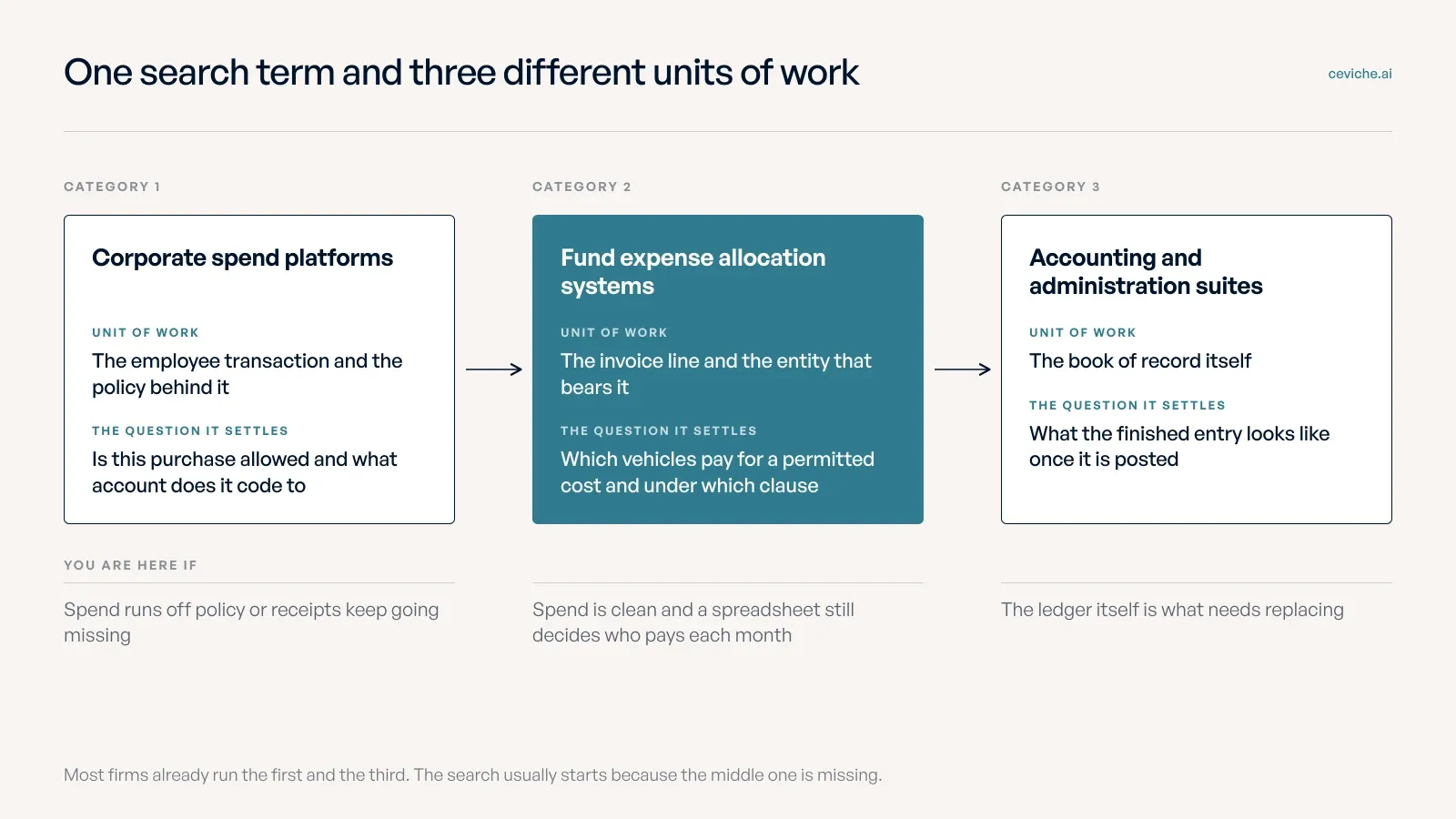
Ramp, Brex, Expensify and Concur. The unit of work is the employee transaction and the policy. They answer whether a purchase is allowed, whether there is a receipt, who approves it and what account it codes to. They are genuinely good at this, and our research says most firms already run one.
Fund Expense Allocation Systems
EAS, StavPay, Resolvr and Ceviche. The unit of work is the invoice line and the entity. They answer which funds bear a cost, in what proportion, under which clause of which agreement, and what evidence supports the split.
Fund Accounting and Administration Suites With an Allocation Module
Sage Intacct, Allvue, Carta, FIS Private Capital Suite and eFront. The unit of work is the book of record, and allocation is one capability inside a much larger purchase.
You are in the first category if employees are spending off policy or receipts go missing. You are in the second if the spend is clean, the sync works, and somebody still opens a spreadsheet each month to decide who pays for what. That is where most of the 80 fund finance teams we spoke with in 2026 sit, with Ramp in 49% of stacks, Bill.com in 39%, and Expensify and Concur at 30% and 11%, shares that overlap rather than sum. The automation and the manual work run side by side, which is why 81% of those teams still allocate in Excel.
See it on one of your own invoices. Ceviche pulls the invoice from Ramp, Bill.com, Expensify, Concur or Brex, applies the allocation methodology each LPA specifies per line, and writes audit-ready journal entries back into QuickBooks Online, NetSuite or Sage. Book a demo.
| Product | Unit of Work | Fund and Entity Model | LPA Provisions and Caps | Where the Entry Lands | Operated By |
|---|
| Ramp | The employee transaction and the policy | Not mentioned on the page | Not mentioned on the page | Your general ledger, coded | Your finance team |
| Brex | The employee transaction and the policy | Not mentioned on the page | Not mentioned on the page | Your general ledger, coded | Your finance team |
| EAS | The invoice line, across funds and deals | Funds, deals, management companies, projects | Digitized expense allowability policies and cap controls | Your enterprise ledger | Your finance team |
| StavPay | The expense, in unlimited layers | Any attribute you define | Not mentioned on the page | Ledgers, banks, wire platforms, administrators | Its operations team, alongside yours |
| Resolvr | The bill, across funds and sub-funds | Funds, sub-funds and legal entities | Named as the compliance driver | Not mentioned on the page | Your finance team |
| Ceviche | The invoice line and the entity | ManCo, GP, funds, SPVs, blockers, feeders | Caps, thresholds, exclusions and eligibility | QuickBooks Online, NetSuite or Sage Intacct | Your controller |
Vendor details change. Every cell above comes from the vendor's own page as it read on 2026-09-03, and none of these vendors publishes prices.
Private Equity Expense Management Software in 2026
The shortlist therefore narrows on fit rather than on cost. Ceviche publishes this page and sells software in the expense allocation category, so read our own entry with that in mind. Nothing below is a capability we tested. Each claim is quoted from the vendor's own page with that page linked where it first appears, and silence on a page is reported as silence rather than filled in.
Ramp
Ramp describes "Automated expense management software built into your corporate card, reimbursements, and more", and the capture story is the strongest part of it. "As soon as you swipe your card, Ramp captures the receipt and fills in memos and categories", with edits and submission through SMS, Slack or Microsoft Teams. Its policy agent will "review 100% of your expenses, approve what's compliant, and only flag what needs your attention, always with direct reference to your policy and a full audit trail."
That is a real product doing a real job, and it is why Ramp shows up in half the stacks we studied. Worth noting for a fund reader, the page does not use the words fund, entity or allocation anywhere.
Brex
Brex sells the same job with the controls in front. Its page states that "Brex auto-enforces spend controls with every purchase", that you "Set rules for how employees can spend, what they need to document, and who needs to approve", and that Brex "automatically approves any expense that is in-policy, and auto-declines anything that is not."
The structural point is the same as Ramp's. The rules govern whether spend is permitted, not how a permitted cost divides across entities with different claims on it.
EAS by Indus Valley Partners
EAS is the deepest fund-specific product in this set and its page reads that way. It "combines intelligent AI agents with configurable allocation rules to automate invoice processing", lets a firm "Configure reusable allocation rules across funds, deals, and business segments", and offers to "Allocate through complex fund structures with multiple levels using industry built logic." Two features are unusual here. Digitized LPA expense allowability policies "ensure allocations align with governing fund documents", and it publishes "Configurable expense cap controls with real-time visibility".
EAS fits large managers on an enterprise ledger with the resources an enterprise deployment needs. Anyone searching the old brand should know that the same page states Indus Valley Partners has owned the product "following its acquisition of IntegriDATA in September 2024", and our EAS comparison covers the fit.
StavPay by Stavtar
StavPay's page promises allocation that runs "in unlimited ways and unlimited layers, using any attribute and sending back into your workflows for your review", with built-in integrations across general ledgers, banks, wire platforms, fund administrators, soft dollar providers and credit card platforms. The part that distinguishes it is not a feature. Its page names a dedicated Business Process Operations team described as "An extension of your accounting team", which makes this the managed-service route. That is a different trade rather than a better one, and our StavPay comparison sets out where each shape wins.
Resolvr by LSG
Resolvr describes itself as an "AI-Driven Expense, Allocation and Workflow Management GRC Software Platform" built "For Hedge Funds, Private Equity and Wealth Managers", and its origin story is a hedge fund that needed bills "accurately allocated across funds, sub-funds and legal entities". Its page names Dodd-Frank compliance and SEC misallocation fines as the buying trigger, which tells you which room the purchase gets approved in. The page does not describe how a split is computed or written back, so put those questions on the call.
Ceviche
Ceviche starts where the spend platforms stop. Each fund agreement's expense policy becomes structured controls, meaning caps, thresholds, exclusions and entity eligibility, and those controls apply per invoice line rather than per transaction. Invoices arrive from the card and accounts payable systems already in place, and finished entries land in the general ledger already in place, so nothing about either changes. At Flybridge the quarterly allocation across 18+ fund entities used to run in spreadsheets, and nobody migrated a ledger to change that.
The Suites
Sage Intacct's private equity page offers "Dynamic cost allocations with customizable rules tailored to automate month-end close" and a shared dimensional chart of accounts. Allvue sells modules that "can be purchased independently", with an Equity Essentials package aimed at "startup private equity managers poised for growth with less than $1 billion in assets under management". Carta markets "The end-to-end suite for fund management" and offers to "Partner with a dedicated team to run your entire fund accounting process", and its page does not use the word allocation. FIS Private Capital Suite is "a unified platform for fund and partnership accounting", and eFront sits at enterprise weight across alternative asset classes.
All five are book-of-record purchases first. If the ledger is settled, the allocation module is rarely enough reason to move, and our ranked guide to fund accounting software for private equity works that decision through.
Where Does a Corporate Expense Platform Stop?
It stops at the point where one permitted charge has to become several entries against several entities.
Take one diligence trip, in the shape a CFO at a hedge and growth investor gave us. His own case ran across seven ledger accounts from a single trip. The dollar figures below are illustrative and the shape is his. Seventy-five card charges, $38,400 in total, covering two deal processes and a firmwide LP meeting that happened in the same week. Thirty-one charges worth $16,800 are diligence on a deal Fund III led with a co-invest vehicle alongside it, split by invested capital at 70% and 30%, so $11,760 and $5,040. Twenty-six charges worth $12,900 are diligence on a deal that never closed, which the LPA treats as a broken-deal cost borne by Fund III alone. The remaining eighteen charges, $8,700, are the LP meeting, which is a management company expense that no fund bears. Once travel, meals, lodging and ground transport are separated on each side of the fund and management-company line, the three blocks spread across several ledger accounts rather than one.
A basis-driven rule states that once per block and posts it. Inside a card tool the same job runs charge by charge, which is where he said the tool falls down. He was fair about whose problem it is:
Things like the modern spend cards are built great for a technology startup. It's not well set up to manage what we do. Nothing really is.
The finance team at a large-cap private equity firm gave us their own read on why the gap persists. The expense platforms are not going to build fund allocation, because the requirement is too niche for them, and that firm's answer was to build the layer itself. At the same firm, 300 to 400 standard invoices a quarter move through the expense platform without trouble, while roughly 100 legal invoices a quarter, each running 150 to 300 lines, are the explicit exception. That is the same shape we see at a wider sample, where 63% of teams name legal-invoice allocation one of their toughest problems.
One asymmetry is worth naming. A VP of finance at a fintech-focused private equity firm told us that on the vendor invoicing side they have a good system with fund allocations in the ledger, and no ability to do allocations for travel and entertainment. Accounts payable and card spend are not the same problem, and most firms have solved only one.
The Part That Is Not a Software Problem
The person who codes an expense is usually not the person who knows where it belongs, and that is a staffing problem no page in this comparison addresses.
A senior finance operator at a large private equity firm described a stack that had everything. A travel and entertainment tool and a bill-pay tool both feeding an enterprise ledger, and the ledger feeding a dedicated allocation system with rules keyed to vendor and mandate. Here is what still limited it:
The people that know what it is are MDs that may be reviewing lightly, and having the assistants put it in, who know the fund structure probably about as well as you do currently. Garbage in, garbage out, and trying to solve for that.
A CFO at a growth-equity investor made the same point about tool switches. Habits are hard to change, and people who are not entering expenses properly in one tool will not enter them properly in another. A controller at a venture firm described what that leaves her doing, reviewing every card line herself and every memo, deciding first whether it is a fund expense and only then how it splits.
Two things follow, and both are worth doing before any purchase. Make the memo field carry structure rather than free text, so the coder answers a question instead of describing a trip. And give people a place to put what they cannot decide. Teams we work with add a catch-all coding in the spend tool that routes a transaction to an unallocated bucket, and the allocation layer picks up only those. That costs nothing and it works whichever tool you run.
What Should You Check Before You Buy?
How Deep Does One Charge Split and How Many Steps Does It Take?
A controller told us splitting inside the tools she has is doable, it just costs three steps where it should cost one. Ask for the deepest split the vendor runs in production, not the maximum it supports.
Do You Pay First or Allocate First?
The two are not equivalent. If you allocate before you pay, the split can live on the bill. If you pay first, the ledger will generally not let you split the lines of a paid bill afterwards, so the correction has to arrive as a separate entry crediting the original and debiting the shares. Neither order is wrong, and the tooling has to know which one you run.
When Is the Allocation Allowed to Be Made?
One controller learned to leave airfare uncoded until the trip actually happens, because plans change and a refund lands against an allocation that has already posted. A tool that forces the decision at the moment of the charge is fighting how the work runs.
Where Does the Review Happen and How Many Times?
One growth-equity team found the same allocation reviewed by the same controller twice, once at allocation and again at reimbursement approval, because the two steps did not know about each other.
How Fast Does the Vendor Turn Around Ordinary Changes?
One CFO's deciding criterion was not a feature. It had taken a month to get a user added to the system he had.
Where Should the Work Sit?
There is an honest objection to all of this and it comes from buyers. One venture CFO told us the workflow needs to live inside the card tool rather than in a second place afterwards, ideally as a window that opens at the moment of payment. Another said she would not want a product sitting in between, and she does the allocation in a spreadsheet today. Both objections are about where the work sits rather than whether the split is right.
Ceviche fits when
Ceviche fits when the first category is already working. Cards, receipts and approvals are handled, the ledger is not moving, the entity count is past a handful, and the split at the end of it is still rebuilt by hand each close by a two-to-five-person team at a firm somewhere between $500M and $15B. It is not a fund administrator, a general ledger or a managed service, and it does not do the allocations for you. A firm that still needs card issuing, receipt capture or policy enforcement should buy that first and put Ceviche behind it.
FAQ
What is the best accounting software for private equity firms?
It depends on which book you are choosing. Most management companies run QuickBooks or NetSuite, which together cover 73% of the ledgers in our 2026 research, and the fund books usually sit with an administrator on its own platform. Our ranked guide sorts the serious options by firm size and by whether you intend to migrate at all.
What is the best software for expense management?
Name your category first. If employees are spending off policy or receipts go missing, you want a corporate spend platform. If the spend is clean and someone still opens a spreadsheet to decide which fund bears what, you want an allocation layer, and our comparison of fund expense allocation software ranks that category on its own terms.
Can we do fund allocation inside our expense card tool?
Partly, and plenty of teams try. The card tools split a charge and code it, and for a firm with two vehicles and stable rules that can be enough. It stops working when one charge has to reach many entities on different bases, when the split has to cite an LPA clause, and when a correction after the sync becomes the ledger's problem rather than the card tool's.
What happens to expenses where no allocation rule has been set up yet?
They should land somewhere visible rather than somewhere convenient, and the harder half of the question is where the answer goes once somebody decides. One buyer asked us directly whether a finished split flows back into the card and bill-pay tools or only forward into the ledger. In the stacks we have looked at it moves one way, so the upstream tool keeps showing the original coding and the ledger carries the corrected one.
Can the billable-or-not decision be made at approval time rather than reconstructed later?
That is exactly what a controller at a growth-equity firm asked us for, a checkbox at the moment of approval that carries through to the entry. It is the right instinct, because reconstructing intent weeks later is what makes the review slow. Ask any vendor where in the workflow the decision gets captured and what happens to it afterwards.
How do we tag and total fundraising expenses across a card program without a manual collation step?
Tag at the vendor rather than at the transaction wherever the spend is repeatable. One firm ran allocation rules keyed to the vendor and the mandate, so a named provider's bills carried their own basis without anyone deciding charge by charge. Fundraising spend that runs through a known set of vendors totals itself that way. What is left is ad hoc travel, and somebody still codes that.