Allvue fits firms that want a front-to-back platform. If your GL works and expense allocation is the problem, these five alternatives fit lean PE and VC teams.
TL;DR
Choose Allvue when you need a front-to-back platform, meaning fund accounting, portfolio monitoring, LP portal, and CRM, plus the runway to migrate off your current GL. Choose something lighter when a lean team on QuickBooks or NetSuite just needs expenses split across fund entities. The alternatives: Ceviche, FundCount, Carta, LemonEdge, and Entrilia.
What is Allvue and who is it built for?
Allvue Systems is a front-to-back investment management platform for private capital, built from the 2019 merger of AltaReturn and Black Mountain Systems. Its private equity suite covers fund accounting on Microsoft Dynamics 365 Business Central and Azure, portfolio monitoring, an investor portal, fundraising and CRM, and deep private credit functionality. Allvue's own materials claim more than $8.5 trillion in assets tracked across 21,000+ funds and 500+ clients. Fund administrators including Apex Group deliver services on Allvue technology, so the buyer base covers GPs and the admins serving them.
Allvue fits a specific firm well. If you close the quarter across many fund and portfolio entities, need LP reporting and credit accounting in one system, and have the runway to migrate off your current ledger, the breadth pays for itself. The Microsoft foundation and the fund-admin ecosystem give large firms a platform they can defend to an investment committee.
Lean PE and VC management-company teams start looking elsewhere for one reason. Allvue's center of gravity is fund-level and portfolio-level accounting, not manco-side expense allocation across entities on a small-business GL the firm has no intention of replacing.
Fund accounting platform vs allocation layer. A fund accounting platform is the authoritative ledger for your funds and usually carries reporting, CRM, and investor portal functions alongside it. An allocation layer computes how a shared expense splits across fund entities by LPA methodology, then posts the resulting journal entries to whatever GL you already run. The platform is the book of record. The allocation layer decides the split.
Why do fund finance teams look for Allvue alternatives?
Four things push lean PE and VC finance teams to evaluate alternatives, and none of them are knocks on Allvue's engineering.
Cost comes first. Allvue publishes no pricing and offers no entry tier, so a buyer cannot see what the accounting or expense capability costs without entering an enterprise sales process. Review commentary on G2 returns to "expensive" as a recurring theme, and the same reviews flag limited access and functionality on the cloud version relative to what buyers expected. That second gap matters most for a small team that assumed a modern SaaS experience.
Implementation weight is second. Allvue's fund accounting runs on Microsoft Dynamics 365 Business Central, and a nine-module platform implements like a platform: migrate a chart of accounts, model entity structures, move data, wire integrations, train users. Apex Group deploys Allvue alongside eFront and Investran for fund-admin clients, which tells you these are multi-quarter rollouts. A two-to-five-person finance team that needs one job done ends up scoping a full suite.
The third reason is a mismatch rather than a defect, and it is the deciding one. Allvue's center of gravity is fund-level and portfolio-level accounting. The daily pain at a lean management company is manco-side expense allocation across entities on a general ledger the firm has no desire to replace. QuickBooks Online and NetSuite have no native way to split a multi-line invoice across fund entities by LPA methodology, and Allvue's answer to that is to replace the whole stack.
The fourth is timing. Firms hit this at exactly the moment they can least afford a migration, usually one or two new vehicles after the last close, when the entity count crossed whatever number the spreadsheet was built for.
The survey data says where the pain lives. Of the 80 fund finance teams we spoke with in the State of Fund Expense Allocation 2026 report, 81% still allocate expenses in Excel, 63% named legal-invoice splitting a toughest problem, and 49% had a gap in their allocation audit trail. Those teams do not need front-to-back infrastructure. They need one workflow fixed on the GL they already run.
Speed of implementation is the recurring theme in our calls. The finance lead at an Asia-based PE firm evaluating the category told us plainly: "You guys are the fastest. We've spoken to a few, but none can match what you guys have done so far." Teams comparing platform-scale suites against focused allocation tools consistently cite time-to-live as the deciding factor.
The alternatives at a glance
Ceviche for lean management-company finance teams that want to keep QuickBooks, NetSuite, or Sage and fix legal-invoice allocation without a platform migration.
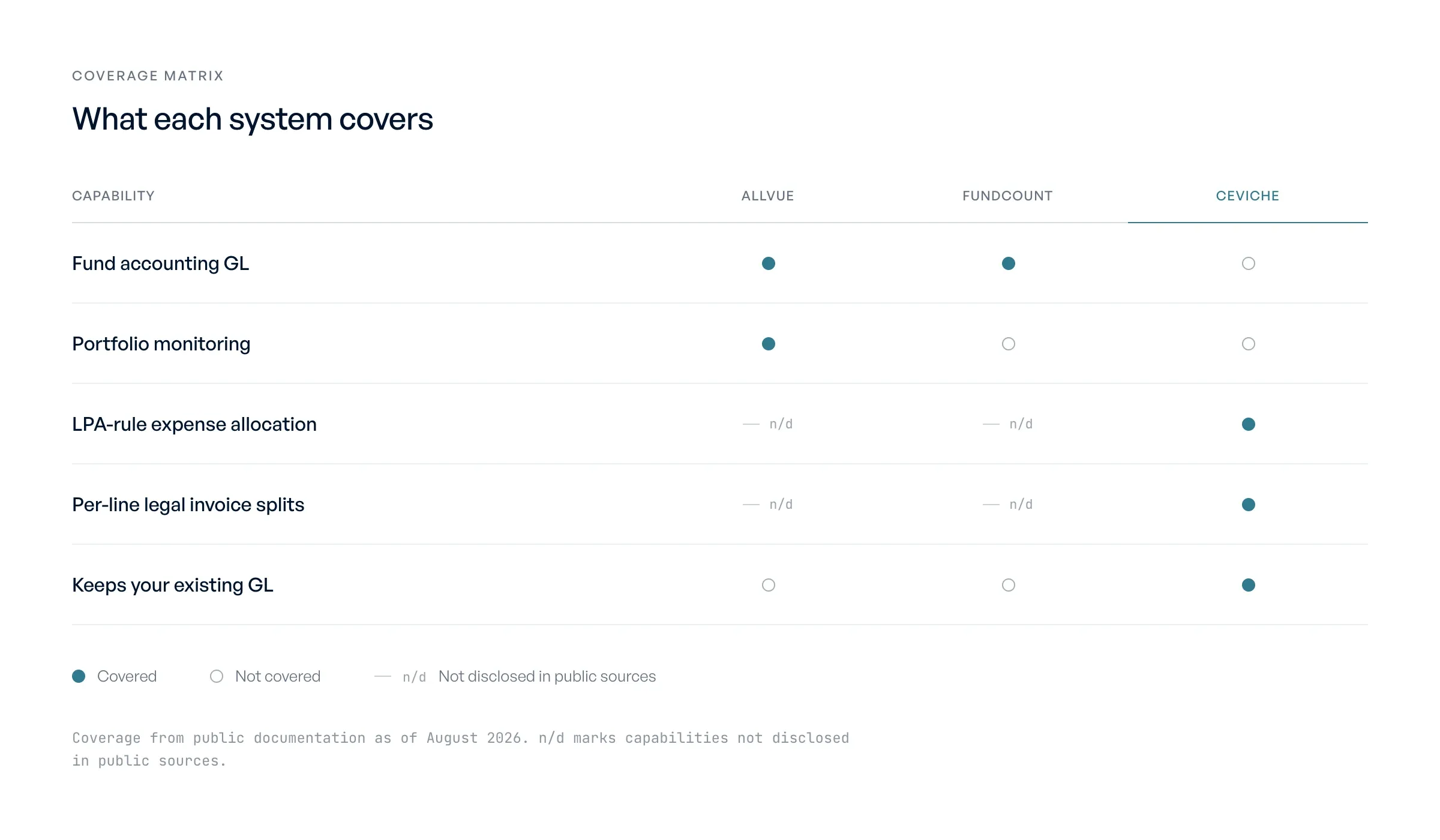 Coverage from public documentation as of August 2026; n/d marks capabilities not disclosed in public sources.
FundCount for fund administrators and accounting-first teams that want integrated partnership accounting with the general ledger as the authoritative record.
Carta for VC and emerging-manager GPs who want cap-table and fund-admin workflows in one place.
LemonEdge for teams evaluating a configurable, cloud-native partnership accounting engine, though independent product detail is thin and warrants direct evaluation.
Entrilia for GPs running complex multinational structures who want an API-first, modular accounting engine over an all-in-one system.
The full comparison
Where a cell reads "not disclosed in public sources," we could not verify that spec in the vendor's own documentation or independent published sources, so we declined to guess.
| Tool | Deployment | GL model | Expense allocation | Onboarding | Pricing | Best for |
|---|
| Allvue | SaaS platform | Native fund GL (Business Central) | Not disclosed in public sources | Enterprise, multi-quarter | Custom, no entry tier | GPs and fund admins wanting front-to-back |
| Ceviche | Allocation layer | GL-agnostic (QBO, NetSuite, Sage) | Per-line, LPA-based, full audit trail | ~3-4 weeks | Not published; scoped to entities and volume | Lean manco finance teams |
| FundCount | SaaS, ledger-first | Internal GL authoritative | Partnership accounting engine; per-line invoice mechanics not documented publicly | Phased rollout | Published: PE from $25,896/yr | Fund admins, accounting-first teams |
| Carta | SaaS, admin-as-a-service | Not disclosed | Not disclosed | Not disclosed | Not disclosed | VC and emerging managers |
| LemonEdge | Cloud, low-code | Not disclosed | Not disclosed | Not disclosed | Not disclosed | Configurable partnership accounting |
| Entrilia | SaaS, API-first | Not disclosed | Not disclosed | Not disclosed | Not disclosed | GPs with multinational structures |
The Allvue alternatives reviewed
Each tool below solves a different problem, so match the review to your actual bottleneck rather than the category label. Where public sources do not confirm pricing, deployment, or allocation mechanics, the reviews say so instead of guessing.
Ceviche
Take one outside-counsel invoice with 25 line items. Litigation work on line 3 belongs to Fund I alone. Formation costs on line 11 split between Fund II and its co-invest SPV pro rata by committed capital. Fund-level diligence on line 18 allocates across Fund I and Fund II by NAV. Each line follows a different methodology per the LPAs, so a controller doing this in Excel builds three separate splits, keys 12 journal entries by hand, and hopes the due-to and due-from tie out. On the co-invest split alone, a $40,000 formation charge at a 65/35 committed-capital ratio produces $26,000 to Fund II and $14,000 to the SPV, and every ratio has to be recomputed when a new closing shifts commitments.
Ceviche does that arithmetic and posts the result. It pulls the invoice from Ramp, Bill.com, Expensify, Concur, or Brex, applies the allocation rule per line, and writes finished journal entries back to your existing general ledger. Every line carries the methodology applied and the entity hit, which is the per-line audit trail an examiner wants when the SEC's Division of Examinations samples transactions against the LPA. Of the 80 fund finance teams we spoke with in the State of Fund Expense Allocation 2026 report, 49% had a gap in that trail and 81% were still allocating in Excel. We broke the audit-trail numbers down separately in our analysis of where those gaps come from.
You keep your GL. Ceviche writes back to QuickBooks Online, NetSuite, and Sage, so there is no chart-of-accounts migration and no fund-admin handoff. Onboarding runs about three to four weeks rather than the multi-quarter deployment an Allvue rollout requires. Ceviche does not publish pricing tiers; cost is scoped to entity count and invoice volume rather than AUM.
Flybridge runs 18+ fund entities on a QuickBooks and Bill.com stack, and every allocation traces back to source documentation with a full audit trail.
Here is what Ceviche does not do. It is not a fund administrator and will not close your books. It is not an ERP or a fund accounting system, so it does not hold capital accounts or run the waterfall. It is not a managed service: a controller runs it, and it does not do the allocations for you the way an outsourced operations team would.
FundCount
FundCount fits fund administrators and accounting-first teams that treat the general ledger as the authoritative record. Its discipline is integrated partnership accounting: capital accounts, contributions, and distributions across legally separate entities, with the ledger and the investment records in one engine. FundCount's own customer materials cite a fund administration firm running it as core infrastructure for more than 12 years. If your priority is ledger control and partnership-accounting rigor rather than upstream automation, FundCount handles that mandate well.
Unusually for this category, FundCount publishes indicative starting prices: private equity from $25,896 per year, the family-office band from $21,928, and single family office from $30,812. Almost nobody else here does that, and it is worth saying so.
Two things to verify before you commit. Adopting FundCount is a ledger migration, with the chart-of-accounts rebuild, historical conversion, and parallel running that implies. And public sources do not document per-line legal-invoice splitting mechanics of the kind described above, so bring a real 25-line invoice to the demo and watch it get processed before assuming that workflow exists.
FundCount is the right answer when the ledger itself is the job, and a heavier answer than the problem requires when your GL already works and multi-entity expense allocation is the one broken workflow. We wrote a dedicated FundCount alternatives comparison if that is your evaluation.
Carta
Carta belongs on this list because it owns the emerging-manager and early-stage VC market, where cap-table administration and fund administration live under one roof. If your cap table already runs on Carta, moving fund admin onto the same platform keeps ownership records, SPV structures, and investor data connected without a second vendor handshake. That continuity is the real reason a first-time fund manager puts Carta on the shortlist.
Beyond the positioning, the independent research thins out fast. No source in our review documents Carta's fund administration pricing, deployment model, or how it handles multi-entity expense allocation. The public content we found originates from Carta, so we cannot treat it as verified market fact.
If you are weighing the legal-invoice allocation problem specifically, evaluate Carta directly rather than trusting a spec sheet. Ask three concrete questions in the demo. Does it split a single outside-counsel invoice across Fund I, Fund II, and a co-invest SPV by line item, each on its own methodology? Does it write those allocated journal entries back to your existing GL, or does it expect you to run accounting inside Carta? What does it cost for a lean team that needs one job done rather than a platform migration?
Carta is a strong fit for VC managers who want cap table and fund admin in one system. It is not documented as an allocation layer, so confirm the mechanics before you commit. For the head-to-head on fund accounting and administration, read our Allvue vs Carta comparison.
LemonEdge
No independent source in our research covers LemonEdge's allocation mechanics, pricing, or deployment model. What follows comes only from LemonEdge's own public positioning, so treat it as vendor claims rather than verified detail. If LemonEdge is the platform you are leaving rather than considering, our guide to LemonEdge alternatives sorts them by the job being replaced.
LemonEdge markets a low-code accounting platform for private capital, aimed at teams that want to build and adjust their own fund-accounting logic without waiting on a vendor's release cycle. The pitch is configurability: you define entity structures, allocation rules, and reporting outputs inside the platform instead of filing change requests. For a firm with unusual fund structures or a real internal engineering appetite, that is the draw.
We cannot verify how LemonEdge handles a multi-entity legal invoice split, whether it writes journal entries back to an outside GL, or what onboarding actually takes. It does not publish pricing, AUM minimums, or close-cycle benchmarks in any source we could confirm, so we are not going to guess at those or rank it against tools where we have real detail.
If LemonEdge is on your shortlist, test it against your own allocation cases. Bring a real outside-counsel invoice with 20-plus line items across multiple funds and a co-invest SPV, and ask the team to walk through the exact configuration and the resulting journal entries. That tells you more than any positioning statement.
Entrilia
Entrilia fits GPs running multinational fund structures who want their accounting engine to connect to everything rather than swallow everything. It describes itself as "the most connected accounting platform in private markets," and the architecture supports the claim: a deterministic semantic layer covering capital, IRR, allocations, FX, and ownership hierarchies, so a change to NAV recalculates the dependent numbers instead of leaving you to reconcile them by hand. We covered the architecture and the November 2025 qashqade partnership in our financial close comparison.
The gap sits exactly where management-company expense work lives. Entrilia does not publicly document its GL write-back specifics, its chart-of-accounts structure, or the methodology it applies to split a single multi-entity invoice across funds by different rules per line. That is the problem a lean finance team searching for an Allvue alternative usually needs solved, and public sources do not confirm Entrilia handles it. Pricing, AUM minimums, and contract terms are not published either.
Evaluate Entrilia if you want an API-first engine keeping connected tools in sync across complex structures. If your bottleneck is allocating outside-counsel invoices per line across Fund I, Fund II, and a co-invest SPV, ask Entrilia directly how it handles that before assuming it does.
Who should actually stay with Allvue?
Stay with Allvue if you need a front-to-back platform and have the runway to deploy one. Fund accounting, portfolio monitoring, an LP portal, and CRM in a single system is a genuine requirement at institutional scale, and Allvue tracks more than $8.5 trillion across 21,000+ funds. That breadth is the reason to buy it.
Three conditions make Allvue the right call. You want fund-level and portfolio-level accounting consolidated in one platform rather than stitched across tools. You have the implementation runway a nine-module deployment demands. And you are a GP or fund admin ready to migrate off your existing GL entirely, since Allvue's fund accounting runs on Microsoft Dynamics 365 Business Central rather than sitting on top of QuickBooks or NetSuite.
Private credit coverage and the fund-admin ecosystem settle it. Apex Group and other administrators deliver services on Allvue technology, so if your operating model depends on that ecosystem, the platform earns its cost. If none of these describe you, the rest of this list is where to look. Teams whose real question is whether a native fund GL beats a layer on the one they have should read our NetSuite REMS comparison next.
Where does Ceviche fit?
Ceviche is the allocation layer a controller runs on top of the existing GL, not a replacement for it. It pulls expenses from Ramp, Bill.com, Concur, Brex, and Expensify, applies your LPA-based allocation rules line by line, and writes audit-ready journal entries back to QuickBooks Online, NetSuite, or Sage. It is not a fund administrator, not an ERP, and not a managed service. A controller runs it to split a 25-line legal invoice across Fund I, Fund II, and a co-invest SPV in minutes, with a per-line audit trail an examiner can sample. The mechanics are in our walkthrough of how to allocate legal invoices across fund entities. If you need front-to-back fund accounting, a CRM, and an investor portal in one system, that is Allvue, not Ceviche.
FAQ
Is Allvue right for a $1B fund?
It depends on scope, not size. A $1B fund that needs fund accounting, CRM, portfolio monitoring, and an LP portal in one system is a natural Allvue buyer. A $1B fund whose main pain is management-company expense allocation on QuickBooks or NetSuite is usually buying more platform than the problem requires.
What does Allvue cost?
Allvue does not publish pricing. Quotes are customized by firm size, asset classes, and module selection through a demo-led sales process, and review commentary describes the platform as expensive. A buyer cannot see the cost of the accounting or expense capability alone without entering the sales process.
Can I keep QuickBooks and still fix my allocation workflow?
Yes. An allocation layer like Ceviche reads from your upstream expense systems, applies your LPA rules, and writes finished journal entries back into QuickBooks Online, NetSuite, or Sage. You keep your general ledger and chart of accounts. There is no data migration and no requirement to move off the GL you already run.
What is the fastest Allvue alternative to implement?
A GL-agnostic allocation layer implements fastest, because nothing about the ledger moves. Ceviche onboards in roughly three to four weeks. Full platforms like Allvue deploy over multiple quarters, since the rollout covers chart of accounts, entity structures, data migration, integrations, and user training.
Does Ceviche replace Allvue?
No. Ceviche does not replace a fund accounting platform. It runs on top of your existing GL and handles one job, expense allocation across fund entities, with a per-line audit trail. If you need front-to-back fund accounting, portfolio monitoring, and an investor portal in one system, Allvue solves a different problem.
What is the difference between a fund accounting platform and an allocation layer?
A fund accounting platform is the authoritative ledger for your funds and typically covers accounting, reporting, and often CRM and portal functions. An allocation layer computes how a shared expense splits across entities by methodology, then posts the result to whatever GL you already use. The platform records. The allocation layer decides the split.