TL;DR
Most PE firms run two ledgers, and the tool worth adding first is usually neither: Ceviche, the allocation layer between them, keeps both where they are. On the fund side FundCount, Allvue, and FIS Private Capital Suite lead; for a management company outgrowing QuickBooks, Sage Intacct or NetSuite. Pick for the ledger you are actually replacing.
Private Equity Firms Run Two Ledgers Rather Than One
Ask a PE controller what their fund accounting software is and you usually get two answers at once: the QuickBooks file where the management company lives, and whatever the administrator runs the fund books on. Vendors sell this category as one platform, one source of truth, one migration. That premise does not match what PE firms actually run.
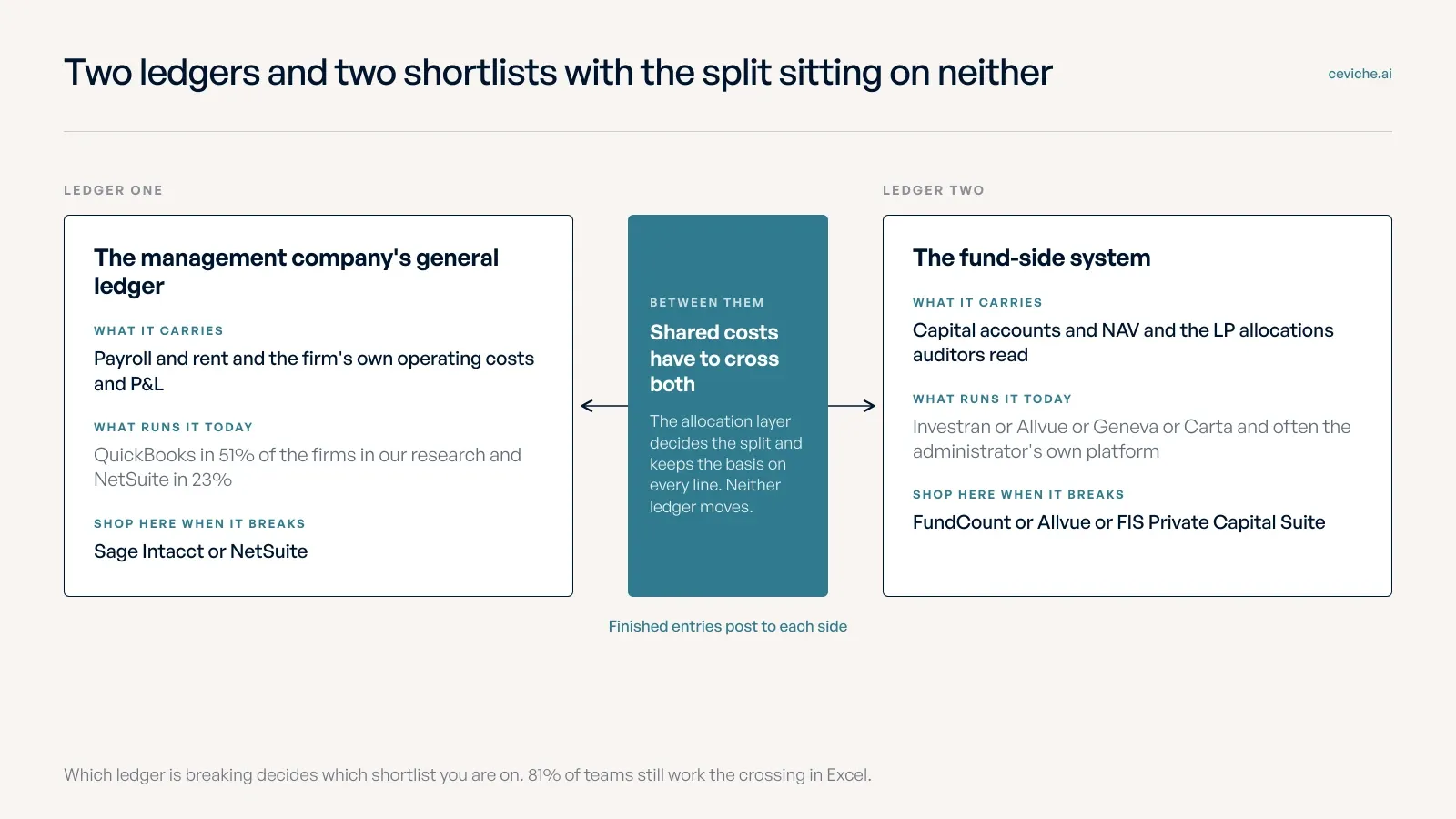
The recurring shape across the 80 fund finance teams we interviewed in 2026 is two systems. On one side, a management-company general ledger carrying payroll, rent, the ManCo's own operating costs, and the firm's own P&L. On the other, a fund-side system carrying capital accounts, investor allocations, NAV, and the fund books LPs and auditors read. QuickBooks is the management-company GL for 51% of the teams we counted and NetSuite for 23%, with Sage Intacct holding 5% and a long tail behind it. The fund side is where Investran, Allvue, Geneva, and Carta live.
So "best fund accounting software for private equity" has two correct answers, and which one applies depends entirely on which ledger is breaking. If your management company outgrew QuickBooks, you are shopping for Sage Intacct or NetSuite. If your fund books are held together by an administrator's spreadsheets and your LP reporting is late, you are shopping for Allvue, FIS, or FundCount. Those are not competing purchases. Vendors present them as one because they sell one thing.
The third answer is the one nobody sells, and it is the reason 81% of teams still work in Excel: shared costs have to cross both ledgers, and no platform on this page splits them for you. The full picture of what firms run is in our tech stack research.
What Is Fund Accounting for Private Equity?
Private equity fund accounting is the maintenance of books and records at the fund level rather than the firm level: partner capital accounts, capital calls and distributions, the allocation of income, expenses, gains and losses across LPs and the GP, waterfall and carried-interest calculations, and financial statements produced under the investment-company model. It runs alongside, not inside, the management company's own general ledger.
The mechanics diverge from corporate accounting in ways that decide which software works. A PE fund is closed-end: capital comes in through drawdowns over years rather than a daily subscribe-and-redeem flow, so the system tracks committed, called, and uncalled capital per LP across a ten-year life. Every LP carries a capital account that has to survive transfers, side letters, and equalization when a later closing happens. Distributions run through a waterfall with preferred return, catch-up, and carry, and the calculation has to be reproducible three years later when an LP or an auditor asks.
That is why general business accounting software struggles here, and why the platforms below exist. For the deeper mechanics, see our guide to private equity fund accounting.
How Did We Evaluate These Platforms?
Four criteria. Which ledger the product replaces, because that determines whether it is even on your list. Depth on the private-capital specifics: capital accounts, waterfall, carry, equalization. Integration with the rest of the stack, since a fund system that cannot read the ManCo ledger and the spend tools leaves the manual work in place. And what the vendor publishes, because a platform that discloses no pricing and no implementation timeline costs you a sales cycle just to scope.
Disclosure: Ceviche publishes this article and sells expense allocation software, which is an adjacent category, not a fund accounting platform. Characterizations below come from each vendor's public material. Where a source does not confirm something, we say so rather than infer.
The Platforms and Who Each One Fits
Ceviche (the Allocation Layer)
Ceviche is not fund accounting software and does not replace anything else on this page. It sits in this comparison because it covers the work that falls between the two ledgers, which is the gap every platform on this page leaves open.
Ceviche reads the spend and AP systems funds already run (Ramp, Bill.com, Expensify, Concur, Brex), applies the allocation methodology each LPA specifies per line, and writes audit-ready journal entries back to QuickBooks Online, NetSuite, or Sage, with the basis for every split recorded. Your GL stays where it is. Your administrator keeps executing. What changes is that the allocation crossing between the management company and the funds is a system output with a per-line trail instead of a spreadsheet.
Flybridge runs it across 18 fund entities on QuickBooks Online and Bill.com, moved from a full day of spreadsheet allocation each quarter to a hands-off run at about 99% accuracy, and onboarded in two weeks with its first allocation cycle the same month.
It fits a two-to-five-person finance team at a PE or VC firm between roughly $500M and $15B AUM where shared-cost and legal-invoice allocation is the slowest part of the close. It does not fit if what you need is capital accounts, NAV, or LP reporting.
FundCount
FundCount is a general ledger and partnership accounting system in one, aimed at fund administrators, family offices, and multi-entity managers who want the investment accounting and the accounting-firm-grade books in a single database rather than reconciled across two.
That integration is the real differentiator. A firm running separate investment and accounting systems reconciles between them; FundCount's pitch is that the capital account and the ledger entry are the same record. It fits administrators servicing many client structures, family offices with mixed asset classes, and PE managers who value a single audited source over best-of-breed modules. FundCount publishes its own vendor comparisons in this category, ranking itself alongside Allvue, eFront, SS&C Advent Geneva and Dynamo, which is a fair map of the competing set.
Public sources do not disclose pricing or a standard implementation timeline. If you are evaluating it against the enterprise field, our FundCount alternatives comparison covers the tradeoffs.
Allvue Systems
Allvue is front-to-back private capital infrastructure, and it reports more than $8.5 trillion in assets tracked across its platforms. Fund accounting sits alongside portfolio monitoring, investor portal, fundraising, corporate accounting for the management company, investment accounting, and business intelligence, all built on Microsoft Dynamics 365 Business Central and Azure with SOC 1 and SOC 2 alignment.
Two things stand out for a PE buyer. Allvue is one of the few vendors that sells a management-company accounting module alongside the fund-side one, which addresses the two-ledger problem inside a single vendor relationship. And its enterprise data management layer lets a firm define precedence rules across contributing systems to build one reconciled dataset, which is the right idea for multi-system firms. Allvue also packages a Private Equity Essentials bundle for emerging managers and publishes support for ILPA's GP-LP reporting framework.
The tradeoff is weight. This is a platform replacement measured in quarters, not weeks, deployed with real project resources and often by an administrator. Allvue discloses no pricing and no implementation timeline publicly. It fits firms genuinely ready to replace the whole stack. If you are not, see Allvue alternatives.
FIS Private Capital Suite (formerly Investran)
Private Capital Suite is the current name for Investran, one of the longest-running fund and partnership accounting systems in private capital and still a default at large managers and administrators.
Its strengths are the private-capital mechanics: fund and partnership accounting in one platform, digital waterfall administration, and automated carried-interest calculation, which is the piece most generalist systems handle badly. The investor-facing side, Digital Data Exchange, is a branded LP portal with analytical dashboards and integrated Preqin benchmark data covering more than 11,000 private capital funds, so LPs can compare fund performance to peers inside the portal.
Investran fits large managers and administrators with complex waterfalls, many vehicles, and a systems team to run the platform. It is enterprise software with an enterprise deployment, and FIS publishes neither pricing nor timelines. A three-person finance team is not the buyer.
Sage Intacct
Sage Intacct is a cloud corporate GL rather than a fund accounting system, and it belongs on this list because it is the most common upgrade path when a management company outgrows QuickBooks.
Its real strength for PE is multi-entity: continuous consolidation across entity structures, inter-entity transactions, and intercompany eliminations handled natively instead of through a month-end spreadsheet. Sage publishes named references, including a corporate controller at a credit and capital firm describing cross-portfolio entries from one dropdown, and an investment partnership that cut its close from two weeks to five hours. Open APIs make it straightforward to connect payroll and expense systems.
Be clear about the limit. Sage Intacct does not do capital accounts, LP allocations, waterfall, or carry. Firms that adopt it for the ManCo still run a fund-side system or an administrator behind it. It fits a growing management company with real entity complexity, not a fund book.
NetSuite
NetSuite occupies the same slot as Sage Intacct and shows up as the management-company GL for 23% of the teams in our research. The migration path we see most often is QuickBooks Online to NetSuite as a firm crosses into multi-billion AUM and adds entities faster than it adds accountants.
NetSuite fits firms that need a real ERP at the management company: multi-subsidiary consolidation, revenue and expense allocation schedules, procurement, and reporting depth QuickBooks cannot reach. Like Sage, it is not a fund accounting system. Capital accounts and waterfalls live elsewhere. Firms often over-buy here, expecting the ERP to solve fund-side problems it was never built for.
Dynamo Accounting
Dynamo sells fund accounting for private equity, venture capital, real estate, and fund of funds, positioned as part of its wider front-office and investor-relations suite. Managers whose main vehicle is a fund of funds can compare the options in our guide to fund of funds accounting software.
Its case is consolidation. A firm already running Dynamo for deal flow, LP CRM, and portfolio monitoring gets accounting on the same data platform, so the reporting layer is not reconciled across two vendors. For a firm not already on Dynamo, the accounting product is competing on its own merits against the specialists above, and public sources disclose neither pricing nor deployment detail.
LemonEdge
LemonEdge is the newest architecture in this list, pitched at PE firms and administrators whose current systems require heavy per-client or per-structure customization to handle complex allocations.
It fits firms with genuinely unusual structures where the incumbent systems require code-level work to model, and administrators looking to replace an aging multi-client platform. As a recent entrant it carries less public reference material than Investran or Allvue, so weight your own diligence and reference calls more heavily.
QuickBooks Plus a Fund Administrator
This is the most common answer in private equity, and no vendor page will tell you so. QuickBooks runs the management company, an administrator runs the fund books on its own platform, and the firm buys no fund accounting software at all.
It fits better and further up market than its reputation suggests. Firms well past $1B AUM run this shape successfully, because the administrator absorbs the fund-side complexity and QuickBooks handles a management company that is, structurally, a small services business. What breaks it is not AUM. It is entity count, the volume of costs shared between the ManCo and the funds, and the point at which the reconciliation between the two sides stops fitting in one person's week. Our guide to fund accounting in QuickBooks covers where the line sits.