TL;DR
If what actually breaks your close is allocation rather than administration, Ceviche is the piece to settle first: it layers on whatever administrator you run and keeps your GL. For administration itself, GPs buy Carta, Juniper Square, or a full-service firm like SS&C; administrators license Allvue, eFront, or LemonEdge.
"Fund Administration Software" Is Two Different Products
Search that phrase and page one hands you two categories wearing the same label, without telling you which one you are looking at. Whether you typed fund administration tools, fund administration systems, fund admin software or software for fund administrators, the results page is the same two categories under one label.
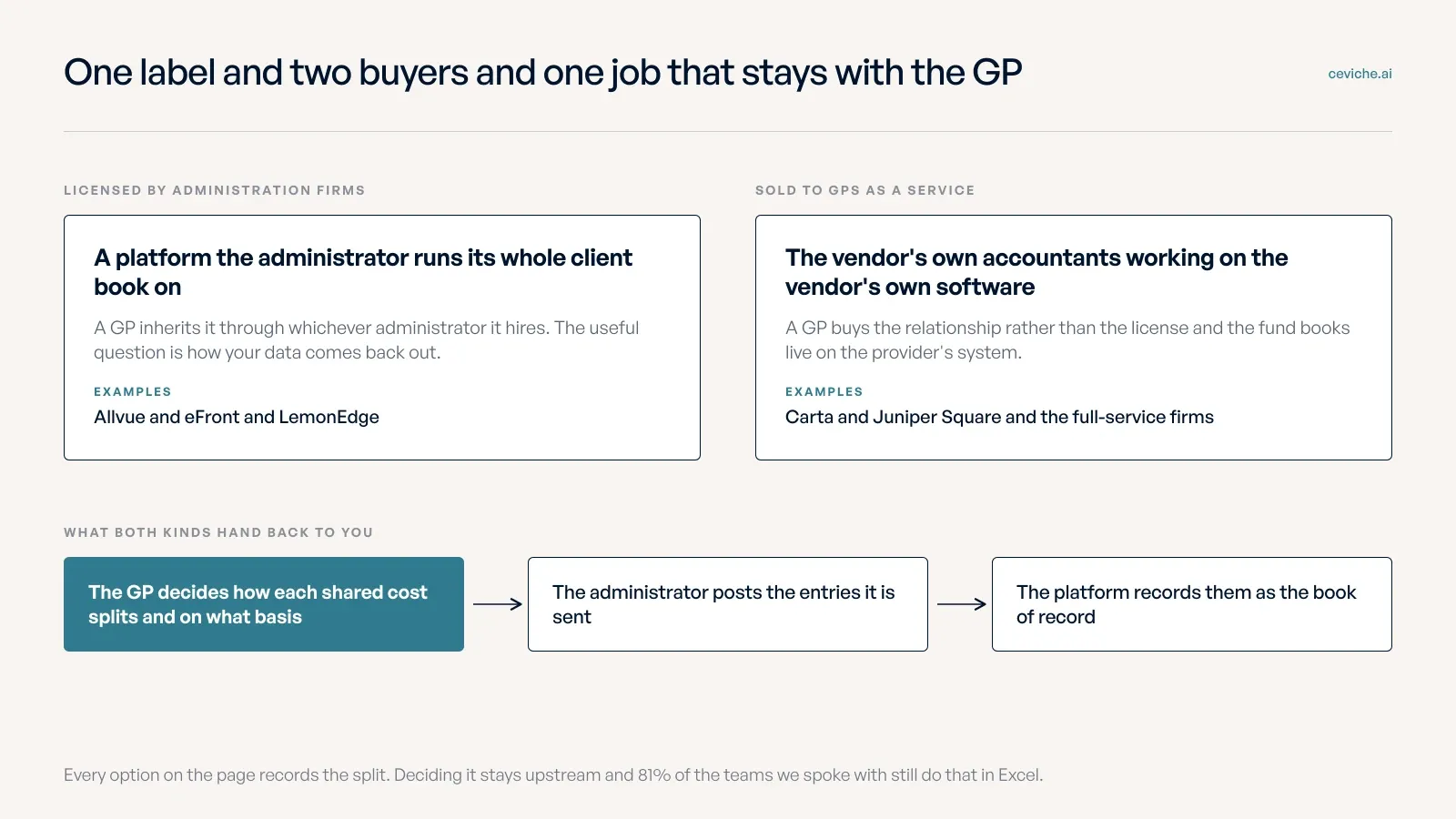
The first result is Allvue's fund administrator page. Read it closely and the buyer is not a GP. It is the administration firm itself, shopping for the platform it will run its client book on. The second result is Carta's fund administration page, which sells a service to GPs: Carta's own accountants do your books on Carta's own software. Third is a VC tools directory that lists both kinds side by side with no distinction at all. A controller at a $2B fund searching this term gets half a page of products they would never buy.
The split matters for a second reason. The full-service administrators most PE and VC funds actually hire, SS&C, Citco, Alter Domus, Apex Group, Gen II, Standish Management, are largely running the platforms at the top of this SERP. Allvue's own fund-administrator page, the first result here, names Standish Management among the administrators running its platform. When a GP asks "what fund administration software should we use," the honest translation is usually "which platform is our administrator running, and can we get our data out of it."
What Does Fund Administration Software Actually Cover?
Fund administration software is the system of record a private fund's back office runs on: the fund-level general ledger, NAV and valuation, capital accounts, capital calls and distributions, investor reporting and the LP portal, and the data feeding audit and tax. It is operated either by a third-party administrator on the GP's behalf or by an in-house fund accounting team.
Four capability areas show up in every serious platform, and they are the right checklist for a demo.
Fund accounting and the ledger comes first: a real general ledger at the fund level, multi-entity and multi-currency postings, and financial statements under the investment-company model. Capital activity is second, and it is where private funds diverge most from corporate accounting: commitment tracking, drawdown and distribution notices, capital account maintenance per LP, and waterfall and carry math. Investor servicing is third: subscriptions, the investor register, a portal LPs will actually log into, and a quarterly reporting package, increasingly measured against ILPA's reporting template and the updated GP-LP framework from January 2025. Fourth is compliance and tax: AML and KYC, FATCA and CRS, Form PF support, K-1 production, and the audit package.
Notice what is not on that list. Deciding how a shared cost splits across Fund I, Fund II, the co-invest SPV, and the management company is not a line item in any of these products, because it sits upstream of the posting. For the definitional split between the service and the accounting function itself, see fund administration vs fund accounting.
How Did We Pick These Platforms?
Five criteria, all of them things a fund controller asks in a first call. Who the product is sold to, because a platform built for administrators is a different purchase than a service built for GPs. Fund type fit, because closed-end PE and VC accounting is not hedge-fund accounting. Onboarding and migration path, because the switching cost is the real cost. GL and spend-tool integration, because most firms keep a management-company ledger regardless of who administers the funds. And what the vendor discloses publicly, because a controller who cannot scope pricing or timeline before a sales call is already at a disadvantage.
Disclosure: Ceviche publishes this article and sells software in the adjacent expense allocation category. Every characterization below comes from the vendor's own public material, cited inline. Where a source does not confirm something, we say so instead of inferring it.
The Platforms and Who Each One Fits
Ceviche (the Allocation Layer)
Ceviche is not a fund administrator and does not belong in the same row as Carta or SS&C. It leads this list because it covers the specific job every option below hands back to you: splitting shared and legal costs across fund entities by the methodology the LPA requires, and proving it later.
Ceviche reads from the spend and AP systems funds already run (Ramp, Bill.com, Expensify, Concur, Brex), applies the firm's allocation methodology per line, and writes audit-ready journal entries back into QuickBooks Online, NetSuite, or Sage with the rationale attached. Your administrator keeps executing on its own platform. What changes is that the allocation arriving at the administrator is a system output with a per-line trail rather than a spreadsheet somebody rebuilt the night before the close.
Flybridge onboarded in two weeks and ran its first allocation cycle the same month. Across its 18 fund entities, on the QuickBooks Online and Bill.com stack it already had, allocation went from a full day each quarter to a hands-off run at about 99% accuracy.
Ceviche fits a two-to-five-person finance team at a PE or VC firm between roughly $500M and $15B AUM, with or without an administrator, where legal and shared-cost allocation is the part of the close that eats the most time. It does not fit if what you need is NAV, capital accounts, and LP reporting, because those are the administrator's job and Ceviche does not do them.
Carta
Carta sells administration as a service on its own software, mostly to VC funds and smaller PE managers who want a service rather than a platform they operate.
Carta reports more than $220 billion in private capital fund assets under administration across venture capital, private equity, and private credit. The scope is wide: fund formation and closings, SPVs, capital calls and distributions, KYC and AML screening on LPs, portfolio valuations, a deal and LP CRM, and an LP portal showing commitment, contribution, vintage, and net asset balance per investor. Fund Tax is an add-on covering the Form 1065, partner K-1s, and state filings. Carta states fund formations execute in six weeks and operations start "in a matter of weeks" with committed onboarding timelines, which is one of the few published timelines in this category. It also runs a Ramp integration carrying expenses from card swipe toward the ledger, and markets AI agents handling cash reconciliation, tax monitoring, schedule-of-investments tagging, and expense preparation.
Carta fits a VC or emerging PE manager that wants one system for cap table, fund admin, and tax, and is comfortable with the fund's books living inside Carta. It fits less well if you keep an independent management-company GL and want fund-side records portable to a different provider later. Ask where allocated journal entries land and in what format you can extract them. If you are weighing Carta against Allvue specifically, our Allvue vs Carta comparison covers both on fund accounting and administration.
Juniper Square
Juniper Square positions as connected software plus administration services for private markets GPs, naming real estate, private equity, and venture capital. The pitch is that one system runs investor relationships, reporting, and the fund accounting behind them, so the GP is not stitching a portal onto an administrator's ledger.
Real-estate-heavy sponsors are its strongest base, and multi-vehicle CRE structures with frequent investor-level reporting are where the model shows best. Public sources disclose neither pricing nor an implementation timeline, so scope both directly. Juniper Square fits GPs who want administration and investor experience from one vendor and will standardize on that vendor's data model.
Allvue Systems
Allvue is enterprise infrastructure, and its fund administration product is aimed at administrators rather than at GPs directly. The platform bundles fund accounting, investment accounting, corporate accounting for the management company, an investor portal, a client collaboration hub for auditors and third parties, portfolio monitoring, and business intelligence. The fund accounting layer is built on Microsoft Dynamics 365 Business Central and Azure, with reporting through Power BI. A consolidated back office keeps one security master across credit and equity, which matters for multi-strategy books. Credit strategies bring their own vendor set, which we cover in our guide to private credit fund administration software. Allvue also publishes support for ILPA's updated GP-LP reporting framework, and packages a "Fund Administration Essentials" bundle for newer administrators building a client book.
Allvue fits an administration firm scaling its client base, or a very large GP running fund accounting fully in-house with the implementation resources an enterprise deployment needs. It does not fit a three-person finance team looking for something to install this quarter. Allvue discloses no pricing and no implementation timeline publicly. If your firm is evaluating a full front-to-back replacement, the comparison you actually want is in our Allvue alternatives guide.
eFront (BlackRock)
eFront covers fund administration and accounting across alternative asset classes and is one of the long-standing enterprise systems in private markets, now inside BlackRock. It shows up most often on the administrator side, deployed by the large administration firms for their client books rather than licensed by GPs directly.
eFront fits large managers and administrators with dedicated systems teams, multi-asset books, and an existing enterprise vendor relationship. For a lean fund finance team it is the wrong weight class, and public material discloses neither pricing nor deployment timelines.
Dynamo Software
Dynamo sells fund administration as a service alongside its better-known front-office and investor-relations products. The draw is consolidation: for a firm already running Dynamo for deal flow, LP CRM, or portfolio monitoring, administration on the same data platform means the reporting layer does not get reconciled across two vendors.
Dynamo fits GPs already committed to its front-office stack. If you are not, the administration offering is competing on its own merits against Carta and the full-service firms, and public sources disclose neither pricing nor service-model detail at the level a controller needs.
LemonEdge
LemonEdge is built for administrators and asset servicers managing multiple clients and asset types on one platform, pitched as a modern alternative to systems that require heavy per-client customization.
A single GP is not the buyer here. Include it in diligence only when you are evaluating your administrator's technology, which is a fair question to put to them.
Fundwave
Fundwave targets smaller PE and VC funds directly with software rather than a service, and it publishes a free entry point. For a first-time manager running one fund and a couple of SPVs, self-serve tooling can be enough before an administrator is worth the fee.
It stops fitting when entity count multiplies faster than headcount, which is the threshold covered in our guide to fund management software for lean teams.
The Full-Service Administrators From SS&C to Standish
For most PE funds above roughly $500M, the real decision is not which software to license. It is which administration firm to hire, and each of these runs on some combination of the platforms above plus proprietary tooling.
They fit differently by profile. Gen II and Standish Management are PE-specialist independents with deep closed-end fund experience. Alter Domus and Apex Group bring multi-jurisdictional reach for funds with European or offshore vehicles. Citco and SS&C carry the largest institutional books and the corresponding process rigor. The evaluation criteria that separate them are PE-specific closed-end experience, references from funds your size, jurisdictional coverage, the portal your LPs will use, turnaround that matches your close calendar, SOC reporting, and how pricing scales as you add vehicles.
Add one question the RFP templates leave out: ask how they handle multi-entity expense allocation, and whether you receive a real per-line audit trail or a summary memo. The honest answer from most administrators is "you send us the allocation and we post it." That answer is correct, and it tells you exactly which work stays yours.