
TL;DR. The SEC's enumerated expense allocation findings sit in a June 2020 examinations risk alert rather than in any year's priorities list. Staff observed shared costs allocated inconsistently with disclosures, expenses the fund agreements did not permit, contractual expense limits missed, and travel policies not followed. Examiners then pull invoices and test whether the methodology and approvals match the stated policy.
What has the SEC actually found on expense allocation?
The findings exist, they are enumerated, and almost nobody quotes them. They sit in section B of a June 2020 examinations risk alert on advisers managing private funds, under a heading that reads Fees and Expenses, written as things the staff observed rather than as a category label.
Four of them are allocation findings. Advisers allocated shared expenses, with broken-deal, due diligence, annual meeting, consultant and insurance costs named as the examples, in a manner inconsistent either with what investors had been told or with the adviser's own policies and procedures. Advisers charged funds for expenses the relevant operating agreements did not permit, and the alert names adviser salaries, compliance, regulatory filings and office expenses as what it saw. Advisers failed to comply with contractual limits on expenses that could be charged to investors, such as legal fees or placement agent fees. And advisers failed to follow their own travel and entertainment policies.
None of the four is an arithmetic finding. Each is a split that does not match a document, either the fund agreement, the disclosure investors received, or the firm's own written policy, and the staff attached the same consequence to each, which is that investors overpaid. The adjacent findings run the same way, with operating partner compensation left undisclosed and assets valued outside the adviser's own stated process.
One case shows the chain end to end. In June 2022 the SEC charged a private equity adviser for allocating a disproportionate share of credit facility expenses to one fund it advised, after agreeing that third-party co-investors would not bear those costs. The order found that under the fund's organizational documents those expenses should have been disclosed or not allocated that way. Energy Capital Partners paid a $1 million penalty and had voluntarily repaid more than $3.3 million. The examination which led to the investigation was run by the Division of Examinations' Private Funds Unit.
Where are the findings published and what is each document for?
Four kinds of document get treated as one thing and carry very different weight. A risk alert is staff observation, telling you what examiners saw across many examinations. Annual priorities are a forward statement of where the Division says it will look. A settled order is an outcome, and a compliance guide describes rules, which is a separate question from what examiners find.
| Document | What it is | What it says about expense allocation | Date |
|---|---|---|---|
| Observations from Examinations of Investment Advisers Managing Private Funds | Staff risk alert | Section B enumerates four allocation deficiencies, covering shared costs split inconsistently with disclosures or the adviser's own policies, expenses the operating agreements did not permit, contractual expense limits not complied with, and the adviser's own travel and entertainment policy not followed | June 23, 2020 |
| Observations from Examinations of Private Fund Advisers | Follow-up staff risk alert | Failures to act consistently with disclosures, including advisory committee consent obtained after the fact and post-commitment-period fee calculations | January 27, 2022 |
| Fiscal Year 2025 Examination Priorities | Annual priorities statement | A dedicated private funds section naming the accuracy of calculations and allocations of private fund fees and expenses, both fund-level and investment-level | Fiscal year 2025 |
| Fiscal Year 2026 Examination Priorities | Annual priorities statement | No dedicated private funds section, and the phrase expense allocation does not appear anywhere in the document | Fiscal year 2026 |
| Order against Energy Capital Partners Management | Settled enforcement action | Disproportionate credit facility expenses allocated to one fund without disclosure, $1 million penalty, more than $3.3 million voluntarily repaid | June 14, 2022 |
| Order against TZP Management Associates | Settled enforcement action | Management fee offset calculation practices inconsistent with the fund agreements, more than $680,000 in monetary relief. A fee offset case rather than an expense allocation case | August 15, 2025 |
The January 2022 follow-up alert carries less expense material, though its consent findings sit on the same axis. The TZP order gets cited as an allocation case and is not one, which matters if you are building a memo off it.
Is expense allocation an SEC examination priority right now?
Here the accurate answer and the widely repeated one come apart. The sentence that circulates is that the Division will review the accuracy of calculations and allocations of private fund fees and expenses, both fund-level and investment-level. That sentence is real. It sits in the fiscal year 2025 priorities, under a section headed Examinations of Advisers to Private Funds.
The fiscal year 2026 priorities do not have that section. The private fund content in the current document sits inside the fiduciary-standards discussion, and it names three groups. Advisers who run private funds alongside separately managed accounts, or who have newly registered, are reviewed for favoritism in investment allocations and interfund transfers. Advisers to newly launched private funds, and advisers who have never run one before, are reviewed for regulatory awareness, liquidity, valuation, fees, disclosures and side letters. The phrase expense allocation does not appear. The 2025 wording is often reproduced under a 2026 heading, sometimes with the 2026 document cited underneath it.
The change does not mean the subject stopped mattering. Deficiency findings and enforcement outcomes are independent of any single year's priority list, and both enforcement matters above landed in years when the wording moved around. A vice president of finance at a large private equity firm that has been examined said it more bluntly when we asked how his team plans for this.
It doesn't matter what the regulatory focus is. They will look at expense allocations.
The current document does not name expense allocation. The previous one did. The enumerated findings are older than both, and a firm planning around one year's list is planning around the wrong document.
What does an exam request look like from the controller's chair?
An email arrives with an Excel worksheet to fill out, and the clock is short. That is the request as a controller at a registered adviser described it to us, at a firm examined shortly after it registered.
You literally don't know when you're gonna get it, and they give you two weeks notice.
What stood out was the thing that did not happen. Her team did not reconstruct anything, only gathered it, which she put down to already keeping the records that way. Her exam focused on performance and net asset value figures rather than expenses, so it is not a story about allocation surviving scrutiny. It is a story about gathering versus reconstructing, and two weeks is where that difference gets expensive.
The other side of it is what reconstruction costs. Someone who had run allocations at a prior firm watched a real SEC exam request go two ways, handled through a system that produced the record in roughly 15 minutes, versus a week and a half of manual reconstruction the old way. The wider pattern sits in our research on audit trail gaps, where the teams who answered quickly were the ones who had built the support at the time of the split rather than after the request.
The pressure arrives before any letter does. A private equity firm founded about five years ago came to us with its first examination on the horizon, its CFO calling expense allocation the highest-priority problem in the back office. First-exam firms are the ones who discover the record does not exist in a form anyone can hand over.
What do examiners test and why are two of the three about documentation?
Our own synthesis, on the research page above, is that examiners test three things: whether expenses that benefited the adviser got charged to the funds, whether the allocation methodology is documented and applied consistently, and whether each split matches what the fund documents permit. Two of the three are documentation questions rather than arithmetic ones.
A chief compliance officer at a venture firm put the expectation in plainer terms than any document does.
The SEC doesn't have an expectation that we have a platform. They have an expectation that we have a logic and a rationale around how we're allocating expenses and that we have documentation to support it. What they would do is come and pull invoices and ensure that whatever our policy is is what we're actually doing.
Pull invoices and check policy against practice. The substantive test, the one about which costs belong to the funds at all, is usually settled before an examiner arrives. That classification question sits underneath all four enumerated findings, and our data on fund vs management company expenses works through how firms decide it, but a firm rarely loses on the classification it chose. It loses on not being able to show the choice.
The documentation an examiner wants is produced by the allocation, at the moment of the allocation. Of the 80 fund finance teams we spoke with in 2026, 81% still allocate in Excel, which leaves no native trail behind the split, and 49% have a gap in exactly the record a request asks for. The finding is not that those firms allocate wrongly. It is that they cannot show how they allocated, which is two of the three things being tested.
What is a deficiency letter and who else reads it?
An examination has more than one ending. The 2020 alert describes a range of outcomes including no-comment letters, deficiency letters and, where appropriate, referrals to the Division of Enforcement. The deficiency letter is the written middle case, listing what the staff found and expecting the firm to say what it is doing about each item.
Why that lands harder than the finding itself came from the same compliance officer. Deficiency letters, he said, are often requested by current or potential limited partners, so something written up in an exam letter can turn up two years later in a fundraise data room. The sensitivity is rational. An LP reading a deficiency letter about expense allocation is reading about money that came out of a fund it invested in.
Why is your auditor's clean opinion not the same test?
One venture CFO we work with drew the line for us in two moves. His firm's newest partnership agreement carries an expense section that runs to about three pages, written so that every chargeable item has a clause behind it, and he has moved part of the audit's expense testing into the interim period so that the record is examined while the allocations are fresh rather than reconstructed at year end.
Most controllers reading this have been through many audits and no examinations, so the audit becomes the mental model for scrutiny. The two tests are not calibrated the same way.
A financial statement auditor works to materiality. Outside management fees, most fund expenses are de minimis from an auditor's testing perspective, so they rarely get questioned on their own, which is how someone who ran allocations at a registered adviser with 34 active funds described the coverage his team got. The standard he held them to came from the other test.
Down to the penny. The SEC comes in, they don't care about any sort of dollar threshold.
Where allocation does surface in an audit, it comes through journal entry testing rather than materiality. Immaterial splits get beaten up more than anyone expects, a CFO at a multi-entity venture firm told us, because that testing is required regardless of size, and the questions arrive at the level of a single line on a single invoice.
So a clean opinion is weak evidence about your allocation record. It says the financial statements are not materially misstated. It does not say a three-figure line can be traced to its invoice, its basis and its approver, which is the question both an examiner and a journal entry test end up asking. Our guide to fixing allocation errors before your auditors do covers the correction mechanics when the answer is no.
Which advisers are in scope after the Fifth Circuit vacatur?
The rule people are usually thinking of is gone. The Fifth Circuit vacated the private fund adviser rules in June 2024, and the SEC's own private fund advisers compliance guide carries that disclaimer at the top, stating the newly adopted rules and the affected amendments are no longer in effect. Our explainer on the private fund adviser rule covers what it would have added for quarterly fee and expense statements.
What the vacatur did not touch is the basis of every finding on this page. The 2020 alert framed its fee and expense deficiencies under the antifraud provisions of the Advisers Act, Section 206 and Rule 206(4)-8, both of which long predate the vacated rule. So the examination questions did not change. A registered adviser is still examined, its allocation practices are still testable against its own fund documents, and the enumerated deficiencies remain the staff's published account of what goes wrong.
What does a defensible allocation record contain?
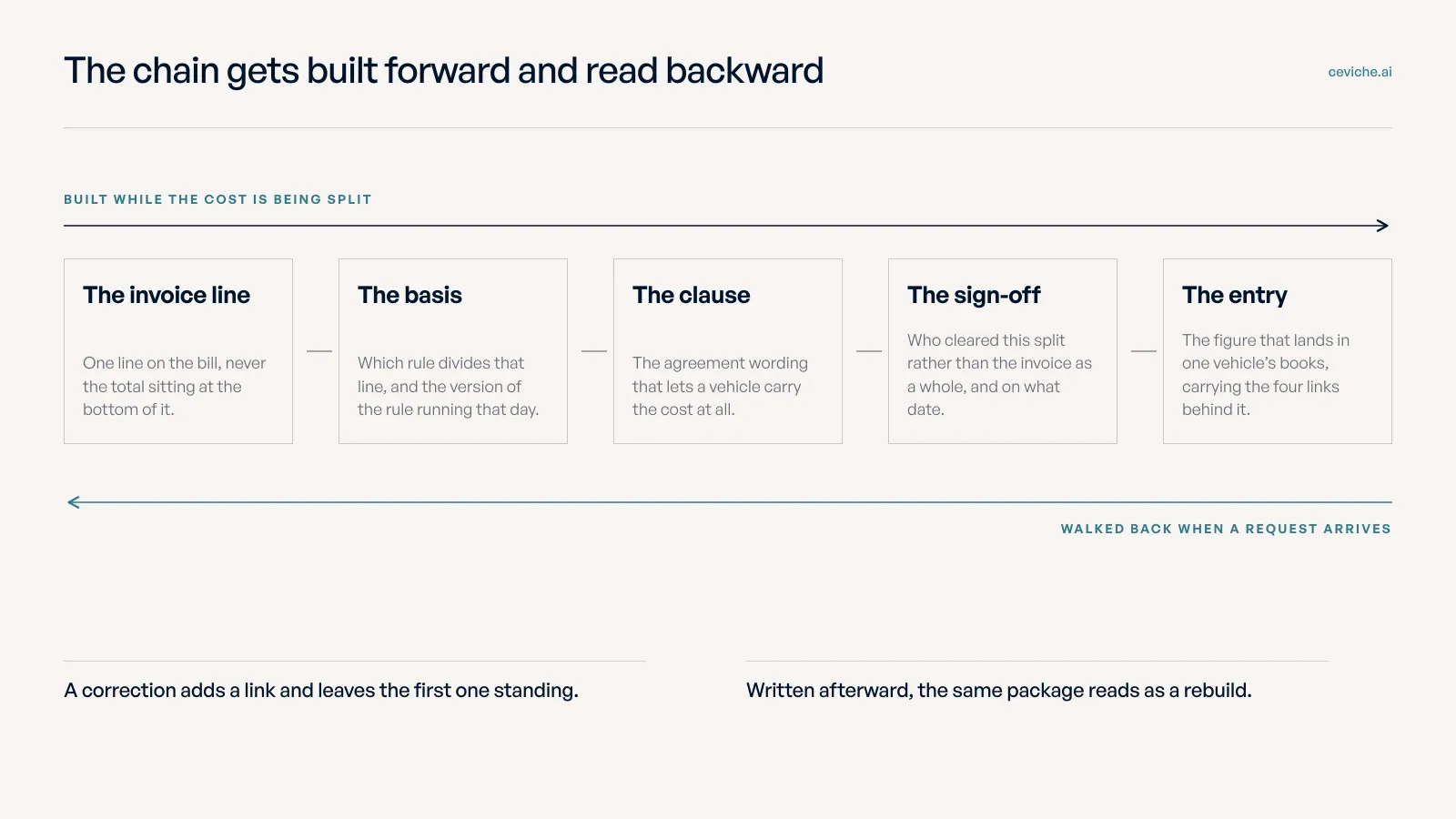
No regulator publishes a specification for such a record. What follows is our own description of one, assembled from what the requests above actually work through rather than from any published requirement.
A defensible allocation record is the permanent evidence behind one split. It ties the journal entry to the source invoice line, the methodology applied and the version of it in force, the LPA clause that permits the charge, the person who approved it, and the date. Corrections create a new versioned entry rather than overwriting the original.
Those elements are what a request works through, which is the expenses charged to the funds, the pro rata allocation, the methodology behind it, and compliance's review of it. The approval belongs at the allocation level rather than on the invoice as a whole, for the same reason.
In our experience the firms most aggressive about billing costs back to the funds have the tightest documentation, not the loosest. There is usually a CFO or chief compliance officer signing off on what gets allocated and why, and a vendor master table carrying the reason each vendor's costs land where they do. The fund agreements behind these charges are general in their language, which is why the firm's own policy and the per-line reasoning carry the weight.
Take a small line, since small lines are where this gets tested. An $8,000 annual subscription to a market data tool is a fund expense under each LPA's expenses clause, allocated pro rata by committed capital across the vehicles that had access during the term.
| Vehicle | Committed capital | Share | Allocated |
|---|---|---|---|
| Fund III | $430.0M | 53.750% | $4,300 |
| Fund IV | $250.0M | 31.250% | $2,500 |
| Fund II | $95.3M | 11.912% | $953 |
| Co-invest SPV | $24.7M | 3.088% | $247 |
| Total | $800.0M | 100% | $8,000 |
An examiner pulls the $247. Answering it takes the invoice, the line on it, the methodology named as committed capital, the driver showing which vehicles had access, the LPA clause permitting a data subscription as a fund expense, the approver and date, and the journal entry carrying $247 into that ledger. The dollar figure is trivial and the question is identical to the one asked of a six-figure legal bill, which is why teams who split legal invoices line by line find the small lines easier rather than harder.
Two habits separate the teams who can produce that package from the teams who cannot. The first is writing the basis at the moment of the split rather than in a memo afterward. The gap has a name, and a controller at a lower-middle-market private equity firm gave it to us.
Excel makes me itchy because there's no proof of when you did it. There's no proof of who reviewed it. So it's hard when a regulator comes in to kind of show all the effort that you put into doing it the right way.
The second is keeping a written rationale for every methodology that involves judgment. Show us your math on all of this. That is the request a CFO at an infrastructure private equity firm plans for, and her answer is the invoice number and the allocation. For every methodology requiring a judgment call, including a forced management company share where no market value exists, her team keeps a quarterly document explaining the reasoning.
The requirement most buyers forget is the one that decides whether any of this is retrievable at all. An export right that exists only at termination is no use during an examination that arrives while the contract is still running, and an export nothing can re-perform the calculation from is not evidence, which is why our checklist for an audit-ready fund expense allocation puts both in the contract rather than in the feature list. A record you cannot get out of a system on the day you need it is not a record.
Where does Ceviche fit?
Ceviche records the four things this page has been describing, which are who allocated a line, on what basis, who approved it and when, with the invoice sitting behind it. It reads the spend and payables systems a firm already runs, applies the methodology each fund agreement specifies per line, and writes journal entries back to the ledger with that support attached. It is not a fund administrator, a general ledger or a managed service, and it does not do the allocations for you. Flybridge moved its quarterly allocations across 18+ fund entities out of spreadsheets, and every allocation there now traces back to source documentation with a full audit trail. See what it does.
Frequently asked questions
What documentation do examiners expect for expense allocation? Methodology documentation first, meaning the written rules for how each expense category splits and the fund agreement clauses authorizing them. Then walkthroughs of specific entries traced back to the invoice and the rule applied. Then evidence that the methodology running in the last period is the one that ran in the first. Every allocation finding in the 2020 alert is a failure of one of the three.
What do we do when one of the items behind a split does not exist? Say so, and date the reconstruction. A memo written this week that reads as though it were written at the time of the split is the one thing worse than a missing basis, because it turns a documentation gap into a credibility problem. Where the approver has since left, the record still has to name who held that authority then. Gaps get disclosed and fixed going forward, not backfilled.
If we correct a prior quarter's allocation, what happens to the original record? The original entry stays, and the correction posts as a new versioned entry naming what changed, who changed it and when. Overwriting the first split destroys the evidence that the methodology was applied consistently, which is one of the three things an examiner tests. In a spreadsheet the overwrite is the default, and nothing records that it happened.
Do auditors test expense allocations the way the SEC does? No. Allocation questions reach an audit mainly through required journal entry testing, which samples entries regardless of size and then asks for the basis behind whichever one it picked. Materiality keeps most individual fund expenses out of substantive testing entirely, so a clean opinion has said almost nothing about them. An examiner works to no threshold at all.
Does the private fund adviser rule still apply after it was vacated? No. The Fifth Circuit vacated those rules in June 2024, and the SEC's compliance guide carries the disclaimer at the top. What did not change is the basis of the allocation findings in the risk alerts, which is the Advisers Act antifraud provisions the staff cited in 2020 rather than the vacated rule. The exam questions are unchanged.