Audit-ready fund expense allocation means a per-line trail from invoice to GL posting with the LPA basis cited. 49% of 80 fund finance teams have a gap.
TL;DR
Audit-ready fund expense allocation software records every expense line from invoice receipt through GL posting, with the controlling LPA methodology cited on each line. When an SEC examiner samples 20 to 50 transactions, that per-line trail is what traces each one back to its basis. Controls tools do not produce it.
What is audit-ready fund expense allocation?
An examiner picks line 14 of an outside-counsel invoice and asks one question. Where in the LPA does it say you can allocate this cost this way? Everything else in an expense exam is procedure. That question is the exam.
Audit-ready fund expense allocation is the practice of documenting each expense line from invoice receipt through allocation to GL posting, with the controlling LPA methodology cited for every line. The record shows which entity bears each cost, which methodology dictated the split, and where the entry landed in the general ledger.
Most controllers can answer that question for any single line. Answering it for 40 sampled lines, a year later, from records someone else maintained, is the part that breaks.
Why do fund expense audits fail and why doesn't SOC 2 help?
A SOC 2 report answers whether your systems are secure and your controls operate. It says nothing about whether the legal invoice you split across Fund I, Fund II, and a co-invest SPV followed the methodology each LPA dictates. The two audits test different things, and passing one tells you nothing about the other. Teams fresh off a SOC 2 push are the most likely to assume otherwise.
Start with methodology drift. You allocate a management-company expense pro rata by committed capital in Q1, then someone applies a headcount split in Q3 without recording why. The examiner now has two answers for the same expense category and wants to know which one the LPA supports.
The second failure is quieter, because it looks like ordinary AP work. A single outside-counsel invoice with 25-plus line items may touch four entities under four methodologies. Of the 80 fund finance teams we spoke with in the State of Fund Expense Allocation 2026 report, 63% name legal-invoice allocation one of their toughest problems. When no line carries a recorded basis, one invoice becomes 25 unsupported allocations.
Then there is the missing LPA citation. The now-vacated Quarterly Statement Rule required advisers to cross-reference the LPA section setting the calculation method for each expense. Vacated or not, that cross-reference is what an examiner reconstructs during fieldwork, and the rule's documentary standard still shapes what gets asked for. Without it, you rebuild the reasoning from memory a year after the fact.
Generic audit management tools do not close any of this. Workiva, AuditBoard, and Vanta document controls, evidence collection, and framework mappings for SOX or SOC 2. None of them encodes an LPA allocation methodology or splits a legal invoice by line. They tell an examiner your process exists. They do not tell an examiner the basis for the number on the page.
The pain is not abstract. A CFO at a multi-billion-dollar PE firm told us he went looking for allocation software late at night the week his firm received an SEC examination notice, because the allocation record lived in spreadsheets nobody could defend line by line. A controller at another fund put the same problem more bluntly: the trail existed only as "different color highlighters and a piece of paper" handed across a desk.
What does "audit-ready" actually require for fund expense allocation?
Four things have to be true before the sampling starts. Miss one and you are building a workpaper on demand instead of pulling a record that already exists.
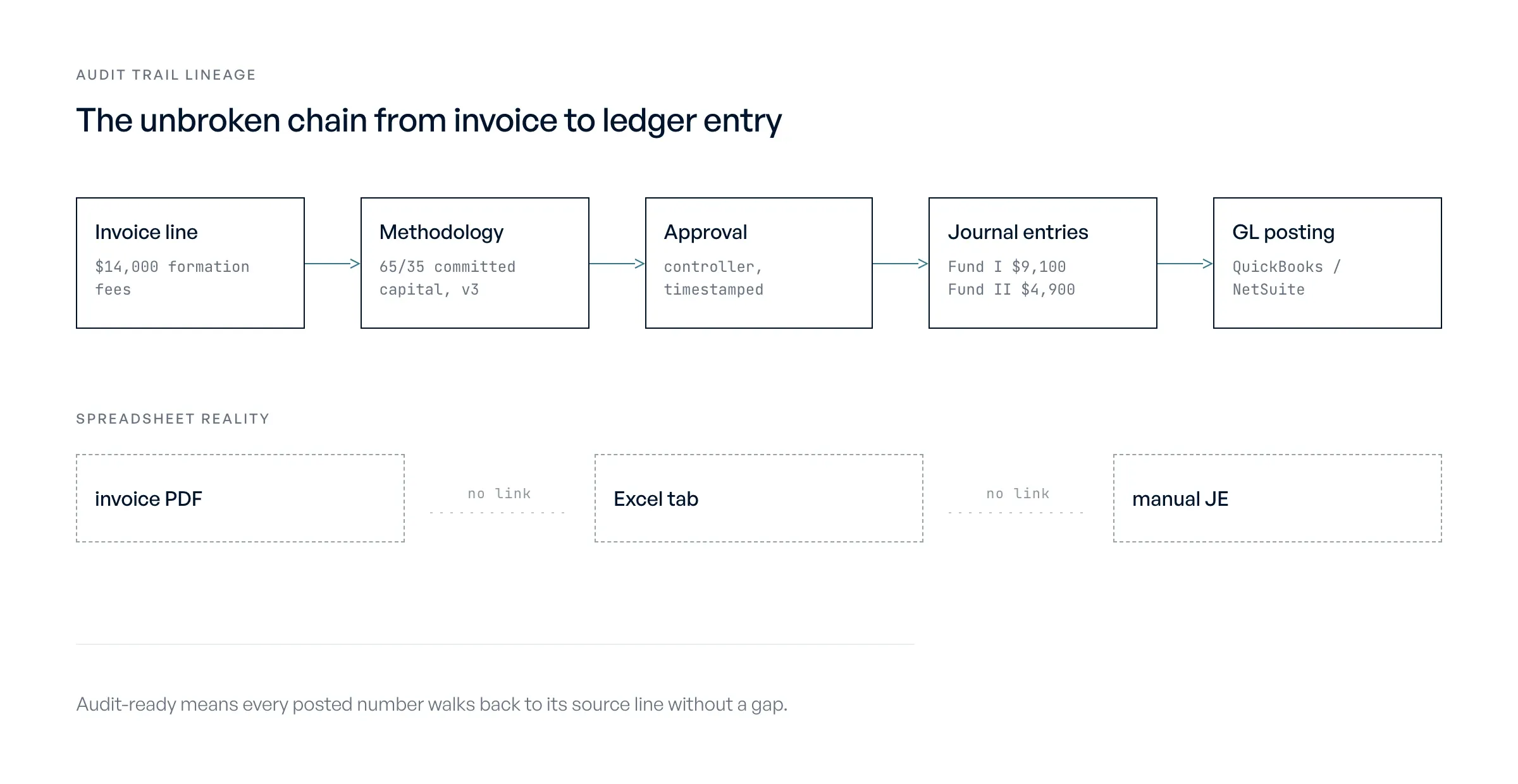 The unbroken chain an examiner expects, versus the spreadsheet reality most funds run.
A per-line audit trail has to run from invoice receipt through allocation to GL posting. The examiner picks a line, and you show the source document, the methodology applied, and the journal entry it produced, with no reconstruction in between.
The methodology on each line has to match the controlling LPA. The SEC's now-vacated Quarterly Statement Rule required advisers to include cross-references to the sections of the fund's organizational and offering documents that set the calculation method for each fee, expense, and allocation. The Fifth Circuit vacated the rule in 2024. The documentary standard it named is still the practical benchmark, because it describes what an examiner needs in order to test anything at all.
Allocations have to stay consistent across entities and across quarters. If Fund I splits an expense pro rata by committed capital this quarter, it does so next quarter too, unless a documented exception changes it. Drift between quarters is the finding examiners write up.
And the trail has to export in a format an examiner reads without your help. A per-line schedule mapping invoice, methodology, LPA citation, and GL entry side by side turns a sampling request into a file transfer.
What does a per-line trail look like on one invoice?
Here is a realistic version of the document that creates the problem. An outside-counsel invoice arrives at the management company for $61,400 across 22 line items, mixing timekeeper fees and disbursements. Four of those lines look like this.
| Invoice line | Work | Amount | Methodology and LPA basis | Where it lands |
|---|
| 3 | Fund III formation and closing documents | $8,200 | Specific-fund, organizational expenses under the Fund III LPA | Fund III, $8,200 |
| 9 | Diligence, Project Larkspur | $14,750 | Pro rata by committed capital across participating funds (Fund II $180M, Fund III $320M) | Fund II $5,310, Fund III $9,440 |
| 14 | Employment matter, management company | $3,900 | Management company expense, not chargeable to any fund | ManCo, $3,900 |
| 18 | Co-invest SPV deal documentation | $6,500 | Specific-vehicle, by deal participation | Co-invest SPV, $6,500 |
Four lines, four methodologies, four separate answers to the examiner's question. The remaining 18 lines, $28,050, carry their own mix. QuickBooks and NetSuite have no native way to split this invoice by line and post entries that keep the methodology attached, so the work moves to Excel and the basis survives as a column heading nobody documents.
The arithmetic is not the hard part. Line 9 is a 36/64 split, which anyone can compute in a cell. The hard part is proving 14 months later that 36/64 was what the Fund II and Fund III LPAs required, and that the same basis was used the quarter before.
How does Ceviche create an unbroken audit trail?
Ceviche encodes your allocation rules as code and runs every invoice through them line by line, from AP intake to GL posting. Each allocation carries its LPA basis, its methodology, and its target entity as recorded data, so a controller traces any journal entry back to the invoice line that produced it without asking anyone what a formula meant three quarters ago.
The rules encode the LPA, not a cell formula. When your fund documents say partnership expenses split by committed capital and co-invest costs split by deal participation, those provisions become named, versioned rules. A spreadsheet records the math. Ceviche records the math and the reason, and the reason is the half an examiner asks for.
Run the invoice above through it and each of the 22 lines gets the rule its category calls for, the basis recorded on the line, and the whole invoice held together as one traceable record. That per-line split is the work QuickBooks and NetSuite leave to you.
GL-agnostic write-back closes the last gap. Ceviche posts finished journal entries back to NetSuite, QuickBooks Online, or Sage without a controller rekeying anything. The chain breaks when the allocation math lives in one file and the posting happens in the GL by hand, because nothing links the two.
What Ceviche does not do is the allocations. It is software you run, not a managed service and not a fund administrator. You keep the rules, the exceptions, and the review. If you want a firm to take the work off your desk entirely, that is the managed-service model, and it is a different product.
Audit trail software compared
Ceviche is our product, so read this table knowing we sell one of the tools in it. The alternatives are real, and each has genuine strengths. Deloitte Cascade Suite is the strongest option when your hardest allocation problem is splitting employee time and compensation across funds. EAS/IntegriDATA fits $10B-plus managers with enterprise GL systems and dedicated implementation staff. Where a competitor's attribute is not disclosed in public sources, we say so rather than guess.
| Tool | Audit trail format | LPA enforcement | Legal invoice line depth | Implementation time | GL-agnostic write-back |
|---|
| Ceviche | Per-line trail from invoice receipt to GL posting, allocation logic stored as code | Rules encode the LPA and cite the governing basis per line | 25+ line invoices split line by line, each line to its own entity and methodology | About 3 to 4 weeks | Yes, writes back to NetSuite, QuickBooks Online, and Sage |
| Spreadsheets | No native trail; formulas overwrite and leave no record of prior methodology | Manual, enforced only by whoever maintains the file | Manual line splitting, error-prone at 25+ lines | None, but you already run it | No write-back; entries re-keyed into the GL by hand |
| Linedata | Not disclosed in public sources | Not disclosed in public sources | Not disclosed in public sources | Not disclosed in public sources | Not disclosed in public sources |
| Deloitte Cascade Suite | Full audit trail of every calculation and rule change; posts journal entries | LPA terms digitized through a guided UI, applied at the expense line level | Line-level configurability across AUM, NAV, location, and time methodologies | Not disclosed; delivered only via Deloitte license or managed service | GL write-back not confirmed; no named GL integrations in public documentation |
| EAS/IntegriDATA | Complete audit trail on every user action, plus a Q&A hub logging invoice communications for SEC readiness | LPA policies digitized and applied automatically to each allocation | AI OCR captures AP invoices and tags each line; N-level entity hierarchies | Not disclosed; only named reference is a $40B manager | Named integrations for SAP, Oracle, and QuickBooks; QBO depth and Ramp/Bill.com connectors unconfirmed |
Linedata Expense Management sits in this category, but no public source we reviewed documents its audit trail format, LPA enforcement, legal invoice handling, implementation timeline, or GL model. We will not infer specifications we cannot verify. The five-platform version of this comparison, including Allvue and Carta, is in our category review.
What does the data show across 80 fund finance teams?
Of the 80 fund finance teams we spoke with for the State of Fund Expense Allocation 2026 report, 49% (39 of 80) have a gap in their allocation audit trail. A gap means an examiner tracing a sampled transaction hits a point where the methodology, the LPA basis, or the posting record cannot be reconstructed from source. Where those breaks occur is broken out in the audit-trail-gaps analysis.
A controller at one fund described the audit record for a quarter's expenses as "just somebody writes a paragraph after the meeting that says we walked through all the expenses and they were all approved." A paragraph is not a methodology and it is not per-line, so an examiner sampling that quarter has nothing to trace.
The gap traces back to the tooling. 81% (65 of 80) still allocate expenses in Excel, and a spreadsheet leaves no native trail. Change a pro rata split in a cell and nothing records who changed it, when, or against which LPA clause. Last quarter's formula is overwritten by this quarter's, which is how methodology drift becomes invisible and why allocation errors tend to surface first at audit.
Legal invoices concentrate the difficulty. 63% (50 of 80) name legal-invoice allocation one of their toughest problems, for structural reasons rather than skill ones: one invoice, 25 or more lines, several funds and SPVs, several methodologies, every quarter. The method we use to split them is in how to allocate legal invoices across fund entities.
Flybridge shows what the closed version looks like. The firm runs 18+ fund entities on QuickBooks Online with Bill.com upstream, and every allocation traces back to source documentation with a full audit trail. The controller still owns the methodology. Ceviche does the mechanical splitting and records each step.
These figures come from the 80 teams we interviewed in 2026, not from the industry as a whole. Treat them as first-party observations from a specific sample, because that is what they are.
FAQ
What does an SEC examiner actually request when reviewing fund expense allocation?
An examiner typically samples 20 to 50 transactions and traces each one back to its LPA basis. They want the invoice, the methodology applied to each line, the calculation, and the specific LPA section authorizing it. Under the vacated Quarterly Statement Rule, advisers had to cross-reference LPA sections for each expense category, and that documentary standard still shapes what examiners look for.
How do fund expense allocation audit trails differ from SOX or SOC 2 documentation?
SOX and SOC 2 document that controls exist and operate. A fund expense audit tests whether each allocation matches the methodology the LPA requires. Ceviche produces the second kind of evidence, a per-line trail from invoice to GL posting with the LPA basis attached. Vanta and AuditBoard certify controls frameworks, not allocation logic, so neither helps in an SEC expense examination.
Does Excel satisfy audit-trail requirements for PE/VC expense allocation?
Excel leaves no native audit trail. A formula shows a number, not who changed the methodology, when, or which LPA section justified it. Of the 80 fund finance teams we spoke with in 2026, 81% still allocate in Excel and 49% have a gap in their allocation audit trail. A spreadsheet holds the math. It cannot reconstruct the per-line reasoning an examiner samples for.
What does LPA enforcement mean in allocation software?
The software encodes each fund's allocation methodology as a rule and applies it every quarter, instead of depending on a controller to remember which basis attaches to which entity. Ceviche writes allocation logic as code tied to the controlling LPA, so a management-fee line and a legal line each follow their own methodology. That consistency removes quarter-over-quarter drift, the most common expense-allocation finding.
How long does implementation take for a lean fund finance team?
Ceviche onboarding runs about three to four weeks for a typical management-company stack. Deloitte Cascade and EAS/IntegriDATA disclose no implementation timeline publicly, and both route through enterprise sales, which rules out a fast start for a small team.
What does private fund compliance software do that a general ledger cannot?
NetSuite and QuickBooks post journal entries, but neither can split a single outside-counsel invoice with 25 line items across Fund I, Fund II, and a co-invest SPV by different methodologies. Ceviche sits between your expense systems and the GL, applies LPA-based rules to each line, and writes audit-ready entries back. The GL records the result. The allocation layer creates the per-line documentation that justifies it.
Where does Ceviche fit?
Ceviche is audit-grade expense-allocation software a controller runs during the management-company close. It sits between your upstream expense systems (Ramp, Bill.com, Expensify, Concur, Brex) and your downstream general ledger (NetSuite, QuickBooks Online, Sage), applies LPA-based rules line by line, and writes audit-ready journal entries back with a per-line trail from receipt through posting. It is not a fund administrator, not an ERP, and not a managed service, and it does not do the allocations for you.
For the full survey behind these figures, read the State of Fund Expense Allocation 2026 report.