Loan servicing, fund administration and the allocation layer all rank for the same search. They solve different problems, and buying the wrong one is the usual failure.
TL;DR
Three different products rank for private credit software. Loan origination and servicing runs the loan. Fund accounting and administration keeps the partnership books for the vehicles holding it. An allocation layer splits shared management-company costs across those vehicles first. Decide which of the three is actually broken before shortlisting anyone.
What Does Private Credit Fund Administration Software Actually Cover?
Search the term and page one returns an origination system, a deal relationship platform, four outsourced administrators and a handful of fund accounting products, with nothing telling you which is which. Google's own People Also Ask block on that page asks what the best loan servicing software for private lenders is, directly beneath a question about fund accounting software.
Private credit fund administration covers the fund-side operations of the vehicles that hold the loans, meaning the partnership general ledger, NAV, capital accounts, capital calls and distributions, investor allocations and LP reporting. Loan origination, underwriting and servicing sit outside it, in the systems where the loan itself lives.
The cleanest statement of that boundary comes from a vendor rather than from us. Caruso, which ranks first for the term, opens its private credit fund administration page by defining the category as software that "centralises and automates the full lifecycle of fund operations (excluding loan origination systems)". A buyer whose real problem is covenant monitoring should shop origination instead.
Where credit diverges from equity is the input. An equity vehicle's books close on positions and capital activity. A credit vehicle's books close on loan data held somewhere else, which is why Alter Domus opens its private credit administration pitch with "The loan is the asset. You need a provider that treats it that way", then names the tax underneath, "Manual reconciliation of loan schedules, interest accruals, and principal movements drives friction and reporting errors".
Three Kinds of Private Credit Software and Which One You Need
Loan origination and servicing is the first kind, covering underwriting, borrower onboarding, servicing, covenant and collateral monitoring, and the security master where the asset is recorded. Several results on this search sit here, and they are right for a direct lending team and wrong for a fund controller.
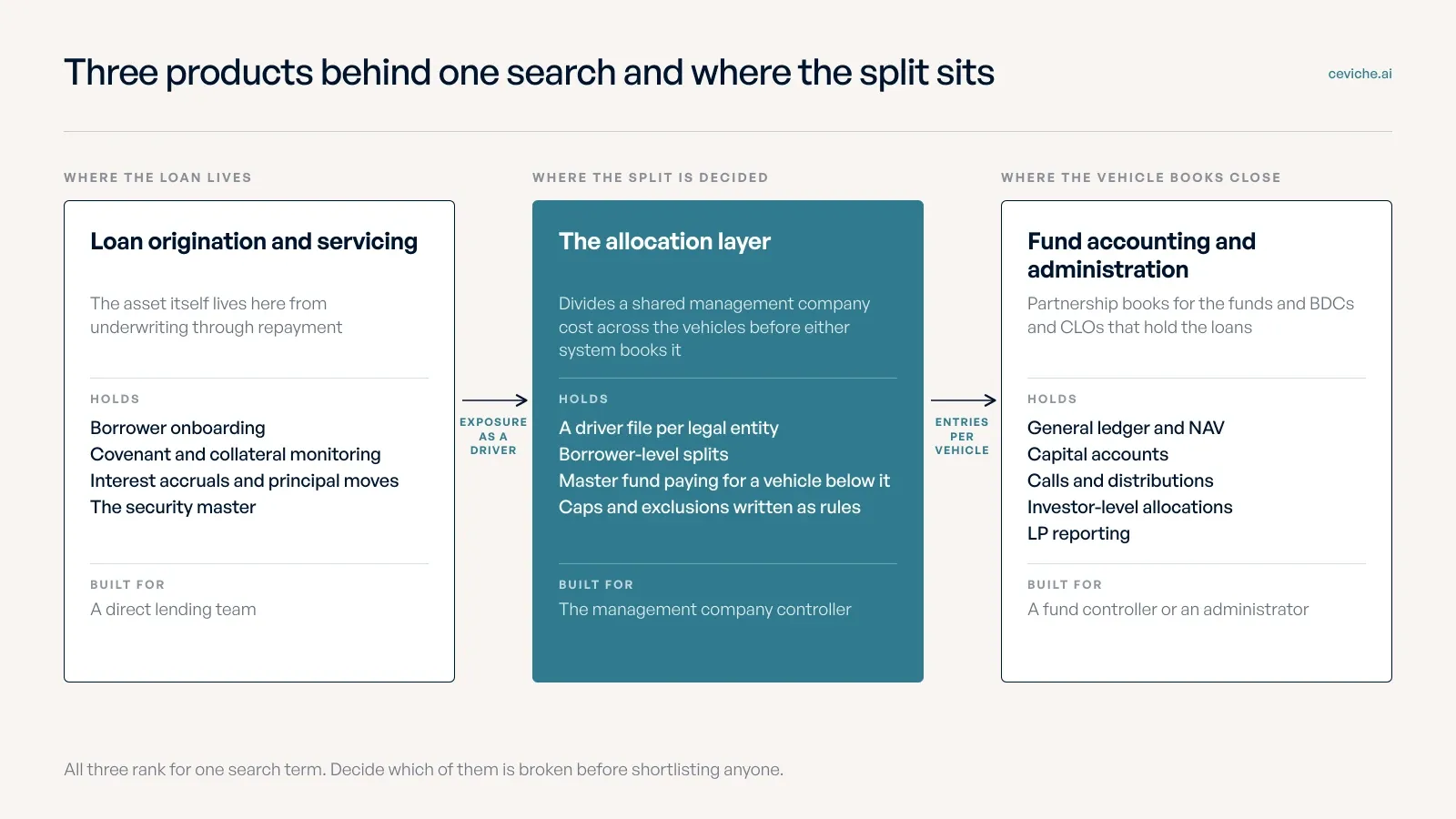
Fund accounting and administration for credit vehicles is the second, and it is what this page covers, across the funds, business development companies, collateralized loan obligation vehicles and separately managed accounts that hold the loans. Some of it is licensed as software you run and some is bought as a service, a fork covered below and in our wider guide to fund administration software. The equity-side shortlist sits in our guide to private equity fund accounting software.
The allocation layer is the third, and no result on this search names it. Before either system books anything, someone at the management company decides how a shared cost divides across dozens of vehicles, on drivers that are not committed capital, under caps that neither system holds.
What Makes Credit Different for a Back Office?
What separates a credit back office from an equity one is the shape of the entity complex and the drivers hanging off it, and no page ranking for this term describes either one.
A finance operations lead at a private credit manager running more than sixty entities walked us through her entity list, which runs to collateralized loan obligation vehicles standing alone, master-feeder groups three or four feeders deep over as many masters, a proprietary fund wrapped in a fund structure, business development companies, and third-party capital funds parceled out to outside administrators. Half that book closes monthly and half quarterly, on overlapping calendars, while fresh invoices arrive out of the management-company ledger every day of the week. Her summary of what that does to a back office was blunt.
"If you don't really know what you're doing, it goes bad really quick."
Committed capital carries most of the weight in equity and barely registers in credit. The same manager keeps two reference files, one holding assets under management per legal entity refreshed quarterly, the other a grid of which vehicles a given vendor may hit, and rules read both before splitting pro rata or evenly across a named subset. Valuation work is priced by borrower, not by fund, so it divides on borrower exposure, and where the borrower sits inside a special purpose vehicle the master fund one level up settles the bill. A chief financial officer at a bank-affiliated credit platform gave us a separate version of the same idea. His shared back office divides across the managers on funded assets under management, and every quarter someone pulls the vehicle-by-asset exposure out of the loan system by hand to do it. Loan data drives the allocation there. It is not loan accounting.
Caps are where credit turns hostile to generic tooling. The same manager listed what her system could not hold, which was a ceiling on organizational costs at one fund with anything above it absorbed by the manager, investors exempt from whole expense types under their own side agreements, categories capped at half for everyone, and co-investment accounts that take an allocation the firm has no legal standing to invoice. Her incumbent tool could only say yes or no to a whole invoice, so every partial rule lived in a spreadsheet beside it. The compliance failure follows from where the ceiling is measured. It counts against a category, so put a fee in the wrong category and it passes a ceiling that was written to stop it, leaving the fund holding a receivable that will never be collected. Of the 80 fund finance teams we spoke with in 2026, 96% named multi-entity allocation a core complexity and 92% were running it across systems that do not talk to each other. That sample is private equity and venture rather than credit, which is worth stating plainly on a credit page.
The money also moves differently. Anything tied to a credit facility skips the allocation entirely at that manager and is booked to the vehicle directly. Of what the management company does pay, roughly four fifths is covered by the management fee and never reaches a fund at all. The remaining fifth is fronted first and recovered afterwards, which hands the controller a quarter's worth of due-to and due-from balances to chase alongside the allocation itself.
Ceviche publishes this page and sells software in the expense allocation category, so read our own entry with that in mind.
See it on one of your own invoices. Ceviche pulls the invoice from Ramp, Bill.com, Expensify, Concur or Brex, applies the allocation methodology each LPA specifies per line, and writes audit-ready journal entries back into QuickBooks Online, NetSuite or Sage. Book a demo.
| Ceviche | Allvue | Juniper Square | Caruso | Alter Domus | FIS |
|---|
| What you buy | Allocation layer | Licensed platform | Software plus service | Software | Service | Service |
| Loan data native | No, used as a driver | Yes | Yes, notice to sub-ledger | Origination excluded on its page | Yes | Yes |
| Vehicles named on the page | Not applicable | Private debt, direct lending | Loan portfolios | Not named by vehicle | Direct lending, mezzanine, CLOs, BDCs, hybrids | Bank debt, structured credit, mezzanine |
| Who operates it | Your controller | Your team | Vendor staff | Your team | Vendor staff | Vendor staff |
| Writes to the ManCo ledger | Yes, QuickBooks Online, NetSuite, Sage | Not stated | Not stated | Not stated | Not stated | Not stated |
| Cross-entity expense allocation | Yes, per line by LPA | Not stated | Investor allocations only | Not stated | Not stated | Not stated |
Vendor details change. Every cell above comes from the vendor's own page as it read on 2026-09-03, and none of these vendors publishes prices.
Private Credit Fund Accounting and Administration Platforms
Every characterization below is quoted from the vendor's own page and linked at first mention, and where a page says nothing about a capability, we say so instead of inferring.
Ceviche (The Allocation Layer)
Ceviche is not fund accounting or fund administration, and it appears first because its job is the one every option below hands back to the management company.
For a credit book the allocation layer means a driver file by legal entity rather than a committed-capital table, borrower-level splits where the valuation invoice demands them, a hierarchy letting a master fund pay for a borrower vehicle beneath it, and rules that express a cap as something other than all or nothing. The one customer we can name here is Flybridge, a venture firm, so what it proves is that the workflow holds rather than that credit is our home turf. Its quarterly allocations across 18+ fund entities moved out of spreadsheets and onto Ceviche, on the Bill.com and QuickBooks Online stack it already had.
It fits a lean team at a manager that fronts costs and reimburses them from many vehicles. A reader shopping for loan accounting, interest accrual, NAV or investor reporting wants one of the platforms or administrators below.
Allvue
Allvue's private debt page opens on scale, noting that "many fund managers find themselves lacking the proper infrastructure and processes to scale their businesses". Its investment accounting module is described as a way to "Manage loan operations on a credit-native accounting system with AI-enabled loan notice processing and cash reconciliation automation", alongside portfolio management, research, investor and investment management, an investor portal, business intelligence, CRM and compliance, with a Private Debt Essentials package for managers who do not want the full suite on day one.
Allvue fits a credit manager running fund accounting in house with the capacity an enterprise rollout needs. Its page does not mention expense allocation between a management company and its vehicles.
Juniper Square
Juniper Square's private credit solution sells the join between the loan and the ledger. "Break down the walls between your loan portfolio and your general ledger. With a direct data flow from loan administration to fund accounting, you get a single source of truth for reporting and investor allocations." Loan activity moves "from notice receipt to directly posting to the sub-ledger in a controlled workflow", which is the join a credit manager on two systems is usually shopping for.
It fits a manager wanting the loan-to-ledger path handled by one vendor with people attached. Investor allocations are named on the page. Expense allocation between a management company and its funds is not.
Caruso
Caruso draws the category boundary most explicitly, covering the fund lifecycle from capital raising and investor onboarding through registry, compliance and ongoing administration, and pitching "the full capital lifecycle in one integrated system". Its customer logos are property and real-asset managers, which is an observation about its current base rather than a claim about credit capability, so ask for credit references.
Atominvest
Atominvest covers three modules for credit managers, investor relations, portfolio management, and fund accounting built on a "transaction ledger and reporting engine" driving investor-specific reporting plus bulk drawdown and distribution notices. It fits a manager wanting investor relations and middle-office operations on one system without an enterprise rollout, and the page carries no detail on expense allocation.
Relevant EquityWorks
Relevant EquityWorks sells "Private debt software powered by accurate, real-time fund data", and its named capabilities land closer to the partnership side than the loan side, covering "your debt fund structure, closings, capital accounts, and waterfall calculations" plus debt schedules, revaluations, dual-custody subscription approvals and an investor portal. It fits a mid-sized debt manager wanting fund structure and waterfalls in one place rather than an enterprise suite. Expense allocation across entities is not described.
Administrators Built for Credit Strategies
If you are buying a relationship rather than a license, this is your half of the market.
Alter Domus
Alter Domus makes the sharpest claim in the segment, stating that its model "was built for direct lending, CLOs, BDC, and hybrid structures, not repurposed from a private equity framework". It puts "6,500 experts across jurisdictions" behind multi-domicile and cross-border structures, and on conflicts its page states that "With no balance sheet exposure, we coordinate cleanly across lenders, borrowers, LPs, and the fund manager." It fits a credit manager with real jurisdictional spread or a hybrid book, and is heavier than a single-strategy domestic direct lender needs.
FIS Fund Services (Virtus)
FIS Fund Services publishes the most specific vehicle list on this search. Virtus "delivers comprehensive fund administration services, including portfolio accounting and fund accounting to investor servicing", for managers running "liquid bank debt funds, risk retention structures, hybrid debt funds, structured credit funds or closed-end funds such as direct lending, mezzanine and special situations". That list is the reason to shortlist it, since in our experience most administrators are strong on one of those shapes and inherit the rest.
SS&C plus CSC and eFront
SS&C sells "adaptable technology and servicing solutions" across private markets, and its public page is thin enough that the honest summary is scale rather than specifics. CSC states that "Whether funds are characterized as direct lending, mezzanine, or distressed, CSC has proven processes to support debt fund managers", adding loan agency to fund administration. BlackRock eFront covers private debt inside its alternatives platform, usually behind an administrator rather than licensed directly.
What Still Lands on the Controller's Desk?
The credit material here comes from managers we interviewed rather than from a survey, and the depth sits with one manager, a chief financial officer at a bank-affiliated platform, and an advisor building an allocation model for a manager with a business development company. Read it as a close look at a few books rather than a sample.
At that manager an allocation could travel for months before it came out the other end, and at no point could she see where a given invoice had got to. She summed the whole thing up in a sentence.
"This shouldn't be as hard as it is."
Two invoices out of one of her batches carry the arithmetic. An audit invoice of $87,000 covers three business development companies, is paid by the manager on their behalf, splits equally at $29,000 each, and each vehicle then reimburses the manager. A valuation invoice of $46,000 in the same batch splits by borrower rather than by fund, on exposure of $120M, $80M and $50M, which is 48%, 32% and 20% of a $250M total, so $22,080, $14,720 and $9,200. Two of those borrowers sit in special purpose vehicles beneath a single master fund, so that master pays $36,800 and the third vehicle pays $9,200. Neither invoice is loan accounting, and both need loan data to be allocated at all.
Multiply that by a queue that refills daily and the failure modes get mundane. Entities were being added at close to the same rate, the reference data behind the rules went in as spreadsheet uploads, and a sub-invoice sometimes sat in the queue after settlement and got paid twice, because at that volume nobody carries paid status in their head. In the same research, 81% of those teams were doing the work in Excel, and a credit book is the version of it carrying the most rules.
The audit trail is where this stops being an efficiency question. As a registered adviser she has to show, on short notice, how a given expense was divided and why, and what she asked for was deliberately unglamorous. She wanted to see who altered an allocation and on what date, and noted that this is table stakes in a small-business ledger. Nearly half the teams in the same research, 49%, had a gap in that allocation audit trail. Fee and expense allocation is a standing focus for the SEC's Division of Examinations, and what an examiner samples is the basis for a split rather than the entry recording it. The regulatory backdrop sits in our piece on the Private Fund Adviser Rule.
The credit platform CFO tied the two together. In his reading the only genuinely time-sensitive act is putting an expense in the right category when it is first coded, because from there on it is arithmetic, and his example was a $10,000 travel charge landing on seven vehicles that hold the same asset. That is also why a ceiling measured by category breaks so easily.
How to Choose Between Them?
Start with which of the three segments is actually broken. If loans are not being serviced correctly, no fund administration option fixes it, and if the books are fine but someone still opens a spreadsheet at quarter end to decide who bears what, an administration platform will not fix that either.
Then work out what your drivers are and whether the system can hold them. Borrower exposure, funded assets under management, a vendor-to-vehicle grid and an even split across a named subset are what break generic tools.
Ask whether the hierarchy is real, because a borrower vehicle can take an allocation that a master fund actually settles, and the system has to carry both facts.
Look at how caps and exclusions are expressed. A partial rule, an exempt investor, a category capped at half and a co-investment account that is allocated but never billed all have to live inside the rules, and if they sit in a spreadsheet beside the tool you bought half a system.
Check what the audit trail records, which is who set the split, on what basis, when it changed and where the document is, the standard set out in our guide to audit-ready fund expense allocation.
Weigh last what it takes to stand the thing up, because shortlists in this segment are decided by implementation capacity more often than by a capability. Where there is no budget or engineering time for a large deployment this year, a buyer needs something she can configure and keep running without anyone writing code, and most of the category falls away before a feature grid gets opened.
Ceviche fits when
Ceviche fits when a management company fronts costs for many credit vehicles, the drivers are borrower or funded assets under management rather than committed capital, caps and exclusions have to be expressed as something other than all or nothing, and there is no implementation budget for a platform migration this year. Ceviche sits on top of the ledger you already run and posts the entries back into it. It is not a fund administrator, a general ledger or a managed service, and it does not do the allocations for you. Loan accounting, interest accrual and facility administration sit outside it too, and shopping for any of those means shopping the platforms and administrators profiled earlier.
FAQ
What is the best loan servicing software for private lenders?
Loan servicing is a different product from fund administration, which is why both questions land on one results page. Servicing systems handle borrower onboarding, payments, covenants, collateral and the security master. Fund administration handles the partnership books of the vehicles that hold those loans. Shop them separately, and expect servicing to feed the fund side rather than replace it.
How does software represent business development companies, private funds and a proprietary fund as one entity complex?
As one legal-entity list with attributes rather than three systems. Each vehicle carries its type, reporting frequency, driver file and reimbursement path, and rules point at groups of vehicles rather than individual names. That is what lets a monthly business development company and a quarterly commingled fund share an invoice queue without a controller sorting them by hand.
Can an allocation to a borrower special purpose vehicle be paid by the master fund above it?
Yes, and for valuation invoices split on borrower exposure it is the normal case. The allocation records the vehicle bearing the cost, and a separate payment relationship records the entity that settles it, usually the master fund sitting above the borrower vehicle. Keeping those two facts apart is what makes the reimbursement balances reconcile later.
How many allocation rules does a private credit manager need to maintain?
More than an equity manager, and the count tracks vendors multiplied by vehicle groups rather than entity count. Ask a vendor what a large rule set does to both performance and maintenance, because a rule written once still needs updating every time a vehicle is added, and credit books add vehicles continuously. Settle in the demo whether rules point at groups of vehicles or at individual fund names.
How do you prevent an allocated invoice from being paid twice?
By holding payment status on the invoice itself rather than in someone's memory. One manager described sub-invoices sitting in the queue after settlement and going out again, which at daily volume is a data problem rather than a discipline problem. The control is one record per invoice carrying paid status, the allocation and the reimbursement against it.
Which tools support a monthly close cycle instead of a quarterly one?
Any tool where allocation runs continuously rather than as a quarter-end batch. Credit managers commonly run both cadences at once, business development companies monthly and commingled funds quarterly, so invoices have to flow in daily and allocation cannot be a scheduled event. Ask whether a mid-period rule change reprocesses cleanly or forces a restatement by hand.