Only two pages on this search are actually about funds of funds. Here is what the structure demands of an accounting system, and which products say they carry it.
TL;DR
A fund of funds allocates on two levels. Some costs split by each vehicle's own size, and deal costs split by each vehicle's commitment to the underlying manager. Test any product on whether it holds both drivers at once, lets you choose per invoice, and computes against the commitments as they stood in the period.
What Does Fund of Funds Accounting Software Have to Do?
The job splits in two, and most products on this search do only the first half well.
At the vehicle level it is ordinary private-fund partnership accounting, meaning capital accounts per limited partner, commitments, contributions, distributions, management fees, carried interest and statements under the investment-company model. A fund of funds makes none of that harder than a buyout fund does.
At the position level it is different work. Every investment is a commitment to another manager, so capital calls arrive on someone else's schedule, valuations come from the underlying general partner, and a second layer of fees and carry is charged below you that your own limited partners still expect to see. That layer is what makes this a segment, and it is also what decides how shared costs divide.
Two Levels to Every Allocation
Fund of funds accounting maintains the partnership books of a vehicle whose investments are positions in other private funds. It carries two allocation levels at once, the vehicle's own size relative to its sibling funds, and that vehicle's committed capital to each underlying manager, because different costs are properly driven by different ones.
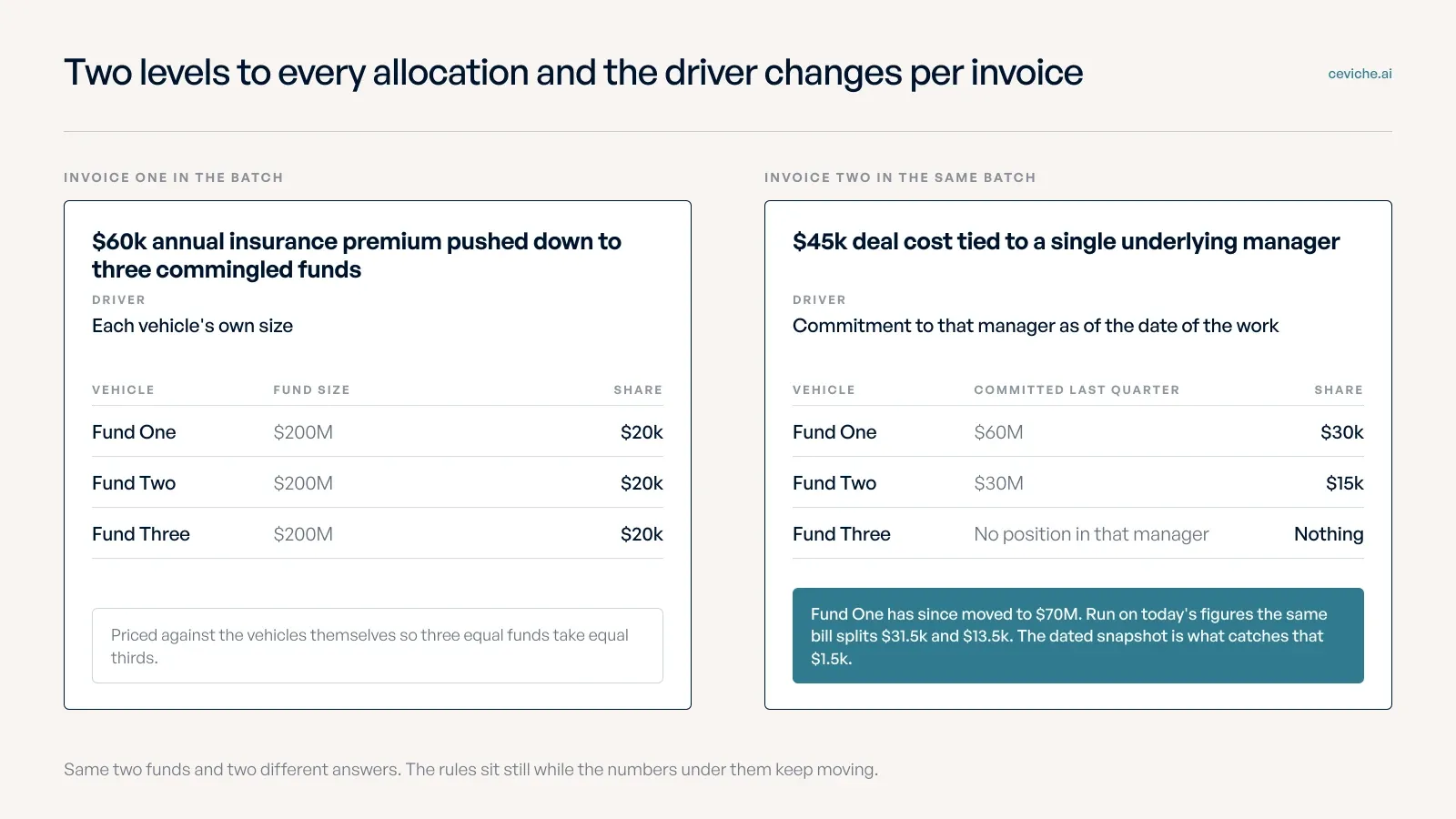
The clearest statement of the problem came from the person doing it. The vice president of finance at a fund-of-funds manager running more than 70 vehicles described it as two levels to everything. Put two $200 million funds side by side and an invoice priced against the vehicles themselves divides evenly between them. Put the next invoice, a deal cost tied to one underlying manager, against the same two funds and it can land seventy-thirty, because what is being measured is no longer the fund but the fund's stake in that manager. A system has to carry both measurements and let a person say which one governs the bill in front of them.
Two consequences follow, and neither shows up in vendor marketing.
The denominator moves. A firm that is always raising and always closing changes the numbers underneath its rules while the rules themselves sit still, and invoices cover stretches of time rather than instants, so the second measurement has to be taken as of the work rather than as of the day someone opens the allocation screen. In practice that means uploading commitments on a schedule and letting the system reach back to the right snapshot, which is what removes the fractional arithmetic people currently do by hand.
The commitment figures also rarely sit in an accounting system. At the firm we know best they live in the customer relationship platform the allocation spreadsheets were already exported from, and because they move only a few times a quarter the buyer talked himself out of a live connector and settled on an upload.
No vendor page scraped for this piece describes holding both drivers as a per-invoice choice. That is an observation about what is published rather than a claim about capability, and it is the first item for a demo agenda.
Four Things Called Fund Accounting and Which One You Want
This search returns four unrelated disciplines under one phrase, which is why the results feel scrambled. Nonprofit and donor-restricted fund accounting tracks money by restriction, and at least one page-one result sells exactly that to charities and schools. Government fund accounting tracks appropriations, and institutional investment accounting produces book values, income and net asset value across asset classes for insurers and pensions. Private-fund partnership accounting keeps capital accounts and allocations for limited partnerships, and it is the only one this page is about. The line between front-office and back-office products is drawn in our comparison of fund management software and fund accounting software, and the general selection criteria live in our guide to choosing a fund accounting system.
Ceviche publishes this page and sells software in the expense allocation category, so read our own entry with that in mind.
See it on one of your own invoices. Ceviche pulls the invoice from Ramp, Bill.com, Expensify, Concur or Brex, applies the allocation methodology each LPA specifies per line, and writes audit-ready journal entries back into QuickBooks Online, NetSuite or Sage. Book a demo.
| Ceviche | Allvue | Dynamo | FundCount | Entrilia | LemonEdge |
|---|
| Primary job | Allocation layer | Fund accounting platform | GL-based fund accounting | Real-time GL plus partnership | Fund accounting platform | Partnership accounting engine |
| Fund of funds named on its page | Not applicable | Yes, dedicated page | Yes, in its audience list | Not by segment | Not by segment | In its audience list only |
| Look-through stated | Not applicable | Not stated | Not stated | Not stated | Not stated | Yes, full look-through |
| Underlying commitment data | Periodic upload from your CRM | Not stated | Not stated | Not stated | REST APIs offered | Not stated |
| Two-level expense allocation | Yes, driver chosen per invoice | Not described | Not described | Not described | Not described | Not described |
Vendor details change. Every cell above comes from the vendor's own page as it read between 2026-09-01 and 2026-09-03, and none of these vendors publishes prices.
Fund of Funds Accounting Software in 2026
Everything said about the other products comes from that product's own page and is linked at first mention, and where a page is silent, the entry says so rather than filling the gap.
Ceviche (The Allocation Layer)
Ceviche does not keep partnership books and is not a fund accounting platform. It appears here because the two-level split sits between the ledger and the spreadsheet, and every product below leaves it there.
What it holds is two driver sets rather than one, vehicle sizes on one side and commitments to each underlying manager on the other, with the driver chosen per invoice and the second measurement taken against a dated snapshot rather than today's numbers. Driver data arrives on a schedule, which suits a denominator that moves a few times a quarter, and finished entries land in the ledger already in place.
The named proof here is a venture firm rather than a fund of funds, so read it as shape rather than segment evidence. Flybridge moved its quarterly allocations across 18+ fund entities out of spreadsheets and onto Ceviche, posting to the QuickBooks Online ledger it already ran.
It fits a finance team whose ledger question is either settled or a year from resolution and whose allocation is still done by hand. A team that needs the partnership books themselves wants one of the platforms below.
Allvue
Allvue's fund of funds page is the only real one on this search, and it opens on the operating problem rather than the product, saying that growth "often leaves them relying on manual and outdated portfolio management tools". Its claim is that the platform "is designed to manage the intricacies of fund of funds accounting", spanning back-office accounting, portfolio monitoring and investor reporting, with the accounting module described as "A complete back-office solution that combines detailed financial statement reporting, a true general ledger, cash management and workflow standards".
It fits a fund of funds wanting accounting, monitoring and investor reporting from one vendor, with capacity for an enterprise rollout. The page does not describe expense allocation between the management company and its vehicles.
Dynamo
Dynamo names the segment on its own page, calling its accounting product "the ultimate solution for private equity, venture capital, real estate, and fund of funds professionals". It describes itself as "GL-based fund accounting software that is flexible, trackable, dynamic", automating "back-office activities, including valuations, IRR computations, and waterfall allocations", with a report library covering US GAAP, ILPA and Invest Europe formats.
It fits a firm wanting a general-ledger-based platform with reporting standards out of the box, especially if the front office already runs on the same vendor. Two-level expense allocation is not described on the page.
FundCount
FundCount answers the vehicle-count problem by selling one posting engine instead of a chain of connected ones. Its "real-time general ledger posts directly from partnership and portfolio accounting", with "no batch jobs, no broken bridges between your accounting system and your investment platform, no spreadsheets in between", unifying partnership accounting, portfolio accounting and the ledger "inside a single posting engine" across trusts, limited liability companies, partnerships and feeders.
It fits an accounting-first team wanting the ledger as the authoritative record. Adopting it is a ledger migration, which is the cost to weigh.
Entrilia
Entrilia sells "Powerful dual-sided accounting, with intuitive event-driven automations tailored for private capital and other alternative asset funds", and it is unusually direct about structure and data access. The page describes setting up and visualizing "any complexity of entity structure" with automations for intercompany, consolidation, funds flow, equity pickup and performance calculations, and offers "RESTful APIs" so a firm can "replicate your existing processes and calculations". The programmatic interface is the reason to shortlist it if you have been burned by a file-upload workflow.
LemonEdge
LemonEdge earns a place for one capability it states in its own words, "Real-time full fund structure transactional processing and look-through", on top of "A full event-based partnership accounting system, supporting lot-level multi-currency, multi-ledger charts of accounts". Look-through is the fund-of-funds requirement most partnership engines treat as a reporting afterthought. It fits a team that wants to configure its own accounting logic, and independent detail on deployment is thin, so test it against your own structure.
BlackRock eFront
eFront covers fund administration and accounting across alternative asset classes, and its contact form lists fund of funds among the audiences it sells to, which is all the page evidences here. It fits large managers and administrators with systems teams.
The Adjacent Categories That Rank for This Term
Three page-one products are not fund accounting at all, and two are genuinely useful to a fund of funds anyway.
S&P Global's iLEVEL is portfolio monitoring, and its page says so, offering "fund of funds a real-time view of their private market portfolios" across "fund investments, co-investments and direct investments, in one place". What matters most here is its managed data service, where a team "collects and consolidates data from your GPs", capturing "capital calls, distributions, fund investment valuations, underlying fund holdings, portfolio company performance and operating metrics". That answers the data-collection half of the problem and none of the accounting half, which is the reason to run it beside a ledger rather than instead of one.
FIS Investment Accounting Manager is institutional investment accounting, described on its own page as "scalable and modular investment accounting software that supports an exhaustive range of investment types, asset classes and accounting methodologies". Limina publishes a guide to the same institutional category rather than a private-fund product page. Both are built for book values and net asset value across asset classes, a different discipline from partnership capital accounts.
What Still Sits Outside the Ledger?
The operating detail here comes from one fund of funds, in two calls and a written record, plus four secondary voices who are not fund-of-funds finance leads. It is one firm's shape described carefully rather than a survey, and we would rather say so than write it in the plural.
A fund-of-funds manager running more than 70 vehicles carries commingled multi-asset funds and single-purpose ones side by side, and a shared cost that the partnership agreements let the firm push down reaches most of them, which is a day of work at a time. Of the 80 fund finance teams we spoke with in 2026, 81% were still allocating in Excel, and 96% of the same teams named multi-entity allocation a core complexity. The general form of the vehicle-count problem sits in our ranking of the best multi-entity accounting software.
Legal bills were not handled with a spreadsheet macro. Someone printed the invoice, went at it with a highlighter, put the marked-up paper back through a scanner, and worked the allocation off that.
The two-level split looks like this in a single batch. An annual insurance premium of $60,000 gets pushed down across three commingled funds of $200 million each, so it splits by fund size into thirds, $20,000 apiece. In the same batch, a $45,000 deal-cost invoice covers diligence and legal work on one underlying manager. Fund Three has no position in that manager and takes none of it, so the split runs on Fund One's and Fund Two's commitments to that manager rather than on their own sizes. Today Fund One is in at $70 million and Fund Two at $30 million, which would be $31,500 and $13,500. The invoice covers work done in the prior quarter, when Fund One had committed $60 million and Fund Two $30 million, so the correct split is two thirds and one third, $30,000 and $15,000. That $1,500 difference is what the snapshot look-back exists to catch, and it is why a live feed of today's commitments is the wrong input.
The audit record is where a fund of funds gets exposed. What passed for approval at that firm was a paragraph typed up after the meeting recording that the expenses had been reviewed and cleared. No invoice ever went to a fund. The clause authorizing each charge survived as a comment inside a spreadsheet cell. The finance lead was not fooling himself about any of it.
"We just keep a record of everything in Excel, and I'm sure the SEC will love that when they come knocking."
Fee and expense allocation is a standing focus for the SEC's Division of Examinations, and what an examiner samples is the basis for a split rather than the entry recording it. For a fund of funds that means showing, per pushed-down cost, which vehicles bore it, which driver decided the share, the commitment or size figures on the relevant date, and the clause permitting the charge.
A chief financial officer with more than ten years inside a multi-strategy adviser counted four businesses under one roof there, the fund-of-funds arm sharing the building with direct venture, buyout and a secondaries product. Being one strategy among several is the common case, and it means these rules sit beside rules written for vehicle types that behave nothing like them.
How to Narrow the List?
The best selection criteria we have came out of a fund of funds that bought a dedicated allocation product, used it for six to eight months and went back to spreadsheets. The arithmetic was never the issue. What defeated the workflow, in his account, was the refresh described above, since driver data had to be re-cut into the shape a tool expected every time the numbers moved. The finance lead explained why that is fatal here.
"The rules don't change, but the numbers that underpin the rules change all the time."
So ask four questions and make each one concrete. How does driver data get in, and what happens when it moves weekly during a raise? Do the fields bend to your own deal and expense dates, or do you re-cut every export? Can another system talk to it, or only a person with a file? And does allocation run against a dated snapshot or against whatever today's data says?
Then ask the two-level question and make the demo show it. One invoice split by vehicle size, the next by commitment to a named underlying manager, run in front of you, with the commitment basis visible afterwards.
Sequencing matters more than it looks. The ledger decision and the allocation decision are usually both in play, and the ledger one starts earlier and runs longer, with go-live often sitting a year past the choice while the quarters keep arriving and the allocation still has to be done.
Ceviche fits when
Ceviche fits when your allocations run on two levels, the commitment data behind the second level lives outside the accounting system and moves a few times a quarter, and the split across your vehicles is built in a spreadsheet before either ledger sees it. Ceviche applies the driver you choose per invoice, computes against a dated commitment snapshot, and posts the entries into the ledger you run today. It is not a fund administrator, a general ledger or a managed service, and it does not do the allocations for you. Look-through reporting and collecting data from your underlying managers sit outside it as well, and if either is what you are shopping for, the platforms above are where to look.
FAQ
What is a fund of funds?
A fund of funds is a pooled vehicle whose investments are commitments to other private funds rather than direct positions in companies. Its limited partners get diversified exposure across managers and vintages through one subscription, and its books carry capital accounts, fees and carry at the vehicle level while tracking calls, distributions and valuations from every underlying manager.
How does the software hold both fund size and commitment to each underlying manager, and let us pick which drives an invoice?
By keeping two driver sets against the same vehicle list, one of fund sizes and one of commitments per underlying manager, and by attaching the choice to the invoice rather than hard-wiring it. Whoever codes the bill selects the set. A product that models only the vehicle level will still return a tidy-looking answer, and it will be the wrong one.
Does QuickBooks allow fund accounting?
Partly, and more firms run this way than admit it. In our experience a fund of funds often keeps the management company on QuickBooks while it evaluates fund platforms, because the platform decision runs longer than the next close. Class tracking can stand in for entities, and the split across vehicles and the intercompany leg are what firms end up building outside it, which is the gap covered in detail here.
Should we choose the fund general ledger first, or evaluate the general ledger and the allocation layer together?
Evaluate them together and expect to buy them apart. A platform migration runs in quarters, often a year or more to go-live, while the allocation work continues every close. An allocation layer that writes into your current ledger and can be repointed later fixes the manual part without waiting for the platform decision.
What does an examiner expect a fund of funds to show for an expense pushed down to a fund?
Per expense, the vehicles that bore it, the driver that decided each share, the size or commitment figures on the relevant date, the agreement clause permitting the charge, who approved it and when, and the invoice itself. A note in a spreadsheet cell citing the clause is real substance with no durable trail around it, which is the gap most firms find during a review.
What is the best fund accounting software?
It depends which of the four disciplines you mean, and this page covers only private-fund partnership accounting. If the fund-of-funds layer is one part of what you run, the wider shortlist sits in our ranking of private equity fund accounting software. For a fund of funds, start with which products name the structure on their own pages, then test the two-level split.