A management fee offset reduces the management fee by a set share of the fees the manager collects from portfolio companies. Worked examples show the percentages, the carryforward and the split across funds.
TL;DR
A management fee offset reduces the management fee that a fund pays its manager. The reduction equals a set share of the fees that the manager and its affiliates collect from portfolio companies. The LPA sets the share, up to 100%, the level that ILPA recommends. Some LPAs carry any excess offset into later quarters.
A management fee offset is a limited partnership agreement term that reduces the management fee a fund pays its manager by a set share of the transaction, monitoring, director and similar fees that the manager or its affiliates collect from the fund's portfolio companies. The offset keeps investors from paying twice for the same work.
The management fee pays the manager to find, buy and oversee companies. A transaction fee or a monitoring fee from a portfolio company pays the manager for part of the same work. ILPA's Principles 3.0 say that portfolio company fees "should be 100% offset against the management fee."
Some LPAs net these fees against the unreimbursed expenses of earning them. Under those LPAs, the offset depends on a record of which fund bore which cost, and Ceviche keeps that record for every split.
Which fees count toward the offset?
The LPA lists the fees. The usual list covers transaction fees on an acquisition and monitoring fees for oversight. It also covers director fees for board seats and advisory fees. Fees that affiliates of the manager collect usually count too.
The LPAs that the SEC quoted in a 2025 enforcement order covered "all transaction fees, advisory fees, monitoring fees or other similar fees." They counted those fees "net of any unreimbursed Expenses incurred in generating such fees." So the unreimbursed expenses of earning the fees came off before the percentage applied.
The percentage can also differ by fee type. A finance lead who runs the management company books at a private equity firm described this. The firm's transaction and monitoring fees each carry an offset percentage, and some fees are not offset at all. The work, in the lead's words, is "being fair to the fund and honoring the contracts."
ILPA asks for exemptions to be "rare, but clearly defined in the LPA." Two gaps recur in SEC exams and enforcement. The first is fees paid to an affiliate of the manager. The second is fees paid to operating partners. A 2014 SEC staff speech said that operating partners are not usually treated as employees or affiliates. In its words, "the fees they receive therefore rarely offset management fees."
What offset percentage is standard?
ILPA recommends 100%. Its Principles also address fees that are "not fully offset," and some LPAs set different percentages for different fee types.
The percentage decides who keeps the portfolio company fees. Take $1,000,000 of portfolio company fees against a quarterly management fee of $2,500,000:
- At 50%. The fee drops by $500,000 to $2,000,000. The manager keeps $500,000 of the portfolio company fees.
- At 80%. The fee drops by $800,000 to $1,700,000. The manager keeps $200,000.
- At 100%. The fee drops by $1,000,000 to $1,500,000. The manager keeps nothing.
How do you calculate a management fee offset?
The calculation has three steps:
- Compute the offset for each fee.
- Subtract the total from the gross fee for the period.
- If the LPA allows a carryforward, carry any excess into the next period.
Offset for one fee = (fee received minus the unreimbursed expenses that the LPA lets you net) x the offset percentage
Net management fee = the larger of zero or (gross fee minus offsets earned this period minus the carryforward in)
Carryforward out = the larger of zero or (offsets earned plus the carryforward in minus the gross fee)
Whether you net expenses, and which expenses, is an LPA term. Read the definition before you build the schedule.
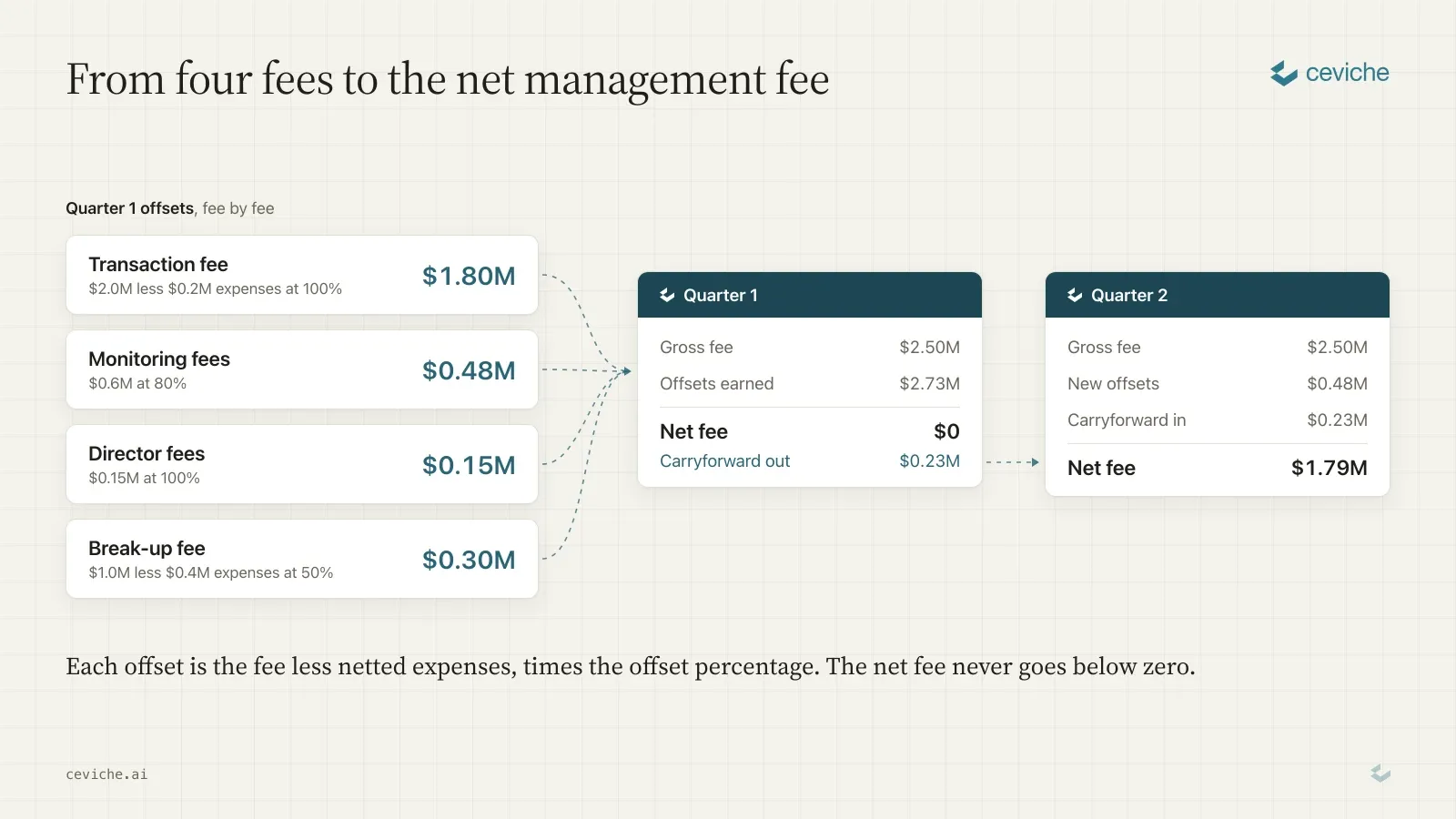
Fund II, an illustrative fund, has $500,000,000 of commitments and a 2% annual management fee on commitments, paid quarterly. The gross fee is $2,500,000 a quarter. In the first quarter, the manager collects four fees from Fund II's portfolio companies and from deal counterparties.
| Fee | Received | Expenses netted | Offset % | Offset |
|---|
| Transaction fee | $2,000,000 | $200,000 | 100% | $1,800,000 |
| Monitoring fees | $600,000 | $0 | 80% | $480,000 |
| Director fees | $150,000 | $0 | 100% | $150,000 |
| Break-up fee | $1,000,000 | $400,000 | 50% | $300,000 |
| Total | | | | $2,730,000 |
The offsets of $2,730,000 exceed the $2,500,000 fee. The net fee for the quarter is $0, and $230,000 carries into the next quarter.
In the second quarter, the companies pay $600,000 of monitoring fees. At 80%, that adds $480,000 of offsets. With the $230,000 carryforward, the total offset is $710,000. The net fee is $1,790,000. Over the two quarters, the offset took $3,210,000 off a gross fee of $5,000,000.
The offset changes what the fund owes the management company. Our guide to due to and due from balances shows how that balance settles between the two sets of books.
What happens when offsets exceed the management fee?
When the LPA allows a carryforward, the excess carries into later quarters. The carryforward can build after the investment period, because the fee can step down while monitoring and exit fees continue.
At the end of the fund, some offsets may never get used. ILPA addresses portfolio company fees "that cannot be offset." Such fees "should be distributed to LPs eligible to receive residual rebates at the end of the fund's life." The LPA decides who those LPs are and how the fund pays the rebate. Have fund counsel review those terms.
The SEC's 2023 private fund adviser rules would have required quarterly statements that showed each offset carryforward. The Fifth Circuit vacated those rules on June 5, 2024. Our page on the vacated private fund adviser rule covers what remains in force.
How is an offset split when several funds own the same company?
Split the fee before you apply any percentage. Each fund's offset can only come from its own share of the fee. The LPA's ownership terms set that share.
Take a $1,000,000 monitoring fee at 100% offset. Fund II owns 60% of the company, Fund III owns 25% and a co-invest vehicle owns 15%. Fund II's offset is $600,000 and Fund III's offset is $250,000. The co-invest share of $150,000 reduces no management fee, because in this example the co-invest vehicle pays no management fee.
The SEC found two errors in this step. Its 2020 risk alert found advisers that "incorrectly allocated portfolio company fees across fund clients, including private fund clients that paid no management fees." The 2025 order found a second error. The adviser cut each fund's share twice, first by invested capital and then by ownership. Across this error and the deferred-fee interest error below, the SEC found excess management fees of $502,041.
Our example shows the effect of a double cut. Suppose the adviser first splits the fee between the two funds only, by invested capital. In this example invested capital follows the 60% and 25% stakes, so Fund II gets 70.59%, or $705,882. Then the adviser cuts Fund II's share again by its 60% ownership. Fund II's offset falls to $423,529, which is $176,471 short. Fund III's offset falls to $73,529 instead of $250,000, a shortfall of the same $176,471.
A finance operations lead at a venture firm with more than one investment program faces the same question with director fees. The firm gives the fee to the program that invested first. If two programs invested at the same time, the firm splits the fee by each program's cost of investment. The firm keeps that policy and the splits in Excel. Our research on splitting shared costs across entities shows how that work grows with each new vehicle.
What else reduces the management fee?
Expenses over an LPA cap can also come off the fee. This is a different mechanism from the offset of portfolio company fees, and it applies only when the LPA provides for it.
A fund finance lead at a venture firm gave an example. The LPA caps organizational and fundraising expenses at $1 million. The fund already bore $999,999 when a $10 vendor invoice arrived. One dollar can go to the fund. The other $9 is still that type of expense, but the fund cannot bear it. Under their documents, the $9 becomes a reduction to the management fee.
A controller at a large venture firm described the same problem at a larger scale. A category has a $2 million cap and $1.8 million is already used. A new $300,000 invoice would put the fund $100,000 over. The team needs the running total before it books the invoice. Our guide to fund expenses versus management company expenses covers which costs the manager bears.
What do examiners and auditors check on offsets?
SEC orders and a staff risk alert show four ways an offset goes wrong:
- Fees routed to an affiliate. In 2015 the SEC found that one adviser's affiliate received $5.74 million in fees that "were not offset against the management fees."
- Accelerated monitoring fees. In 2015 three advisers in one group ended monitoring agreements early and took the future fees at once. They did not disclose that practice until after they took the fees, and they used some of those payments to offset management fees. The settlement also covered an undisclosed legal fee arrangement. It gave the advisers a larger discount than the funds received. The total was nearly $39 million.
- Interest left out. In the 2025 order, the adviser collected interest on deferred transaction fees. It "did not include such interest in the corresponding fee offsets."
- No tracking. The 2020 risk alert found advisers that "did not have adequate policies and procedures to track the receipt of portfolio company fees."
The SEC's fiscal 2027 exam priorities say examiners will look at "the accuracy of fee and expense calculations at both the fund and investment levels." A controller at a growth-equity firm said that examiners are "more than happy to give you a comment on $600." Auditors work differently. A venture finance leader who once ran fund finance at a registered adviser said this about a low-NAV fund.
"[A]nything except management fees is de minimis from an auditor's testing perspective."
The offset is part of the management fee, so it sits inside the one number that, in this leader's experience, auditors test. An offset record that an auditor can test has these seven parts for each fee:
- the amount and the date received
- the payer
- the LPA clause and the percentage
- the ownership split
- the expenses netted
- the carryforward it feeds
- the approver
An offset that nets expenses depends on the fund's expense allocation records. Of the 80 fund finance teams we spoke with in 2026, 49% (39 of 80) had a gap in their allocation audit trail. Our article on what SEC examiners ask about expense allocation covers the exam process in more detail.
Where does Ceviche fit?
Ceviche reads each vendor invoice and applies the rules your team approved, and every split keeps the quarter's basis numbers it used. Ceviche sets guardrails from your LPA, including expense caps. Costs that the funds should not bear can stay with the management company.
Frequently asked questions
Do portfolio company fees paid to the manager's affiliates count toward the offset?
It depends on the LPA. If its definition includes affiliate fees, they count. A 2014 SEC staff speech said that most LPAs require fees from employees or affiliates of the adviser to offset the fee. Read the definition for "affiliates" and "operating partners." ILPA also asks that any fee an affiliate of the manager generates go to a majority of the LPAC for review and approval. Fees outside the definition do not reduce the management fee.
Are fees offset before or after unreimbursed expenses?
The LPA decides. Some agreements count fees net of the unreimbursed expenses incurred to earn them. Under that wording, a $1,000,000 break-up fee with $400,000 of unreimbursed expenses counts as $600,000. Other agreements count the gross fee. The LPAs that the SEC quoted in its 2025 order counted fees "net of any unreimbursed Expenses incurred in generating such fees."
What happens to unused offsets at the end of the fund?
The LPA decides what happens to a balance left at the end of the fund. Before then, when the LPA allows a carryforward, the excess moves into the next quarter while the fund pays a fee. ILPA says that fees that cannot be offset should go to LPs eligible for residual rebates at the end of the fund's life.
How are fees paid in stock offset?
ILPA's Principles say that fee income paid in kind should count at its fair market value. ILPA also gives a timing rule for a payment with no fair market value. That payment should be offset "as soon as the security becomes marketable or at the end of the life of the fund, whichever is first." The LPA sets the actual terms, so check how it treats securities and options received for board service.
Is the 2% management fee charged annually?
The rate is annual, but managers often bill it in quarterly installments, in advance or in arrears. A 2% fee on $500,000,000 of commitments is $10,000,000 a year, or $2,500,000 a quarter. The fund applies offsets against each installment, and any excess carries into the next one.
