Almost every Juniper Square alternatives list is about real estate investor portals. This one is about the fund administration half, and what an alternative has to do with the fund books.
TL;DR
Juniper Square is two products sold together, an investor management platform and an administration service run by its own accountants. Replacing the first is a software decision. Replacing the second is a decision about who your accountants work for. Work out which half broke before you read anyone's shortlist, including this one.
What Does Juniper Square Actually Sell?
Two things, and the alternatives question changes depending on which one you mean.
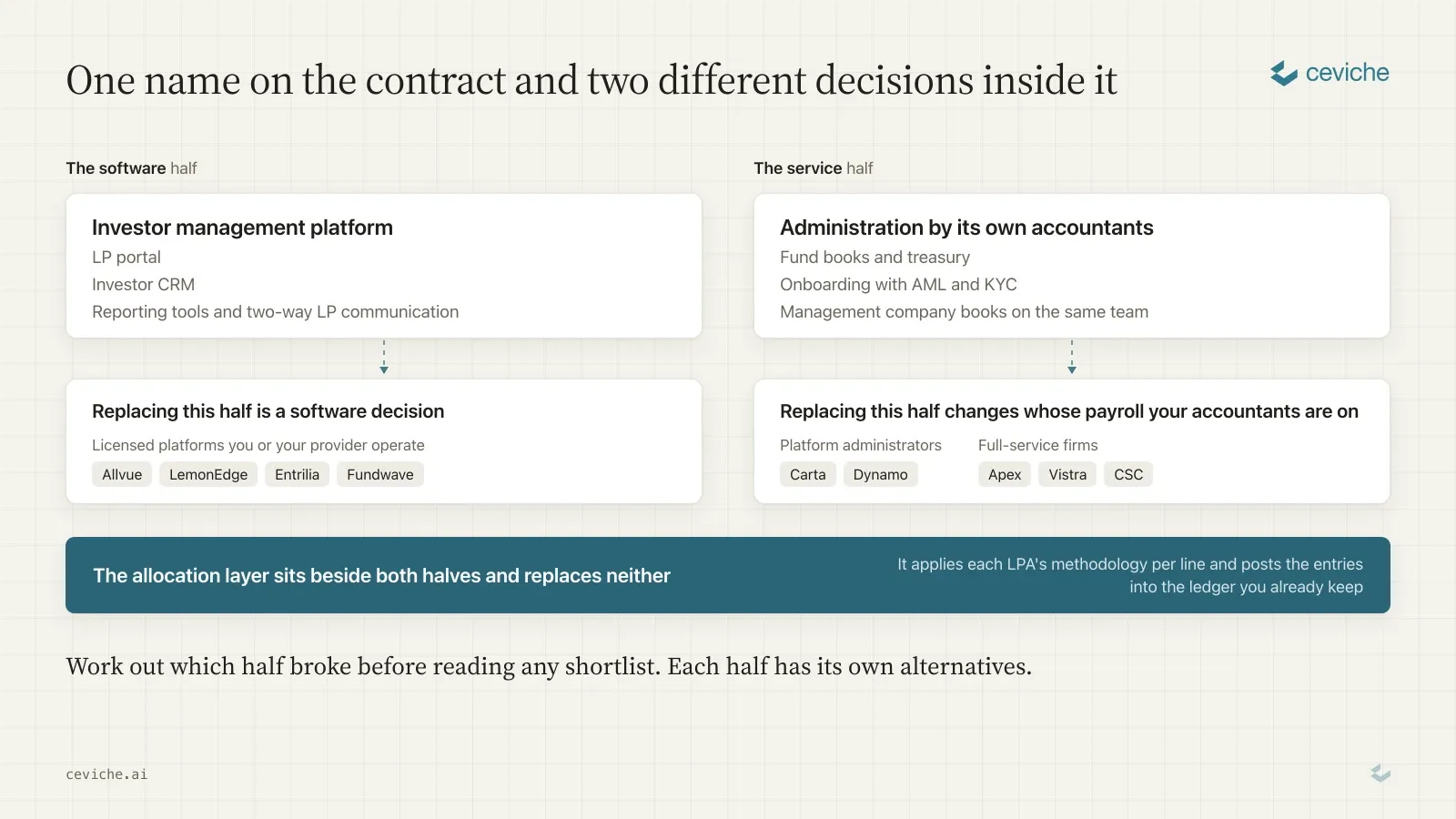
The software half is investor management. Juniper Square's administration page claims a portal used by "over 650,000 LPs with over $1T of equity", and that reach is the strongest thing on the site.
The service half is administration, delivered by Juniper Square's own accountants, and its own administration page offers "to support everything from SMAs to large, global, cross-jurisdictional funds for over $200B of assets", with fund accounting, treasury, investor services, onboarding, AML and KYC, private credit loan administration and management company accounting all named as service lines. One sentence in that list carries more weight than the others, an offer to "outsource your fund financials and complex allocations to our expert team", and management company books are sold on the same basis, staffed by the people already handling the funds.
A number beats the feature list here. The same page states "We maintain a 94% annualized retention of our fund accounting and investor services staff", which is as close as anyone in this category comes to promising the same faces will be on your account next year.
Fund management software covers the front-office and investor-facing systems a private fund runs: deal pipeline and CRM, portfolio company monitoring, valuation tracking, fundraising and investor relations, the LP portal, and reporting to investors. It manages relationships, positions, and information rather than the general ledger.
Fund administration is the outsourced service a GP buys to run a fund's middle and back office. It covers fund accounting plus investor servicing and onboarding, capital calls and distributions, the investor register and reporting package, AML and KYC checks, and support for audit, tax, and regulatory filings.
Those definitions carry the whole argument here, and fund administration versus fund accounting is where we set them out at length.
Why Are Most Juniper Square Alternatives Lists About Real Estate?
Because most comparison writing treats Juniper Square as a real estate investor portal. One alternatives list recommends real estate investor portals, a ratings site recommends property investment managers and syndication tools, several other lists are commercial real estate outright, and the one substantive editorial page written for fund managers is aimed at syndicators.
The association has a real basis. A finance chief who runs both venture and real estate vehicles told us he keeps the real estate funds with Juniper Square because his venture administrator could not support them, and that the real-estate-focused administrators he looked at were older school, still issuing statements as documents.
It is also incomplete. Juniper Square's own private equity page sells "pairing a modern fund administration solution with best-in-class fundraising and investment management technology", and its administration page names real assets, private equity, private credit and venture capital. A GP running venture or buyout funds is asking a question those lists have not answered.
Four Kinds of Juniper Square Alternative
The first is another platform administrator, where the software and the accountants come from the same company. Carta and Dynamo sell that shape.
The second unbundles it. You license software and either you or your provider operates it, which turns one decision into three, the portal, the ledger and the people. Allvue, LemonEdge, Entrilia and Fundwave sit here, and our review of fund management software covers the front-office half if that is the piece coming out.
The third buys people. A full-service administrator puts the technology behind the team rather than in front of it, and several of them run the very platforms from the second category on your behalf. Apex, Vistra and CSC belong in this group.
The fourth leaves the administration relationship where it is and moves only the layer that failed. None of the alternatives lists offers it as an option, though an allocation layer and an administration platform sit alongside each other rather than in place of each other, so for a lot of readers it is the honest answer.
One question cuts across all four, and it is where the commitment registry lives. Who committed what to which vehicle sits inside the administration platform, so anything allocating on commitment sits downstream of that registry, and part of choosing an alternative is asking how that data gets out. Ceviche publishes this page and sells software in the expense allocation category, so read our own entry with that in mind. Provider claims here are lifted from each provider's own site rather than from a ratings page, linked on first mention.
See it on one of your own invoices. Ceviche pulls the invoice from Ramp, Bill.com, Brex, Expensify, or SAP Concur, applies the allocation methodology each LPA specifies per line, and writes audit-ready journal entries back into QuickBooks Online, NetSuite, or Sage Intacct. Book a demo.
| Option | What you get | Who keeps the fund books | Investor portal | Management-company books | Expense allocation, as published |
|---|
| Juniper Square | Software and a service team | The provider's accountants | ✓ | Sold as its own service | Outsourced to its team |
| Platform administrators | Software and a service team | The provider's accountants | ✓ | Not described on Carta's page | Carta publishes card-spend splits between funds |
| Licensed software | Software you run yourself | You, or your provider | ✓ | Allvue sells a Corporate Accounting module | Fundwave publishes an Allocate module |
| Full-service administrators | A team, technology behind it | The provider's accountants | Varies by provider | Apex sells it separately | Not mentioned on the pages we checked |
| Ceviche | One workflow, nothing else | Unchanged | ✕ | Reads and writes the GL you run | Per line, by LPA methodology |
Vendor details change. Every cell above comes from the vendor's own page as it read on 2026-09-03, and none of these vendors publishes prices.
The Juniper Square Alternatives Reviewed
Carta
Carta is the nearest like-for-like swap for a venture or emerging manager, bundling the portal and the accountants the same way. The fund administration page leads with the LP experience, one place for investors to sign subdocs, fund capital calls and read their own performance, backed on the GP side by real-time net and deal IRR, TVPI and DPI. Agents run cash reconciliation, tax monitoring and schedule-of-investments tagging around the clock, and a Ramp integration carries card spend from swipe toward the ledger.
Its allocation claim is specific and narrow. The Ramp integration page offers to "minimize errors with categorization rules and expense allocations", with the categorization and the splitting both scoped to card transactions landing in Carta's own ledger. The fit is a VC or emerging PE manager wanting cap table, administration and tax in one place, and a manager already on Carta who wants the administration without the bundle will find the field laid out in our Carta fund administration alternatives guide. The misfit is a real estate sponsor, which is precisely the reader Juniper Square serves best.
Dynamo Software
Dynamo turns up on the ratings pages' own Juniper Square shortlists, and it earns the spot for reasons that have little to do with portals. Dynamo's fund accounting page covers general ledgers for main funds, co-investment vehicles, SPVs, alternative investment vehicles and general partner entities, capital activity reported quarterly, year to date and inception to date, gross and net IRR across various dimensions, and a report library aligned to US GAAP, ILPA and Invest Europe. Its Excel integration is a genuine differentiator for a preparer who wants to see the formula behind a number rather than take it on trust.
Buy it when Dynamo is already the front office. Putting the books on the same data platform as the deal flow and the LP records removes an entire reconciliation between two vendors.
Allvue
Allvue answers the GP whose complaint is the accounting rather than the portal, and the administrator shopping for a platform to run a client book on. Its investor portal automates investor notice generation and distribution, lets you brand the investor dashboard, and ships with out-of-the-box configurability aimed at quick implementation, with LPs getting self-service reporting and per-investor delivery preferences.
What sets Allvue apart on this list is a module called Corporate Accounting, sold as management company accounting for private equity, venture capital and private debt GPs. That is a real answer to the seam this page keeps returning to, delivered at enterprise weight. Firms with the people and the runway for that rollout get a great deal from it. A three-person finance team gets a project.
LemonEdge
LemonEdge speaks to the reader whose real problem sits under the portal. Its fund administration page runs parallel GL types out of the box, IFRS beside local GAAP, which is the answer for anyone carrying onshore and offshore vehicles under different standards, and it offers a white-label investor portal plus Canvases that copy the entire live system so a scenario can be modeled before a client instruction lands. A data-isolation model keeps multi-office providers' client books apart from one another.
The buyer it is written for is a service provider carrying many client books, and there is a self-hosted install for firms with jurisdictional data requirements. Bought directly, it suits a GP prepared to run a partnership accounting engine in-house, which is not the firm comparing investor portals; how it stacks up against the other ledger platforms is worked through in our LemonEdge alternatives guide.
Entrilia
Entrilia competes for the same decision from the software side, a ledger and an investor portal bought as one thing and operated by the manager rather than by a provider. Its fund accounting page leads with "powerful dual-sided accounting, with intuitive event-driven automations tailored for private capital and other alternative asset funds", with reversing entries, ledger locks and entry approval workflows on the control side, and "using our RESTful APIs, you can replicate your existing processes and calculations" for a firm carrying logic it refuses to abandon.
That extensibility is the draw for a team that wants an engine built recently rather than one worked around, and the cost of it is that operating the engine becomes your job rather than a provider's.
Fundwave
Fundwave is the lightest thing here and the only one that volunteers anything about how it charges. Its own page puts fund administration, portfolio, dealflow and an investor portal in one product, with a four-eyes approval check and role-based access for firms answering to a compliance regime, custom reporting templates a user can build without a database specialist, and an Allocate module offering to "improve your efficiency by automating even the most complex allocations". Commercially it advertises transparent pricing and prints no number. The natural owner is a manager on their first fund with a vehicle or two beside it, comfortable running software instead of hiring a service. Room runs out once vehicles multiply faster than headcount.
The Full-Service Administrators
If what you want is more people rather than better software, this is the category, and comparing its members is a service comparison.
The useful fact about Apex Group for a reader on this page is the technology list on its own site, which names eFront, Investran and Allvue among the platforms it delivers on, which makes the software question and the provider question two questions rather than one. Vistra says the quiet part out loud, offering to "design a co-sourcing model that works for you" when a manager arrives holding technology it intends to keep rather than surrender. For the provider-by-provider ranking, including the platforms each administrator runs underneath, the fuller treatment is our fund administration software comparison.
A venture CFO who spent years inside a fund administrator described the trade plainly, that this category wins on people and gives ground on software.
Ceviche
Ceviche is the fourth category, and it replaces nothing else on this page. It sits above whatever platform and provider you keep, and its whole job is the split, with the basis behind each line traveling alongside the entry.
Most of that work never reaches a platform at all. Of the 80 fund finance teams we spoke with in 2026, 81% built the split in a spreadsheet. Flybridge used to split those costs across 18+ fund entities in spreadsheets. The split now runs through Ceviche, with Bill.com and QuickBooks Online left exactly where they were.
What Does an Alternative Have to Do With the Fund Books?
A fund-of-funds manager running more than 70 vehicles had two platforms on the table for its general ledger and investor portal when we first spoke.
I am eighty-five percent confident we are going to make a change. I just don't know what the change is going to be to yet.
By the next time we spoke, they had chosen a new general ledger and investor portal, and their expense allocation was still almost entirely in Excel.
That is not a criticism of the platform. It is the point. The ledger decision and the allocation problem were two projects, and choosing the first did not start the second. 96% of the teams in our multi-entity research call that complexity a core problem, and 92% are running the allocation across systems that do not talk to each other, which stays true whether the fund books live in a spreadsheet, a fund-native ledger or a provider's platform.
Read the published scope of the options above and the same pattern appears. Juniper Square answers allocation with people, offering to take your complex allocations on. Fundwave publishes a module. Carta publishes card-spend splits inside its own ledger. Allvue's fund administrator page does not use the word, and LemonEdge's uses it once, for GP allocations inside its Algorithms feature. Each is a description of what the vendor publishes, and none of them decides which fund bears which share of an invoice that arrived this morning.
The Work That Stays With Your Team on Every Option
The platform itself supplies the structural argument. At that same firm the investor portal subscription is one of the buckets allocated out across the funds and reimbursed to the management company afterward, so the platform you are shopping for is an allocated expense before it is anything else.
The administration fee behaves the same way, and the entry count is what makes it expensive. Take a hypothetical engagement of $126,000 a year covering six vehicles, three funds and three SPVs, where the engagement letter prices an SPV at half the work of a fund. The fee divides into three full shares and three half shares, so a full share is $28,000, each fund bears $28,000 and each SPV $14,000, which is $84,000 and $42,000 against the $126,000 invoice with nothing left over.
Now count the entries. The management company pays the one invoice, so there is a payable and six due-from balances on the management-company side, six matching due-to balances on the vehicle side, and six internal transfers once the reimbursements are approved. One fee, thirteen journal entries and six bank transfers, before anyone has touched a deal expense. Every other shared cost on the ledger repeats the pattern with its own denominators.
Your administrator will post all of it once you hand it over. Deciding it, documenting why the split is what the LPA allows, and rebuilding the ratios after every close stays on your desk whichever provider is on the other end.
How Do You Choose Without Locking Yourself In?
Two finance leads gave us the same rule from opposite directions, and it is the most useful selection criterion we have heard. One, expecting to change both his fund ledger and his management-company ledger, said anything he added now had to be vendor-agnostic and integrate with whatever came next. The other, standing up a new firm with an outside administrator, described co-sourcing in a single sentence.
Rather than the admin owning the license to the GL, the manager owns it. I have access to my full GL rather than just outputs from my fund admin, and if I ever wanted to switch fund admin, the transition would be a lot easier because I own all my information.
The rest follows from it. Settle what leaves with you in year three and in what shape. The commitment registry deserves the closest look of anything in the record, because it is the input every allocation runs on, and an API that reaches the reporting pack but not the registry leaves you re-keying the one thing you cannot afford to get wrong. Management company books are the third item to pin down, since one provider will staff them, another will sell software for them and several will not mention them, which describes scope rather than quality. Then choose the order on purpose. Ledger and portal first is defensible, and it is what the fund of funds above did, as long as you know what it leaves undone and schedule that rather than assume it away.
Ceviche fits when
Ceviche fits when the provider and the ledger are both settled, the vehicle count has run past what a spreadsheet handles, and two to five people are still building the shared-cost split in a spreadsheet each quarter. It is not a fund administrator, a general ledger or a managed service, and it does not do the allocations for you. When the portal or the provider relationship is what broke, the answer is one of the four categories above and it is not this. The product walkthrough shows what comes out the other side.
Frequently asked questions
How much does Juniper Square cost?
Prices are not published, here or almost anywhere in this category. Scoping happens inside a sales process, and the levers a buyer actually controls are vehicle count, LP count, which of the administration services are in scope, and whether management company books come along. Find out which of those are metered before you put two proposals next to each other.
What is Juniper Square used for?
Two jobs sold as one purchase. On the software side it runs investor management, which means the LP portal, the investor CRM and the reporting around them. On the service side it runs administration, staffed by its own accountants and covering the fund books, treasury, investor servicing, onboarding, compliance screening and the management company. Firms buy both, so replacing it is two decisions rather than one.
Is Juniper Square a CRM?
It includes one. The CRM is a component rather than the product, which is why comparing Juniper Square against a standalone CRM misses most of what a GP buys and all of the administration half.
Should we replace the general ledger and investor portal before fixing expense allocation, or after?
Ledger and portal first is defensible and it is the common order, as long as the allocation work goes on the calendar as its own project rather than being folded into the rollout. The trap is a mid-year go-live, because a new ledger and a fund closing in the same quarter split the year into two allocation periods on two different systems.
How do we avoid locking into one vendor's data model?
Buy things that are agnostic about what sits either side of them, and check who owns the general ledger license. Co-sourcing, where the manager holds the license and the administrator operates it, turns a future provider change into a data-access question rather than a migration. Confirm API scope for the commitment registry before you sign.
Can we keep Juniper Square and change only the allocation layer?
Yes, and where the portal and the provider are both working it is usually the cheaper move. The layer takes the invoice in, computes each line on the basis the LPA sets, and posts completed entries to the ledger you already keep, so your provider receives a documented breakdown instead of a workbook. Nothing migrates, and the relationship carries on exactly as it did.
