
TL;DR
A limited partnership agreement (LPA) is the contract that sets the terms of a private fund and governs it for its whole life. It binds the general partner and every limited partner. It sets the commitments, the management fee, the carried interest, the governance rights and the list of expenses that the fund may bear.
The expense sections of an LPA set the limits for fund expense allocation. Ceviche applies the rules that your team approved once, according to your LPA and expense policy.
A limited partnership agreement is the contract between a fund's general partner and its limited partners. It sets how capital comes in and goes out, what the manager is paid, who decides what, and which costs the fund pays instead of the manager.
What does a limited partnership agreement do?
When a fund is a limited partnership, the LPA is the agreement among its partners. ILPA's model LPAs use Delaware law. Section 17-101 of the Delaware Revised Uniform Limited Partnership Act defines a partnership agreement. It is any agreement "of the partners as to the affairs of a limited partnership and the conduct of its business." A partner is bound by it "whether or not the partner ... executes the partnership agreement," under the same section.
Delaware law lets the partners write their own terms. Delaware's act states a policy "to give maximum effect to the principle of freedom of contract," under 17-1101. So the answer to most questions about a fund is in its own LPA, not in a statute. Federal tax law also looks to the LPA. Under 26 U.S.C. 704(a), the partnership agreement determines each partner's distributive share, subject to the other partnership tax rules.
ILPA released a whole-of-fund model LPA in October 2019 and revised it in July 2020. The section numbers on this page come from that model.
Who signs an LPA and what does each party do?
The general partner (GP) manages the fund. The limited partners (LPs) commit capital and do not run the business. Under 17-303(a), an LP is not liable for the fund's obligations. The exceptions are an LP that is also a GP and an LP that "participates in the control of the business." That second LP is liable only to persons who transact business with the fund "reasonably believing ... that the limited partner is a general partner."
The ILPA model has a third signatory, the fund manager. The GP delegates its powers to the fund manager, which receives the management fee. The GP also commits its own capital. The ILPA model leaves that percentage blank for the parties to fill in. ILPA's Principles 3.0 say the GP commitment "should be contributed in cash" rather than through a waiver of management fees.
A limited partner advisory committee (LPAC) of investor representatives gives consent on some decisions, such as the first term extension. Section 13.2.1 says that LPAC members "shall take no part in the management or control" of the fund.
What economic terms does an LPA set?
In the ILPA model, five terms set most of the economics:
- Commitments. Each LP agrees to contribute up to a set amount over the life of the fund.
- Capital calls. When the fund needs cash, the GP draws the commitments through capital calls.
- The management fee. The ILPA model charges the fee on commitments during the commitment period. After that, it charges the fee on invested capital, less the cost of investments that were sold or written off.
- The distribution waterfall. The model returns contributed capital first and then pays a preferred return. Next comes a GP catch-up, and then the GP and the LPs share the profits.
- Carried interest and clawback. The GP's share of profits is the carried interest. A clawback makes the GP return carry that it received in excess of its share.
The model leaves the numbers in brackets as drafting placeholders, such as an [8]% preferred return and a [20]% carry. These are not market data. Each fund negotiates its own.
What governance terms does an LPA set?
The ILPA model sets a commitment period that runs from the first close to the [fifth] anniversary, with a possible one-year extension. It sets a term to the [tenth] anniversary of the first close, with up to two one-year extensions. The first extension needs LPAC consent, and the second needs a majority in interest of the LPs.
If a named key person stops devoting the required time to the fund, the key person clause suspends the commitment period. If a majority in interest of the investors does not approve a remediation plan or waive the suspension within [ninety (90)] days, the period ends. Most amendments need the GP and 75% in interest of the LPs. The GP also reports to the LPAC each year on the management fee, the carried interest and the other fund expenses.
How do side letters and MFN clauses change an LPA?
A side letter is a separate agreement between the GP and one investor. It can grant that investor different rights. The ILPA model lets the GP enter side letters, but the GP must notify every LP of the terms after the final close.
In the ILPA model, a side letter can give one LP more favorable rights. Every other LP then gets the benefit of those rights, with four listed exceptions. This is the most favored nation (MFN) process. The model counts "the costs of compliance with a 'most favored nations' process" as organizational expenses. ILPA's Principles 3.0 add that a cap on organizational costs "should take into account the costs associated with negotiating side letters."
How is an LPA different from a PPM?
The private placement memorandum (PPM) is the offering document. It describes the fund, the strategy, the terms and the risks to prospective investors. The LPA is the binding contract that the partners sign. SEC examiners check what an adviser does against both. A 2022 SEC risk alert lists LPAs, operating agreements, PPMs, due-diligence questionnaires and side letters together as "fund disclosures."
What does an LPA say about fund expenses?
The ILPA model divides costs into two lists, which separate fund expenses from management company expenses. The first list is the fund expenses that the fund pays. The second list is the costs that the GP or the fund manager pays. The ILPA model itemizes 14 categories of fund expenses in section 2.5.1. They include diligence costs, "including broken deal expenses to the extent not borne by potential co-investors," and "reasonable premiums for liability insurance." Under section 2.6, the GP pays the "normal operating expenses" of the fund's investment activities. These include staff salaries and the cost of Form ADV and Form PF filings.
Broad wording causes trouble. In a 2014 speech, the head of SEC examinations described the problem. "Many limited partnership agreements are broad in their characterization of the types of fees and expenses that can be charged to portfolio companies." In a 2020 risk alert, SEC staff found advisers that charged funds for expenses "not permitted by the relevant fund operating agreements."
The LPA lists what the fund may pay. The team still chooses what to charge. A fund accounting lead at a growth-equity firm described how the team works from it.
"We read the LPA and then we kind of set parameters based on that language. And so, you know, to be as conservative as possible, there's a lot that we won't bill back."
That team skips charges under $25 and categories such as minibar and laundry. A defined term can also split one trip. At another growth-equity firm, the LPA makes travel costs reimbursable, and its definition of travel leaves out meals. So the team checks each trip line by line and moves the meals to the management company. A fractional CFO for an emerging private equity manager made a similar decision on insurance. The LPA lets the fund bear the full premium, but the GP put 20% of it on the management company. In that CFO's words, "today it's just we're making these judgment calls and, like, documenting it, and then we'll apply going forward."
Where do you look in your LPA to allocate an expense?
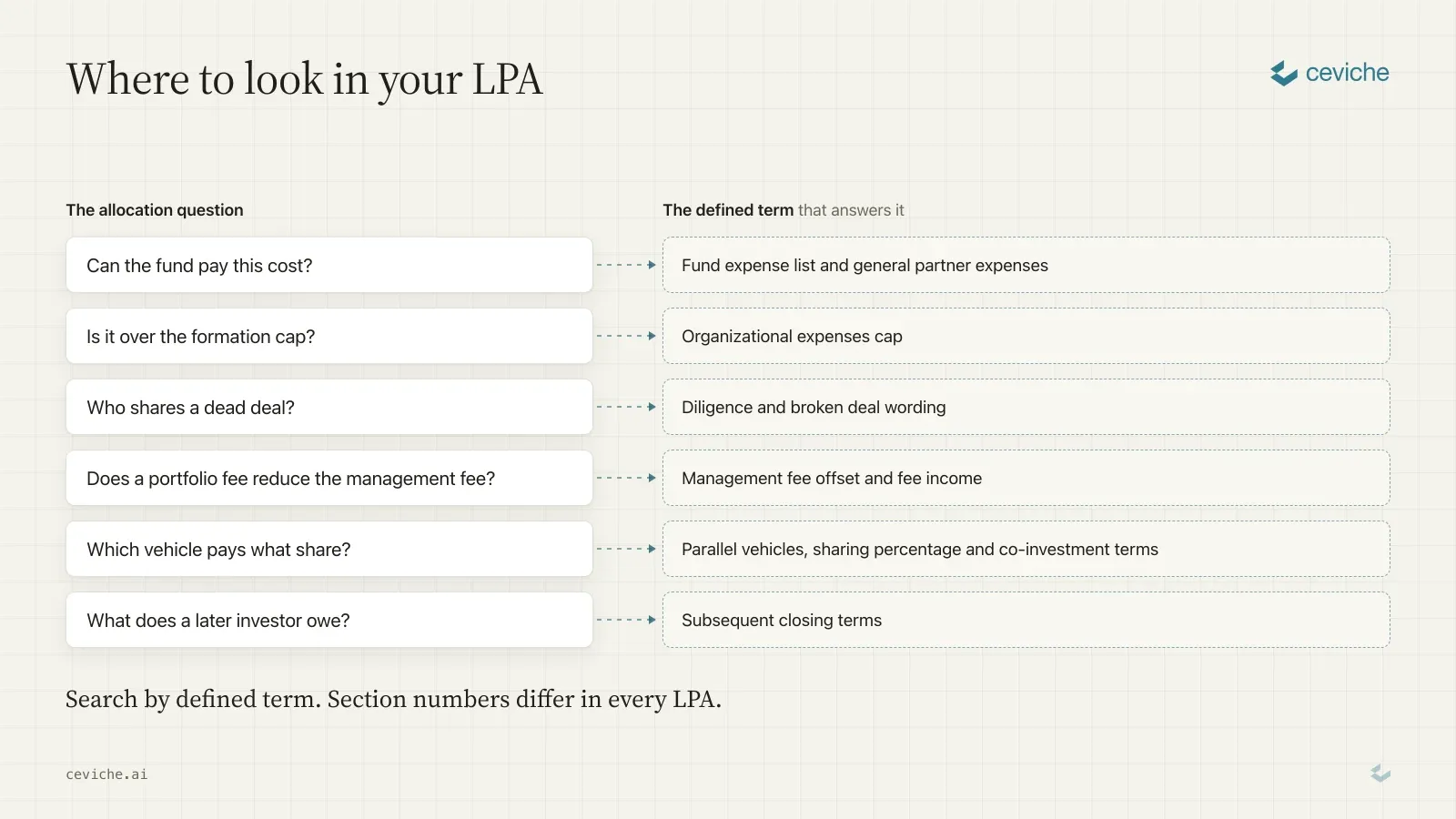
Search your LPA by the defined term, because the section numbers differ in every agreement. In the ILPA model, these sections answer the allocation questions:
- Can the fund pay this cost? The fund expense list in 2.5.1 and the GP expense list in 2.6.
- Is it over the organizational expenses cap? The organizational expenses cap in 2.5.3. The fund pays organizational expenses up to that cap.
- Who shares a broken deal? The broken deal wording in 2.5.1.7. Broken deal expenses are the costs of a deal that never closes.
- Does a portfolio fee cut the management fee? The management fee offset in 8.4. The offset reduces each LP's fee by its pro rata share of fee income. That income covers fees that the GP, the fund manager and their affiliates receive from portfolio companies.
- Which vehicle pays what share? The parallel vehicle sections from 2.8 to 2.10, the drawdown bases in 6.2.4 and the co-investment terms in 9.3.3.
- What does a later investor owe? The subsequent closing terms in 5.1.4.
Sometimes the LPA does not list a cost at all. ILPA's Principles 3.0 expect this. They say that expenses "will arise that may not have been considered at the initiation of the fund." A finance-operations leader at a multi-billion-dollar private equity firm described how this happens. New SPVs can get LPAs without a fund admin expense, and then the management company pays it. In that leader's words, "we forgot to put a fund admin expense in the LPA." That leader wants a monthly report of what the management company absorbs. Then each gap goes either back to a fund or to counsel for the next LPA. Directors and officers insurance is another example. The older LPAs at one large private equity firm do not list it. That firm's CFO splits the premium across all the funds. The shares of the funds whose LPAs do not list it then go back to the management company.
The team then has to apply the clause to each split. Of the 80 fund finance teams we spoke with in 2026, 49% (39 of 80) have a gap in their allocation audit trail. An audit-ready allocation record ties each split to the LPA section that permits it.
What does pro rata mean in an LPA?
The ILPA model uses at least three different methodologies, depending on the cost:
- General fund expenses. Split among LPs by commitments, under 6.2.4.3.
- Expenses of one investment. Split by each LP's sharing percentage for that investment, under 6.2.4.2. The sharing percentage is based on the capital that each LP contributed to that investment.
- Between the fund and its parallel vehicles. Investment costs split by the capital committed to that investment. Other costs split by relative commitments, under 2.8.2, subject to an adjustment that the GP finds equitable.
Real LPAs can give the manager more discretion. An accounting lead at an investment firm that runs private funds described the usual wording.
"[O]ur documents typically outline either by capital or reasonable means by a manager, or reasonable means determined by the manager. Which a lot of times in practice just means by capital balance."
So the team needs to write down the methodology that it uses in practice, because the LPA alone does not set it. Some LPAs are stricter. In the experience of a CFO at a private equity firm, most LPAs leave allocations to the manager. That firm's LPAs name invested capital as the default. So the team documents every split that uses a different methodology. The general cost allocation methods apply inside those limits.
How does one quarter of vendor invoices split under an LPA?
Take an illustrative fund that follows the ILPA model's terms. The main fund has LP commitments of $200M and a parallel vehicle has $40M at the first close. At the final close, the totals are $300M and $100M.
Share = vendor invoice x (this vehicle's or this LP's basis / the total basis that the LPA names for that cost)
An audit and tax invoice of $120,000 posts before the final close. By relative commitments, the main fund pays 83.33%, or $100,000, and the parallel vehicle pays 16.67%, or $20,000. At the final close, the split becomes 75% and 25%, or $90,000 and $30,000. So the parallel vehicle pays the main fund $10,000 at the true-up. A finance lead at a venture firm with parallel vehicles said that this split "would have refreshed" at every close.
A legal invoice of $60,000 relates to one portfolio investment. The main fund invested $45M in it and the parallel vehicle invested $15M. So the main fund pays $45,000 and the parallel vehicle pays $15,000. If the main fund pays the whole invoice, the team records the parallel vehicle's $15,000 in the due to and due from balances.
Inside the main fund, two LPs show why the methodology matters. LP A has a $30M commitment, and the GP excused LP A from that investment. LP B has a $27M commitment and took part in it. Assume every LP has drawn the same share of its commitment. Because LP A is excused, $270M of commitments take part in the deal, so LP B's sharing percentage is $27M / $270M, or 10%. The audit row uses the main fund's $90,000 after the true-up.
| Item | LP A, excused | LP B, in the deal |
|---|---|---|
| Audit invoice, by commitments | $9,000 | $8,100 |
| Deal legal invoice, by sharing percentage | $0 | $4,500 (10% of the deal) |
| Deal legal invoice, wrongly by commitments | $4,500 | $4,050 (9%) |