
TL;DR. Close management software governs the close as a process, meaning task ownership, deadlines, dependencies, approvals and status. Close automation software reduces the manual work inside it, meaning matching, reconciliation, rule-based entries and exception flags. At a fund, neither category reaches the step that actually stalls the close, which is splitting each invoice line across fund entities.
The generic distinction is a real one
Two labels get used interchangeably in this market and they describe different products. One coordinates the close. The other performs parts of it.
Close management software coordinates the financial close as a process. It holds the task list for the period, gives each step an owner and a due date, enforces the dependencies between steps, routes approvals, keeps the sign-off record, and reports status while the close is still running. It governs the work rather than doing it.
Close automation software reduces the manual work inside the close. It matches transactions against source records, runs reconciliations from rules, prepares and posts recurring journal entries, flags anomalies for a person to resolve, and carries the supporting evidence for each item it settles. It does work rather than scheduling it.
Neither definition is ours alone. Numeric's guide to close software puts task management at the center of the first one, as "Close checklists with dependencies, preparer/reviewer assignments, deadlines, and auto-rollforward, built specifically for accounting workflows rather than repurposed project management tools." Xenett draws the same line in two sentences, "Close management software governs the work. Close automation software reduces manual work," and puts "matching rules, exception handling, reconciliation automation, anomaly flags, and rule-based checks" on the automation side.
Both categories are real. A team that cannot say who owns the intercompany reconciliation on day six has a management problem, and a team keying the same accrual by hand every month has an automation problem.
The argument here is that allocation has no owner in either category, which is convenient for us to say and also what our buyers keep demonstrating. If you want the vendor layer rather than the distinction, our comparison of financial close software for funds cuts the market a different way, separating fund-native platforms from enterprise close platforms. This page sits one level above that.
What does a fund close contain that a corporate close does not?
A corporate close is one ledger, reconciled, consolidated and signed. A fund close is at least two sets of books and usually a third party working to a schedule the firm does not set. The funds we interviewed for our fund close-time benchmark described closes in the range of two to three weeks. One venture controller walked us through where hers goes. The billing file goes to the administrator, the administrator has ten business days to deliver, she needs two or three more to review what comes back because the process is manual, and only then does the rest of the close begin. Her books are fully closed "almost three weeks" after month end.
A venture studio CFO described the same shape as a chain rather than a list. The payroll entry posts first, then the card allocations, then the allocation depending on those, and the close gets longer every time another allocation joins the sequence. The full version is in our month-end close checklist, and the half of it generic templates omit is the fund half.
That half has no revenue to recognize. It has each cost classified as a fund or a management company expense against the partnership agreement, shared invoices split line by line across legally separate vehicles, a recharge from the management company to each fund, capital accounts to roll forward, and an administrator package to tie out. On top of that sits a reporting calendar, and the one the controller on our team keeps for this work has quarterly unaudited reporting typically due at quarter end plus 45 or 60 days and the annual audit at year end plus 120 days.
Where do the two ledgers meet and why does nothing own that seam?
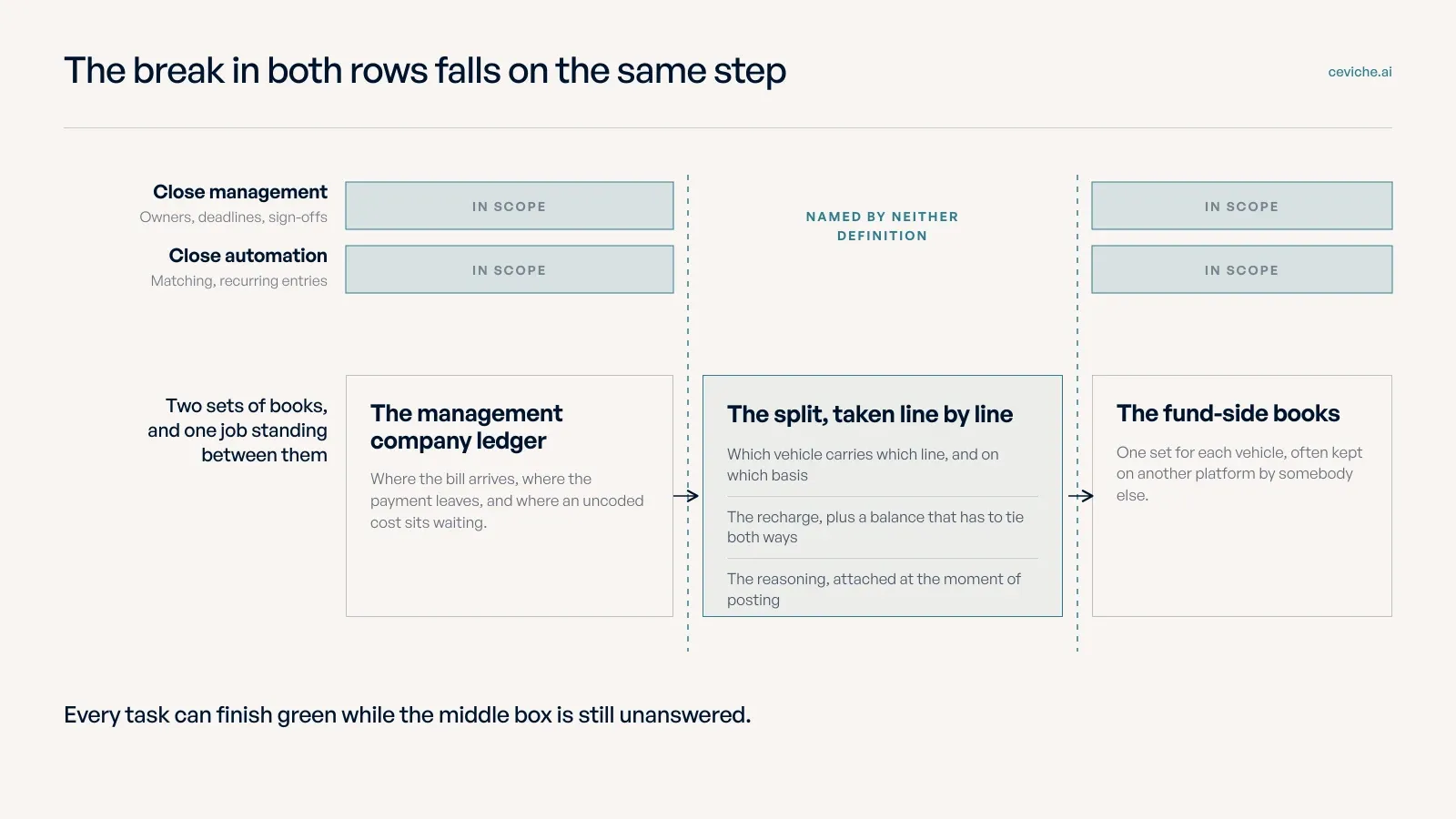
Of the 80 fund finance teams we spoke with in 2026, 81% still run the allocation itself in Excel and 92% report disconnected systems on either side of it, and the structure behind those two numbers is consistent. Our fund finance tech stack data records both halves of it. The management company keeps its own general ledger, QuickBooks or NetSuite for 73% of those teams, and behind it sits a separate fund-side system for the vehicles themselves, named there as Investran, Allvue, Carta or Geneva and frequently run by an administrator.
The work between those two books is allocation, which is a third job rather than a harder version of the first two. Someone decides which entity bears which line of which invoice, on which basis, and then produces the journal entries and the recharge invoice that move it. Neither definition names that step, and neither page behind them mentions allocating a cost across entities. The buyers who map their own close against those definitions keep finding the step unowned.
A venture CFO running more than twenty fund entities described his design choice plainly. The management company fronts the cost and issues one monthly recharge invoice per fund, rather than booking every expense invoice by invoice inside the fund system, which leaves one layer of fund-side activity per fund instead of one per fund per invoice. That recharge creates the due to and due from balances that have to tie in both directions before anyone signs the close.
Put the two categories against what a fund's close needs and the bottom of the table empties out.
| Capability | Close management | Close automation | What a fund also needs |
|---|---|---|---|
| Task ownership and deadlines | Owns it | Not its job | Nothing beyond the generic close |
| Reconciliation and matching | Tracks whether it happened | Owns it | The same work across more accounts |
| Journal entry preparation and posting | Tracks whether it happened | Owns recurring entries | Entries per fund entity, not one consolidated set |
| Per-line allocation across entities | Outside the definition | Outside the definition | The methodology each partnership agreement specifies, per line |
| The management company recharge and its reconciliation | Outside the definition | Outside the definition | An invoice per fund and a balance that ties both ways |
| The audit link from a ledger line back to the split | Outside the definition | Outside the definition | Basis, denominator and approver attached at posting |
Take a $1,000 vendor charge nobody coded to an entity. It lands in the unallocated account in the management company ledger, and the naive treatment splits it evenly across ten funds, so the adjusting entry debits each fund $100, credits the original $1,000 line, and the bucket returns to zero. Run the same charge on committed capital instead and every one of the ten numbers moves. Across a commitment base of $2,000M, a $40M fund takes $20 rather than $100, a $120M fund takes $60, a $340M fund takes $170, a $500M fund takes $250, and the six later vehicles holding the remaining $1,000M take $500 between them. Both columns total $1,000.
Now run either version through a close checklist. The task is worded as posting the allocation entries, someone posts ten lines, and the step closes green. Nothing in that record says which of the two columns the partnership agreements call for, or who decided. Both close identically, the vendor bill is never edited in either, and only one of them is right.
The close that finished on time while the allocation ran eight months behind
At a private credit manager running more than sixty entities, invoices feed into the allocation platform daily and the reporting cadence is monthly and quarterly. The books close on time. The allocation cycle inside that platform runs about eight months behind.
Sit a close management tool over that firm and it would have shown every close task complete, on time, for eight consecutive months, because every task was performed. What the task depended on had not been answered.
At a large private equity firm the allocation lives in a separate spreadsheet per vendor, one shape for audit fees, another for tax, a third for legal. Instructions travel with the invoice as an attachment, the processing team often cannot interpret them, and the question escalates back to the controller. Downstream, the administrator gets a template meant to mirror what the management company calculated, the instructions are not followed correctly, and it comes back for rework. Not one of those loops is a task a checklist can mark complete, and all of them are close time.
Why is judgment per line harder than volume?
A corporate close gets harder as transaction volume rises, which is why generic close tools are built around throughput. A fund close does not behave that way. At one private equity firm, three to four hundred standard invoices a quarter run through the expense system without incident. About a hundred legal invoices a quarter from a single law firm do not. Some sit unpaid for months, not because anyone disputes the amount, but because the back-and-forth over which entity each line belongs to never finishes.
A single legal invoice can cover six months of work, and if the deal splits changed inside that window, the May lines and the September lines on the same bill need different allocations. Volume did not cause that. One judgment call per invoice line did, and it is the call 81% of those teams still make in Excel.
How do you tell which category a product actually belongs to?
Four questions separate the two categories faster than any feature grid, and they work on any vendor in either one.
Ask what the entry looks like in your own ledger. A management tool tells you the entry was posted. A tool that performs the work shows you the entry, the accounts it hit and the support attached to it. One controller at a large venture firm refused to accept screenshots for this and had reports run out of the ledger sandbox instead.
The direction the allocation writes matters more than most buyers expect. An outsourced fund accounting firm wanted to know whether an allocation updates in the spend and bill-pay tools, or whether the result only ever lands in the ledger once a transaction has left them. The answer places the tool in the chain.
Then there is the invoice number. A CFO at an infrastructure private equity firm named it as her paper-trail concern, because a system minting its own numbers leaves the fund's copy pointing nowhere in particular.
Ask, last, what happens to costs that never get allocated. Rent, and anything else the fund documents make a management company cost, should be classified once and pass through untouched rather than queue for a decision nobody needs to make.
What does neither category automate?
Four things, and naming them is most of what a buyer should demand.
The methodology is judgment and it stays with your controller. A VP of finance at a large private equity firm described the real work as thinking about which methodology is right, rather than the calculating and recording that follows, and that time does not compress. Where a firm has written its reasoning down, software can apply it. Where it has not, there is nothing to apply.
One-off adjustments are the second. A CFO put it to us that there is "always gonna be manual one off adjustments", and no vendor should tell you otherwise. An engineering lead who had implemented his own firm's allocation system drew the same boundary when he told us what he would buy next, which was "the allocation engine itself, and the ability to track entity relationships" rather than the invoice workflow and payment features he had already seen enough of.
Then there is the tail. The recharge has to tie to the receivable on the other side, and intercompany accounting across a fund complex is a standing job rather than a period-end task. At one private equity firm the management company had put $23 million of expenses through the intercompany account and received $22.8 million back, and the balance still standing between the two is what the reconciliation exists to explain.
The audit link is the last of them, and it gets skipped because it is cheap at the moment of posting and expensive at every later moment. If the support is not built as the line posts, someone reconstructs it under exam pressure later, and that reconstruction is its own multi-day job, which is the shape most SEC exam findings on expense allocation take.
The same controller whose processing team could not read the allocation instructions gave the clearest answer to what any of this is for. Asked what mattered most in a new system, he said trust, and being able to see problems before they surfaced, and he ranked it above speed. Without trust, in his words, everything is broken and the time savings go out the window.
Where does Ceviche fit?
Ceviche automates the allocation step inside the close, and it is worth stating plainly enough to test. It reads the unallocated bucket from the spend tool or the ledger, applies the methodology to each line, posts an adjusting journal entry per fund that credits the original unallocated line, issues the fund invoice off the result, and carries a link from every journal-entry line back to the split behind it. The original vendor bill is never edited and payments stay in the systems the firm already runs, which cuts days from the close because that step is where the days go. It is not a fund administrator, a general ledger or a managed service, and it does not do the allocations for you. Flybridge moved its quarterly allocations across 18+ fund entities out of spreadsheets, and the entries now post to QuickBooks Online. See what the allocation layer does.
Frequently asked questions
What is the difference between close management software and close automation? One governs the close, the other performs parts of it, and most vendors market themselves as both. Two tests separate them. Ask whether the product would still be useful if every task in it were already done on time, which only a true automation tool survives. Then ask what it writes into your ledger, because a management tool writes nothing and reports that somebody else did.
Does the allocation write back to the spend tool, or only to the ledger? In most designs it writes forward to the general ledger and not backward into the spend or bill-pay tool. Once a transaction has synced out of the spend tool, that system treats it as final, and the allocation lands in the ledger as journal entries instead. Ask any vendor which direction it writes, because the answer decides where your record of the split lives.
What happens to costs that never get allocated? They should pass straight through. Rent, and anything else the fund documents make a management company cost, gets classified once and posted without waiting in a queue for a decision. A system forcing every transaction through an allocation step manufactures work on the pure management company lines, which are usually a meaningful share of the ledger.
Does the fund invoice keep the original vendor invoice number? It should, and it is worth asking early. When a system mints its own numbers for the recharge, the fund's copy no longer points back to the bill it came from, and the auditor's trace from a sampled expense to its source picks up an extra hop. Carrying the vendor's original number onto the fund invoice keeps the paper trail intact.
What is the difference between fund accounting software and financial close software? Fund accounting software maintains the books, capital accounts, NAV, and partnership ledgers as the system of record. Financial close software handles the period-end work of reconciling and posting entries so the books can be finalized. The allocation step is the gap this page is about, and generic close software does not reach it.