TL;DR. Of the 80 fund finance teams we spoke with in 2026, 96% call multi-entity allocation a core complexity and 92% run it across systems that do not talk to each other. From there, 81% still allocate in Excel, 63% name legal-invoice allocation one of their hardest problems, and 49% have a gap in the allocation audit trail.
<!-- 96% multi-entity complexity (77/80) | /research/state-of-fund-expense-allocation-2026 | published 2026-06-29 --> <!-- 92% disconnected systems (74/80) | /research/state-of-fund-expense-allocation-2026 | published 2026-06-29 --> <!-- 81% allocate in Excel (65/80) | /research/state-of-fund-expense-allocation-2026 | published 2026-06-29 --> <!-- 63% legal-invoice allocation a hardest problem (50/80) | /research/state-of-fund-expense-allocation-2026 | published 2026-06-29 --> <!-- 49% allocation audit-trail gap (39/80) | /research/audit-trail-gaps-fund-expense-allocation | published 2026-06-29 --> <!-- n=80 methodology, PE/VC/growth-equity/credit fund finance teams interviewed across 2026 | /research/state-of-fund-expense-allocation-2026 | published 2026-06-29 --> <!-- GL captured on 75 of 80 teams; spend tools on most | /research/fund-accounting-tech-stack | published 2026-06-29 --> <!-- Seven sets of books at three funds, two co-invests, a GP entity and a management company | /research/multi-entity-expense-allocation | published 2026-06-29 --> <!-- Six or more sets of books, hub variant of the same structure | /research/state-of-fund-expense-allocation-2026 | published 2026-06-29 --> <!-- $600M firm with twelve vehicles vs $3B firm with four | /research/multi-entity-expense-allocation | published 2026-06-29 --> <!-- 8 to 13 funds and entities per single outside-counsel invoice | /research/legal-invoice-allocation-benchmark | published 2026-06-29 --> <!-- More than 2,800 invoice line items tracked by hand in one year | /research/legal-invoice-allocation-benchmark | published 2026-06-29 --> <!-- $113,000 audit invoice split and paid by cash availability, one wire at a time | /research/legal-invoice-allocation-benchmark | published 2026-06-29 --> <!-- 150 invoices in one quarter's legal pile | /research/legal-invoice-allocation-benchmark | published 2026-06-29 --> <!-- 1 to 5 days per quarter on allocation, teams who quantified it | /research/fund-close-time-benchmark | published 2026-06-29 --> <!-- 10 days to 1 to 2 hours, 5 to 10 days off the close | /research/fund-close-time-benchmark | published 2026-06-29 --> <!-- 15-business-day close with roughly 10 days on manual allocation | /research/fund-close-time-benchmark | published 2026-06-29 --> <!-- Closes described in the range of two to three weeks | /research/fund-close-time-benchmark | published 2026-06-29 --> <!-- A full day at the end of every quarter before a single fund invoice went out | /research/fund-close-time-benchmark | published 2026-06-29 --> <!-- QuickBooks 51% of management-company GLs (of 75) | /research/fund-accounting-tech-stack | published 2026-06-29 --> <!-- NetSuite 23% of management-company GLs (of 75) | /research/fund-accounting-tech-stack | published 2026-06-29 --> <!-- QuickBooks plus NetSuite 73% of management-company GLs | /research/fund-accounting-tech-stack | published 2026-06-29 --> <!-- Sage Intacct 5%, long tail 21% | /research/fund-accounting-tech-stack | published 2026-06-29 --> <!-- Ramp 49% of stacks (mentions of 80) | /research/fund-accounting-tech-stack | published 2026-06-29 --> <!-- Bill.com 39% of stacks (mentions of 80) | /research/fund-accounting-tech-stack | published 2026-06-29 --> <!-- Expensify 30% of stacks (mentions of 80) | /research/fund-accounting-tech-stack | published 2026-06-29 --> <!-- Concur 11% of stacks (mentions of 80) | /research/fund-accounting-tech-stack | published 2026-06-29 --> <!-- Manco GL plus separate fund-side system (Investran, AllVue, Carta, Geneva) | /research/fund-accounting-tech-stack | published 2026-06-29 --> <!-- SEC exam request answered in roughly 15 minutes vs a week and a half | /research/audit-trail-gaps-fund-expense-allocation | published 2026-06-29 --> <!-- Examiners test three things, Ceviche synthesis not SEC text | /research/audit-trail-gaps-fund-expense-allocation | published 2026-06-29 --> <!-- Fund vs management company is the least-documented question in fund finance | /research/fund-vs-management-company-expenses | published 2026-06-29 --> <!-- The split is governed by the LPA, not by which entity the vendor billed | /research/fund-vs-management-company-expenses | published 2026-06-29 --> <!-- Flybridge, 18+ fund entities on QuickBooks Online and Bill.com | website canon (ceviche-site customers + homepage data, research hub sentence verbatim) | corrected 2026-09-15 --> <!-- One investment across eight of the firm's funds arriving as a single legal bill, split by hand | /research/legal-invoice-allocation-benchmark | published 2026-06-29 --> <!-- Invoices "sit in email inboxes" and delay the close by two weeks | /research/state-of-fund-expense-allocation-2026 | published 2026-06-29 --> <!-- Flipping between three or four windows to reconcile a single bill | /research/fund-close-time-benchmark | published 2026-06-29 --> <!-- Pull quotes: multi-entity, legal, close, tech stack, audit gap | live research pages plus evidence pack 25 items E9/E10 | 2026 -->The five headline findings
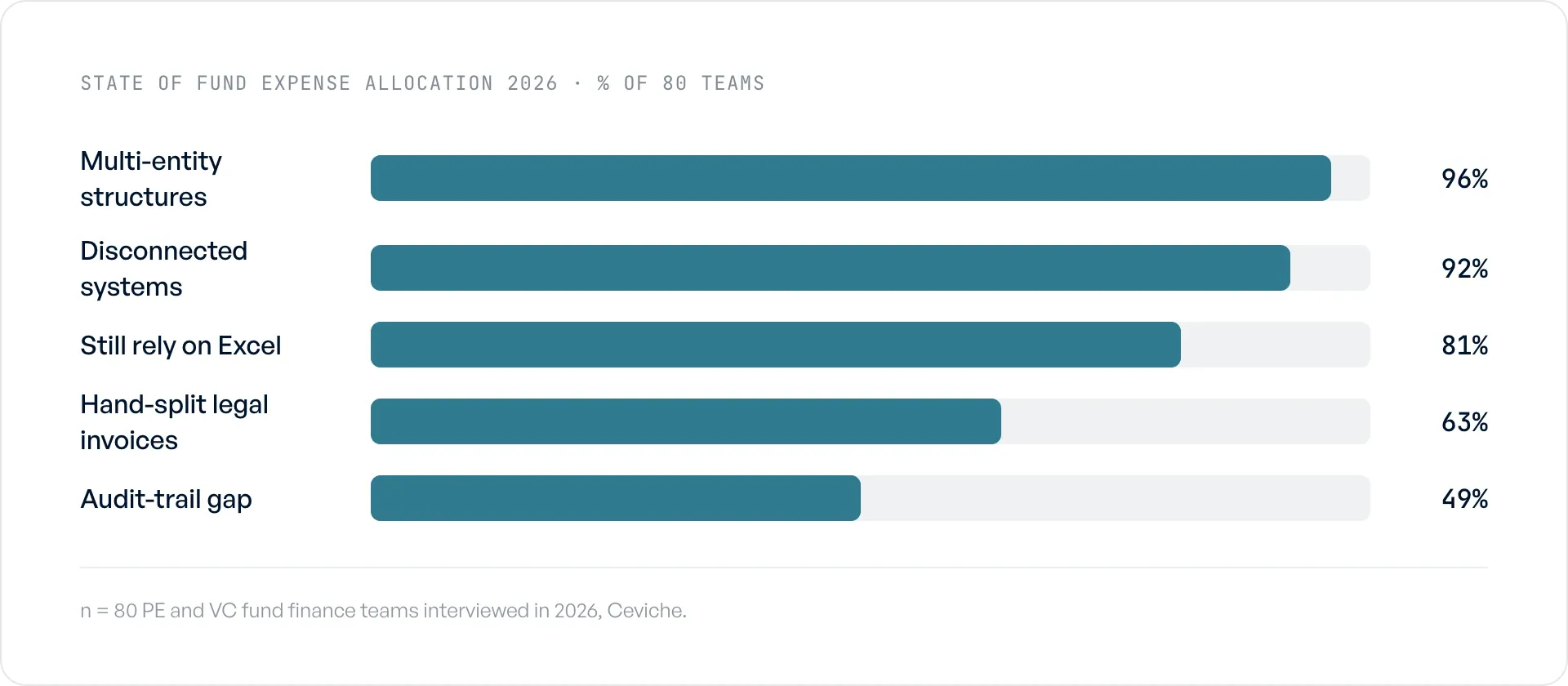
- 96% of fund finance teams cite multi-entity allocation as a core complexity (77 of 80).
- 92% run allocations across disconnected systems that do not talk to each other (74 of 80).
- 81% still allocate expenses in Excel (65 of 80).
- 63% name legal-invoice allocation one of their hardest problems (50 of 80).
- 49% have a gap in their allocation audit trail (39 of 80).
Those five are ranked as they sit in the data, and each one is set out with its source below.
Nothing else on this page is new. Every figure below already sits on one of our seven research pages, each linked at the point it is used, and this page exists so that all of them can be read, cited and checked in one place.
Methodology
The figures draw on Ceviche's analysis of 80 PE, VC, growth-equity and credit fund finance teams interviewed across 2026. That means controllers, CFOs, fund accountants and the fund administrators who serve them, each walking us through the same set of pains, systems and outcomes, coded the same way. The full write-up is The State of Fund Expense Allocation 2026, and the standing framing for every share on this page is "of the 80 fund finance teams we spoke with in 2026", never a claim about all private funds.
Coverage is not uniform across every question. A general ledger was captured on 75 of the 80 teams, spend tools on most, and on close time only the teams who quantified it are counted. Where a denominator differs from 80, it is stated at the figure. There is no per-segment cut, no AUM band, no geography split and no year-over-year comparison, because this is the first edition and none of those exist in the data.
Multi-entity structure statistics
96% of fund finance teams (77 of 80) cite multi-entity allocation as a core complexity, which makes it the most universal pain in the dataset. 92% (74 of 80) run allocations across disconnected systems that do not talk to each other. The full breakdown sits on our multi-entity expense allocation page.
The driver is structure rather than size. A firm running three funds, two co-invests, a GP entity and a management company is already maintaining seven sets of books, each with its own rules. In our data a firm holding twelve vehicles on $600M felt this harder than a firm holding four on $3B. The mechanics are ordinary. Pick a driver for each cost, compute the split, post a journal entry to every entity that bears part of it, and book the intercompany due-to and due-from that balances the set. What breaks is the volume, because one invoice can land on many of those books at once, which is what the legal figures below measure.
That is also why the two structural figures move together. When a shared cost has to reach seven sets of books and no single system holds all seven, the split lands in whatever tool sits between them, which is how 96% on complexity and 92% on disconnected systems end up describing the same afternoon.
A VP of finance at a healthcare investment firm put the daily version of it plainly.
This morning, I only process two invoices and it took me the whole morning.
Legal invoice allocation statistics
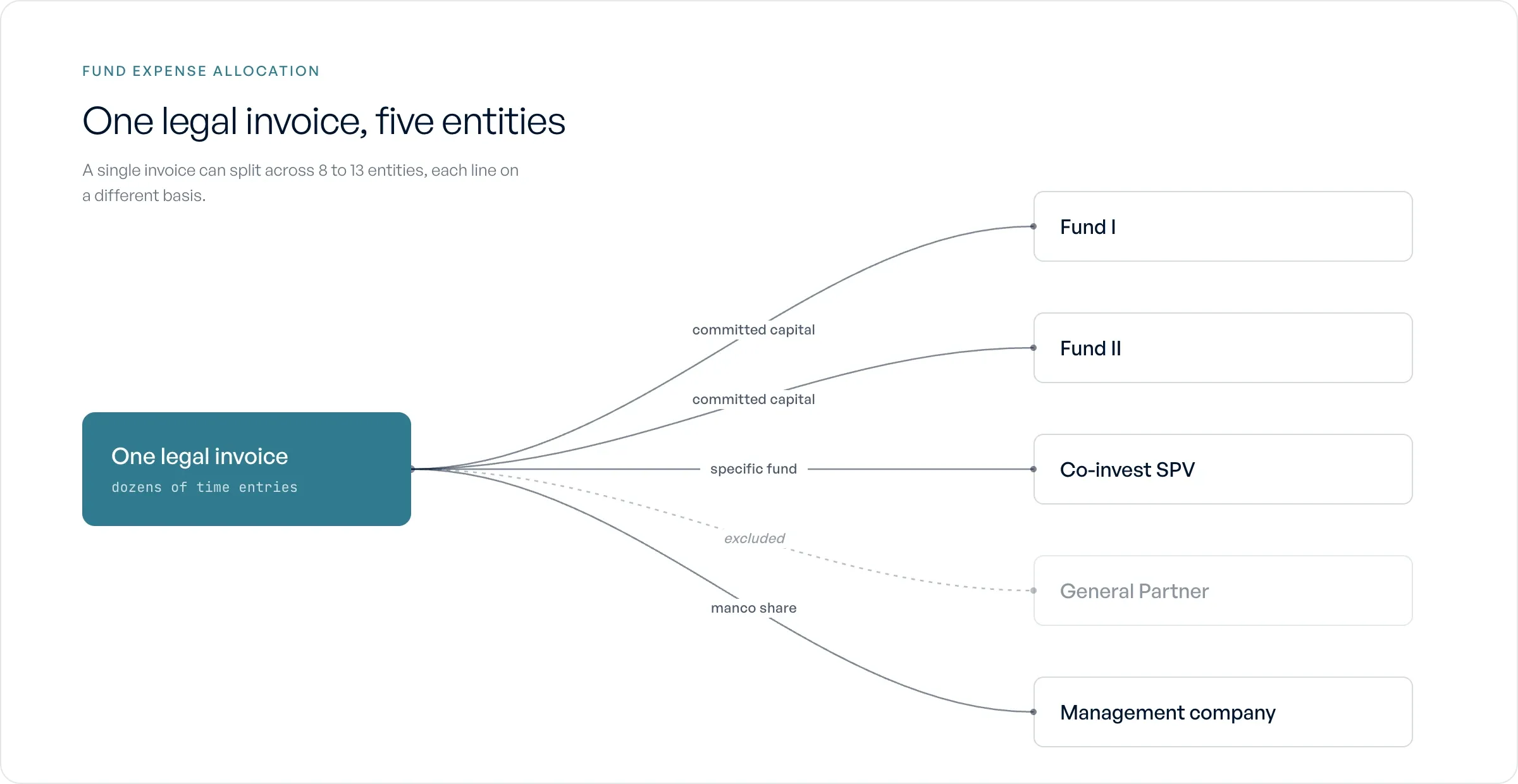
63% of fund finance teams (50 of 80) name legal-invoice allocation one of their hardest problems, the sharpest single pain in the dataset after the structural ones. A single outside-counsel invoice can split across 8 to 13 funds and entities, which is the headline range in our legal invoice allocation benchmark.
Legal is the most time-consuming invoice type to allocate, because every line needs interpretation before it can be split. One bill from outside counsel can carry dozens of timekeeper entries spanning several matters. One PE controller walked us through an invoice split "between two, four, six, eight different funds" and, on a separate occasion, across 13 SPVs and funds at once. The same PE team manually tracked more than 2,800 invoice line items across a single year, copying and pasting out of their AP tool into a spreadsheet. A $113,000 audit invoice had to be split and paid across multiple funds by cash availability, one wire at a time.
A VP of finance at a fund-of-funds platform described a quarter where the legal pile alone was "150 invoices" dropped into a system. A controller at a growth-equity firm described the recurring shape, one investment made across eight of the firm's funds arriving as a single legal bill that then has to be split by hand, and told us legal invoices are the most complex type to allocate.
A controller at a multi-billion-dollar fund described the volume version of the same problem.
One invoice that sometimes gets allocated over like 10 different funds.
Close time and manual effort statistics
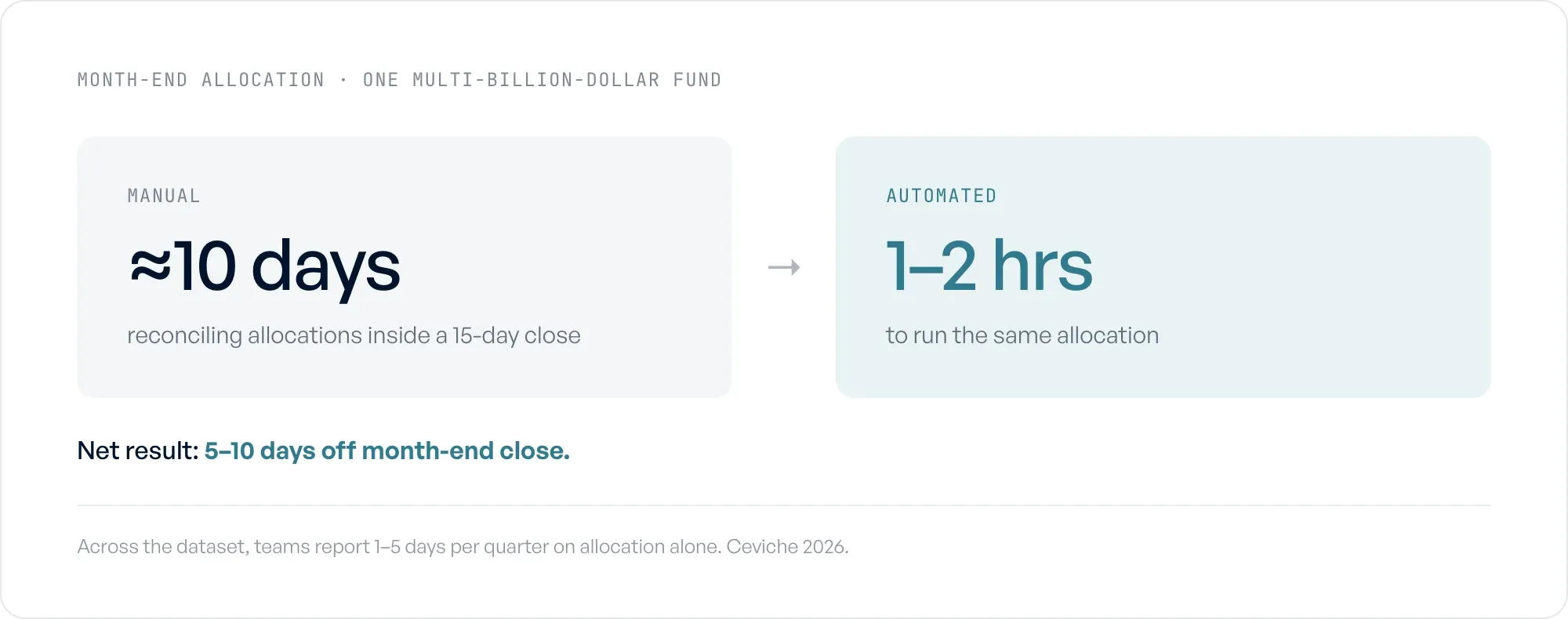
Fund finance teams spend 1 to 5 days per quarter on allocation alone, concentrated at the close. That range comes from the teams who quantified it rather than from all 80, and it is set out with the rest of the timing data in our fund close-time benchmark.
The anchors behind the range are specific. One multi-billion-dollar fund cut its month-end allocation work from roughly 10 days to 1 to 2 hours, taking 5 to 10 days off its close; inside its 15-business-day close, roughly 10 days had gone to manual allocation and reconciliation. The funds we interviewed described closes in the range of two to three weeks. Another controller, allocating travel and intercompany costs by hand, told us it took a full day at the end of every quarter before a single fund invoice went out. The 2,800 hand-tracked invoice line items above are the same work seen across a full year rather than a single close.
Two things are worth saying about this set. The range is wide because the work scales with entity count and invoice volume rather than with fund size, and no incumbent tool in this category has published a close-time benchmark we could find, so there is nothing to compare these anchors against.
The split itself is rarely the bottleneck. The handoffs are. A bill lands in one system, the allocation is worked out in a spreadsheet, and the result is typed into the ledger by hand, so nothing carries the line-level decision across the gap and the close waits on the person who does. One controller told us invoices "sit in email inboxes" and delay the close by two weeks, and another described flipping between three or four windows to reconcile a single bill.
Fund finance tech stack statistics
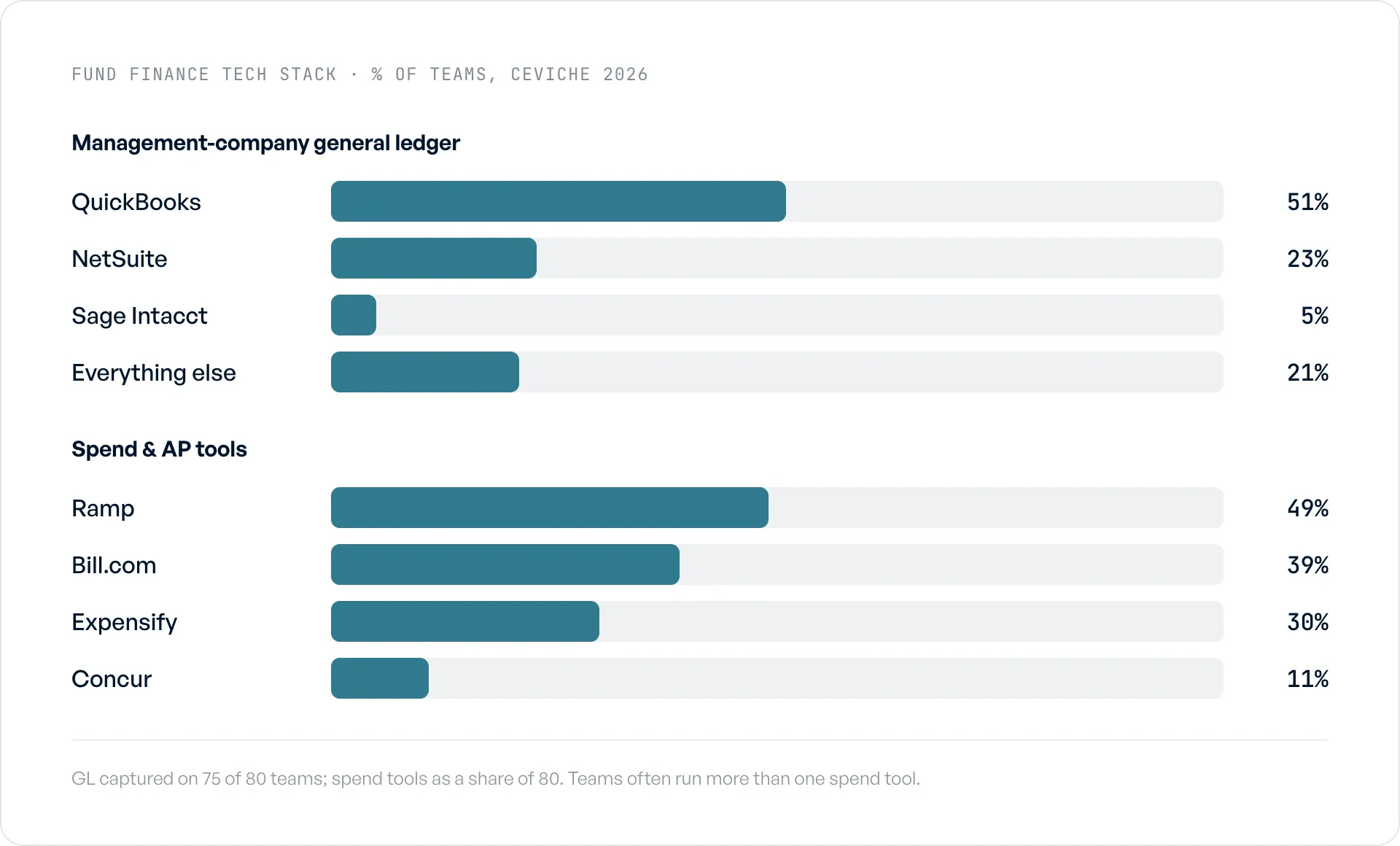
We looked for a published count of which ledger private funds keep their books on and did not find one as of September 2026, so what follows is ours. QuickBooks and NetSuite run 73% of the management-company general ledgers we captured, which was on 75 of the 80 teams, with QuickBooks at 51% and NetSuite at 23%. Sage Intacct holds a real but smaller third lane at 5%, and the remaining 21% is a long tail of Xero, Carta, Dynamo, MS Dynamics 365 and Workday, plus a few firms migrating off Quorum and onto newer ledgers. The full picture is in our fund finance tech stack analysis.
| Management-company GL | Share of the 75 teams where a GL was captured |
|---|---|
| QuickBooks (Online + Desktop) | 51% |
| NetSuite | 23% |
| Sage Intacct | 5% |
| Everything else | 21% |
On the spend side, Ramp appears in 49% of stacks, Bill.com in 39%, Expensify in 30%, and Concur trails at 11%. Firms usually name two or three of these, so the mentions overlap rather than sum to a clean 100%.
| Spend tool | Mentions among the 80 teams |
|---|---|
| Ramp | 49% |
| Bill.com | 39% |
| Expensify | 30% |
| Concur | 11% |
The recurring shape is not a single platform. It is a management-company general ledger, QuickBooks or NetSuite, for the firm's own books, with a separate fund-side system behind it for the funds themselves, Investran, AllVue, Carta or Geneva. The management-company ledger carries payroll, rent and operating costs while the fund system carries capital accounts, investor reporting and the fund-level books, so a shared cost has to be split across both worlds and then posted into each. One pairing recurs often enough to name, Bill.com plus Expensify feeding QuickBooks Online. Ramp, at 49% of stacks, is also where teams say they are heading, and the moves they described run from Bill.com to Ramp Bill Pay and from Brex to Ramp.
A controller at a venture firm summed up the tooling.
All the systems out there don't all do the thing that you want them to do. They each do a piece of the thing.
Audit trail and SEC exam statistics
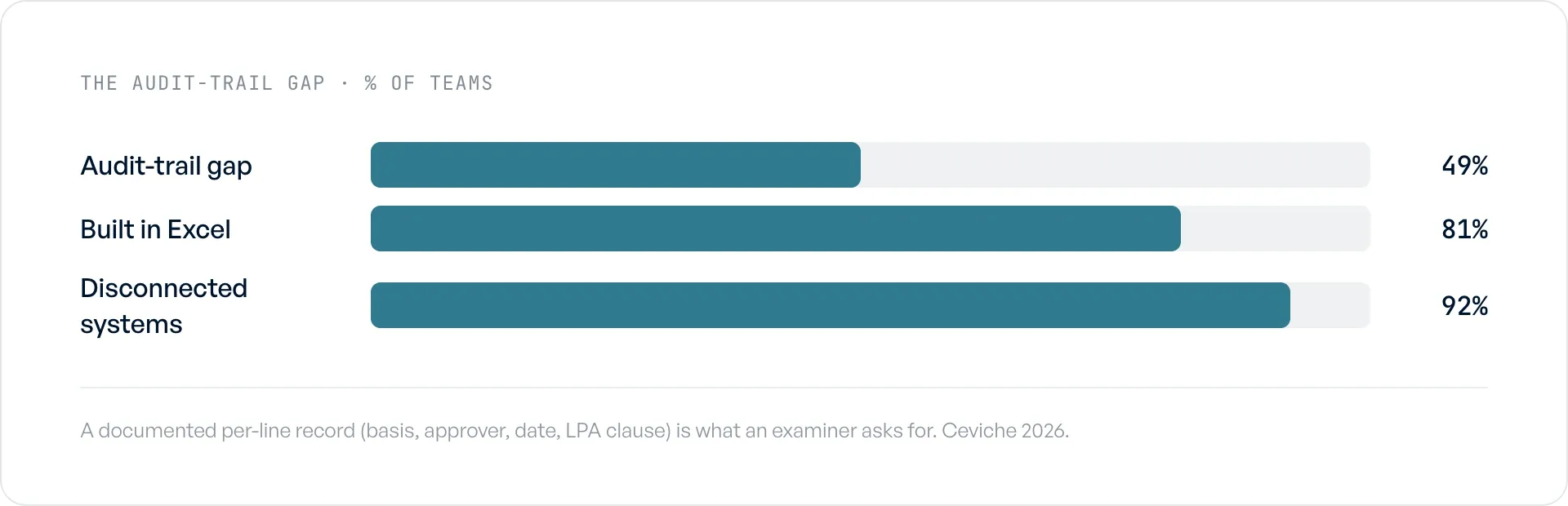
49% of fund finance teams (39 of 80) have a gap in their allocation audit trail, which is the lowest of the five headline pains in our data, and it skews toward the SEC-registered and PE side. It is also the one most directly caused by another figure on this page, since 81% (65 of 80) still allocate in Excel, which leaves no native trail behind the split. The detail, including the regulatory sourcing behind it, sits on our audit-trail gaps page.
The difference a trail makes shows up when someone asks for it. Teams with a real trail answered an SEC exam request in minutes instead of a week and a half, one of them through a system that produced the record in roughly 15 minutes against a week and a half of manual reconstruction the old way.
In practice, examiners test three things: whether expenses that benefited the adviser got charged to the funds, whether the allocation methodology is documented and applied consistently, and whether each split matches what the fund documents actually permit. Two of the three are about documentation rather than about the math. That three-part reading is ours rather than a quotation of the regulator, and the primary sources behind it are cited on the audit-trail page.
The VP of finance at the fund-of-funds platform described the audit record behind a quarter of expenses.
Somebody writes a paragraph after the meeting that says we walked through all the expenses and they were all approved.
A paragraph is not a methodology and it is not per line, so it does not answer the question an examiner is actually asking. The same person told us the record underneath it is all kept in Excel, and said the SEC would love that when it came knocking.
Fund versus management company statistics
Where the line falls between a fund expense and a management-company expense is one of the least-documented questions in fund finance, addressed mostly in law-firm client alerts rather than any fund-finance data source. Our own treatment of fund vs management company expenses is built around two tests, who actually benefited from the cost and what the fund documents permit.
63% of fund finance teams (50 of 80) name legal-invoice allocation one of their hardest problems, and legal is where this line is hardest to draw, because one bill can carry fund-level work, the adviser's own legal work and everything in between. The split is governed by the LPA, not by which entity the vendor happened to bill, which is why the same vendor's invoice can land differently at two firms with identical structures.
The absence of published data here is the reason this page exists in the form it does. A controller deciding whether a recruiting fee, a technology subscription or a diligence bill belongs to the fund or to the management company has fund documents, a law-firm memo and her own judgment, and no count of what comparable teams do. We could not find one in published form. The figures above do not settle that question either. What they establish is how common the question is.
Where Ceviche fits
Ceviche sits between the spend systems funds already run and the general ledger, applies the firm's allocation methodologies per the LPA line by line, and writes audit-ready journal entries back with the rationale attached. It is not a fund administrator, a general ledger or a managed service, and it does not do the allocations for you. Flybridge runs it across 18+ fund entities on QuickBooks Online and Bill.com. You can see how Ceviche handles fund expense allocation.
The figures on this page were measured across 2026 from 80 fund finance teams, and the page is refreshed annually.
FAQ
How long does fund expense allocation take? Teams report one to five days per quarter on allocation work, concentrated at the close. One multi-billion-dollar fund cut that work from roughly 10 days to 1 to 2 hours after automating it, taking 5 to 10 days off a close that had been running 15 business days. Only the teams who quantified their time are counted in that range.
What percentage of private funds still allocate expenses in Excel? In Ceviche's 2026 analysis of 80 fund finance teams, 81% still allocate expenses in Excel. It remains the real incumbent in the category, ahead of any dedicated software. That figure is also the reason 49% of the same teams have a gap in their allocation audit trail, because a spreadsheet leaves no native record of why each line went where it did.
What is the hardest expense type to allocate? Legal invoices. 63% of the fund finance teams we interviewed named legal-invoice allocation one of their hardest problems, because a single outside-counsel invoice can split across many funds and entities with a different methodology per line. It is also the most time-consuming type, since every line needs interpretation before it can be split at all.
How many funds and entities does a single invoice split across? The headline range in our data is 8 to 13 funds and entities for a single outside-counsel bill. Deal-related work usually splits by committed capital across the funds that invested, formation costs go to the specific vehicle, and general advice lands on the management company, so one invoice can carry several bases at once. That is the count for a single bill, before you consider that the same firm may process dozens of them in a quarter.
How do funds decide which allocation methodology to use? Two tests decide it. Who actually benefited from the cost, and what the fund documents permit. From there the common bases are committed capital, headcount, and a fixed schedule agreed in advance, with the choice recorded per expense type rather than per invoice. The LPA governs the answer, not which entity the vendor happened to bill.