
TL;DR
Fund expense allocation is how a fund manager splits a shared cost across the funds, SPVs and management company that the cost served. Each vehicle's LPA or operating agreement sets what that vehicle may bear and which methodology applies. The finance team computes each share, posts the journal entries and keeps a record that an auditor can re-perform.
Ceviche is fund expense allocation software. Every split it posts traces back to a rule or an allocation that your team approved.
Fund expense allocation is the work of dividing a shared cost across the fund entities, SPVs, and management company it served, applying the methodology each vehicle's governing documents support, producing the resulting journal entries, and recording the basis for each split in a form an auditor or examiner can sample.
What counts as a fund expense?
A cost is a fund expense when two things are true. The fund's governing documents permit the fund to bear it. The cost also served that fund. If either test fails, the cost stays with the management company.
The SEC's 2020 risk alert on private fund advisers gives examples of both kinds of cost. It lists shared costs that advisers split among clients. Examples are "broken-deal, due diligence, annual meeting, consultants, and insurance costs." The same alert lists costs that advisers charged to funds without permission, such as "salaries of adviser personnel, compliance, regulatory filings, and office expenses." The first list needs a split. The alert calls the second list "adviser-related expenses" that the fund agreements did not permit.
LPA wording on fees and expenses is often broad. In a 2014 speech, the SEC's head of examinations said broad LPA wording on portfolio-company charges "has created an enormous grey area." Our guide to fund expenses vs management company expenses works through the contested categories one by one.
Eligibility is also a per-fund question. Fund IV's LPA can allow a cost that an SPV's agreement bars, even when both hold the same company. A fund accountant at a venture firm kept the annual meeting cost on the management company's books until someone checked each fund's agreement.
"[I]t took, you know, a little bit of work going to each fund's LPA to see ... if a fund can absorb AGM costs or not. And we have a tracker for that going on in spreadsheets."
Some cost types have their own LPA provisions, such as broken-deal and organizational expenses. A written expense allocation policy records how the firm applies each provision.
What decides how a shared expense is split?
The LPA decides the split. Four of its provisions set most splits:
- which costs the management company bears and which the funds bear
- how the funds treat broken-deal costs
- the cap on organizational expenses
- the methodology for each cost type
The methodology is how a cost splits, for example pro rata on commitments. The basis is the set of numbers that the methodology uses for one period. Closed-end private equity and venture funds use a short list of methodologies:
- Pro rata on commitments. Each fund's share of total committed capital.
- Pro rata on invested capital. Each fund's share of the capital invested, often in one company.
- By investment. The cost goes to the funds that hold the investment that caused it.
- A fixed schedule. Percentages that the agreements set in advance.
- A blended methodology. Two or more of the above, weighted as the LPA permits.
Commitments change at a subsequent close. Invested capital changes with every deal. So every split must state which numbers it used and as of which date. Our guide to the allocation methods funds use compares the methodologies in detail.
The arithmetic is the same for every methodology:
Entity share = shared cost x (the entity's basis amount / the total basis amount of the entities eligible for that cost)
The LPA sets which entities are eligible. An entity that may not bear the cost is not in the denominator.
How does fund expense allocation work step by step?
Each shared cost needs the four decisions in the diagram below. The five steps that follow carry out those decisions, from the vendor invoice to the cash that the funds pay back.
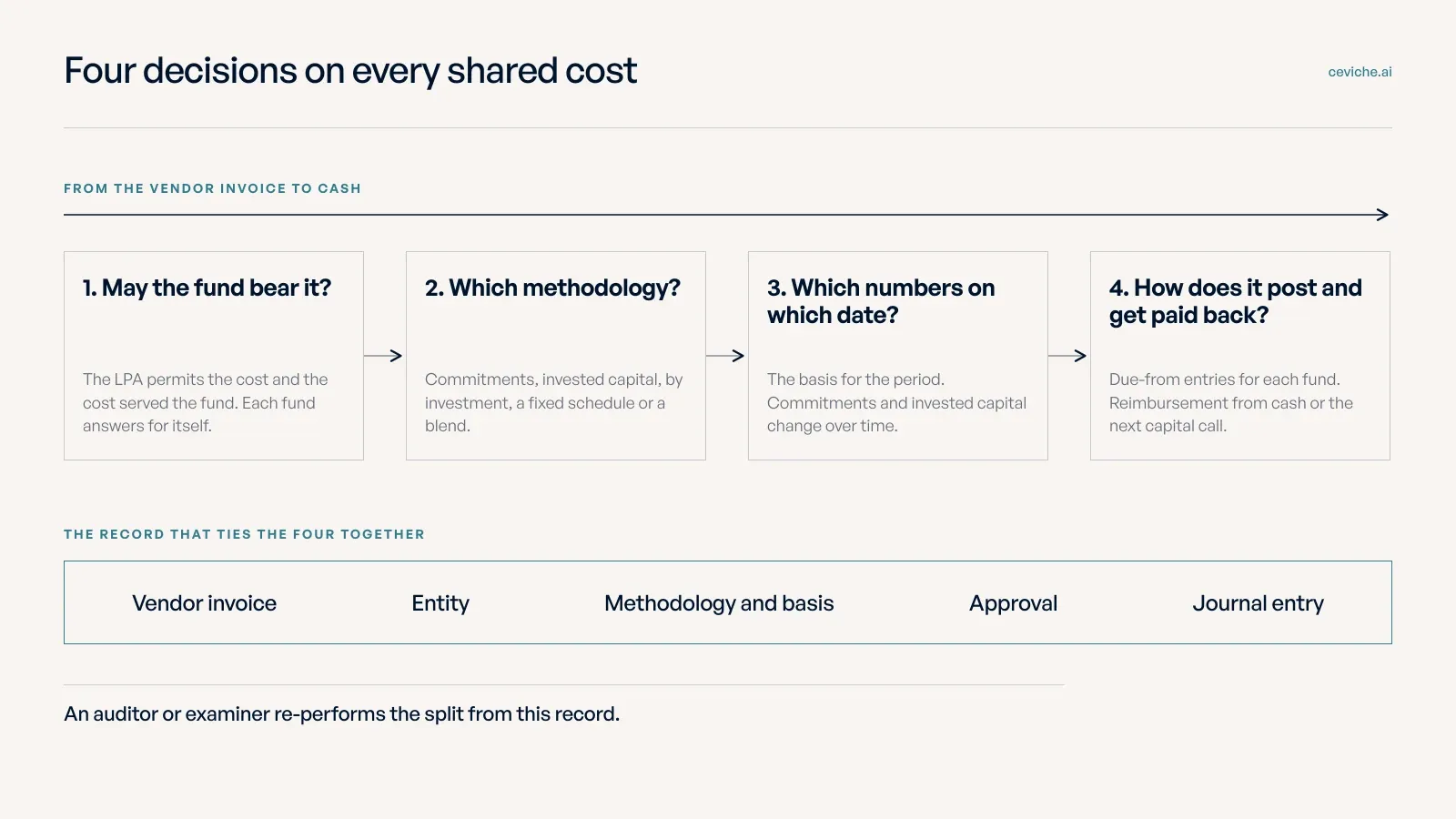
Step 1: Classify the cost
Decide whether the cost belongs to a fund, several funds or the management company. Legal invoices make this step hard because outside counsel often addresses the invoice to the firm, not to a fund or SPV. A finance lead at a venture firm sends those invoices back.
"The lawyers don't say what entity they're working on. They just say, here's an invoice to [the firm]. And then we have to go back and say ... this is for [Fund] 5[,] this was for a deal related cost. This was for management company."
The team wants the correct entity on the document itself, because the auditor compares the invoice with the ledger. Another team gets the entity right before the invoice arrives. A finance lead at a venture firm with many vehicles gets a separate invoice for each vehicle from the firm's tax preparer. The team's law firms mostly do the same, so the team splits only an occasional bill. Our guide on how to allocate legal invoices across fund entities covers the line-by-line version.
Step 2: Choose the methodology and basis
Find the methodology that the LPA sets for this cost type. Then take the basis numbers as of the correct date. Use the same methodology for the same cost type every quarter. A change needs a reason that someone wrote down.
Step 3: Compute the split
Apply the formula to each eligible entity. Check that the shares add up to the invoice total. That check catches typing errors but not a wrong basis.
Step 4: Post the entries
Post the management company's payment to a balance-sheet account, such as due from funds. Then move each fund's share into its own due-from account. A former fund CFO who now advises fund teams explained the reason.
"If I know that the expense is going to be charged back to the fund ... I'll book it to a balance sheet account. You know, [due] from funds account ... I don't ever want that expense to show up in the income statement."
When a team cannot map a cost to a due-from account, the cost lands in the management company's P&L. A finance lead at a private equity firm reclassed a year of fund expenses by hand at year end. The team now does the reclass every month. Our guide to due to and due from accounts shows the matching entries on the fund side. The venture finance lead with many vehicles uses a simpler pattern. Payments run through an intercompany clearing account, and each fund vehicle is a customer in the accounting system. Each fund's share is then an invoice to that customer.
Step 5: Settle with the funds
The management company usually pays first, so the allocation is also a receivable. The funds pay it back from cash on hand or at the next capital call. That can be months later. At a growth-equity firm, one audit or tax invoice can need a split across as many as 100 entities. The team exports each split to Excel. The owner of each fund reviews that fund's share and sends the cash to the management company in the same step. A finance lead at a lower-middle-market private equity firm described the gap that a slow repayment leaves.
"[W]e don't have a great process timing wise for funds paying back expenses. ... [T]he only result is that we end up floating the funds expenses for maybe a little bit longer than we should."
What does one quarter of fund expense allocation look like?
Take an illustrative firm with three funds. Fund II has $150M of commitments, Fund III has $250M and Fund IV has $400M. Fund III and Fund IV both hold one portfolio company. Fund III invested $30M in it and Fund IV invested $70M. The management company pays four vendor invoices this quarter.
| Cost paid by the management company | Treatment | Fund II | Fund III | Fund IV | Management company |
|---|---|---|---|---|---|
| Fund III annual audit, $48,000 | Direct to Fund III | $48,000 | |||
| Fund counsel for LPAC and governance work across all three funds, $36,000 | Pro rata on commitments | $6,750 | $11,250 | $18,000 | |
| Add-on diligence on the company that Fund III and Fund IV hold, $22,000 | Invested capital in that company | $6,600 | $15,400 | ||
| Firm CRM subscription, $18,000 | Adviser overhead | $18,000 | |||
| Total, $124,000 | $6,750 | $65,850 | $33,400 | $18,000 |