A fund complex does not roll up the way a corporate group does, so consolidation is downstream of the split. Here are the systems in play and the eight criteria that separate them.
TL;DR
Three kinds of system compete for this job. ERP consolidation engines roll entities upward, fund-native ledgers hold capital accounts, and an allocation layer applies your team's rules to what lands in each entity first. For a fund complex, consolidation is downstream of that split, so score candidates on how the split gets decided.
What Does a Fund Complex Need That a Corporate Group Does Not?
The ERP consolidation engines on this page were built for a parent that owns subsidiaries. The subsidiaries roll up, the intercompany activity gets eliminated, and one set of financials comes out the other end. A fund complex does not behave that way. Fund II's limited partners and Fund III's limited partners are different investors with different rights, so there is no consolidated statement across them that anybody reads or signs. What the funds share is cost. The audit fee, the D&O policy, the administrator's bill and every outside-counsel invoice arrive addressed to one entity and legally belong, in fractions, to several. Our explainer on multi-entity accounting software makes that case in full, so this page starts from it rather than restating it.
One private credit manager we spoke with runs more than sixty legal entities. Consolidating them is not the hard part. Deciding what belongs to which of them is.
That is the most universal finding in our research. Of the 80 fund finance teams we spoke with in 2026, 96% cite multi-entity allocation as a core complexity and 92% are running them across systems that do not talk to each other, a pattern the multi-entity allocation data breaks out by structure. The pain tracks structure rather than size. Twelve vehicles at a $600M firm gave the team more trouble than four at a $3B one.
Consolidation Is the Easy Half
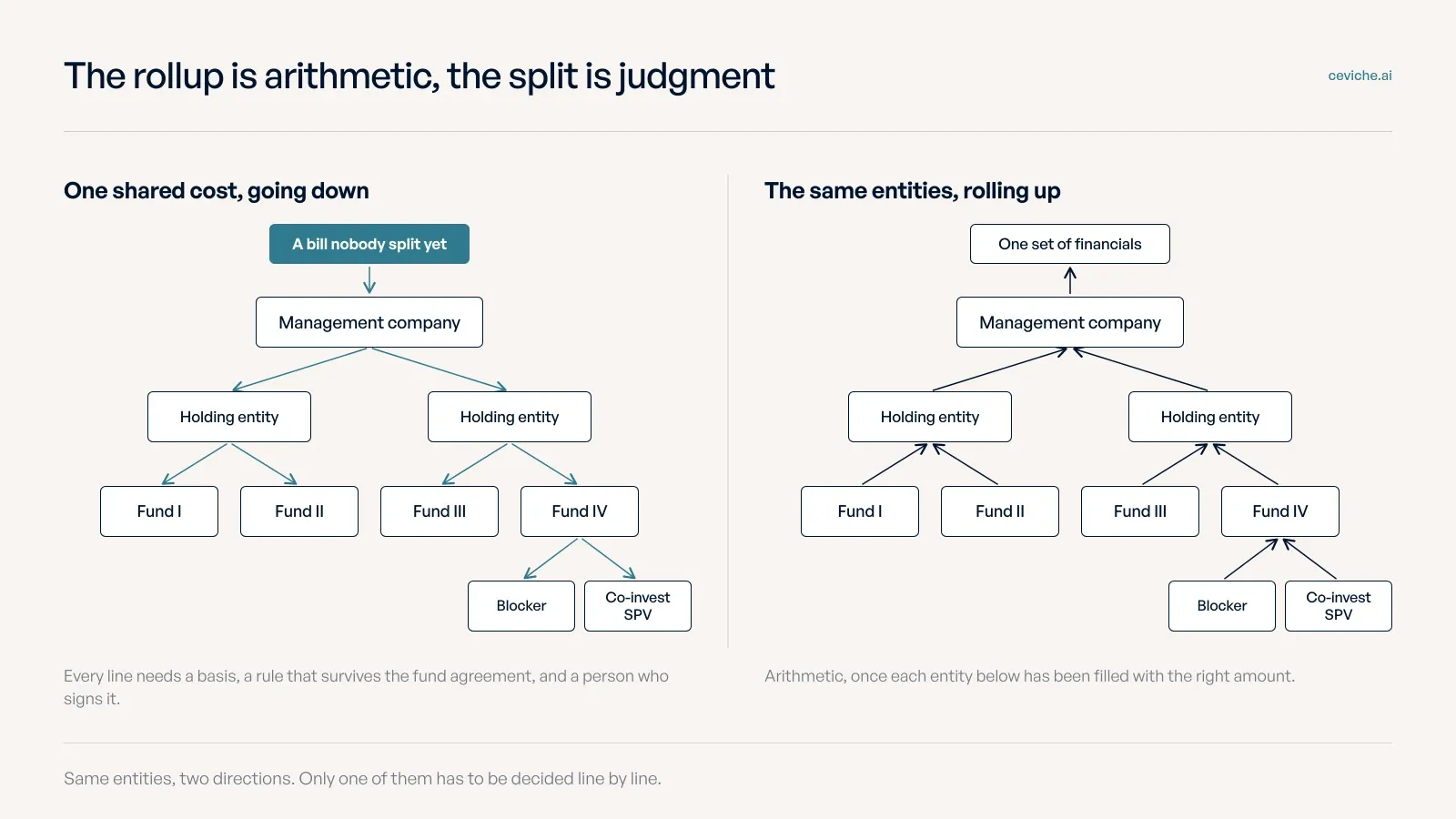
Multi-entity allocation is the practice of splitting a shared cost across the fund entities, the general partner, the co-invest vehicles, and the management company that benefited from it, applying a defined methodology to each line and posting the result to each entity's general ledger with a documented rationale. Consolidation rolls those entities up; allocation decides what goes into each one first.
At the large end of the market the entity list is already solved. A very large multi-strategy manager told us it runs an internally developed system for deal ownership, a separate entity management system holding the fund structures, and then a team of people who maintain every operating expense allocation by hand. Both systems know the entities. Neither does the allocation.
What refuses to consolidate is the knowledge. A CFO at a lower-middle-market investment firm described what the consolidation half looked like before software.
For most of the first year we did it all in Excel. They would send us their trial balances and we just remapped them to a holding company, a consolidated income statement and balance sheet.
That is the work the platforms on this page take over, and they take it over well. The other half stays with whoever knows the rules. The finance lead at that private credit manager keeps hers in two files. One holds every entity and what it carried each quarter. The other answers, expense type by expense type, which funds are eligible to bear a cost and whether the share follows assets or divides evenly. A candidate system has to absorb that second file, because that file is the methodology.
The mechanism underneath is unglamorous. Shared costs land in a single unallocated account against a single unallocated entity, and the month's work is emptying that holding pen into the real entities. The consolidated view is only ever as good as how that bucket was emptied, which is why the allocation step and not the consolidation step is where the risk sits. Our ranked comparison of best multi-entity accounting software scores products on that basis; this page scores the decision itself.
See it on one of your own invoices. Ceviche pulls the invoice from Ramp, Bill.com, Brex, Expensify or SAP Concur, applies the allocation methodology each LPA specifies per line, and writes audit-ready journal entries back into QuickBooks Online, NetSuite or Sage Intacct. Book a demo.
| System | What It Consolidates | How an Entity Is Modeled | Intercompany and Eliminations | How the Split Is Decided | Operated By |
|---|
| Sage Intacct | Entities into one set of financials, across currencies and standards | A dimension on a shared chart of accounts | Inter-entity journals and eliminations in the product | Rules configured inside the ledger | Your accounting team |
| Oracle NetSuite | Subsidiaries into a parent, on one platform | A subsidiary in a hierarchy | Automated intercompany accounting and netting | Allocation schedules across segments | Your accounting team |
| SoftLedger | Entities in real time, with eliminations booked | A location, plus up to three custom dimensions | Offsetting lines posted automatically | Tagged dimensions on each line | Your accounting team |
| Gravity Software | Entities in one Microsoft-hosted database | An entity sharing vendors and a chart of accounts | Automated intercompany including due to and due from | Configured in the ledger | Your accounting team |
| Fund-native ledgers | Fund books, capital accounts and partnership allocations | A fund, SPV, AIV or GP entity | Inside the platform, module level | Partnership allocation engine | Fund accountants or your administrator |
| Ceviche | Nothing; it fills the entities before consolidation | Every entity mapped to its ledger identifier | Due-to and due-from entries generated per split | LPA methodology applied per invoice line | Your controller |
Vendor details change. Every cell above comes from the vendor's own page as it read on 2026-09-03, and none of these vendors publishes prices.
The Three Kinds of System on This Shortlist
Budget planning therefore starts with a call in every case. These systems are also not competing with each other, which is why scoring them on one feature list produces nonsense. ERP consolidation engines hold many entities, keep a general ledger for each, and produce one consolidated set of financials with drill-down. Fund-native ledgers are built around capital accounts, partnership allocations and the investment record, and are usually operated by an administrator. The allocation layer consolidates nothing. It applies your rules to work out what each entity owes on a shared cost and posts the result into whichever of the first two you run.
Most funds never buy the first kind. They buy a ledger, hire an administrator, and do the hard part by hand. Our tech stack data shows the recurring shape, a management-company general ledger with a separate fund-side system behind it and a spreadsheet wedged between them doing the actual split.
Multi-Entity Consolidation Platforms for Funds in 2026
Ceviche publishes this page and sells software in the expense allocation category, so read our own entry with that in mind. Ceviche is the third segment below, nothing here was benchmarked by us, and where a page says nothing on a point, the silence is what gets reported.
Sage Intacct
Sage's multi-entity page promises to "Automate multi-entity consolidations" and to "Combine data from all entities and manage different currencies, accounting standards, and fiscal periods", with journaled consolidations and inter-company eliminations named as features. Its private equity page offers to "Conduct continuous multi-entity consolidations of complex global financials" on a shared dimensional chart of accounts. The general multi-entity page does not use the words fund, LP, SPV or allocation anywhere.
Oracle NetSuite
NetSuite states that its "financial consolidation capabilities deliver centralized oversight of accounting processes, data and reporting across multiple business units, subsidiaries and regions on a single platform", and Oracle's documentation holds the allocation mechanics, with schedules that distribute expenses across departments, locations, classes and custom segments. Segments are not funds, so the mapping work is yours.
Gravity Software
Gravity is the only generic entrant here with a page written for this reader, offering to "Simplify multi-entity accounting for investment firms and holding companies with consolidated financial reporting, automated intercompany transactions, and Microsoft-powered insights". It names the daily tax it removes, teams spending hours switching between company files and reconciling intercompany balances, and it shares vendors, customers and a chart of accounts across entities on the Microsoft Power Platform.
SoftLedger
SoftLedger sells against implementation weight, saying legacy systems "often take at least several months and outside consultants to set up". Its page states that it "has the ability to add offsetting journal line items for automatic intercompany journal entries" and that eliminations "are automatically calculated and booked". The detail that decides fit is that alongside locations and ledger accounts it carries "Cost Centers, Products, Jobs, and up to three custom dimensions", a ceiling worth checking against your structure.
DualEntry
DualEntry pitches the growth curve directly, with "Add subsidiaries. Not accountants." and "Add entities in minutes. Consolidate in real time." Its page says currency translations, intercompany eliminations and cumulative translation adjustment postings all happen automatically. The vocabulary throughout is subsidiaries rather than funds.
Allvue
Allvue's fund accounting product is a fund-native ledger, described on its own page as "a true general ledger" configurable "across business processes, reports, and allocation methods", with an optional waterfall module that "allows carry fee calculations with detailed modeling of LPAs". It is enterprise weight, generally deployed by administrators or very large managers.
FundCount
FundCount argues the integration point rather than the feature list, stating that "Because the books and the investment record are the same record, the financials that come out the other side are reconciled by construction". Its page names family offices, fund administrators and asset managers as its base, with trusts, LLCs, partnerships and feeders as source activity.
LemonEdge
On its private equity page LemonEdge calls the product "a full event-based partnership accounting system, supporting lot-level multi-currency, multi-ledger charts of accounts". Its separate fund administration material aims squarely at service providers carrying many asset-manager clients on one installation.
Dynamo
Dynamo's fund accounting page carries the clearest fund-shaped entity modeling in this set, offering to "Accurately maintain general ledgers for main funds, co-investment vehicles, SPVs, AIVs, general partner entities, and more". It fits firms already standardized on Dynamo for deal flow, investor relations or portfolio monitoring.
Ceviche
Ceviche is the third segment on its own, and it consolidates nothing. It pulls the invoice from Ramp, Bill.com, Brex, Expensify or SAP Concur, applies the allocation methodology each LPA specifies per line, and writes audit-ready journal entries back into QuickBooks Online, NetSuite or Sage Intacct. Flybridge is the reference point here. Across 18+ fund entities the quarterly allocation used to run in spreadsheets, and it now runs through Ceviche and posts to QuickBooks Online. Bill.com and QuickBooks Online stayed exactly where they were.
The Multi-Entity Tier of the Ledger You Already Own
Before shopping, it is worth opening the tier of the ledger already in place. Intuit's help material describes eliminating intercompany accounts during consolidation, recording intercompany journal entries between companies and running consolidated reports on a shared chart of accounts synced from a parent. One CFO we spoke with moved onto that tier because it ties the two halves of an intercompany entry together so they cannot drift, and was using one of its extra dimensions as a yes-or-no flag for whether a transaction needs allocating at all.
Eight Criteria to Score Them On
These eight came out of buyer conversations rather than out of a feature grid.
1. Can a Rule Select the Entities or Does Somebody Pick Them From a List?
The finance lead at that private credit manager was blunt about it. She did not want anyone clicking individual funds out of a list of more than sixty. She wanted the system to know it is these twelve, from the rule, every time. That requirement separates a platform that holds many entities from one usable at many entities, and it is the first thing to test in a demo.
2. How Does It Resolve the Entity Named on the Document to the Entity That Pays?
At a real-assets manager the names printed on a legal invoice frequently are not the funds that settle it, so the team keeps a master file year over year and joins it with a spreadsheet lookup before any allocation can start. Ask a candidate system what it does with an invoice addressed to a name it has never seen.
3. Does It Hold Its Own Entity List Authoritatively or Inherit It From a Periodic File?
One firm's reference file left out a newly formed entity. That single gap moved the denominator, so every remaining entity in the batch was allocated a share that was wrong, not only the one nobody had added.
4. Does It Have Headroom for the Structure You Will Have?
One infrastructure manager had ten funds and expected twelve to fourteen inside a year, and asked how the process handles that. A decision made against today's entity count is being made against the wrong number.
5. Do Intercompany Balances Tie in Both Directions?
A fund administrator put the requirement plainly. A due-to should reconcile to the counterparty's due-from, because it is the flip side of the same coin. The recurring reason the two sides differ is late expense reports that miss the quarter's schedule, and our guide to intercompany accounting covers the mechanics.
6. Can It Consolidate Knowledge and Not Just Numbers?
At the largest firms several administrators each hold a slice of the structure and none holds the whole picture, so the only complete account of the complex is the one a person maintains by hand. A system that stores entities without taking that account over has moved the risk rather than removed it.
7. Does It Model an Entity the Way Your Ledger Already Models One?
At a venture firm past forty vehicles the entities are set up as customer records inside a single QuickBooks file, and allocation runs down to the fund from there. That is a modeling fork a candidate system either matches or fights, and finding out afterward is expensive.
8. What Empties the Unallocated Bucket?
Here is one month of it. The unallocated account holds $268,400 across 11 bills at the management company, and the largest is a $96,000 outside-counsel invoice across 17 lines. The structure runs four levels deep, from the management company through two holding entities to four funds, with a blocker and a co-invest SPV beneath Fund IV.
The invoice is addressed to a legal name that is not a paying entity, and the master file resolves it to Fund IV. Eight lines totalling $54,000 are deal diligence on a transaction Fund IV led with the SPV alongside it, split by invested capital at 62% and 38%, so $33,480 and $20,520. Six lines totalling $30,000 are fund-level regulatory work benefiting Fund III and Fund IV, allocated pro rata by committed capital of $450M and $750M, so $11,250 and $18,750. Fund IV holds its position through a blocker with no bank account of its own, so the blocker's share is documented at the blocker and posted at Fund IV rather than left where it cannot be paid from. There is no separate blocker line in the totals below because the blocker's share sits inside Fund IV's.
Three disbursement lines totalling $12,000 follow the work they supported. Filing fees of $7,200 track the deal block at 62% and 38%, giving $4,464 and $2,736. Travel of $4,800 tracks the regulatory block, giving $1,800 and $3,000. The invoice closes at $13,050 to Fund III, $59,694 to Fund IV and $23,256 to the SPV, and the unallocated entity holds nothing once the other ten bills clear the same way.
When Does a Fund Actually Need One of These?
It is worth saying where this stops being a real problem. A venture CFO whose own structure is a short list of funds told us directly that at his firm's scale the manual process was manageable and the software was not compelling. His read on the threshold was fifty or more entities, alternative investment vehicles and blockers in the structure, and more than one allocation methodology in play. Below that a spreadsheet is an honest answer, and 81% of the teams in our research are still there.
The threshold usually gets crossed by a method breaking rather than by a number being passed. At a venture firm on the other side of that line, the CFO described paying each invoice as separate split payments from each fund entity, which worked at three funds and stopped working at more than twenty vehicles. Structure moves the line further than size does, which is why an assets-under-management threshold is the wrong test. Count entities, count methodologies, and count how many people can reproduce last quarter's split without asking anyone.
How Do You Choose?
Decide which of the three segments you are buying before you take a demo, because a shortlist mixing all three cannot be scored. One consolidated set of financials points to an ERP consolidation engine. Capital accounts and partnership allocations point to a fund-native ledger, and the honest question there is usually which one your administrator already runs. If both of those are settled and the shared-cost split is still a spreadsheet, the eight criteria above are your scorecard.
Ceviche fits when
Ceviche fits when consolidation is not the bottleneck. The ledger and the administrator are chosen and staying, the structure has outgrown a handful of entities, and the split feeding every consolidated number is still assembled by hand each close by a small team at a firm somewhere between $500M and $15B. The exclusions matter as much. It is not a fund administrator, a general ledger or a managed service, and it does not do the allocations for you. A firm needing any of that picks from the fund-native ledgers above and lets Ceviche fill the entities underneath.
Frequently asked questions
Can QuickBooks be used for fund accounting?
Most of the market is already doing it. QuickBooks is the management-company general ledger for 51% of the teams we interviewed, and the ledger is rarely what breaks. One controller told us the product is mostly single-entity, that some top plans may handle more, and that he had built workarounds either way. Our walkthrough of fund accounting in QuickBooks covers where it stops.
What is the best accounting software for multiple companies?
There is no single answer, because the question hides three purchases. Companies that roll up into one parent want an ERP consolidation engine. Funds needing capital accounts and partnership allocations want a fund-native ledger, usually the one their administrator runs. Firms whose entities share cost rather than ownership want the allocation layer that applies their split rules before either of the others records it.
How many entities is too many for a spreadsheet?
Entity count is the wrong unit. One finance lead described a single invoice splitting into twenty entities and then twenty separate wires, with no dependable way to see which portion of the fee had been paid and which had not. A spreadsheet can hold the split. What it cannot hold is the payment status sitting behind each line, and that is usually what runs out first.
With dozens of entities, can the system decide which ones an expense hits from a rule?
Several can, and the thing to check is not whether rules exist but whether yours were ever loaded into them. One operator told us her incumbent system had never been configured to use the criteria she supplied, which left the work manual and open to error. Ask to see your own criteria running against your own entity list.
How do the management company's due-to balances get reconciled against each fund's due-from?
Both sides have to agree a schedule before they can agree a number. One fund administrator described the old version as a large spreadsheet passed back and forth, each side asking the other what it thought was outstanding. Closing the difference means fixing the cut-off for late expense reports, which is why due-to and due-from entries belong in the close checklist.
Is there actually software for allocating and consolidating across dozens of fund entities?
Yes, and the gap is awareness rather than availability. A bookkeeper at a firm past forty vehicles told us she had never heard that a solution existed and had assumed this was simply how things were. Consolidation is well served by the ERP engines and the fund-native ledgers above. The split that feeds them is what the allocation layer handles, and 81% of teams still do it in Excel.
