A three-way comparison of the platforms that hold private fund books, organized around the question that actually decides it, which is who runs the thing day to day.
TL;DR
All three hold the fund books, and all three show up two ways, licensed and run by your own team or run inside a fund administrator's operation. Which of those two you are buying decides the price shape, the implementation, and who you call when a number is wrong. Settle it before comparing features.
The First Question Is Who Operates It
The query treats these as three competing purchases. In practice the first fork is who runs it.
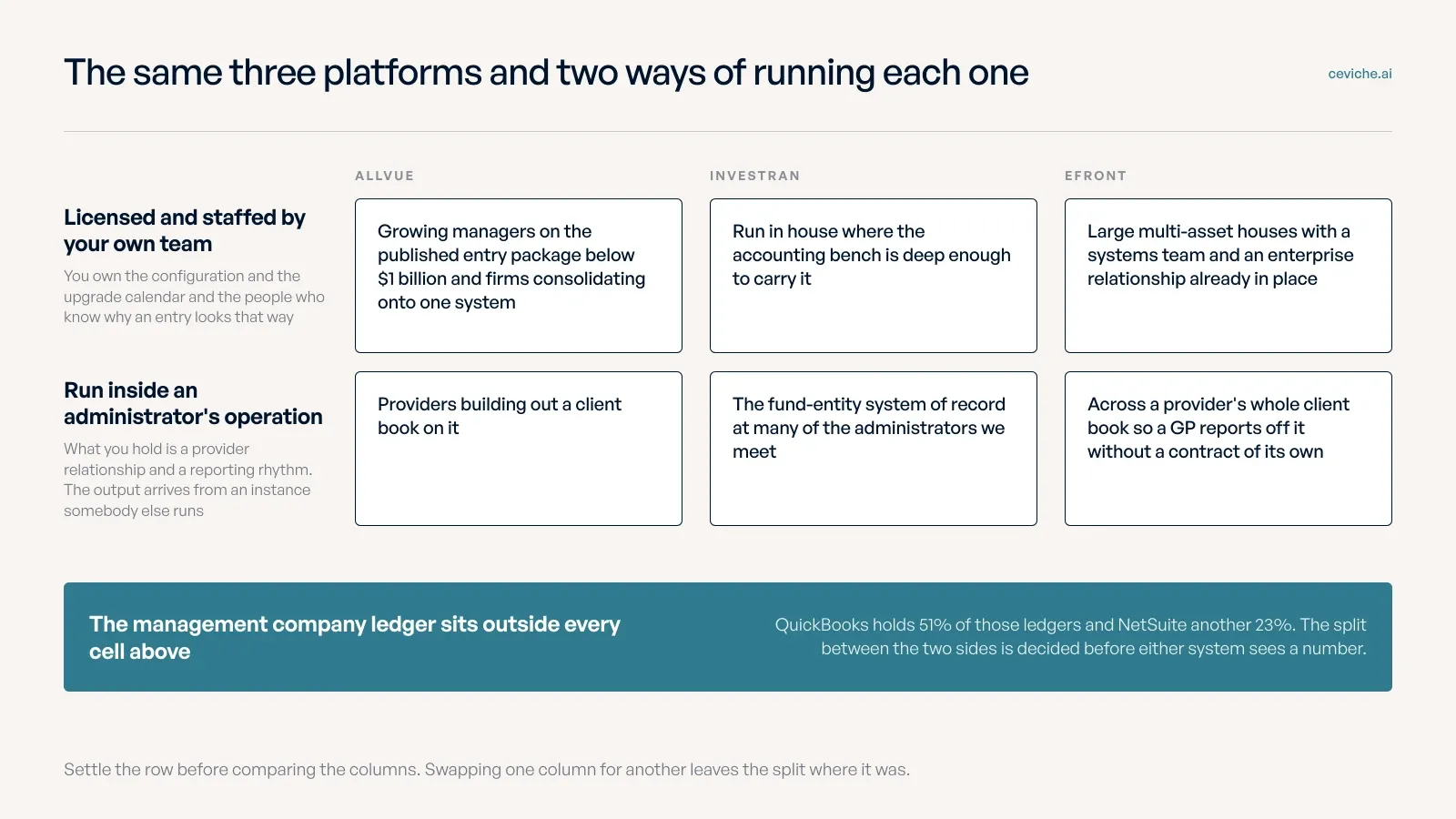
Every one of the three appears in both models. A firm licenses the platform and staffs it, or an administrator runs an instance and the firm receives output from it. We have seen the same product on both sides of that line within a month of each other, and almost nothing about the buying decision survives the switch. In the licensed model you own the configuration, the upgrade calendar and the people. In the administered model you own a relationship and a reporting cadence, and the person who knows why an entry looks the way it does works somewhere else.
That difference shows up fastest in the audit trail. At one venture firm with more than 20 fund entities, the administrator runs the Investran instance and books the fund side, and it sees only the final allocated amounts rather than how the split was reached, unless the controller sends all of the supporting work with it. The controller asked for a feed out of the platform on agreed cut-off dates instead of a quarterly file.
Fund accounting software maintains a private fund's books and records: the general ledger, NAV and valuations, partnership and capital account accounting, management fee and carried interest calculations, and the financial statements LPs and auditors rely on. It is the system of record for the numbers, not for the relationships.
Anyone still untangling the software from the service wrapped around it should read our fund administration versus fund accounting page, which separates the two. Ceviche publishes this page and sells software in the expense allocation category, so read our own entry with that in mind. What we sell is an allocation layer, which is not any of the three products below and does not compete with them. Product claims here are the vendors' own words, quoted and linked at first mention.
Allvue in Its Own Words
Allvue's fund accounting page claims a product "built to manage the complex fund structures and unique financial reporting requirements of private equity funds", pulling partnership accounting, financial statement reporting, a multi-currency ledger, cash management and workflow standardization under one roof. It advertises "a true general ledger" with a flexible report writer, an optional module automating "carried interest waterfall calculations" against detailed LPA modeling, and configuration "across business processes, reports, and allocation methods". Underneath sits Microsoft Dynamics 365 Business Central on Azure, with SOC 1 and SOC 2 alignment, and a claim that over 21,000 funds run on the platform.
Two commercial details tell you more than any of that. Modules "can be purchased independently", according to Allvue's private equity page, despite the suite being designed end to end, and there is an Equity Essentials package pitched at "startup private equity managers poised for growth with less than $1 billion in assets under management". For a platform this heavy, publishing a stated entry point at all is unusual. Allvue also ships Andi, "an AI-powered Knowledge Assistant delivered through a browser extension" for finding your way around the product.
Scope beyond fund accounting is where Allvue is widest of the three, covering portfolio monitoring, investor portal, investment accounting and a corporate accounting module for management-company books.
Investran in Its Own Words
The naming needs one paragraph, because a buyer meets it early and most comparison pages get it wrong.
FIS markets the product as Private Capital Suite, and its own page states that "FIS Private Capital Suite (formerly Investran) automates fund accounting and investor reporting". Apex Group separately publishes an Investran page headed FIS Investran, as one of the platforms it delivers services on. Those are the two published facts. Neither page states a corporate transaction, so this page states none, and we use the name Investran throughout because that is what buyers and controllers still say.
On capability, FIS opens with the problem rather than the product, saying "spreadsheets can no longer keep up with the data, investors and reporting demands private equity firms manage today", and offers to "connect accounting, reporting and investor management on a single, unified platform" and to "gain consistency, auditability and scalability by replacing manual tasks with automated workflows". A Digital Data Exchange investor portal sits alongside it, carrying Preqin benchmark data on more than 11,000 private capital funds. The Apex page adds the operational detail, describing support for "a wide array of direct investments and fund structures", "managing complex fund structures and supporting multiple sets of books while automating calculations and complex functions", and the ability to "perform allocations dynamically".
Worth saying plainly, because it affects how you read any comparison including this one. The published vendor material on Investran is thinner than on the other two, and the Apex page runs to about 163 words. That is a fact about the record, not about the software.
eFront in Its Own Words
Being a BlackRock company, with pages nested inside BlackRock and Aladdin navigation, tells you most of what matters about where eFront sits commercially. Its fund administration and accounting page says the suite "covers all alternative asset classes, including private equity, real estate, infrastructure and private debt funds", and puts in front of general partners "a flexible, transaction-driven accounting system specifically designed to meet the nuances of a diverse set of alternative investment structures across all asset classes".
The family is sold in named pieces rather than as one product. eFront FAIR, Invest GP, Invest LP, Invest AS, Investment Cafe, Portfolio Monitoring and Insight are each separately positioned, and the private equity page repeats the same multi-asset framing. Administrators are where you meet it most, deployed across a client book, so a GP can be reporting off eFront without having signed anything for it.
Nobody in this trio publishes a price. Every quote emerges from a sales process, priced off the number of funds, the shape of the entity map, the modules taken and the length of the build, which is how two firms of comparable size end up nowhere near each other.
The Three on the Five Things a Fund CFO Decides
| Platform | What you are buying | Who operates it | Scope beyond fund accounting | Management-company ledger | Expense allocation, as published |
|---|
| Allvue | A licensed platform, modules purchasable independently | Your team, or an administrator | Portfolio monitoring, investor portal, investment accounting | ✓ Corporate Accounting sold as its own module | Configuration across allocation methods |
| Investran | A licensed platform, also delivered as a service | Your team, or an administrator | Investor portal with benchmark data | Not described on the pages we checked | Allocations performed dynamically |
| eFront | A licensed product family, sold in pieces | Mostly an administrator | Portfolio monitoring, LP and asset-servicer products | Not described on the pages we checked | Not described on the pages we checked |
| Ceviche | One workflow on top of what you have | Your controller | ✕ None | ✓ Reads and writes the ledger you run | Per line, by LPA methodology, before either ledger sees it |
Vendor details change. Every cell above comes from the vendor's own page as it read on 2026-09-02, and none of these vendors publishes prices. Where a page said nothing on a topic, the cell says so rather than filling the gap with a guess.
Firm Size and Strategy Show Where Each One Is Usually Found
Allvue is the broadest of the three and the one with a published on-ramp, so it turns up at both ends, inside administrators scaling a client book and at growing managers who took Equity Essentials rather than a full deployment. It is also the platform we most often see named when a firm is deciding whether to consolidate. A private equity controller framed his evaluation as one question, whether to consolidate onto a single system carrying both the ledger and the fund accounting or to stay best-of-breed and accept the seam. That is the real decision underneath a three-way feature comparison, and no table makes it for you.
Investran is the one you meet most often through somebody else. It is the system of record for the fund entities at a large share of the administrators we deal with, and it is also run in house at firms with the accounting staff to carry it.
eFront is the enterprise answer, most often deployed across an administrator's client book or at large multi-asset managers with a systems team and an existing enterprise relationship.
They are also not always rivals. One venture and growth firm we spoke with runs one of these platforms for the fund books, another for compensation and carry, and QuickBooks Online for the management company. Sometimes these are three competitors. Sometimes they are three modules a firm bought separately. Readers weighing the wider set, including FundCount, LemonEdge, Dynamo, Carta, Entrilia and Juniper Square, should begin with our guide to private equity fund accounting software rather than a two-vendor page.
The Seam That Survives the Platform Decision
Our buyer evidence across these three is not symmetrical, and it is worth saying so before the argument. We hold a lot on Investran, a fair amount on Allvue, and one prospect voice on eFront, so where this page speaks from experience it says which product that experience is about, and everything said about eFront comes from eFront's own pages.
The structure is the same whichever you pick. The fund accounting systems we meet most are Investran and Allvue, plus administrators' own in-house ledgers. They hold the fund books. The management company sits on NetSuite or QuickBooks with its own controller. For decades the entries that mirror between the two have been booked by hand. Two ledgers cover most of that far side. Of the 80 fund finance teams we spoke with in 2026, QuickBooks holds 51% of management-company general ledgers and NetSuite another 23%, a spread our 2026 tech-stack research sets out in full.
At a large buyout firm running NetSuite on one side and Allvue on the other, the management-company team has no access to the fund system at all, so the percentages driving the split live in Excel and go stale until a fund controller updates the investment schedule.
The two systems don't talk to each other.
A private equity CFO running six funds across several countries described the same shape from the other end, using eFront for capital account statements and LP reporting, a basic local ledger for debits and credits, and Excel for everything in between.
Suddenly I find myself having six funds, and the expense allocation has become a nightmare.
Take one quarter at that kind of firm, where 100 to 200 transactions run through the books. A diligence trip covering five portfolio companies costs $9,400 in flights, hotels and meals, split five ways at 20%, so $1,880 per company. Two of those companies sit in the same fund, so that fund takes $3,760 and three other funds take $1,880 each. A sector conference costs $27,000 and benefits the platform, so it is allocated on invested capital across six funds holding $600M between them. At $30M, $60M, $90M, $120M, $180M and $120M invested, the shares are 5%, 10%, 15%, 20%, 30% and 20%, which gives $1,350, $2,700, $4,050, $5,400, $8,100 and $5,400.
Two costs, two different bases, ten fund-side entries and the mirrored due-from entries on the management-company side, from two lines of a quarter that holds a hundred more. Those same teams reported allocations crossing systems that do not talk to each other in 92% of cases, named multi-entity allocation a core complexity in 96%, and were doing the split in Excel in 81%. Swapping one of these three for another moves the fund-side system and leaves that work exactly where it is, for any firm keeping a separate management-company ledger. Allvue is the published exception, since its Corporate Accounting module is sold for those books, and taking it means moving that ledger onto the platform too.
What firms actually do about it is more interesting than any feature grid. One large technology-focused private equity firm running Investran in house built the layer itself, with an internal application that reads commitments and cost of investment out of the platform, allocates, pushes the result back to it, and moves the entries through the expense system into the management-company ledger. That firm evaluated no fund platform to solve this. It kept the platform it had and built the connective tissue. Its controllers were still blunt about what the tool did not give them.
I'm not really sure we have anything in terms of auditability, the ability to go back and confirm that we're doing things consistently.
Integration is the other half. The management-company ledgers publish APIs. The fund platforms are harder, and Investran in particular is the system of record for most of the snapshot data an allocation depends on, which is why some administrators are now putting a data warehouse in front of it so anything can read and write without touching the platform directly. That is our experience rather than a vendor statement, and it is worth asking your administrator about before you compare write interfaces. Our own fund expense allocation software is built for exactly that gap.
Ceviche fits when
Ceviche fits when the platform holding your fund books is chosen, the question of who operates it is settled, a separate management-company ledger is staying put, and the thing still landing in a spreadsheet is the split across funds, SPVs and the management company before either system sees a number. It takes the invoice, computes each line on the basis its LPA sets, and writes audit-ready entries into the ledger you already run, recording that basis alongside every line. It is not a fund administrator, a general ledger or a managed service, and it does not do the allocations for you. Flybridge runs it across 18+ fund entities today, on the Bill.com and QuickBooks Online stack it already had, with no ledger migrated. If the fund accounting platform itself is still an open question, or you need a general ledger at all, this is the wrong product to be evaluating and the three above are the right ones. The product walkthrough shows the output.
More Comparisons
If Allvue is your incumbent and you are pricing the field rather than the three-way, our Allvue alternatives guide covers the full set with fit conditions for each. If the ledger itself is the job and you want the accounting-first options weighed against each other, start with FundCount alternatives instead. If LemonEdge is on the same shortlist as the newer partnership-accounting engine, our LemonEdge alternatives guide weighs it against this field.
Frequently asked questions
Who are Allvue's main competitors?
On the platform side, Investran, eFront, FundCount, LemonEdge, Entrilia and Dynamo, plus the administrators that run those platforms as a service. Carta and Juniper Square compete for the same buyer at the smaller and service-led end. The honest set depends on whether you are buying software, a service, or both, which is the fork this page opens with.
Who owns Allvue Systems?
Vista Equity Partners. Allvue was formed in 2019 when Vista bought AltaReturn and merged it with Black Mountain Systems. Reuters reported in August 2026 that Vista was exploring a sale of the business, which was the position as at 2026-09-03. Ownership changes rarely alter a product in the near term, but they do alter roadmaps and support, so it belongs in diligence.
How much does Allvue cost?
No price list exists at Allvue, FIS or eFront. Every quote is assembled in a sales process, and the inputs are fund count, entity complexity, module selection and build length. Allvue is the outlier for publishing an entry package pitched below $1 billion in assets, which at least confirms a smaller configuration exists. Ask for the build quoted as its own line item, since two proposals with similar software numbers can sit a multiple apart on implementation.
Can allocation drivers be pulled from Investran, Allvue or eFront rather than re-keyed?
Controllers put this to us more than any other question. The platform already holds commitments, cost of investment and entity structures, so anything sitting above it ought to read those rather than ask you to maintain a duplicate. Where a direct read is off the table, an ingestible file or the administrator's own data layer usually is not. Establish which one applies before you commit.
Should we consolidate the management-company ledger and the fund accounting onto one platform, or keep them separate and solve the seam?
Both are defensible and the trade is clear. Consolidating removes the seam and commits you to one vendor's data model and one migration. Staying best-of-breed keeps each ledger fit for its job and leaves a gap someone has to cross every quarter. Decide which cost you would rather carry, then buy for that.
What about a co-invest vehicle the fund platform does not track?
Ask about it in every demo, because it is where hand-maintained inputs creep back in. A vehicle outside the platform has no commitment record to read, so the allocation layer needs somewhere to store a custom basis for it and to keep that basis under the same audit trail as everything else. If the answer is a spreadsheet on the side, nothing has been solved.
