Most Carta alternatives lists are about cap tables. This is the administration decision, with the four real options and the question that picks between them.
TL;DR
Four kinds of alternative exist. A rival platform administrator selling software and accountants as one thing, a full-service firm selling mostly people, a license you or your provider operates, or no administration change at all and a fix to the one layer that is failing. Start by naming what broke.
What Does Carta Fund Administration Actually Cover?
Take the incumbent from its own pages rather than from a competitor's characterization of it. Carta's fund administration page presents the software and the accountants as one purchase, promising you can "start running your fund operations on Carta in a matter of weeks" against committed timelines and AI-driven data migration. Fund Tax, SPVs, fund formations, KYC and AML services, a deal and LP CRM and portfolio valuations make up the named scope, with formations and first closings executed in six weeks and more than $220 billion in private capital fund assets under administration on the platform. The larger pitch is the Fund ERP, a single ledger tying the front, middle and back office together with "400+ finance experts" standing behind the data. That is what a GP is actually weighing, and it is a serious offer.
Allocation shows up in exactly one place in Carta's published material, on the Ramp integration page, which promises you can "minimize errors with categorization rules and expense allocations" and that "with custom rules, you control how and where expenses are allocated, from creating categories to splitting transactions between funds". The scope on that page is precise and worth reading slowly. Card spend is what moves, from the swipe into Carta's own general ledger. Neither the word invoice nor the words management company appear anywhere on it.
That precision matters for anyone weighing alternatives, because it tells you which half of the problem is inside the platform. A head of finance at a two-fund venture firm that runs both the funds and the management company on Carta described the rest of the workflow to us. She reads each invoice, tells the platform the split, and the fund-side entries book automatically, while card spend is allocated in the card platform and synced across. The allocation is still a decision she makes line by line before any of that automation runs.
Fund administration is the outsourced service a GP buys to run a fund's middle and back office. It covers fund accounting plus investor servicing and onboarding, capital calls and distributions, the investor register and reporting package, AML and KYC checks, and support for audit, tax, and regulatory filings.
Buyers regularly conflate the bought service with the accounting work inside it, so we pulled the two apart in our piece on fund administration versus fund accounting.
Why Do Most Carta Alternatives Lists Cover Cap Table Software?
Because Carta sells two different products and most writing on its alternatives covers only one. More than half of the alternatives lists are about cap table and equity management, and a couple more cover real estate syndication and SPV administration. The handful of pages that address administration each replace Carta with whatever the author happens to sell, whether that is a portfolio reporting tool, a carry calculator or an investor-onboarding platform. A GP asking about Carta fund administration has already bought fund administration and is asking something narrower, which is what else could hold the fund books and the service relationship.
The Four Kinds of Carta Alternative
The first kind is another platform administrator. Software and the accountants who run it come from the same company, which is Carta's own model, and Juniper Square and Dynamo sell the same shape.
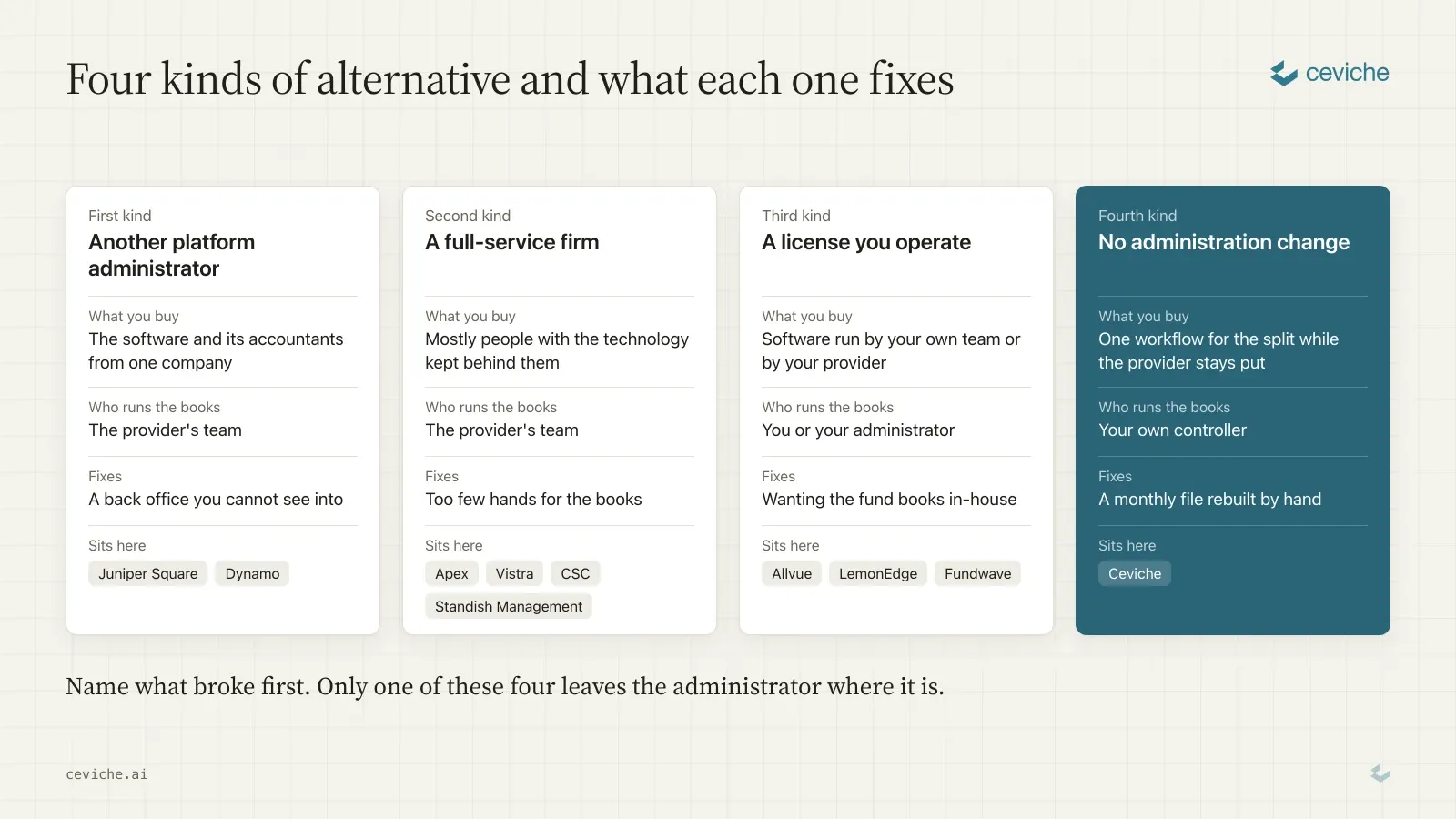
The second is the full-service firm, where you are mostly buying people and the technology stays behind them. Apex, Vistra, CSC and Standish Management sit here.
The third is a license, operated by you or by your provider. Allvue, LemonEdge and Fundwave live there. Taking that route means taking operations in-house, and the economics of that move are in our guide on when to bring fund administration in-house.
The fourth changes no administration at all. The provider stays, and only the failing layer moves. None of the alternatives lists raises the possibility, which is a shame, because the administrator is rarely what actually broke.
Two questions narrow all four quickly. The first is who employs your accountants, which decides who picks up the phone at six on a close day. The second is what becomes of the management company, whose ledger usually sits outside whatever you sign. Ceviche publishes this page and sells software in the expense allocation category, so read our own entry with that in mind. Everything attributed to a provider below is quoted from its own site and linked the first time it appears.
See it on one of your own invoices. Ceviche pulls the invoice from Ramp, Bill.com, Brex, Expensify, or SAP Concur, applies the allocation methodology each LPA specifies per line, and writes audit-ready journal entries back into QuickBooks Online, NetSuite, or Sage Intacct. Book a demo.
| Option | What you buy | Who operates the books | Management-company books | Expense allocation, as published | Sold to |
|---|
| Carta | Software plus a service team | Carta's accountants | Not described on the fund administration page | Card spend split between funds inside Carta's ledger | VC and emerging managers |
| Platform administrators | Software plus a service team | The provider's team | Juniper Square sells it as a named service | Juniper Square outsources complex allocations to its team | GPs across real assets, PE, VC, credit |
| Full-service administrators | A team, with technology behind it | The provider's team | Apex and CSC sell it separately | CSC names the annual expense budget; the others do not mention it | Funds above roughly $500M |
| Licensed software | A license you operate | You, or your administrator | Allvue sells Corporate Accounting for GPs | Fundwave publishes an Allocate module | Administrators and larger GPs |
| Ceviche | One workflow, nothing else | Your controller | Reads and writes the GL you already run | Per line, by LPA methodology, posted to your GL | Lean GP finance teams |
Vendor details change. Every cell above comes from the vendor's own page as it read on 2026-09-03, and none of these vendors publishes prices.
Carta Fund Administration Alternatives in 2026
Juniper Square
Juniper Square is the nearest like-for-like swap, selling its own software and its own accountants as one relationship. The administration page lists treasury services, where its professionals run capital calls, distributions and payments while investors update wiring instructions under secondary approval, alongside investor services, onboarding with AML and KYC, and loan administration built for private credit managers. It supports Luxembourg-domiciled entities through its own local operation, and says it works with hundreds of real asset, private equity, private credit and venture GPs across thousands of entities.
Where it separates from Carta is the management company. Juniper Square sells those books as a named service of their own, run by the same accountants who handle the funds, so a firm that hands over both sides retires the question instead of connecting two systems. That suits sponsors running many vehicles with dense investor reporting, and it suits nobody who intends to keep management-company accounting inside the firm.
Dynamo Software
Dynamo does the same trick from the other direction, delivering fund administration services on top of the platform it also licenses. Its own page describes "a fully integrated general ledger purpose-built for GPs" covering capital calls, distributions, fee calculations, waterfall models and investor allocations, with onboarding workflows carrying KYC and AML into downstream accounting, GAAP statements and K-1s, and a portal for LPs. It claims over 1,000 clients and offices spanning Boston, Singapore, London and Hong Kong.
The economics work best when Dynamo already runs your fundraising, CRM or portfolio monitoring, because putting administration on the same data platform retires a vendor-to-vendor reconciliation. Without that, it is judged on the administration alone against everyone else here.
The Full-Service Administrators
These are one category, not four profiles, and the comparison between them is a service comparison rather than a software one.
Apex Group calls fund administration the business it started in and the cornerstone of everything else it sells, with 2,000 specialists behind $3.5 trillion under administration, and it prices management company work as a separate service line rather than folding it in. Vistra puts 2,000 fund experts behind $1 trillion of assets, spread across more than 12,000 structures and over 50 jurisdictions, and runs its own VFunds platform alongside whatever else a client brings. CSC writes "preparation and maintenance of the annual expense budget" into its private equity scope, the only administrator page we reviewed that puts expense planning in writing. Standish Management keeps its scope plain, covering financial reporting, audit and tax coordination, partnership accounting, capital call and distribution management, LP communications and performance return calculations.
This category fits any fund above roughly $500M that wants an independent party on the books and judgment rather than automation on the hard parts. A venture CFO who spent years inside a fund administrator put the choice to us as technology against judgment. The platform administrators are ahead on software, he said, and the audit and the tax allocation workbook still come down to people who understand them, which is why he treats the lower-risk vehicles as the place to try a platform administrator first. Which platform sits behind the service, and whether the record leaves in a usable form, belongs in the RFP rather than in a brochure.
Allvue
Allvue is a license, aimed mostly at administrators and at GPs large enough to run accounting themselves. Its fund administration page frames Fund Accounting as "a complete back-office solution that combines detailed financial statement reporting, a true general ledger, cash management and workflow standards", with a Client Hub giving auditors and other third parties direct access to shared documents and live reports, plus Business Intelligence through Power BI and a Fund Administration Essentials bundle for administrators still building a client book.
Then there is Corporate Accounting, which Allvue calls "management company accounting software that's designed especially for private capital GPs". Few licensed platforms address both ledgers in their own material, and this is one. Take it on if the people and the runway for an enterprise rollout exist, and leave it alone if the finance team fits around one table.
LemonEdge
LemonEdge is an accounting engine you license, and its page for fund administrators is unmistakably written for service providers carrying many client books at once. The pitch turns on getting spreadsheets off the desk. Its Algorithms technology pulls existing Excel calculations into the platform so they run against live data under permissions and a full audit trail, and its API toolkit moves data both ways, including posting into a client's own warehouse or a third-party ledger for a shadow process.
If the real exercise is evaluating your administrator's technology rather than buying any of it, this is the page to read before that meeting. Bought directly, it suits a GP prepared to operate a partnership accounting engine internally, which is a very different firm from one looking to replace its administrator.
Fundwave
Fundwave is the smallest thing on this page and the only one that mentions commercials unprompted. Its fund administration page leans on automating the mechanical parts, generating the journal entries behind a capital call notice with no extra work, calculating unrealized gain journals straight from a valuation screen, producing a trial balance in seconds against account groupings you define yourself, and computing management fees on commitment, cost of investment or NAV with different rates per investor. On price it advertises "transparent pricing, unlimited users, product updates, no hidden costs" and still prints no figure.
The fit is a first-time manager with one fund, a couple of vehicles, hours to spare and no appetite for a service contract. Anyone who arrived here wanting software rather than a provider should start with our review of VC fund accounting software.
Ceviche
Ceviche sits in the fourth category and administers nothing whatsoever. It rides on top of whichever provider and ledger you keep. The single thing it owns is the split itself, together with a written basis for each line.
Excel is still where this happens for almost everyone. Of the 80 fund finance teams we spoke with in 2026, 81% ran the allocation there and 92% ran it across systems that do not talk to one another, most with an administrator already engaged. Nothing about who administers your funds changes. Your administrator gets read-only access to the workings instead of a spreadsheet arriving by email the night before a deadline.
What Does Switching Actually Cost?
More than the quote, and the cost is almost entirely data. A venture CFO who has terminated an administrator told us what the migration was really about.
It is a monumental effort to do that. Everybody should have portable data. The reality is it's all about getting data off of one person's platform.
He still told emerging managers to hire a third party rather than build a back office, which is exactly the point. The switching cost is not an argument against administrators. It is the reason to settle portability before signing instead of discovering it on the way out. Three questions do the work. In what format does the record leave if you go in year three? Which parts of it reach an API, and which live only inside the portal? And whose people rebuild the history in the new system?
Set against that, one honest reason firms move onto a platform administrator in the first place. A head of operations at a ten-person venture firm moving onto Carta told us her previous administrator was a black box run over email, with no visibility into anything, and she wanted to see the back end herself. If that is your complaint, a platform administrator is the right answer and this page's fourth category is not what you need.
The Work No Administrator Takes Off Your Desk
Every option above records allocations. None of their published material describes deciding them. That distinction is invisible in the sales process and obvious the first quarter after you sign, and it holds whether allocation is handed to a team, sold as a module, or left off the page altogether.
A CFO whose funds sit across two different administrators described what that feels like from the management-company side.
I have found them to be pretty protective and resistant. We tried to have a consolidated way of doing certain things, and they said we can't integrate with any of your systems.
The arithmetic is small and the decision is not. Take a firm processing about 60 invoices a month, where 59 belong wholly to one entity and need no thought at all. The sixtieth is a $46,200 annual insurance renewal covering the management company and six vehicles.
Of that, $13,800 is the management company's own layer, priced separately on the invoice, so specific identification puts all of it on the management company. The remaining $32,400 covers the funds and splits pro rata by committed capital across Fund I at $60M, Fund II at $120M, Fund III at $180M, two SPVs at $30M each and a continuation vehicle at $120M, which is $540M in total. Fund I takes $3,600, Fund II $7,200, Fund III $10,800, each SPV $1,800 and the continuation vehicle $7,200.
Seven entities, one invoice, and two different bases inside it. Your administrator will post all seven entries the moment you hand them over. Deciding them, documenting why the management-company layer is not a fund expense, and rebuilding every ratio when Fund IV closes next quarter is work that stays with you no matter which provider is on the other end. That one invoice out of sixty is the entire problem, and it is why the 81% figure above survives the presence of an administrator.
How Do You Choose a Carta Alternative?
Name what broke first, because each category fixes something different. Slow or error-prone fund books point at another administrator. A black box you cannot see into points at a platform administrator. Too few people points at a full-service firm. A monthly file somebody rebuilds by hand points at nothing on the administration menu at all.
Next, work out who employs your accountants and whether that team survives the year. Ask each provider what its accounting-team turnover looks like and whether the people who learn your funds stay on them, because continuity is what separates one service firm from another and almost nobody puts it in writing.
Then the management company. One provider will staff those books, another will sell you software for them, and several say nothing at all, which tells you about scope rather than quality. Whatever you choose, that ledger and the split between it and the funds are where the work lands. Finally, establish what leaves with you, because a provider that opens an API for the cap table and not for the ledger is a normal provider rather than a bad one, and you want to know which kind you hired before the data is inside it. Our wider review of fund administration software goes further on the platforms sitting behind each of these names.
Ceviche fits when
Ceviche fits when your provider and your ledger are both decided, the vehicle count has passed what one spreadsheet holds, and a small team somewhere between roughly $500M and $15B is doing the shared-cost split by hand every quarter. It is not a fund administrator, a general ledger or a managed service, and it does not do the allocations for you. If the administration relationship is the thing that broke, one of the four categories above is the answer and this is not. Flybridge moved its quarterly allocations across 18+ fund entities out of spreadsheets without touching the Bill.com and QuickBooks Online stack underneath. The product walkthrough shows the output.
Frequently asked questions
How much does Carta charge for fund management services?
No public price list exists, at Carta or at most of the providers here. Quotes come out of a sales conversation, and the variables you can move are how many entities and LPs you carry, how many SPVs you spin up in a year, whether the management company runs on the platform, and which services are bundled rather than billed on top. Establish which of those are metered before setting two quotes side by side.
If we use the fund platform's allocation module, do we have to move our fund general ledger onto that platform too?
A fund controller at a private equity firm put that constraint to us plainly, and Carta's own published material is consistent with it. The allocation described on the Ramp integration page runs card transactions into the Carta general ledger. Using a platform's allocation module generally means being on that platform's ledger, so scope the ledger decision and the allocation decision together.
Won't Carta just add full expense allocation itself?
What Carta publishes today is card-spend allocation through its Ramp integration, scoped to transactions flowing into its own ledger. Predicting anyone's roadmap is not our business. Buy against what is shipped and ask the vendor directly what is on the plan and when.
Can we keep our administrator and change only the allocation layer?
Yes, and for firms whose provider is working it is usually the right answer. The layer takes the invoice, applies the basis each LPA calls for line by line, and posts completed entries into your own ledger, so what reaches the administrator is a documented split rather than a workbook. The relationship is untouched and nothing migrates.
How hard is it to migrate off a fund administrator?
Harder than the sales process implies, and the difficulty is data portability rather than paperwork. Historical capital accounts, allocation history and supporting documents are the parts that fight you, and rebuilding them in the new system usually falls to your team. Ask for the extract format and the API scope in writing before you sign, not when you leave.
What is the best accounting software for private equity firms?
It depends which layer you mean. For fund books, licensed engines like Allvue and LemonEdge compete with platform administrators. For the management company, most firms keep QuickBooks, NetSuite or Sage Intacct and add what is missing. Our reviews cover each layer separately rather than treating one product as the answer to all three.
