
TL;DR
Placement agent fees pay a placement agent for finding a fund's investors, typically as a percentage of the commitments the agent brings in. The LPA decides who bears the fee. The manager pays it, or the fund pays it and the manager reduces its management fee by that amount. Some LPAs let the fund bear it up to a cap.
A placement agent is a firm that a fund manager hires to find investors and sell them interests in a fund. The placement agreement sets the agent's fee and which investors count toward it. The LPA decides whether the manager bears that fee or the fund pays it and the manager reduces its management fee by the same amount.
Whichever route the LPA picks, someone has to book the agent's vendor invoice to the right entity. In Ceviche, AI reads that invoice, and the split comes from a rule your team approved.
What is a placement agent?
A placement agent's work goes beyond introductions. The law firm Morgan Lewis describes duties such as marketing materials and investor meetings. The agent can also keep a master log of the investors that it contacted. It can also help shape the fund's terms and the pitch.
Not every manager uses one. One long-established venture firm does no marketing and prepares no PPM, according to its finance lead. Most of its LPs are large endowments and institutions with long ties to the firm. For its next fund, the firm cut allocations back.
How is a placement agent fee calculated?
Morgan Lewis writes that "Typically" the fees are "calculated as a percentage of the total capital commitments" from investors that the agent introduced. So the placement agreement must say which investors count. Morgan Lewis names two common methods. One is a schedule of target investors. The other is an objective test, such as at least two face-to-face meetings between the agent and an investor. Morgan Lewis also advises managers to exclude commitments from the GP and its affiliates.
The agreement also sets these terms.
- Expenses. The agreement can reimburse the agent's own expenses, which the ILPA documents treat separately from the fee.
- A sequel fund. Morgan Lewis notes that an agent may ask to be paid for investors it introduced who later invest in a sequel fund. Some agents also ask to act for that sequel fund.
- Timing. The fee can fall due after the final closing or as the fund calls capital.
The ILPA model LPA and ILPA's Principles 3.0 set no fee rate, so any rate is a term of one agreement.
Who pays a placement agent fee?
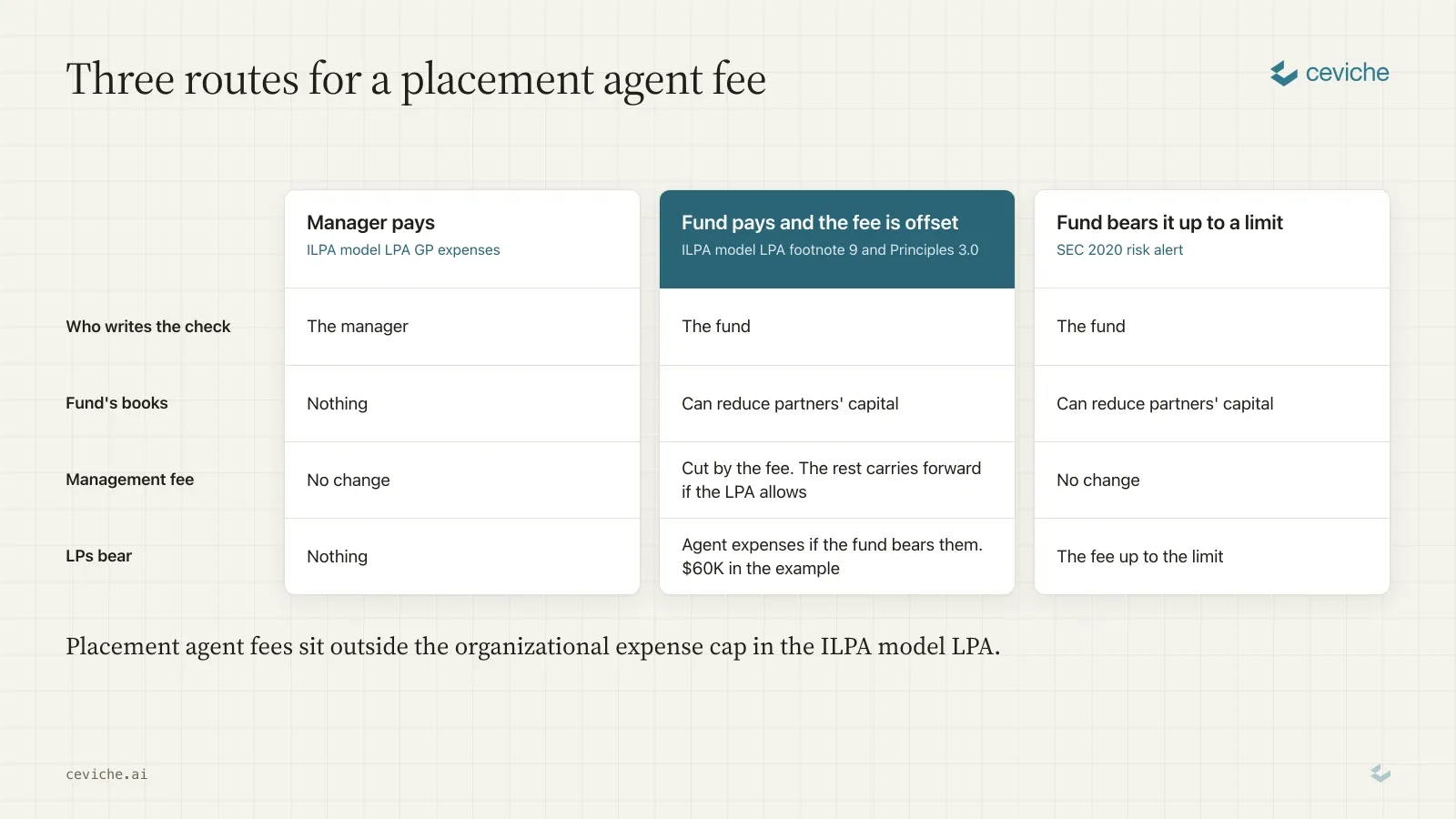
The LPA picks one of three routes.
- The manager pays. ILPA's model LPA lists "placement agent fees and expenses" among the general partner expenses that the GP or its affiliates pay.
- The fund pays, and the manager reduces the management fee by the same amount. Footnote 9 of the model says "placement fees (but not placement agent expenses) may be paid by the Fund but offset against the Management Fee."
- The fund bears the fee up to a limit in the LPA. The SEC's 2020 risk alert found advisers that "failed to comply with contractual limits" on expenses "such as legal fees or placement agent fees."
ILPA's Principles 3.0 recommend that the manager bear the fee but put placement expenses on the fund. "Placement agent fees should be borne by the fund manager while placement expenses should be borne by the fund." Where the fund bears the fees, ILPA says "the management fee should be fully offset for such amounts."
Firms set their own policy on which costs a fund bears. At one fund manager with a long track record, the finance lead keeps deal travel and diligence at the management company. The one exception is fundraising.
"[I]f there's a fundraising, then that's a syndication cost, and that's specific to a fund that we're raising."
At one venture firm, the management company fronts nearly every cost. A member of its finance team thought placement fees might have been one of the rare bills that went to a fund directly. At an emerging venture manager, placement agents are on the short list of costs that the funds bear. Other items on that list include the fund administration fee, the audit, other fundraising costs and legal. Our page on which costs the fund bears and which stay with the manager covers the wider split between fund and management company costs.
How does the management fee offset work for a placement fee?
Under the second route, the fund pays the agent and each LP bears its share of the fee. Then the manager reduces each LP's management fee by that LP's share. The manager ends up bearing the fee through lower fee income. Under the ILPA model, the agent's expenses stay with the GP even when the fund pays the fee.
A large fee can exceed one quarter's management fee. The ILPA model handles a similar case for portfolio company fee income. It reduces each installment "but not below zero" and carries the excess to the next payment dates. A placement fee offset needs a clause like that. The ILPA reporting template also gives the placement fee offset its own line, stated "gross of any unapplied balance."
How is a placement fee recorded in the fund's books?
A placement fee is a cost of selling interests in the fund, not a cost of running it. The ILPA template says placement fees "might not be recorded as an income statement line-item" but as "a direct reduction to partners' capital." Our guide to capital accounts and capital calls shows how a charge reaches each partner's capital account.
The fee also sits outside the organizational expense cap. The ILPA model defines organizational expenses as "excluding the fees or expenses of any placement agents." Section 709(a) of the Internal Revenue Code bars deducting amounts paid "to promote the sale of (or to sell) an interest" in a partnership. Treasury Regulation 1.709-2 lists "brokerage fees" among syndication expenses, which "must be capitalized."
The fee belongs to the fund being raised, and the funds that are raising can change over time. A management company finance manager at a venture and growth investor gave an example. In that example, every invoice from one vendor is a fundraising expense.
"The fundraising expense needs to be coded differently, and the funds in fundraising will change over the period of the subscription potentially."
When several funds raise at once, one agent's invoice can serve all of them. One fund-of-funds manager splits shared syndication costs across funds that raise together. A colleague of its finance lead added, "We're just doing the breakouts manually." That manual work grows with each fund that shares the bill.
What does a placement fee offset look like in numbers?
Take an illustrative fund under the second route. Fund III has $400,000,000 of LP commitments. LP A committed $50,000,000, LP B committed $120,000,000 and LP C committed $230,000,000. The agent introduced $150,000,000 of those commitments. The example assumes a placement fee of 2.00% of the commitments the agent introduced and a management fee of 1.75% a year on commitments. These are inputs for the example, not market rates.
LP share = LP commitment / total LP commitments
LP placement fee = placement fee x LP share, and the shares must add up to the whole fee
The placement fee is $3,000,000. Assume the LPA follows Principles 3.0, so the fund bears the agent's expenses of $60,000. The management fee is $7,000,000 a year, or $1,750,000 a quarter.
| LP | Share | Placement fee charged to capital | Agent expenses | Management fee offset | Net cost to the LP |
|---|---|---|---|---|---|
| LP A | 12.50% | $375,000 | $7,500 | $375,000 | $7,500 |
| LP B | 30.00% | $900,000 | $18,000 | $900,000 | $18,000 |
| LP C | 57.50% | $1,725,000 | $34,500 | $1,725,000 | $34,500 |
| Total | 100.00% | $3,000,000 | $60,000 | $3,000,000 | $60,000 |