
TL;DR. Fund administration in private equity outsources a fund's middle and back office: fund accounting, NAV, capital accounts, capital calls, investor reporting, and compliance. The administrator posts the books, but does not decide how shared costs split across your funds, the GP, and co-invest vehicles. That work stays the GP's job, and for 81% of teams it still lives in Excel.
Your administrator does the accounting and not the judgment
Here is the thing nobody else will tell you, because everyone writing about fund administration is selling fund administration. Hiring an administrator does not move expense allocation off your desk. The administrator can post the journal entry once you decide the split. It cannot decide the split. The methodology for dividing an outside-counsel invoice across Fund I, Fund II, and a co-invest SPV, the intercompany due-to and due-from, the documented basis an examiner will ask for: that work is yours whether you run the books in-house or pay a third party to.
This matters because the marketing implies otherwise. A GP reads "we handle fund accounting and reporting" and assumes the messy allocation problem went with it. It did not. In our 2026 research across 80 PE, VC, and credit fund finance teams, 81% were still allocating expenses in a spreadsheet, and plenty of those teams already had an administrator. The administrator was posting clean entries on top of an allocation that a controller still built by hand the night before. So before the definitions, hold onto the one operator point: administration covers the accounting, not the judgment.
What is fund administration in private equity?
Fund administration is the third-party management of a private fund's middle- and back-office operations: fund accounting and the general ledger, NAV and valuation, capital-account maintenance, capital calls and distributions, investor reporting and servicing, and regulatory and compliance support. The administrator keeps the official books and produces the records LPs and auditors rely on. The GP keeps investment decisions and the policies the administrator executes.
Private equity administration is its own discipline, not a relabeled version of hedge-fund admin. A PE fund is closed-end and long-lived. Capital comes in through drawdowns over years, not a daily subscribe-and-redeem flow, so the administrator tracks committed versus called versus uncalled capital per LP, maintains a capital account for each investor across the life of the fund, and computes distributions through a waterfall with carry. The accounting is event-driven and uneven, and the records have to hold up across a ten-year fund life and an SEC exam, which is a different problem from marking a liquid book to market every night.
What does a private equity fund administrator do?
The mandate runs wider than "they do the accounting." The real list breaks into four areas of work.
Start with fund accounting, the core. The administrator maintains the general ledger, books transactions, reconciles cash and positions, and produces the financial statements under the AICPA's investment-companies guide. Sitting on top of that is valuation and NAV, including performance figures like IRR and the multiple metrics LPs expect each quarter.
Capital activity comes second, and it is where PE diverges most. The administrator issues capital-call and distribution notices, tracks each LP's commitment and called capital, and maintains the capital accounts that say who is owed what.
Third is investor servicing: onboarding and subscriptions, the investor register, the LP portal, responding to LP queries, and the quarterly and annual reporting package, which increasingly follows ILPA's reporting template for fees and expenses.
Last comes compliance and tax support: AML and KYC checks, FATCA and CRS reporting, supporting Form PF and other regulatory filings, and coordinating with the fund's auditors and tax preparers at year-end. The administrator does not sign the audit or file the return. It assembles and reconciles what the auditor and the tax team need.
Notice what is not on that list. Deciding how a shared cost gets allocated across entities is not a line item, because it sits upstream of the posting. The administrator records the allocation you hand it. We will come back to that, because it is the gap that costs fund finance teams the most.
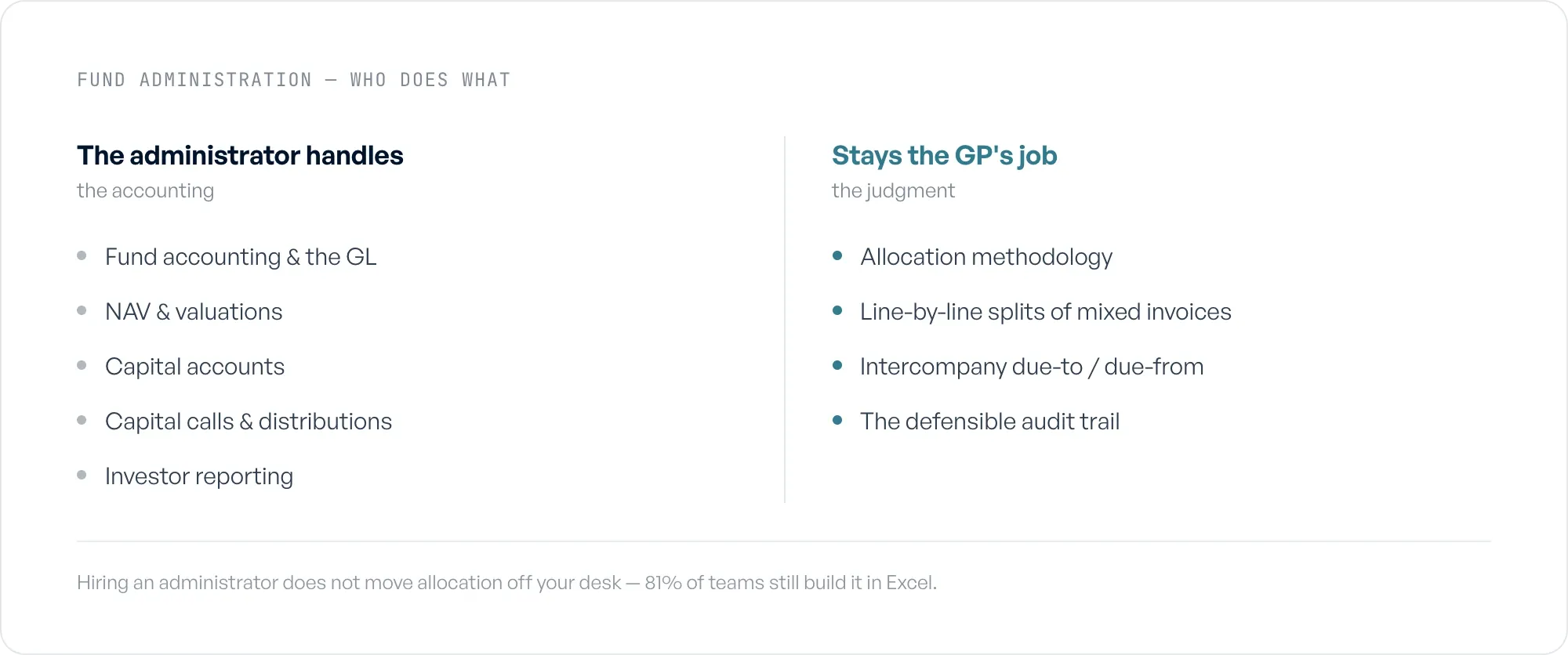
Administration covers the accounting, not the allocation judgment.
The books they keep are the subject of our private equity fund accounting guide.
Why do GPs outsource fund administration?
The honest reason is focus, plus a few real operational benefits. A GP's edge is sourcing deals, managing portfolio companies, and raising the next fund. Building an in-house fund accounting team that can handle multi-currency, multi-vehicle closed-end accounting under SEC scrutiny is expensive, slow to staff, and not where a GP wants its marginal hire. Handing the back office to a specialist lets the front office stay on the front office.
The operational case is concrete. An administrator scales with the fund family without the GP hiring ahead of growth, brings infrastructure and multi-jurisdictional reach a single fund could not justify on its own, and gives LPs an independent party touching the books, which most institutional LPs now expect in diligence. For a first-time or growing manager, an administrator is often the only way to look institutional to the LPs you are courting.
What outsourcing does not buy is the disappearance of operational work on the GP side. Someone at the firm still owns the data the administrator depends on, still answers the methodology questions, and still produces the allocation logic. The 92% of teams we interviewed who run allocations across disconnected systems that do not talk to each other include firms with administrators. The administrator is one more node in that chain, not the thing that connects it.
The one thing administration leaves on your desk is expense allocation
This is the section everyone else skips. An administrator can post the books and still leave you doing the hardest part by hand, because fund expense allocation is judgment, and judgment does not outsource cleanly.
Across our 80 conversations, 96% named multi-entity allocation a core complexity and 63% named legal-invoice allocation one of their hardest problems. Those pains belong to the GP. The administrator inherits the result. When a controller told us, "we get one invoice that sometimes gets allocated over like 10 different funds," the administrator was not going to decide that split. It was going to wait for the controller to decide it, then book it.
Legal-invoice allocation is the work of dividing a single outside-counsel invoice, often dozens of timekeeper lines plus disbursements, across the fund entities, the GP, co-invest vehicles, and the management company that the work served, applying the methodology each line's matter and the LPA support, then recording the basis for each split.
Here is the worked example, because no one selling administration will show you one. An outside-counsel invoice lands at 25 lines: deal-diligence time on a portfolio company, formation work on a new fund, and general fund matters, mixed with filing fees and travel disbursements. The deal-diligence lines get split across the three funds and the co-invest SPV that participated, weighted by invested capital in that deal. The formation lines belong only to the new fund, allocated by specific identification. The general fund lines go pro rata across the active funds by committed capital. The travel disbursement follows whichever line it supported. That is three different methodologies inside one bill, and the administrator can post all of it once you decide it. Deciding it is the part that took a controller the night before the close.
Then there is the trail. 49% of the teams we interviewed have a gap in their allocation audit trail: the split happened, but the documented reason each line went where it did does not survive in a form an examiner accepts. One controller described the support for a past allocation as "somebody writes a paragraph after the meeting." An administrator booking your entries does not fill that gap, because it documents what it posted, not why you chose the split. Fee and expense allocation is a recurring priority for the SEC's Division of Examinations, and what an exam pulls on is exactly the reasoning the administrator never had.
So the four things administration hands back to you: the allocation methodology, the line-by-line split of mixed invoices, the intercompany due-to and due-from logic, and the audit trail behind why each split is defensible. The administrator executes. The GP decides.
In-house vs third-party vs co-sourcing
The old framing was build or buy. The 2026 framing is build, buy, or co-source, and most growing funds land in the third bucket.
Full in-house means the GP runs its own fund accounting team and systems. It gives the most control and the tightest feedback loop, and it costs the most in headcount and infrastructure. It tends to fit larger managers who have already built the team, or firms with allocation logic so specific they would rather own it than explain it to a vendor every quarter.
Full third-party means the administrator runs the back office. It is the fastest way to look institutional and the lightest on internal headcount, with the tradeoff that you are a step removed from your own books and dependent on the administrator's turnaround and accuracy.
Co-sourcing is the hybrid, and it is where the real 2026 answer sits for most firms: keep the administrator for the heavy, repeatable accounting and reporting, but own the layer where your judgment lives. Expense allocation is the obvious thing to keep, because it is the part that depends on your LPA, your methodologies, and your defensibility, and it is the part that still runs on a spreadsheet at most firms.
The reason the hybrid works is the stack. The allocation problem sits between the systems funds already run, and an administrator is rarely positioned to bridge them. On the GL side, QuickBooks and NetSuite cover 73% of management-company general ledgers in our tech-stack data, usually with a separate fund-side system behind them. On the spend side, the firms cluster around Ramp, Bill.com, and Expensify.
| Layer | What the data shows |
|---|---|
| Management-company GL | QuickBooks ~51%, NetSuite ~23% (73% combined) |
| Spend / AP tools | Ramp ~49%, Bill.com ~39%, Expensify ~30% |
The allocation lives in the gap between the spend tools and the GL, which is exactly where a spreadsheet gets wedged in. Co-sourcing replaces that spreadsheet with a system you own, while the administrator keeps doing the accounting on the other side of it.
How do you choose a private equity fund administrator?
The standard checklist is sound and worth running: PE-specific experience with closed-end structures, references from funds your size and complexity, the right jurisdictional coverage, technology and an LP portal you can live with, a service model and turnaround that match your close calendar, security and SOC reporting, and transparent pricing as you add vehicles. Ask all of it.
Add one question the other guides leave out, because it is the one that predicts whether the relationship actually reduces your work: ask how they handle multi-entity expense allocation, and whether they hand you a real audit trail or a paragraph written after the meeting. If the answer is "you send us the allocation and we post it," that is honest and correct, and it tells you the split, the methodology, and the trail are still your job. Plan to own that layer regardless of who you hire. The administrators that pretend otherwise are the ones to be skeptical of.
What software do fund administrators and in-house teams run?
Administrators bring their own fund accounting platforms. In-house teams assemble a stack: a general ledger, AP and spend tools, and an allocation layer that splits shared costs across entities. Our 80-team studies of fund expense allocation software and financial close automation software cover the tools both models rely on. If you are choosing a provider, our comparison of fund administration software covers the platforms and who each one fits.
Where does Ceviche fit?
Ceviche is the allocation and audit-trail layer that sits between the spend systems funds already run and the general ledger, so the part administration hands back to you stops living in a spreadsheet. It reads your expense and AP tools, applies your methodologies per the LPA, and writes audit-ready journal entries back to the GL with the rationale attached, which the administrator then works from. Flybridge runs it across 18+ fund entities on QuickBooks Online and Bill.com. You can see how Ceviche handles fund expense allocation.
Frequently asked questions
What does a private equity fund administrator do? A PE fund administrator runs the fund's middle and back office: maintaining the general ledger and fund accounting, computing NAV and performance, processing capital calls and distributions, keeping each LP's capital account, handling investor onboarding and reporting, and supporting AML, KYC, regulatory filings, audit, and tax. It executes and records. The GP keeps investment decisions and the policies the administrator carries out.
What is the difference between a fund administrator and a fund accountant? A fund accountant is a role that does the bookkeeping: posting transactions, reconciling, and producing statements. A fund administrator is the third-party firm you outsource the whole back office to, which includes fund accounting plus investor servicing, capital activity, reporting, and compliance support. Put simply, fund accounting is one function inside the broader administration mandate.
Should a private equity fund use a third-party administrator or keep it in-house? It depends on size and the value of control. In-house gives the tightest control at the highest headcount cost and tends to fit larger managers. Third-party is faster to look institutional and lighter on staff, at the cost of being a step removed from your books. Most growing funds now co-source: the administrator runs the heavy accounting, and the GP keeps judgment-heavy work like expense allocation.
How much does private equity fund administration cost? Pricing usually scales with assets, fund count, entity count, and the complexity of the structures, charged as an annual fee or basis points on commitments or NAV, with setup costs per fund. Because it varies widely by manager and jurisdiction, treat published ranges as rough and ask for a quote against your actual structure. What does not show up in the quote is the internal time you still spend on allocation, which stays with the GP either way.
Does a fund administrator handle expense allocation? An administrator posts the allocation. It does not decide it. The methodology for splitting a shared or legal invoice across funds, the GP, and co-invest vehicles, plus the audit trail behind each split, stays the GP's responsibility. In our 2026 research, 81% of fund finance teams still ran that allocation in Excel, and many of them already had an administrator. Outsourcing the books does not move the allocation off your desk.
Who are the largest private equity fund administrators? The independent and Big-4-adjacent administrators that come up most for PE funds include Alter Domus, Gen II, Citco, SS&C, State Street, Apex Group, and Standish, alongside accounting-firm practices like RSM and Baker Tilly. The right one depends on your size, structure, and jurisdictions, not on the league table, so weigh PE-specific fit and references over raw scale.